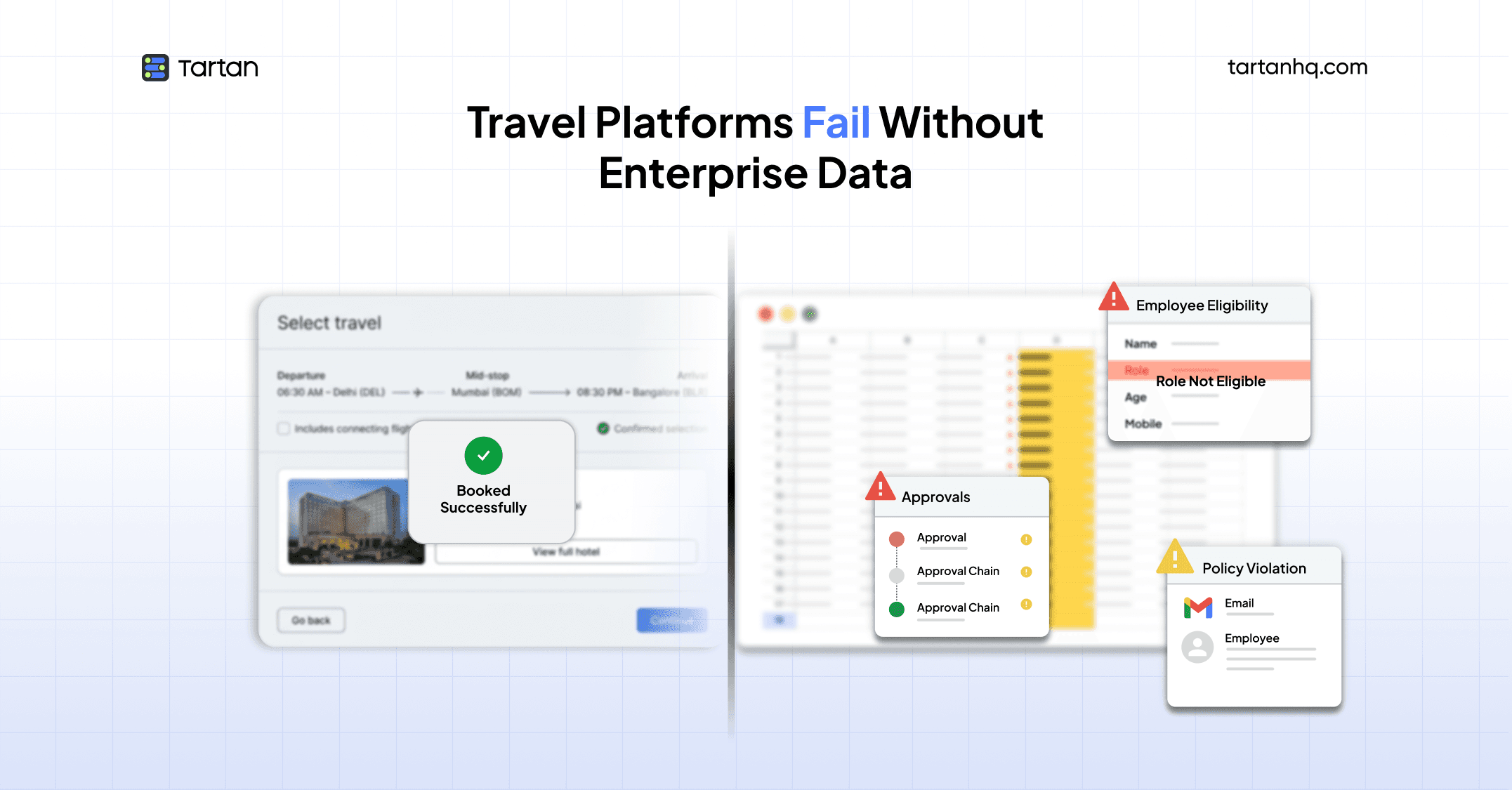
Most corporate travel platforms solved inventory and booking infrastructure years ago.
You can book flights, hotels, or rental cars from dozens of platforms with comparable inventory, pricing, and user experience. The technology for searching availability, processing bookings, and issuing tickets is mature and commoditized.
Yet corporate travel remains operationally complex and expensive - with inefficiencies that have nothing to do with booking flights.
The real challenge today isn't inventory access. It's managing enterprise data across disconnected systems - determining who's eligible to book what, enforcing travel policies automatically, routing approvals to the right people, reconciling expenses against budgets, and integrating corporate card spend with payroll deductions.
All of these are fundamentally data problems. And the data required doesn't live in travel platforms. It lives in HR systems, payroll platforms, finance tools, and policy management databases that most travel platforms never touch.
This creates a persistent disconnect: travel platforms have excellent booking infrastructure but operate blindly regarding the enterprise context that should govern every booking decision. The result is manual workarounds, policy violations surfacing too late, approval bottlenecks, reconciliation nightmares, and bureaucratic user experiences.
The next generation of corporate travel platforms will compete on data infrastructure, not inventory access.
The Five Data Problems Corporate Travel Can't Solve Alone
1. Employee Eligibility for Travel
Not every employee should be able to book every type of travel. Eligibility rules are complex:
Travel class eligibility: Junior employees fly economy. Senior managers get premium economy on long-haul. Executives qualify for business class. These rules tie to designation and salary grade - data in HR systems, not travel platforms.
International travel authorization: Some roles require regular international travel. Others need explicit approval. Immigration compliance and tax implications mean eligibility isn't universal.
Budget ownership: Certain employees have departmental budgets they can commit against. Others need manager approval for any spend. Budget allocation lives in finance systems.
Vendor-specific restrictions: Companies negotiate preferred rates with airlines or hotel chains. Different employee tiers have different vendor access based on procurement policies.
Without real-time HR data access:
Employees book travel outside their eligibility
Bookings get flagged for manual review
Travel coordinators check HR databases and policy documents
Days pass before approval or rejection
The eligibility problem is solvable only with real-time access to HR and organizational data. When the travel platform knows the employee's current designation, department, and policy tier, it can enforce eligibility rules automatically - showing only options they're authorized to book.
2. Policy Enforcement
Corporate travel policies control costs and ensure duty of care. But enforcement traditionally happens after booking, not during:
Advance booking requirements: Flights booked 7-14 days advance get better rates. Last-minute bookings violate policy but aren't detected until expense submission.
Spending thresholds: Policies cap hotel rates by city tier. Employees can still book above these if the platform doesn't have access to current policy limits.
Approval routing: Travel above cost thresholds requires manager approval. International travel needs additional finance or compliance approval. The platform often doesn't know who the employee's manager is or what thresholds apply.
Result: employees book policy-violating travel, realize it weeks later during expense submission, scramble for justifications, create reconciliation headaches.
Effective policy enforcement requires the travel platform to access current policy rules, employee-specific policy tiers based on designation, manager hierarchies for approval routing, and budget balances - all from systems outside the travel platform.
3. Approval Workflows
Corporate travel requires multi-level approvals: manager approval for business case, finance approval for budget impact, compliance approval for international travel.
The challenge: travel platforms rarely know the organizational structure needed to route correctly. Who is this employee's direct manager? What department owns their budget? Does this destination require compliance review?
Without real-time access:
Employees manually select approvers (introducing errors)
All approvals route to a central desk for manual determination
Outdated org charts cause misrouted approvals
A manager who changed departments last week doesn't receive approval requests for former team members. Every misrouted approval adds days to booking confirmation.
Real-time integration with HR and finance systems solves this - approvals route correctly the first time based on current manager, department, budget owner, and compliance requirements.
4. Expense Reconciliation
After travel, expenses must be reconciled against budgets and allocations. Traditional reconciliation is manual:
Finance exports travel spend from the platform
HR exports employee-department mappings
Payroll exports salary data to validate policy compliance
Manual spreadsheet matching to allocate costs
Weeks of effort quarterly to close travel expense accounts
The problem: travel platforms, finance systems, HR databases, and payroll tools operate independently. Data lives in silos.
When travel platforms integrate with HR and finance systems, reconciliation becomes automatic. Each booking is tagged with the employee's current department, manager, and cost center at travel time. Expenses allocate automatically. Policy violations flag in real time. Tax categorization happens automatically.
5. Corporate Card Integrations
Corporate card challenges:
Card eligibility: Based on travel frequency, designation, tenure - data in HR and travel analytics, rarely accessible to card issuers in real time.
Spending limits: Corporate cards need dynamic limits based on approved travel plans. A junior employee traveling internationally may hit their limit mid-trip if not adjusted.
Automatic expense coding: Card transactions should auto-code to correct department and cost center based on the traveler's organizational data, requiring HR system access.
Card lifecycle management: When employees leave, cards should deactivate immediately. When promoted, upgrades should happen automatically. This requires real-time HR sync.
Current state: manual processes with lag. HR emails new hire lists for card provisioning. Finance manually reconciles card spend monthly. Card deactivation for departed employees happens with delay, creating fraud exposure.
Corporate card integrations work seamlessly only when card management, expense platforms, and booking tools all access real-time HR data.
Why Travel Platforms Can't Solve This Alone
The common thread across these five challenges: the data required to solve them doesn't originate in travel platforms. It lives upstream in enterprise systems:
HR systems (Darwinbox, Workday, Keka, SAP SuccessFactors) hold:
Employee designations and salary grades
Organizational hierarchies and reporting relationships
Department assignments
Employment status and tenure
Join dates and exit dates
Payroll platforms contain:
Salary information affecting travel class eligibility
Deduction data for corporate card reconciliation
Payment schedules relevant to advance planning
Finance tools (ERPs, budget management systems) manage:
Departmental travel budgets
Cost centers and allocation codes
Spending authority and approval thresholds
Vendor payment reconciliation
Policy management tools specify:
Travel class rules by designation
Advance booking requirements
Hotel rate caps by city
Approval workflows
Travel platforms can build excellent booking experiences, but they cannot independently answer: Who is this employee's current manager? What department owns their travel budget? What's their salary grade and corresponding travel policy tier? Has their designation changed in the past month affecting their eligibility?
These questions require integration with systems outside the travel platform's control.
The Data Infrastructure Imperative
Solving corporate travel's data problem requires a fundamental architectural shift: from travel platforms as standalone booking tools to travel platforms as data-integrated orchestration layers.
This means:
Real-time HRIS integration: Travel platforms need live access to employee data, organizational hierarchies, and designation information. When an employee attempts to book travel, the platform queries their current designation, department, manager, and policy tier in real time - not from a static database exported monthly.
Finance system connectivity: Budget balances, cost center allocations, and spending thresholds must be accessible at the point of booking. The platform should know if a department is within budget before allowing the booking, not discover budget overruns during quarterly reconciliation.
Policy engine integration: Travel policies - eligibility rules, approval workflows, spending caps - should be configurable in policy management systems and accessible via API. When policies change, the travel platform reflects updates immediately without manual reconfiguration.
Bidirectional data flow: It's not enough for travel platforms to read data from enterprise systems. They must also write back: booking confirmations update budget balances in finance systems, completed trips trigger expense creation in accounting tools, travel patterns inform HR analytics on employee mobility.
The technical challenge: India's enterprise landscape is fragmented across 100+ HRIS platforms, dozens of finance systems, and countless policy tools. A travel platform cannot build and maintain custom integrations with every system their corporate clients use.
This is where unified API platforms like HyperSync become essential. By providing standardized connectivity to 100+ HRIS and payroll systems through a single integration, HyperSync enables travel platforms to access employee data, organizational hierarchies, and payroll information regardless of which underlying systems their clients use.
For travel platforms, this means:
One integration provides access to employee data across all corporate clients
Designation, department, manager, and salary data are available in standardized formats
Employment status updates flow in real time
Policy enforcement becomes operationally viable at scale
The Competitive Shift
Ten years ago, corporate travel platforms competed on inventory breadth and booking UX. The winner was whoever offered the most flight options and the smoothest checkout flow.
Five years ago, competition shifted to pricing and supplier relationships. Negotiated corporate rates, preferred vendor partnerships, and volume discounts became differentiators.
Today, the competitive axis is shifting to data infrastructure. The travel platforms that win enterprise accounts will be those that seamlessly integrate with corporate HR, finance, and policy systems - eliminating manual approvals, enforcing policies automatically, routing expenses correctly, and providing real-time budget visibility.
This isn't a marginal improvement. It's a categorical change in product offering. A travel platform with deep enterprise data integration delivers:
Eligibility enforcement: Employees only see options they're authorized to book
Automatic policy compliance: Violations are impossible, not detected retroactively
Instant approvals: Correct routing based on live organizational data
Real-time reconciliation: Expenses allocate automatically without manual matching
Corporate card intelligence: Limits adjust dynamically based on approved travel
These capabilities are structurally impossible for platforms operating without enterprise data integration.
Conclusion
The corporate travel industry spent the last decade solving inventory and booking problems. Flight aggregation is commoditized. Hotel inventory is widely accessible. Payment processing is mature. User interfaces are polished.
What remains unsolved - and increasingly urgent - is the enterprise data problem.
Who's eligible to book this trip? Does it comply with policy? Who should approve it? Which budget does it charge to? How does it reconcile with payroll deductions and corporate cards?
These aren't booking questions. They're data integration questions. And they can't be answered by travel platforms operating in isolation from the HR, finance, and policy systems where enterprise truth actually lives.
The next generation of corporate travel platforms will be built on data infrastructure that connects booking workflows to authoritative enterprise systems in real time. They'll leverage unified APIs like HyperSync to access employee data, organizational hierarchies, and payroll information across fragmented enterprise landscapes.
The competitive moat won't be access to flight inventory. It will be seamless access to enterprise data - turning corporate travel from a booking tool requiring manual administration into an intelligent orchestration layer that enforces policy, routes approvals, and reconciles spend automatically.
Corporate travel is becoming a data problem. The platforms that solve it will define the industry's next decade.