Every large employer will tell you the same thing: employee benefits are a significant investment. Group health cover, term life, accidental insurance, NPS contributions, flexi-benefit plans - the spend is real, the intent is genuine, and the expectation is that employees feel it.
Most employees don't.
Not because the benefits aren't valuable. Because the experience of accessing, understanding, and actually using them is broken in ways that have nothing to do with the benefits themselves.
Enrollment is a once-a-year event that happens during a two-week window that half the workforce misses.
Coverage doesn't update when salaries change. A new dependent added to the family in March doesn't get reflected in health cover until the next enrollment cycle in November. The flexi-benefit plan carries a balance the employee forgot about and the HR team has to manually chase before year-end.
This is not a benefits design problem.
It is a data infrastructure problem. And it starts at the layer where HR systems, payroll platforms, and benefits providers fail to talk to each other in any meaningful, real-time way.
The Static Benefits Problem
The way enterprise benefits administration works today is largely unchanged from how it worked a decade ago. Once a year, HR opens an enrollment window. Employees log into a portal, declare their choices, add dependents, select top-up covers if available, and submit. That data is then reconciled - often manually, often over days - with the insurer or benefits provider. Coverage kicks in on a fixed date.
The cycle closes.
Until next year.
The problem is that an employee's life doesn't run on an annual cycle. Salary revisions happen mid-year.
Promotions change income brackets and with them the appropriate coverage level.
Marriages, children, dependent parents - these are life events that change an employee's benefits needs immediately, not at the next enrollment window.
An employee who joined at Rs. 8 LPA and is now earning Rs. 16 LPA after two promotions is almost certainly underinsured on their employer-provided term cover - because nobody recalibrated coverage when the salary changed.
The employer is spending money on benefits that aren't appropriately sized to the employee's actual situation. The employee has coverage that doesn't reflect their current life. The insurer is pricing group risk on enrollment data that's anywhere from one to eleven months stale. Everyone in this system is working with outdated information and the only reason nobody notices immediately is because most employees don't claim often enough to test whether their coverage is right.
Until they do. And then it's too late to fix it.
Where the Data Layer Breaks
Trace any benefits administration failure back far enough and you hit the same structural issue: the systems that hold the relevant data don't share it with each other in real-time.
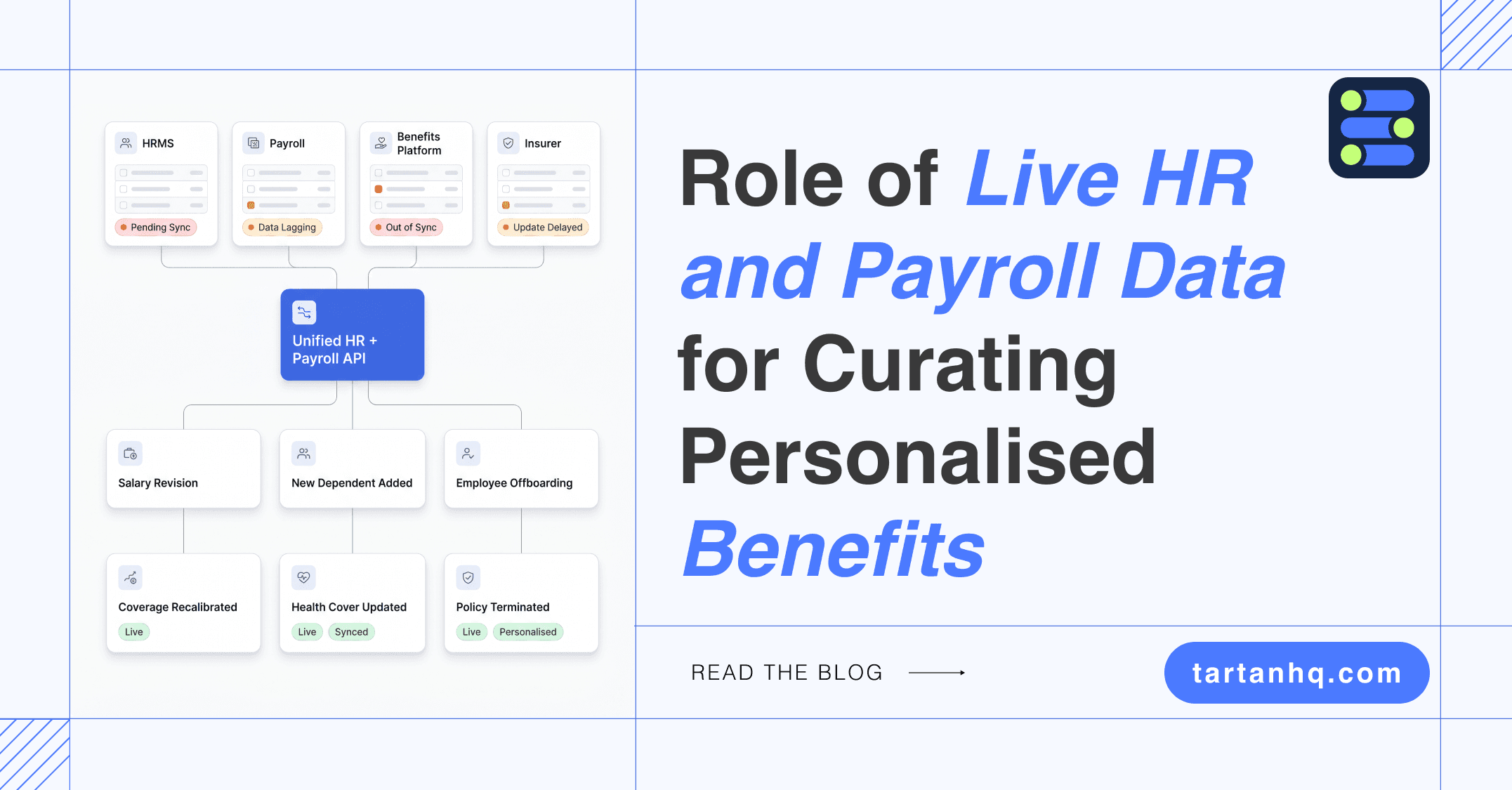
The HRMS holds employment status, designation, salary band, tenure, department, and dependent declarations. The payroll system holds gross salary, net take-home, statutory deductions, and the actual salary revision history.
The benefits platform holds enrollment choices, coverage levels, and claims history. The insurer holds policy terms, premium calculations, and risk assessments.
These four systems are the complete picture of an employee's benefits context. In most enterprise environments, they are connected - if at all - through scheduled batch syncs, manual exports, or brittle point-to-point integrations maintained by an IT team that has forty other priorities.
The HRMS pushes a data file to the benefits platform monthly. The payroll system reconciles with the insurer quarterly. Nobody has a real-time, normalized view of any individual employee's complete benefits picture at any given moment.
The consequences cascade. A new joiner's benefits enrollment is delayed because the HRMS hasn't synced to the benefits portal yet. A salary revision in the payroll system doesn't trigger a coverage recalculation because there's no live connection between payroll and the insurer. An employee exits the organisation but remains on the group health policy for 60 days because the offboarding event in the HRMS never propagated to the benefits provider. These are not edge cases - they are routine failures in benefits administration at scale.
What Real-Time Unified HR and Payroll APIs Change
A unified API layer connecting HRMS, payroll, and benefits platforms doesn't just make data sharing faster. It changes the fundamental architecture of how benefits are administered - from a periodic batch process to an event-driven, real-time system.
Salary-linked coverage that recalibrates automatically. When a payroll API is live-connected to a benefits platform, a salary revision becomes a trigger.
The system detects the income change, recalculates appropriate coverage levels based on the new salary, surfaces an update recommendation to the employee and HR, and - if the employer has configured it - adjusts coverage automatically within the policy terms.
No annual window. No manual reconciliation. The coverage reflects current reality.
Life event triggers that work in real-time. A marriage declaration in the HRMS should immediately trigger an option to add a spouse to group health cover. A new dependent added to payroll records should prompt a top-up recommendation.
A role change that moves an employee into a senior band should surface enhanced benefits eligibility. With a unified HR data layer, these events are detectable in real-time and actionable immediately - not batched until the next enrollment cycle.
Accurate offboarding that protects the employer. One of the most consistent benefits administration failures in enterprise is the gap between an employee's last working day and the date their benefits are actually terminated.
When offboarding in the HRMS is connected via a unified API to every downstream benefits provider, policy termination happens at the right time, automatically. The employer stops paying premiums for former employees.
The insurer's risk pool stays accurate. A simple data connection eliminates a liability that HR teams currently manage through manual checklists.
Personalised benefits utilisation. The best benefits programs go unused because employees don't know what they have, don't know how to use it, or don't receive the right prompt at the right moment.
A unified data layer makes personalised, contextual benefits communication possible - surfacing the right benefit to the right employee based on their actual employment context, life stage, and utilisation history. An employee approaching their one-year anniversary who hasn't activated their NPS benefit gets a timely, personalized nudge.
A new parent who just added a dependent gets a health cover review prompt. This is not complicated logic - it's event-driven communication built on live HR data. The infrastructure just hasn't existed to do it until now.
The Employer and Platform Opportunity
For CHROs and HR technology leaders, this reframe matters strategically. Benefits spend is one of the largest line items in total compensation.
The return on that spend - measured in employee satisfaction, retention impact, and talent competitiveness - is currently being eroded by an administration layer that makes benefits feel bureaucratic rather than valuable.
The fix is not more benefits spend.
It is better benefits infrastructure. An employer that moves from annual static enrollment to a real-time, event-driven benefits system - powered by a unified HR and payroll data layer - will see measurable improvement in benefits utilisation, a reduction in administrative overhead, and a benefits experience that employees actually feel as a tangible part of their compensation.
For benefits platforms and insurtechs building in this space, the unified API layer is the distribution and product infrastructure play simultaneously.
Connecting to a normalized HR and payroll data layer means faster employer onboarding, real-time policy management, accurate group risk pricing, and a product that can genuinely respond to employee life events rather than waiting for the next enrollment window.
The employee benefits market in India is growing fast - group health, corporate term, and financial wellness are all expanding as employer priorities. The platforms that will win this market are not the ones with the most comprehensive policy catalog.
They are the ones whose infrastructure is live, connected, and responsive to the employment and payroll data that makes personalised benefits possible.
Benefits That Actually Work
The promise of employee benefits has always been simple: help your people when they need it most. A comprehensive health cover when there's a medical emergency. A term policy that actually reflects what the family depends on. A financial wellness product that meets the employee where they are in their financial life - not where they were when they filled out an enrollment form eleven months ago.
Delivering on that promise is a data problem. The benefits are there. The willingness to fund them is there. What's missing is a live, normalized connection between the systems that know who the employee is today - their salary, their life stage, their dependents, their role - and the platforms delivering coverage and financial products against that reality.
Unified HR and payroll APIs are that connection. Not a feature. Not an integration project. The foundational infrastructure layer that turns a static annual benefits exercise into something that actually works the way it was always supposed to.