In 2024, RAG was the answer to enterprise AI’s most visible problem: hallucination. Large language models would confidently state things that were wrong, and the fix was to give them access to relevant documents at inference time - retrieve, augment, generate. It worked well enough to become the dominant pattern for enterprise AI deployment.
By mid-2026, the limitations of RAG as an enterprise AI foundation are becoming structurally visible. VentureBeat named it clearly in May: context architecture is replacing RAG as agentic AI pushes enterprise retrieval to its limits. Buyer intent for hybrid retrieval tripled from 10.3% to 33.3% in a single quarter.
Retrieval optimization overtook model evaluation as the top enterprise AI investment priority for the first time.
Something is changing. Understanding what - and why - is the architectural question that will define enterprise AI deployments for the next three years.
What RAG does well - and where it breaks
RAG is genuinely effective at one thing: grounding an AI model’s response in relevant documents at the moment of generation. You have a knowledge base. A user asks a question. The RAG pipeline retrieves the most semantically similar documents and stuffs them into the model’s context window.
The model generates a response grounded in those documents rather than solely in its training data.
For a human-scale problem - an employee asking an internal chatbot a policy question, a support agent looking up a product specification - this works. The latency is acceptable. The retrieval quality is adequate.
The context window is large enough to hold the relevant documents. The output is materially better than a model operating without retrieval.
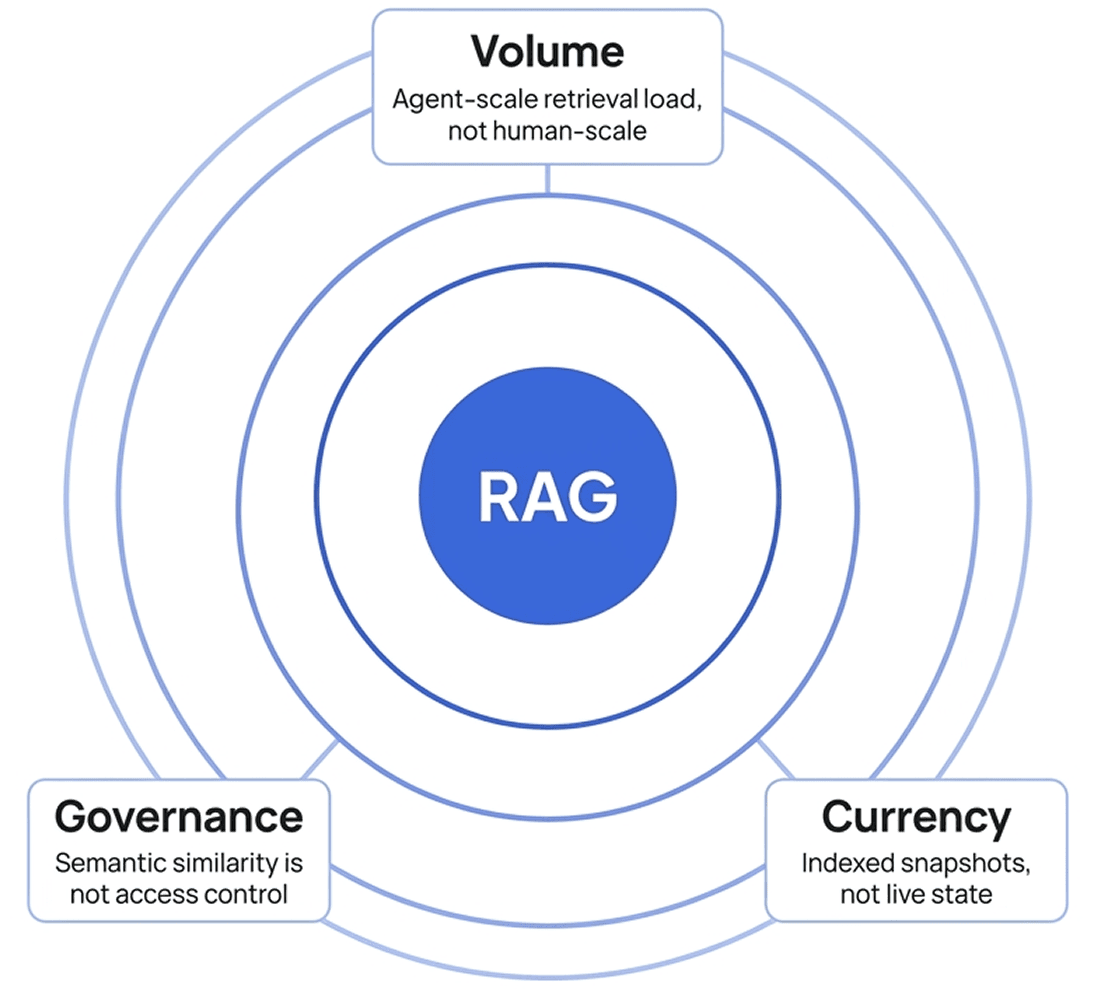
For agentic AI operating at enterprise scale, RAG breaks in three specific ways:
Volume. Agents make orders of magnitude more data requests than human users. A RAG pipeline built for human-scale queries does not survive the retrieval load of an agent completing a multi-step task across dozens of data points. The infrastructure was not built for machine-speed, machine-volume retrieval.
Currency. RAG retrieves from an indexed knowledge base. The knowledge base reflects the state of documents at the time of indexing. An agent reasoning about current employment status, a live transaction, or an active policy version needs data that is accurate as of the moment of the request - not as of the last index update. RAG has no mechanism for this.
Governance. RAG retrieves semantically similar content. It does not enforce access policies. An agent running a RAG pipeline against an enterprise knowledge base may retrieve documents the user is not authorised to access, because semantic similarity is not a governance control. In regulated environments, this is not a minor issue - it is a compliance failure at the retrieval layer.
“RAG moved from research novelty to production reality in 2024. Real-world deployment then revealed critical gaps - retrieval precision failures in multi-hop reasoning, the inability to explain answers to auditors, and security vulnerabilities where the retrieval layer itself could be compromised. The solution is not better RAG. It is a different architecture.”
What the context layer actually is
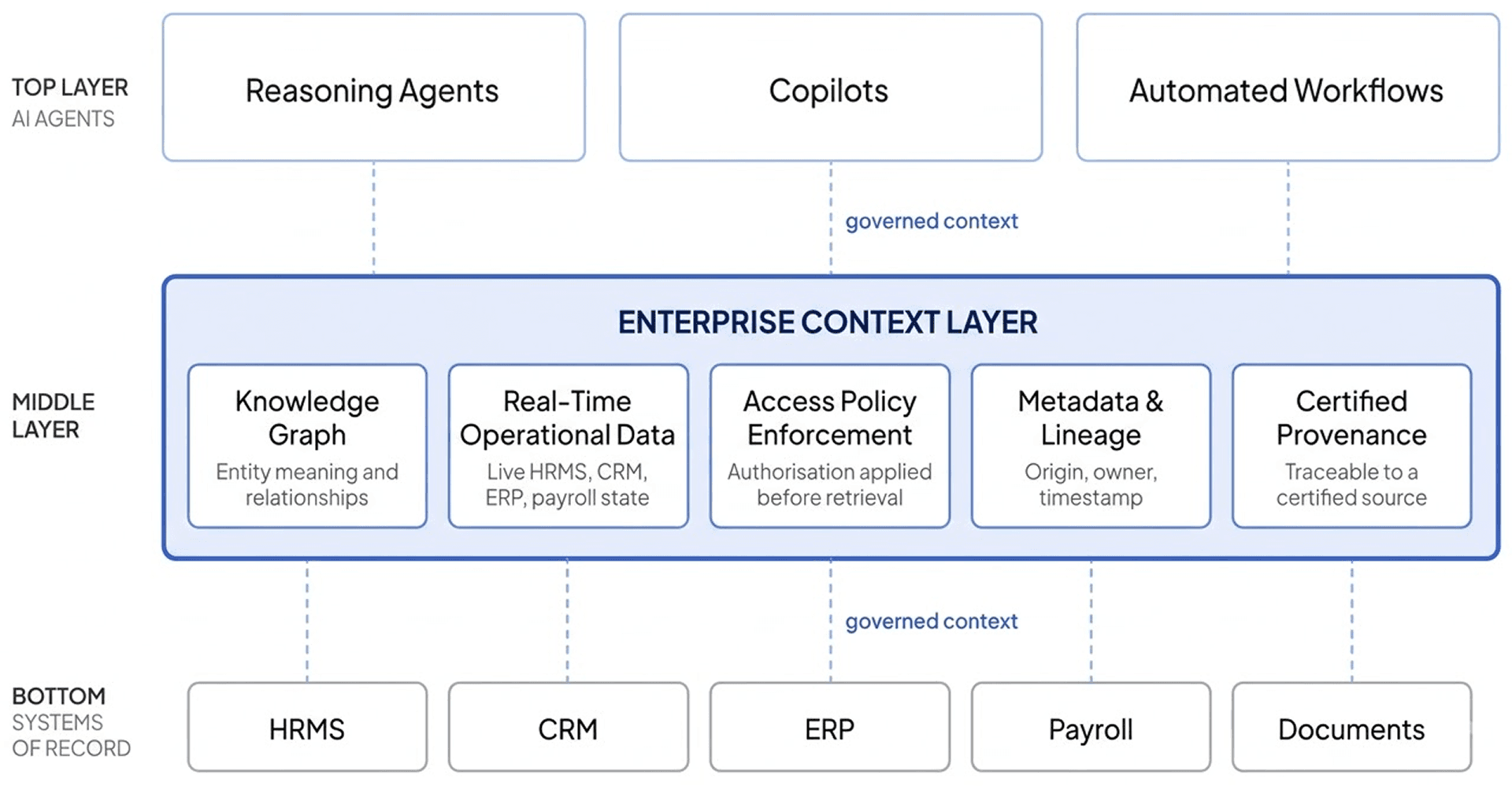
The context layer is not a replacement for RAG. It is the infrastructure layer within which RAG operates - and which provides capabilities that RAG alone cannot.
An enterprise context layer has five components that together produce context an agent can reliably reason from:
A knowledge graph - structured representation of business entities, their relationships, and the semantic meaning of terms. Resolves ambiguity: when an agent encounters “customer,” the knowledge graph tells it which entity definition applies in this context.
A real-time operational data feed - live connections to the systems that hold current operational state: HRMS, CRM, ERP, payroll. What is true right now, not what was indexed last week.
Access policy enforcement at retrieval - governance controls applied before context reaches the agent, not after. The agent only receives context it is authorised to access, enforced at the infrastructure level.
Metadata and lineage tracking - where every piece of context came from, when it was created, who owns it, and whether it has been certified as reliable.
Certified provenance - an attestation attached to every piece of context that allows the agent’s output to be traced back to its source data, enabling both explainability and audit.
RAG handles part of the first component - retrieval from a knowledge base. The context layer handles all five. The difference is the difference between a retrieval trick and governed data infrastructure.
Why agentic AI specifically requires this shift
The movement from AI assistants to AI agents is what forces the context layer question into the open. An AI assistant that answers questions can tolerate occasional context failure - the human reading the response can catch and correct errors.
An AI agent that takes actions cannot. The agent’s output is not a draft for human review. It is a decision, a communication, a transaction. Context failure produces action failure - and action failure in financial services, insurance, or enterprise operations has consequences that text failure does not.
Agentic RAG - the dominant pattern in 2026 where specialised agents handle retrieval and validation in parallel - is a partial response to this. It improves retrieval quality and adds validation steps. But it does not address the governance gap (who is authorised to access this context?), the currency gap (is this context current as of now?), or the provenance gap (can this context be traced to a certified source for audit purposes?).
These gaps are addressed at the context layer level, not the retrieval algorithm level. The agent that reasons from a governed, current, provenance-tracked context layer is structurally different from the agent that retrieves from an indexed knowledge base - even if the retrieval algorithm is identical. The quality of the reasoning is bounded by the quality of the context, and the quality of the context is determined by the infrastructure that produces it.
The operational data gap in most context layer implementations
Most enterprise context layer implementations have made significant progress on the knowledge graph and metadata components. Vendors like Atlan have built strong offerings for knowledge graph construction, metadata management, and semantic layer governance. These components handle institutional knowledge well - policies, procedures, historical decisions, organisational definitions.
What most implementations have not solved is the operational data component - the real-time feed of the current system states that agents in financial services, insurance, and enterprise operations depend on for their most consequential decisions.
A credit underwriting agent does not need to know what the lending policy says. It needs to know that, and what the applicant’s current employment status is, and what their salary is as of today, and whether they are still actively employed. The first piece of context lives in the knowledge graph. The second, third, and fourth pieces live in a live HRMS connection. Without both, the agent is reasoning from an incomplete context - and in lending, an incomplete context produces a misprice or a misjudgement.
This is where Tartan’s HyperSync sits in the context layer architecture - as the real-time operational data feed that provides current employment, income, and enterprise data from 80+ HRIS and payroll platforms, with consent management and audit trail built in.
It is not a knowledge graph product. It is the operational data component of the context layer that knowledge graph products do not cover - the piece that makes the agent’s context current, not just complete.
The shift that is already happening
The market signal is unambiguous. Retrieval optimisation investment rose from 19% to 28.9% in a single quarter in early 2026, overtaking model evaluation spending for the first time. Enterprises that spent the previous year measuring their retrieval quality are now spending to fix it. The context layer is an active procurement decision in 2026, not a roadmap item.
The enterprises that define their context architecture now - building the knowledge graph, establishing the real-time operational data feed, enforcing access policy at retrieval, implementing provenance tracking - are the ones that will not have to rebuild it when agent workloads scale. The ones that continue treating RAG as a context strategy are accumulating architectural debt that will compound with every new agent deployed on top of it.
RAG was the beginning. It solved the hallucination problem well enough to make enterprise AI deployable. The context layer solves the reliability, governance, and currency problems that RAG cannot - and those are the problems that determine whether enterprise AI delivers on its promise or continues to disappoint at the production stage.