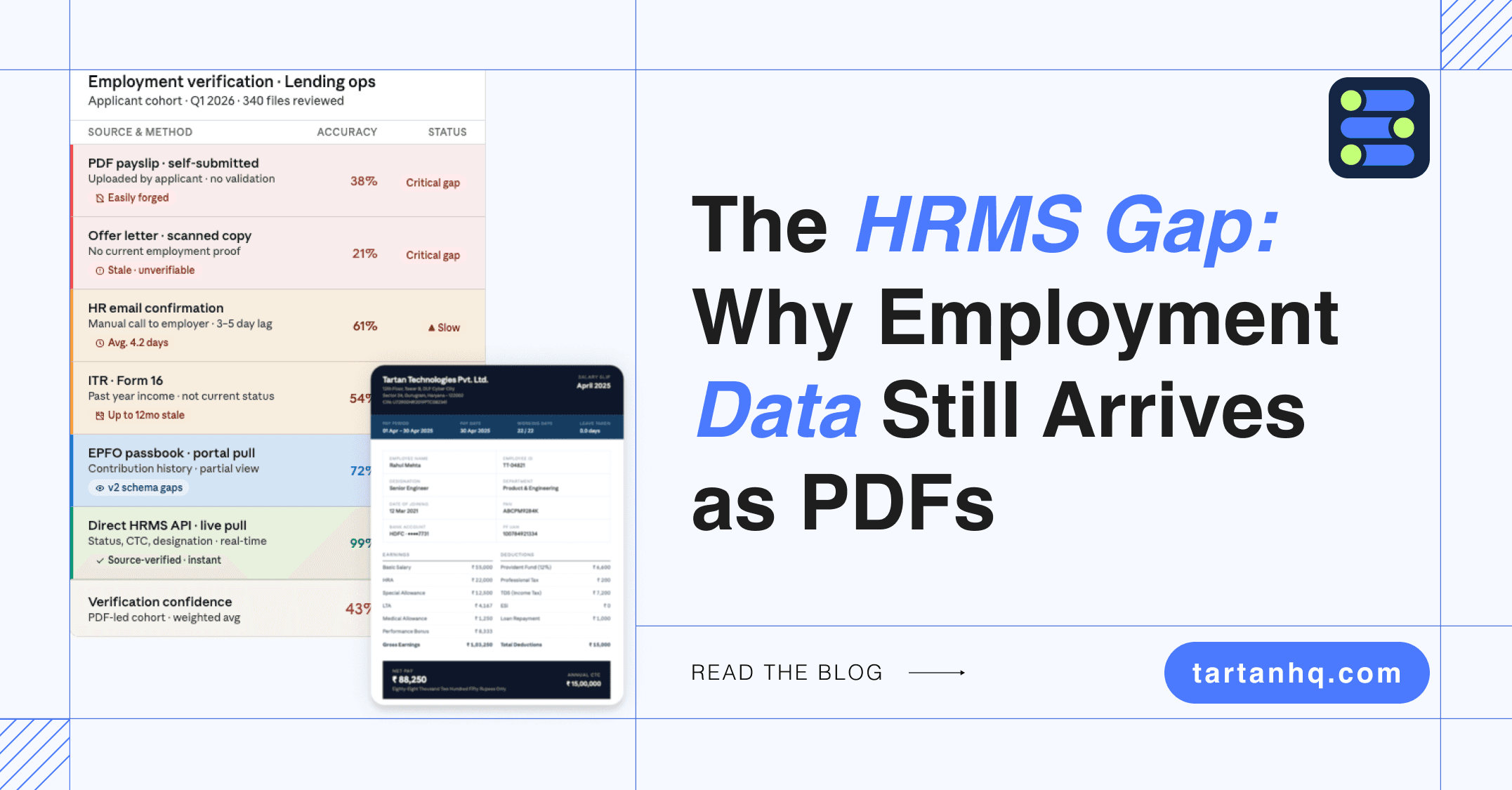
Every digital lender talks about faster TAT. Fewer manual touchpoints. Straight-through processing. And yet, in 2025, the average credit ops team still receives a salary slip as a PDF attachment - downloaded from an HRMS, emailed to an applicant, uploaded to a loan portal, and then parsed by an OCR engine that gets it right about 80% of the time.
That's not a process problem. That's a data infrastructure problem.
The information underwriters need - verified salary, employment tenure, designation, deductions, variable pay - already exists in a structured, machine-readable format inside HRMS platforms like Keka, Darwinbox, GreytHR, Zoho People, and SAP SuccessFactors. The problem is that lenders have no direct path to it. So they take a detour: ask the borrower to download their own payslip and hand-carry it across the gap.
That detour is where TAT dies. It's also where fraud walks in.
What Underwriters Actually Need - And What They Get
When a credit underwriter assesses a salaried borrower, the core questions are straightforward:
Is this person currently employed?
What is their gross and net take-home?
How long have they been with this employer?
Are there any deductions that affect repayment capacity - PF, TDS, advance salary, loan EMIs?
Is their income stable, or does it swing with variable pay?
These aren't exotic data points. They live in the HRMS. Every time an employee's salary is processed, that data is reconciled, updated, and stored - timestamped and employer-verified.
But what the lender actually receives is a PDF. Or a bank statement. Or, in better implementations, AA-consented transaction data that shows salary credits - but not the employer's breakdown of what that number is made of.
Bank statements tell you that Rs. 84,000 hit someone's account on the 1st. They don't tell you that the gross was Rs. 1,10,000, that Rs. 12,000 was PF, that Rs. 8,000 was TDS, and that there's an active advance salary deduction of Rs. 6,000. That distinction matters enormously for underwriting. It's the difference between an accurate FOIR calculation and an optimistic one.
HRMS data gives you the full picture. The problem is getting to it.
Why HRMS Data Is Structurally Better for Underwriting
Bank-derived income signals have a ceiling. They show you cash flow, not employment reality. An applicant can have consistent credits from a legitimate employer - and still be on a performance improvement plan, in their notice period, or drawing down an advance. The bank statement doesn't know. The HRMS does.
Here's what makes HRMS-sourced data meaningfully better for credit assessment:
It's employer-verified, not self-reported. The salary figure in an HRMS isn't what the applicant told you they earn. It's what the employer has processed and paid - reconciled against payroll, compliant with statutory deductions, and timestamped. That's a materially higher quality signal than an uploaded PDF that your OCR engine had to interpret.
It carries employment context. Tenure, designation, employment type (full-time vs. contractor), department - these are underwriting-relevant signals that don't exist in a bank statement. A borrower with 14 months at their current employer is a different risk profile than one with 4 years, even at the same income level.
It enables real-time verification. An HRMS pull at the point of application tells you the current employment status. A payslip tells you what was true last month. In a market where employment attrition is high and notice periods are short, that lag matters.
It's fraud-resistant. Payslip manipulation is a known vector in retail lending. Salary slip templates are widely available. OCR engines can't detect a doctored figure if the formatting is clean. An API pull directly from an HRMS bypasses the document layer entirely - no slip to forge, no upload to manipulate.
The Integration Problem No One Has Solved - Until Now
If HRMS data is so valuable, why isn't every lender using it?
Because the integration layer doesn't exist out of the box - and building it is harder than it looks.
India's HRMS market is fragmented. The mid-market runs on Keka, Darwinbox, and GreytHR. Large enterprises use SAP SuccessFactors, Workday, or Oracle HCM. Startups and SMBs are on Zoho People, HROne, or a dozen smaller platforms. Each has its own API architecture, authentication model, data schema, and rate limits. Normalized salary data looks different across all of them.
For a lender to build direct HRMS integrations, they'd need to maintain separate connectors for every platform their borrowers might use. That's not one integration - that's 12 to 20, each requiring ongoing maintenance as HRMS vendors update their APIs. It's an engineering commitment most lending product teams have no appetite for, and rightfully so. Integration maintenance is not their core competency. Credit decisioning is.
This is precisely where a unified API layer changes the math.
What a Unified HRMS Integration Layer Makes Possible
A unified API abstracts the complexity. Instead of building point-to-point connections to each HRMS, lenders connect once - to a single normalized API endpoint - and get access to employment and salary data across every supported HRMS platform without managing individual integrations.
The data that comes back is consistent regardless of the source: same schema, same field naming, same structure. Gross salary, net take-home, deductions broken down by component, employment start date, current designation - returned in a standardized format the lender's underwriting engine can consume directly.
For lending product and credit teams, this translates into concrete operational improvements:
Faster TAT. A direct API pull replaces a multi-step document collection process. No applicant upload, no OCR parsing, no manual verification. Employment data is fetched and returned in seconds at the point of application.
Higher accuracy. Structured data from source eliminates the parsing error rate that comes with OCR-based document processing. What the HRMS holds is what the underwriter sees.
Better thin-file decisioning. Borrowers with limited credit history but stable, verifiable employment are currently underserved because their income signals don't come through clearly in bureau data or bank statements. HRMS-sourced income verification opens a more accurate underwriting path for this segment.
Reduced fraud exposure. Removing the document layer removes the fraud surface. Lenders that have moved to API-based verification report a measurable drop in salary-related misrepresentation at application stage.
Who Should Be Paying Attention
If you're a lending product head or a VP of credit at an NBFC, a digital bank, or a consumer lending platform - and your current income verification flow involves asking borrowers to upload a payslip - this is the gap to close next.
The borrowers you're trying to reach are salaried professionals whose employment data sits in an HRMS their employer already uses. Getting to that data directly, at point of application, without adding friction to the borrower journey, is now a solved infrastructure problem.
The question isn't whether HRMS-integrated underwriting is better. It clearly is. The question is whether you're building the integrations yourself - and absorbing that maintenance overhead indefinitely - or connecting to a unified layer that does it once, across all platforms, and keeps pace as those platforms evolve.
For most lending teams, the answer is obvious. The infrastructure is already there. The gap is just the last mile between an HRMS and a credit decision.
That last mile shouldn't be a PDF.