There's a distribution problem hiding in plain sight in Indian fintech.
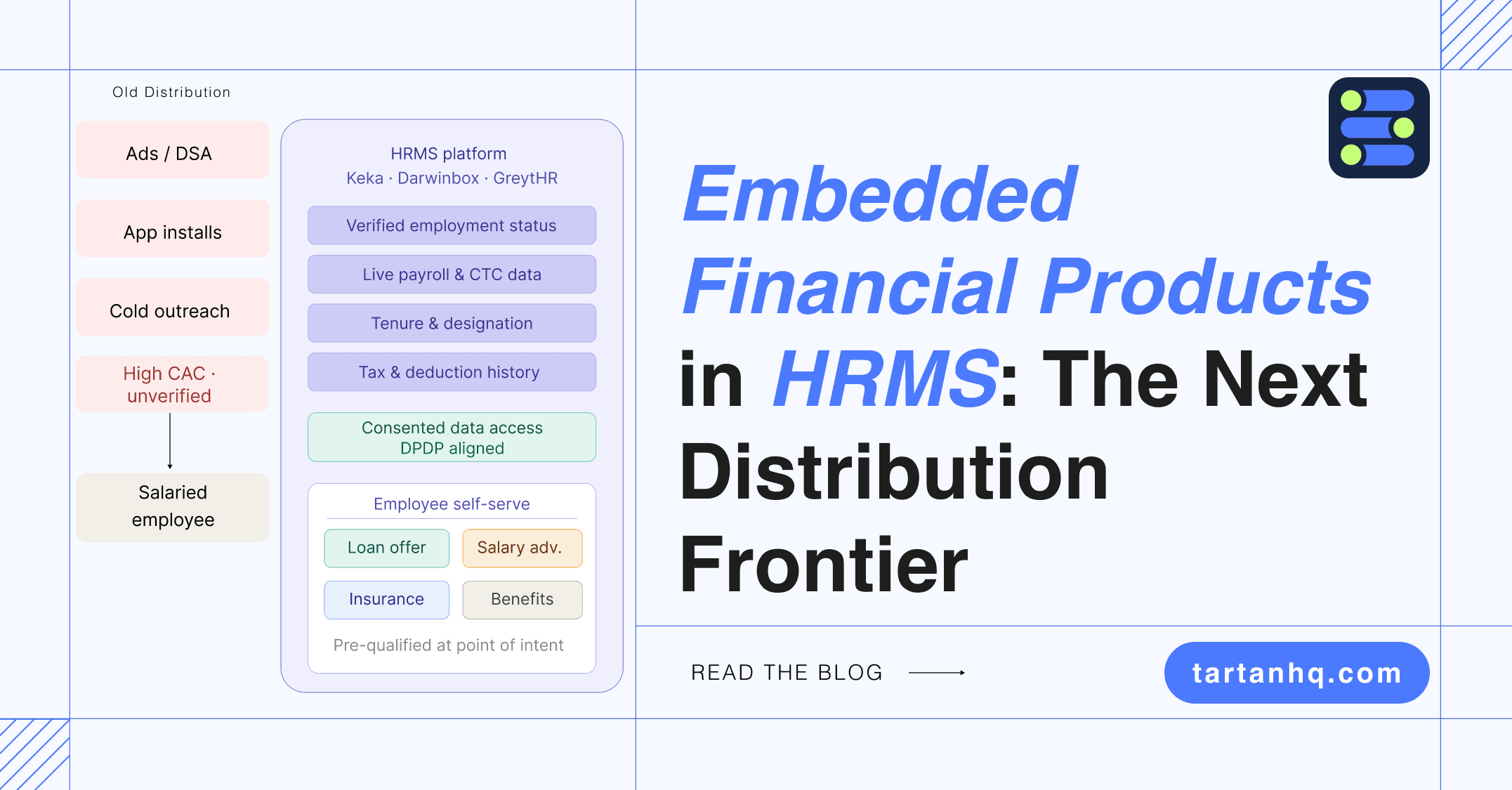
Lenders, insurers, and salary advance providers spend significant money acquiring salaried borrowers - Google ads, DSA networks, co-branded partnerships, app installs. The CAC is high, the intent signal is weak, and the income verification still happens after acquisition through a document upload that introduces friction and drop-off.
Meanwhile, an HRMS platform like Keka, Darwinbox, or GreytHR already has everything: the employee's verified salary, employment tenure, designation, PF deductions, and their employer's payroll cycle. It has a logged-in, trusted relationship with that employee - visited monthly, at minimum, to check payslips and leaves.
The distribution surface is already there. The question is why financial products aren't sitting inside it yet.
They will be. And the fintechs that move first on this will own a customer acquisition channel that is structurally cheaper, higher-intent, and better-verified than anything running on paid media today.
What "Embedded Finance in HRMS" Actually Means
Embedded finance is an overused term. In this context, it means something specific: financial products - salary advances, personal loans, group insurance, term cover, tax-saving instruments - surfaced directly inside an HRMS platform at the moment of highest relevance, with employment and income data already available to power instant underwriting.
The employee doesn't go to a lender's app. They don't fill out an income declaration form. They don't upload a payslip. They're already logged in to their HRMS. The product appears contextually - at salary processing time, during benefits enrollment, or at a life event trigger like a promotion or a salary revision. The data needed to underwrite or enroll them is already there, with employer attestation.
This is not a new idea in global markets. In the US, platforms like Gusto and Rippling have moved aggressively into embedded financial products - offering payroll-linked lending, benefits, and insurance directly inside their HR platforms. In India, the HRMS layer has been slower to monetize this surface - which is exactly why it's still an open opportunity.
Why the HRMS Is the Highest-Quality Distribution Surface for Financial Products
Distribution quality is a function of three things: intent signal, data quality at acquisition, and trust. The HRMS outperforms most acquisition channels on all three.
Intent signal. An employee checking their payslip at the end of the month, seeing a salary advance option contextually surfaced, is a fundamentally different prospect than someone who clicked a Google ad for a personal loan. The former has a verified employment context, a known income, and a specific financial moment - salary received, perhaps a gap to bridge before the next cycle. That's a high-intent, high-context moment. Paid media can't manufacture it.
Data quality. Every financial product has an underwriting problem at acquisition. CAC is high partly because so much of it goes into verifying what the customer told you at sign-up. In an HRMS-embedded model, the verification is pre-done. Gross salary, net take-home, tenure, employer identity - all employer-verified, all available at the point of product offer. The underwriting happens before the customer even applies. Approval rates go up. Fraud risk goes down. TAT compresses dramatically.
Trust. Employees trust their HRMS because their employer uses it. It's the platform that processes their salary and manages their leave. A financial product surfaced inside this environment inherits that trust by association - which is meaningfully different from a cold fintech app trying to establish credibility from zero.
The Products That Fit This Distribution Model
Not every financial product belongs inside an HRMS. The ones that do share a common trait: they are materially better when income and employment data is already known.
Salary advance / on-demand pay. The most natural fit. The employer is already in the payment flow. A salary advance product embedded in the HRMS can use real-time payroll data to calculate advance eligibility, deduct repayment directly from the next salary run, and never ask the employee to upload a document. The entire lifecycle - apply, approve, disburse, recover - runs inside the platform.
Personal loans and BNPL. Lenders offering payroll-linked personal loans can pre-approve employees based on HRMS income data, surface offers contextually, and underwrite at a fraction of the normal cost. Repayment through payroll deduction reduces default risk and collection overhead. For employers, it's a zero-cost financial wellness benefit. For lenders, it's a pre-verified acquisition channel.
Group health and term insurance. HR teams spend significant time collecting employee declarations during annual benefits enrollment. An HRMS-embedded insurance flow can auto-populate employee data, surface employer-sponsored plan options, allow top-up selection, and complete enrollment without a single form - using data the HRMS already holds. For insurers, group onboarding TAT drops from weeks to hours.
Tax-saving instruments and investment products. Section 80C declarations happen inside HRMS platforms every year. It is one of the most underleveraged distribution moments in Indian fintech. An employee declaring their tax-saving investments is already in a high-intent financial moment. Surfacing relevant ELSS, PPF, or NPS products at this exact touchpoint - with income context already available - is a product design decision that no major HRMS player has fully executed yet.
The Integration Problem That Has Kept This From Happening
If this opportunity is so clear, why hasn't the market moved faster?
Because building financial products inside HRMS platforms requires a two-sided integration problem to be solved simultaneously.
On one side, the fintech - lender, insurer, or investment platform - needs reliable, normalized access to employment and payroll data across HRMS platforms. They can't build individual connectors to Keka, Darwinbox, GreytHR, SAP SuccessFactors, Zoho People, and every other platform their target employers might use. That's a multi-year engineering commitment with no clear leverage point.
On the other side, the HRMS platform needs to expose its data securely to financial product partners without creating a compliance liability or a data governance problem for the employers whose payroll data they hold.
This is precisely the gap that a unified API layer closes. Instead of point-to-point integrations between every fintech and every HRMS, a normalized API layer sits in the middle - handling authentication, data standardization, consent management, and employer authorization in a single integration. The fintech connects once and accesses employment data across every supported HRMS. The HRMS exposes its data through a governed, permissioned layer rather than building bilateral data-sharing agreements with every financial partner.
The infrastructure to make embedded HRMS finance work at scale now exists. What's lagging is the product and GTM intent to use it.
Who Moves First Wins the Channel
This is a timing argument, and the timing is now.
India's HRMS market is consolidating. Keka, Darwinbox, and GreytHR collectively manage payroll for tens of millions of salaried employees. As these platforms mature, they are actively looking for ways to deepen their value proposition to employers - financial wellness, embedded benefits, and embedded lending are high on that list. The HRMS platforms that build this surface early will have a monetization lever and a retention driver built in. The fintechs that integrate early will have a distribution channel that competitors can't easily replicate.
For lenders specifically - NBFCs, digital banks, salary advance platforms - the math is hard to ignore. An HRMS-embedded acquisition model replaces a significant portion of paid CAC with a channel that comes pre-verified, pre-consented, and pre-underwritten. The borrower you acquire through this channel costs less, converts faster, and carries lower fraud and default risk than the borrower you acquired through a DSA or a Google ad.
Distribution in fintech has always been a hard problem. The HRMS is a distribution surface that most of the market has not taken seriously yet.
That won't be true for long.