And why the customer intelligence you think you have is mostly a historical artefact. Walk into any insurance strategy meeting and you'll hear the same confident assertions. We have X million active policyholders. We know our customer base. Our data shows the profile of our book.
That confidence is largely misplaced.
What most insurers actually have is a collection of snapshots - identity details, income declarations, employment records, addresses, and risk signals captured at the moment a policy was sold and preserved, largely unchanged, for months or years afterward. The customer that data describes may have moved cities, changed jobs, started a business, had children, or experienced a material change in their financial situation. The policy record doesn't know any of that. It knows who they were on the day they signed.
This is the quiet data problem at the centre of insurance. Not a fraud problem. Not an acquisition problem. A policy intelligence problem. And it's more consequential for growth than most insurers have begun to reckon with.
The Data You Have vs. The Data You Think You Have
Let's be specific about what goes stale in a policy record - and how quickly.
Employment records. At proposal, insurers collect occupation type, employer name, and sometimes income band. This data serves underwriting - it's a proxy for financial stability, claims propensity, and in some product lines, direct risk assessment. It's also one of the fastest-changing data points in a customer's life. India's labour market is dynamic.
Formal-to-informal transitions happen. Salaried employees become entrepreneurs. Professionals switch industries. Gig work supplements or replaces permanent employment. The average tenure at a company in many sectors is under three years. For a ten-year life policy, the employment record captured at onboarding is likely to be materially inaccurate within the first half of the policy term.
Income bands. Income declarations at proposal are self-reported and point-in-time. They're used for sum assured adequacy, for premium pricing in some health products, and increasingly for cross-sell modelling. They're also among the least maintained data points in a policy record.
A customer who declared income of ₹8–12 lakh annually at policy issuance in 2021 may now be earning significantly more - making them underinsured, under-served, and an invisible upsell opportunity. Or significantly less - making them a lapse risk who needs a retention conversation, not a renewal auto-reminder.
Addresses. Already discussed at length in the context of lending and claims - but worth restating in the insurance frame. Address data collected at proposal is used for policy document delivery, nominee correspondence, field sales territory mapping, and fraud signal detection.
All of these functions degrade as address data ages. In a country with the internal migration rates India has, a five-year-old address on a policy record is barely a useful data point.
Phone numbers. Mobile number portability and recycling means that the number captured at onboarding may belong to a different person within eighteen months. OTP-based authentication to the old number doesn't catch this. The insurer continues to believe they have a working contact channel. They often don't.
Risk signals. Perhaps most consequentially for the actuarial functions that drive underwriting and pricing: the health declarations, lifestyle disclosures, and financial risk signals captured at onboarding are frozen at a moment in time. A customer who declared non-smoker status at issuance and took up smoking two years later represents an actuarially different risk.
A customer whose BMI, chronic condition profile, or family medical history has changed is a different underwriting proposition. The policy record doesn't reflect any of this. It reflects a health snapshot from the day the proposal was completed.
Taken together, this means that for any policy with meaningful tenure, the data the insurer is operating on is a historical artefact - not a current description of the customer relationship. And most insurers are building their growth strategies on top of it.
Why This Is a Growth Problem, Not Just a Data Quality Problem
The instinct, when data quality issues are raised, is to file them under operational hygiene. A problem for the data team. Something to fix in the next system migration. Important but not urgent.
That framing is wrong for insurance - and here's why.
Insurance growth, at its core, is driven by three levers: new policy acquisition, cross-sell and upsell into existing relationships, and retention at renewal. The industry has poured its investment into the first lever. Acquisition marketing, digital onboarding, comparison platforms, bancassurance tie-ups - enormous resources chasing new customers.
But the second and third levers are significantly more capital-efficient. Selling additional cover to an existing policyholder costs a fraction of acquiring a new one. Retaining a renewing customer generates premium revenue without the CAC. The economics of serving existing customers well are fundamentally better than the economics of constantly replacing the ones you lose.
Here's the problem: both of those levers - cross-sell and retention - are entirely dependent on understanding who your existing customers are today. Not who they were. Who they are now.
Cross-sell modelling that runs on stale income data will miss the promotion-driven earner who now has the financial capacity to increase their sum assured. It will miss the customer who added a dependent since onboarding and is now the prime profile for a term top-up. It will surface product recommendations calibrated to a two-year-old financial profile - and those recommendations will be wrong, or irrelevant, or both.
Retention models that run on stale data will misidentify lapse risk. A customer whose income has dropped, whose policy premium feels proportionately heavy, and who has been getting service communications to a phone number they no longer use is at high lapse risk. The insurer's system may be scoring them as stable, because their payment history is clean and nothing in the policy record signals change. The signal is in the life data - the employment shift, the income movement - and the insurer doesn't have access to it.
Inaccurate policy intelligence doesn't just create operational friction. It systematically undermines the growth strategies that depend on knowing your customers.
The Enrichment Reframe
The standard response to stale data is a data refresh campaign. Re-collect. Ask customers to update their details. Run a re-KYC drive. These approaches share a common failure mode: they treat data currency as a one-time correction rather than an ongoing operational function.
The reframe that unlocks the real value is this: enrichment is not a data hygiene exercise. It's a growth intelligence function.
Continuous enrichment means that policy records are treated not as static files to be periodically corrected, but as living intelligence assets that are regularly updated against external authoritative sources. Employment signals from EPFO data and bank statement patterns. Address currency against live databases. Income band inference from banking behaviour and bureau signals. Contact detail validation against telecom-level data. Health and lifestyle signal monitoring where consented and available.
When enrichment is continuous, the growth applications unlock.
Underinsurance detection becomes actionable. A policyholder whose verifiable income has grown significantly since onboarding is underinsured against their current financial profile. That's not a sales insight - it's a genuine service insight. The customer's family is less protected than they should be. The insurer has both an obligation and an opportunity to surface that gap. Without current income data, that conversation never happens.
Lapse prediction becomes accurate. The early warning signals for lapse are often in life data - income stress, address instability, employment change - rather than in payment behavior. Payment behavior is a lagging indicator. Life data changes happen months before the first missed premium. With enriched records, retention models can identify at-risk customers while there's still time for a meaningful intervention.
Cross-sell relevance improves materially. Product recommendations that are calibrated to a customer's current life stage - not their life stage at proposal - have a fundamentally higher conversion rate. The customer who just changed jobs and lost group health cover is an immediate opportunity for an individual health policy. The customer who just had a child is a term insurance upsell candidate. These opportunities are visible in enriched data. They're invisible in static policy records.
Fraud detection strengthens. Many insurance fraud patterns involve discrepancies between declared and actual risk profile - undisclosed occupational changes, address mismatches, identity inconsistencies. Enriched, current policy data that's continuously validated against authoritative sources surfaces these discrepancies as signals rather than waiting for them to emerge at claim.
What Continuous Enrichment Actually Requires
Moving from the current model - verification at issuance, static record thereafter - to continuous enrichment isn't primarily a technology problem. It's an architectural decision about how insurers think about customer data.
The technical requirements are API-accessible connections to authoritative external data sources: employment and income signals, address databases, telecom-level contact validation, bureau data for financial profile updates. These exist. They're not exotic infrastructure.
What's harder is the organisational reframe. Enrichment needs to be owned, resourced, and connected to the business functions it serves. If it sits in a data team with no line to product, cross-sell, or retention, it will remain a backend hygiene function. If it's connected to the growth stack - feeding the cross-sell models, informing the retention scoring, triggering servicing outreach - it becomes a revenue function.
The insurers who will build durable growth advantages in the next five years are the ones who make that connection now, while most of the industry is still treating policy data as an archive rather than an asset.
Where Tartan's HyperVerify Fits Into This
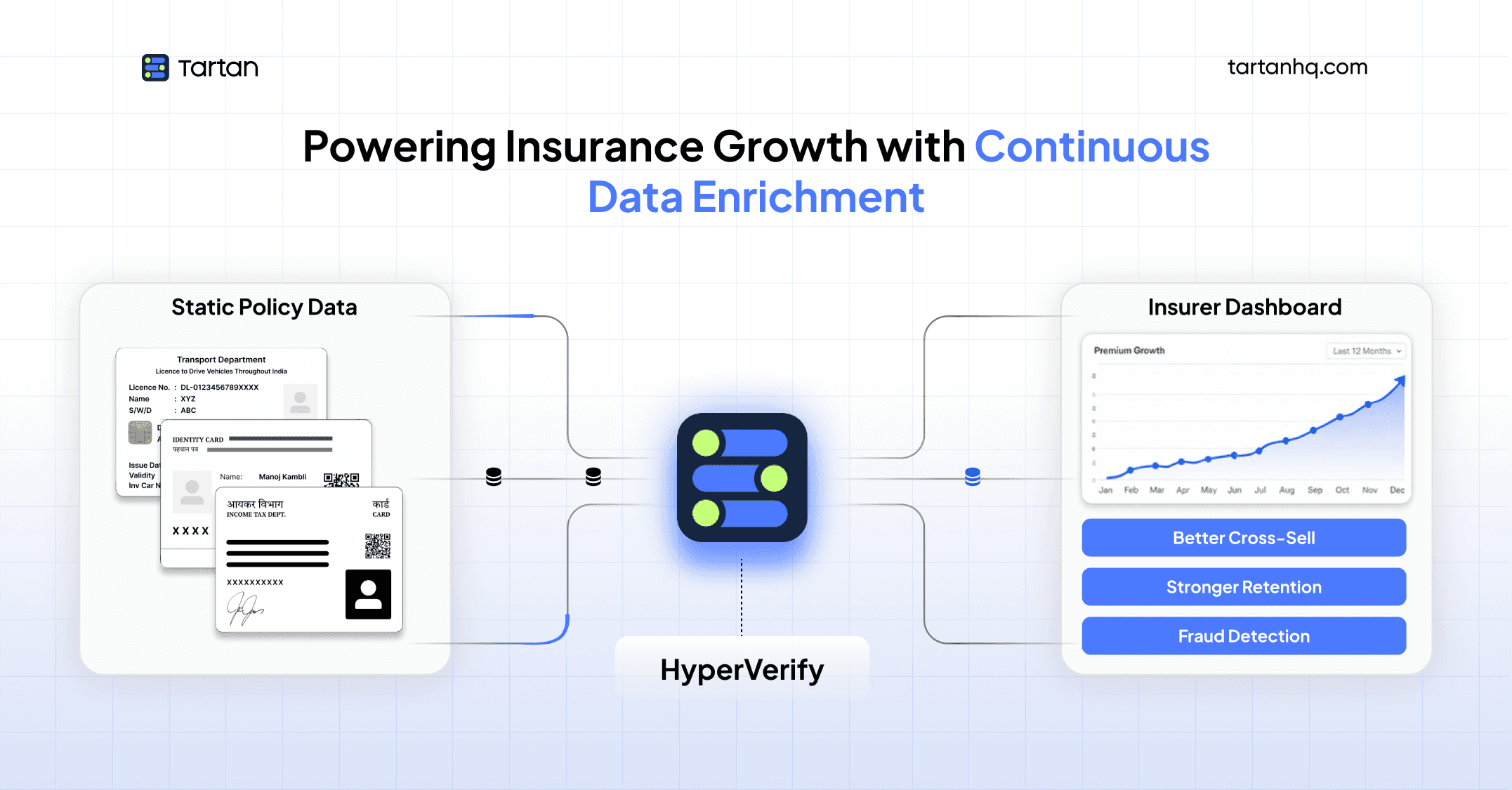
Tartan built HyperVerify to provide the data infrastructure layer that makes continuous enrichment operationally viable for insurers.
HyperVerify connects insurers to authoritative, real-time data sources across the dimensions that matter most for policy intelligence: employment and income signals drawn from EPFO records and bank statement analysis; address currency verified against live databases rather than self-declared updates; mobile number validity confirmed at the telecom level; identity consistency maintained against official sources.
These aren't one-time pulls. HyperVerify is designed to be queried at trigger points across the policy lifecycle - at renewal, at servicing events, before cross-sell campaigns are run, at claims initiation - so that the data driving decisions is current rather than historical.
For cross-sell and upsell teams, HyperVerify's enriched signals tell you which customers' financial profiles have shifted enough to warrant a conversation about increased cover. For retention teams, it surfaces the life-data signals - employment stress, address instability, contact degradation - that predict lapse before payment behaviour does. For claims and fraud teams, it provides the identity and profile consistency checks that make the policy record trustworthy at the moments it matters most.
Policy data that sits still is policy data that lies. Not maliciously - just through the ordinary passage of time and the ordinary changes of a customer's life. Insurers who treat enrichment as a continuous function rather than a periodic correction will have the only thing that actually drives sustainable growth in insurance: an accurate understanding of who their customers are today.
HyperVerify is built to give them that.
Your policy records are as old as the day they were written. Your customers have moved on. Continuous enrichment is how you catch up - and stay ahead.