Every investment platform in India has a personalisation problem.
Open any wealth app today - Zerodha, Groww, INDmoney, Scripbox - and the experience after onboarding is largely the same regardless of who you are. A 28-year-old software engineer earning Rs. 18 LPA gets broadly the same fund recommendations as a 42-year-old mid-level manager earning Rs. 36 LPA.
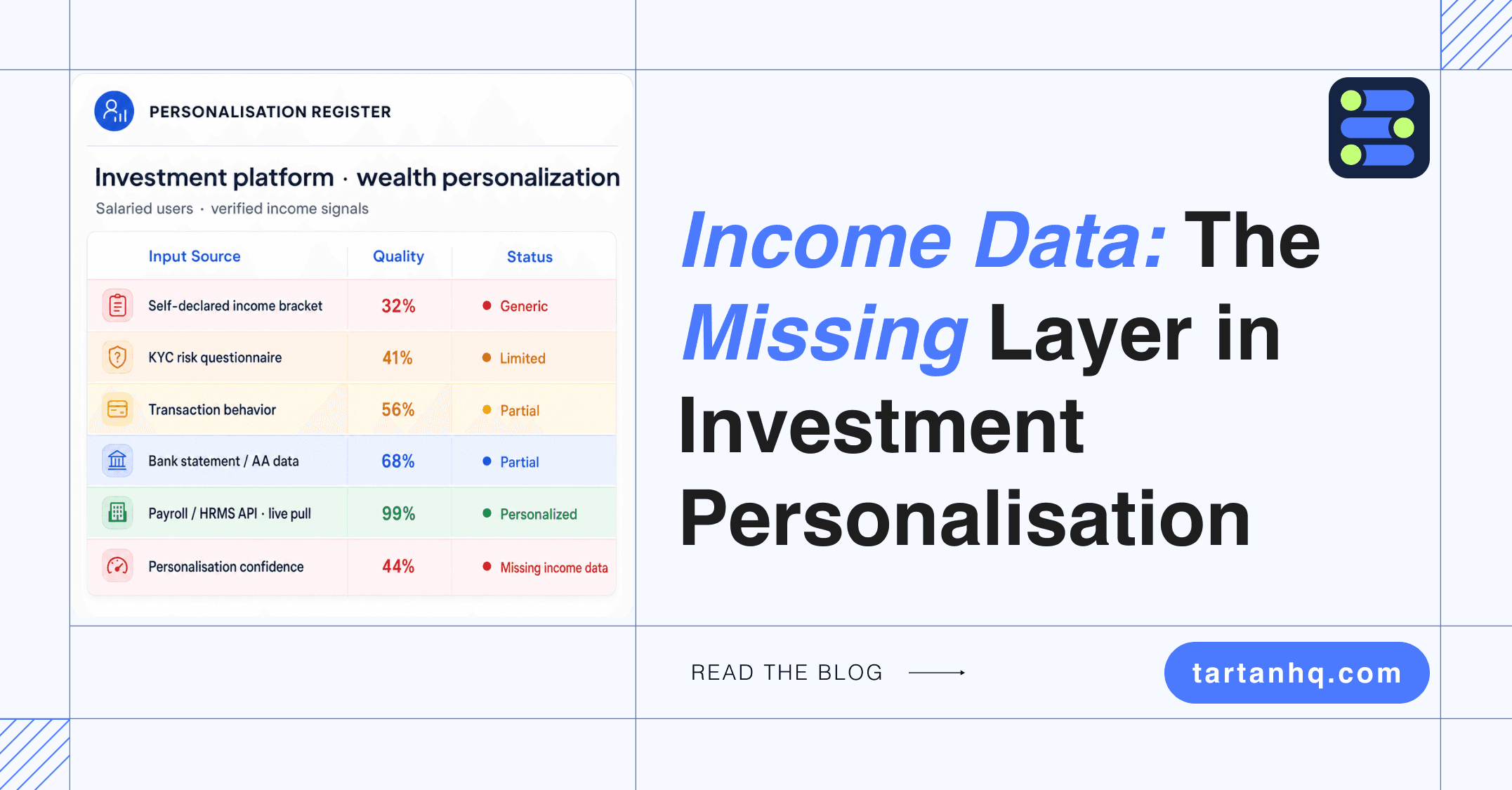
The UI might look polished. The nudges might feel smart. But the underlying personalisation logic is thin - built on age, declared risk appetite from a KYC questionnaire, and past transaction behaviour if the user has been active long enough.
That's not personalisation. That's segmentation dressed up as intelligence.
The reason is not a product design failure. It's a data infrastructure failure. Investment platforms don't have reliable, verified income data at the individual level. What they have is what the user told them during onboarding - a self-declared income bracket, checked on a form, never verified, never updated.
That single data gap is why personalisation in wealth tech remains largely theatrical.
The Problem With Self-Declared Income
When an investment platform asks a new user their annual income during KYC, the user picks a bracket: "Rs. 5-10 LPA", "Rs. 10-25 LPA", "above Rs. 25 LPA." That declaration does several things - it satisfies a regulatory checkbox, it buckets the user into a broad risk segment, and it immediately becomes stale.
It doesn't tell the platform what the user's actual monthly investable surplus is. It doesn't capture their fixed obligations - home loan EMI, rent, insurance premiums, existing SIPs. It doesn't reflect a salary revision that happened six months after onboarding. It doesn't distinguish between a user earning Rs. 18 LPA with no liabilities and one earning Rs. 22 LPA servicing a Rs. 40,000 monthly EMI.
These distinctions matter enormously for investment recommendations.
The investable surplus - what's actually available after fixed outflows - is the number that should anchor portfolio sizing, SIP recommendations, and asset allocation. Without it, every recommendation the platform makes is an educated guess layered over a self-reported number that may not have been accurate to begin with.
The wealth platforms that have tried to solve this have done so through bank statement analysis - asking users to upload statements or connect via Account Aggregator. It's a step in the right direction. But bank statement analysis gives you cash flow, not income structure.
It shows credits and debits. It doesn't tell you what portion of that credit is base salary versus variable pay versus a one-time bonus - distinctions that change the investment thesis significantly.
What Verified Income Data Actually Unlocks
When an investment platform has access to verified payroll and employment data - not declared, not inferred from transactions, but sourced directly from the employer's HRMS or payroll system - the personalisation logic changes completely.
Accurate SIP sizing: A platform that knows a user's net take-home, their payroll deductions, and their salary cycle can recommend a SIP amount that is genuinely calibrated to their cash flow - not a generic "start with Rs. 500" nudge or a percentage-of-declared-income heuristic. If net take-home is Rs. 92,000 and the payroll data shows a recurring advance deduction of Rs. 8,000, the investable surplus calculation is materially different from what the declared bracket would suggest.
Smarter asset allocation: Employment tenure and income stability are legitimate inputs into risk profiling. A user in a stable public sector role with 12 years of tenure is a different risk profile than a startup employee at the same income level - even if both select "moderate" on a KYC questionnaire. Verified employment data lets platforms build risk profiles that reflect actual financial stability, not self-assessed comfort with volatility.
Goal-based planning with real numbers: Every wealth platform talks about goal-based investing. But goal-based planning without verified income is guesswork. If the platform knows verified gross income, statutory deductions, employer PF contributions, and existing salary-linked commitments, it can build a genuinely accurate picture of what a user can save toward a home purchase, a child's education, or early retirement - and when. That's the difference between a financial plan and a financial projection.
Lifecycle-triggered recommendations: Payroll data carries events. A salary revision. A promotion that changes the income tier. A new employer after a switch. Each of these is a financial inflection point - a moment when investment behaviour should change and the platform should be proactively adjusting recommendations. Without a live data connection to income and employment, the platform never knows these events happened. With it, they become personalisation triggers.
Why Unified APIs Are the Infrastructure That Makes This Possible
The obvious question is: why don't investment platforms just build direct integrations with payroll and HRMS systems to get this data?
The answer is the same one that applies across every sector trying to access employment and income data at scale. India's payroll and HRMS landscape is deeply fragmented. Large enterprises run SAP SuccessFactors or Workday. Mid-market companies use Keka, Darwinbox, or GreytHR. SMBs are on Zoho Payroll, HROne, or a dozen regional platforms. Every system has a different API architecture, a different data schema, and a different authentication model.
For a wealth platform to build direct integrations with each of these, they'd need to maintain 15 to 20 separate connectors - each requiring ongoing engineering attention as HRMS vendors update their APIs. That is not a product investment most wealth platforms are positioned to make. Their core competency is portfolio construction and user experience, not payroll data integration.
A unified API layer solves this with a single connection. The wealth platform integrates once, against a normalized schema, and gets access to employment and income data across every supported HRMS and payroll platform. Gross salary, net take-home, deductions, tenure, employment status - returned in a consistent format, with employer attestation, regardless of which underlying system the user's employer runs.
The user experience is frictionless. At onboarding or at a portfolio review moment, the platform requests consent to pull income data. The user authorizes in one step. The platform receives verified payroll data within seconds - no document upload, no bank statement parsing, no self-declaration that ages the moment it's entered.
The Competitive Angle Wealth Platforms Are Missing
Personalisation is the stated priority of every wealth platform in India right now. Every product roadmap has it. Every investor pitch references it. But most of the personalisation being built is behavioural - based on in-app actions, transaction history, and content engagement. That's useful signal. It's not enough.
The platforms that will pull ahead are the ones that close the income data gap. Because once you have verified income at the individual level - not a declared bracket, not an inferred cash flow, but actual payroll data with employer attestation - the quality of every downstream recommendation improves. SIP sizing. Asset allocation. Risk profiling. Goal-based planning. Lifecycle nudges. All of it gets sharper.
The infrastructure to do this exists. Unified payroll and HRMS APIs are live, connected to the platforms where salaried India's income data actually lives, and accessible through a single normalized integration.
The wealth platforms that treat income data as a core input - not a KYC formality - will build a personalisation layer that competitors running on self-declared brackets simply can't replicate.
Verified income is not a nice-to-have for wealth tech. It is the foundation that every personalisation claim is currently being built on sand without.