Everyone is building with AI agents right now.
The pitch is compelling: autonomous workflows that execute multi-step tasks, pull context from across your systems, make decisions, and hand off to the next step without a human in the loop. Customer onboarding that runs itself. Credit decisioning that fires in seconds. HR workflows that trigger, verify, and resolve without a single ticket being raised.
The demos look extraordinary. The production reality is more complicated.
Most enterprise AI agent deployments are hitting the same wall - not a model problem, not a prompt engineering problem, not even a compute problem. They're hitting a data access problem. The agent is intelligent enough to know what it needs. The infrastructure it's sitting on can't reliably get it there.
This is the gap that's separating AI automation that works in pilots from AI automation that works at scale. And closing it is less about AI and more about the data layer underneath it.
What AI Agents Actually Need to Function
An AI agent is, at its core, a reasoning engine that takes actions based on context. The quality of its actions is directly proportional to the quality and completeness of the context it has access to.
In an enterprise environment, that context lives across a sprawl of systems. CRM, HRMS, ERP, payroll platforms, identity verification services, credit bureaus, compliance databases, communication tools. Each of these holds a piece of the picture that an agent needs to do its job well. A customer onboarding agent needs identity data, employment data, income data, and compliance flags - from four or five different systems - to complete a single workflow. A credit decisioning agent needs bureau data, bank transaction data, and employer-verified income data to produce an output worth acting on.
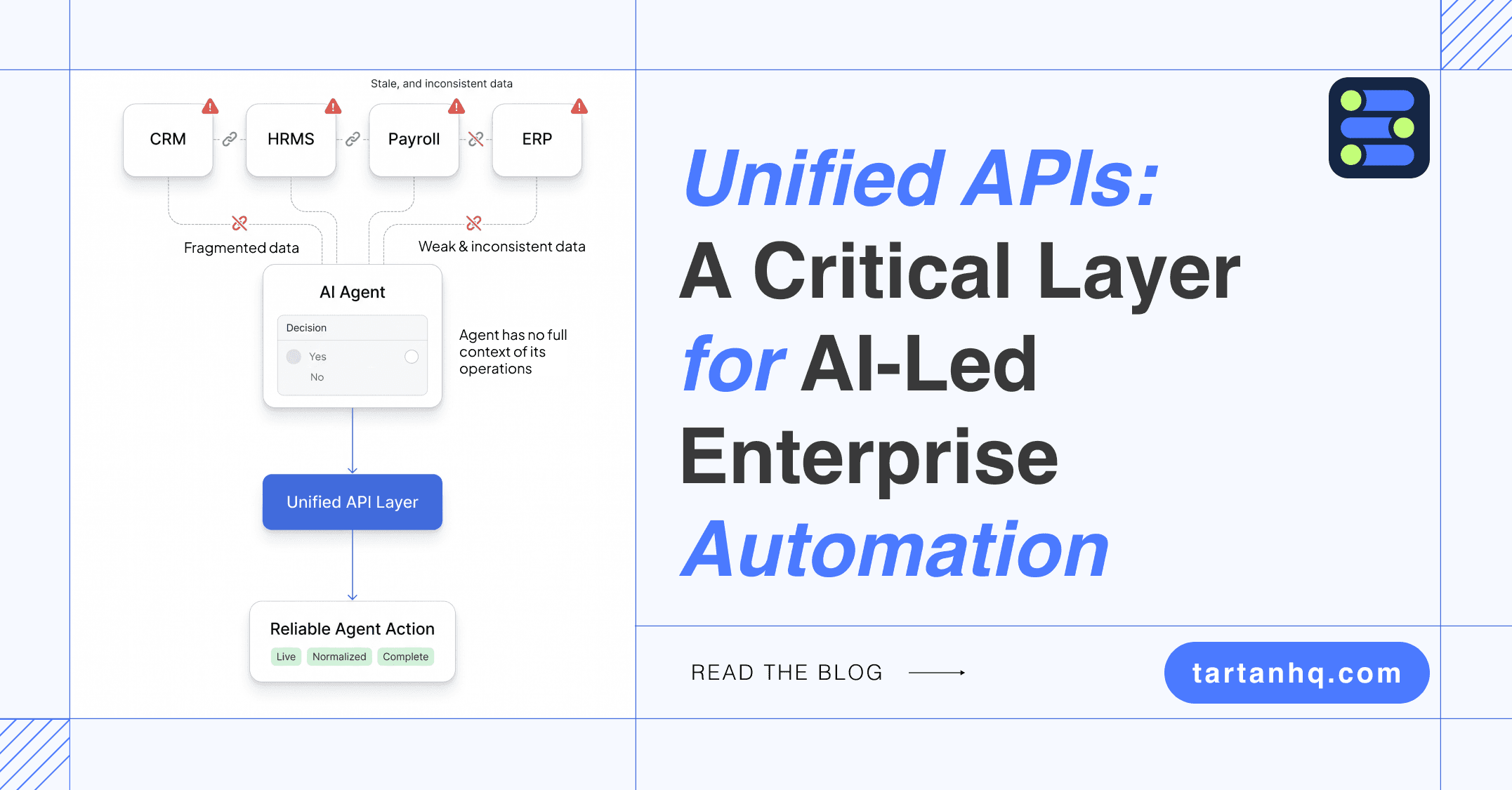
When those systems are siloed - which they are in almost every enterprise - the agent hits one of three failure modes.
It works with incomplete context. It can only access the systems it's been directly connected to. Everything outside that perimeter is invisible. The agent makes decisions on partial information and either produces wrong outputs or escalates to a human - defeating the purpose of automation entirely.
It accesses data inconsistently. Different systems return data in different formats, with different field names, different update frequencies, different authentication models. The agent has to handle all of this variation at runtime. This is technically possible but it makes the agent brittle - a schema change in one upstream system breaks the workflow, often silently.
It can't act in real-time. Stale data is a silent killer in agentic workflows. An agent making a credit decision on income data that's 48 hours old, or checking employment status against a system that only syncs nightly, is not operating in real-time regardless of how fast the model itself runs. The intelligence is there. The data freshness isn't.
This is not an AI problem. It is a data infrastructure problem.
The Integration Layer Is the Actual Bottleneck
When an enterprise deploys an AI agent and it underperforms, the instinct is to interrogate the model. Better prompts. More fine-tuning. A different foundation model. Sometimes that's right. More often, the model is fine - the integration layer feeding it is the bottleneck.
Think about how enterprise systems are actually connected today. Most large organisations have accumulated a web of point-to-point integrations built over years, by different teams, using different methods. REST APIs next to SOAP services next to database exports next to file transfers that run on a schedule. Each connection was built to solve a specific problem at a specific moment. None of them were designed with AI agents in mind.
When an AI agent needs to pull data from five of these systems to complete a workflow, it's navigating five different authentication flows, five different data schemas, five different error handling patterns, and five different latency profiles. The engineering overhead of building and maintaining these connections isn't a one-time cost - it's an ongoing tax on every agent deployment. Every system upgrade, every API deprecation, every vendor migration creates a ripple of breakages that engineering teams have to triage and patch.
At scale, this is what kills enterprise AI automation velocity. Not the AI. The plumbing.
What a Unified API Layer Changes for Agent-Based Workflows
A unified API layer changes the fundamental architecture of how an AI agent accesses enterprise data. Instead of a direct web of point-to-point connections between the agent and every upstream system, there is a single normalized interface. The agent makes one call. The unified layer handles authentication, data retrieval, normalization, and response - across every connected system simultaneously.
The agent doesn't need to know whether employment data is coming from Keka or Darwinbox or SAP SuccessFactors. It doesn't need to handle schema differences between a payroll system running on a legacy stack and one running on a modern API-first platform. It gets back clean, normalized, consistent data - regardless of the source - in a format it can act on immediately.
For enterprise AI automation, this changes three things concretely.
Context completeness goes up. When a unified API layer is connected to the full range of relevant enterprise systems, the agent has access to complete context at the point of decision.
A credit agent can pull verified income, employment status, bureau data, and identity verification in a single orchestrated call. A compliance agent can check identity data across multiple verification sources simultaneously. The decisions get better because the context is fuller.
Workflow reliability goes up. The fragility that comes from direct point-to-point connections - where a single upstream API change can silently break an agent workflow - is contained at the unified layer.
Schema changes, authentication updates, and endpoint migrations are handled in one place, not propagated across every agent deployment. The agents running on top of the unified layer don't break when upstream systems change. They just keep running.
Time-to-deployment drops significantly. Building a new agent workflow on top of a unified API layer means the data connections are already there. The engineering work is in the workflow logic, not in rebuilding data access from scratch for every new use case.
For enterprise teams shipping multiple AI workflows across different functions - HR, credit, compliance, finance - this compounds into a serious velocity advantage.
Why This Is a Strategic Decision, Not a Technical One
CIOs and CDOs evaluating enterprise AI investments are increasingly discovering that the ROI question isn't just about model quality or use case selection. It's about whether the data infrastructure underneath the agents is capable of supporting them at production scale.
An AI agent pilot that works beautifully in a sandboxed environment with clean, manually prepared data will not automatically translate to a production deployment pulling live data from six enterprise systems with varying API maturity. The gap between pilot and production is, in most cases, a data infrastructure gap.
This is why the unified API layer conversation is moving up from engineering architecture reviews into technology strategy discussions.
It's not just about cleaner data pipelines. It's about whether the organisation's AI automation ambitions are architecturally achievable on the current data infrastructure - or whether every agent deployment will continue to hit the same integration ceiling.
The enterprises that are shipping AI automation at scale - not in demos, not in pilots, but in production, across functions, with measurable business outcomes - have almost universally made a prior investment in normalizing and unifying their data access layer.
Not because they anticipated AI agents specifically. But because clean, unified, real-time data access is a prerequisite for any intelligent system to operate reliably.
The AI is ready. The question every enterprise technology leader needs to answer honestly is whether the data layer is ready for it.
The Connective Tissue Framing
Connective tissue is an apt metaphor here. In biology, connective tissue doesn't do the visible work - it doesn't contract like muscle or transmit signals like nerves. But without it, neither of those systems functions. It holds everything in relation to everything else. It enables the coordination that makes complex, multi-part action possible.
A unified API layer is connective tissue for enterprise AI. The agents are the intelligence. The models are the reasoning. But the unified data layer is what holds it all together - making sure the right data reaches the right agent at the right moment, in a form it can actually use.
Without it, enterprise AI automation is a collection of isolated experiments. With it, it becomes a system.