There's a gap sitting right in the middle of your lending workflow. It's not a technology gap - the technology exists. It's not a data gap - the data exists too. It's a connectivity gap. And every day it stays open, it's adding days to your loan TAT, burning ops bandwidth, and quietly killing conversion on applications that should have closed in hours.
Here's the gap: your Loan Origination System needs employment data to make a credit decision. Your applicant's HRMS has that exact data - current salary, employment status, designation, date of joining, PF contribution history. But right now, the only way to move that data from one system to the other is a human being, carrying a PDF.
That's the problem. And for NBFCs processing salaried loans, personal loans, or salary-advance products at any meaningful volume, it's one of the most expensive problems in the stack.
The Current State of Play
Walk through a typical salaried loan application today, and you'll see the same pattern regardless of which lender you're looking at.
The applicant fills out the loan form and uploads their salary slips - usually three months' worth. They upload their offer letter or employment certificate. Sometimes they upload their PF passbook.
The lender's ops team downloads these documents, manually enters the relevant fields into the LOS, and flags anything that looks inconsistent for a credit analyst to review. The credit analyst reviews. If anything's missing or unclear, the applicant gets a call asking for more documents. Rinse, repeat.
Average turnaround from application to decisioning: two to five days, depending on volume, document quality, and how backed up the ops queue is.
Now consider what the HRMS at the applicant's employer already knows: their exact monthly gross and net salary, their department and designation, their date of joining, their current employment status, their UAN and PF contribution history, their variable pay breakdown. It's all there, structured, up to date, and verifiable - sitting in a system that your LOS has never spoken to.
The document ritual isn't adding information. It's just slowly, expensively transferring information that already exists elsewhere.
Why This Matters More Now Than It Did Five Years Ago
NBFC lending in India has changed significantly. The shift toward digital-first origination, the RBI's push on account aggregator frameworks, and the explosion of embedded lending products have raised borrower expectations dramatically. Applicants who apply for a salary advance through their employer's benefits portal or a personal loan through a fintech app expect a decision in minutes - not days.
Meanwhile, the competitive pressure is real. Fintechs with tighter tech stacks and lower ops overhead are able to turn around decisions faster. Banks with existing payroll relationships have direct access to employment data that NBFCs typically don't. The lenders who figure out how to close the HRIS-to-LOS connectivity gap are going to have a structural TAT advantage that compounds over time.
And it's not just about speed. Manual document verification introduces error. Salary slips get doctored - it's one of the most common fraud vectors in retail lending. Employment certificates get fabricated. A live, direct data pull from an HRMS eliminates the document entirely and gives you verified, employer-confirmed employment data instead.
Faster decisions, lower fraud exposure, and less ops cost. That's the full case for solving this.
What Direct HRIS-to-LOS Connectivity Actually Looks Like
In practice, a direct integration between HRIS and LOS means your loan origination system can programmatically request and receive employment verification data at the point of underwriting - without a document, without a phone call, and without ops team involvement.
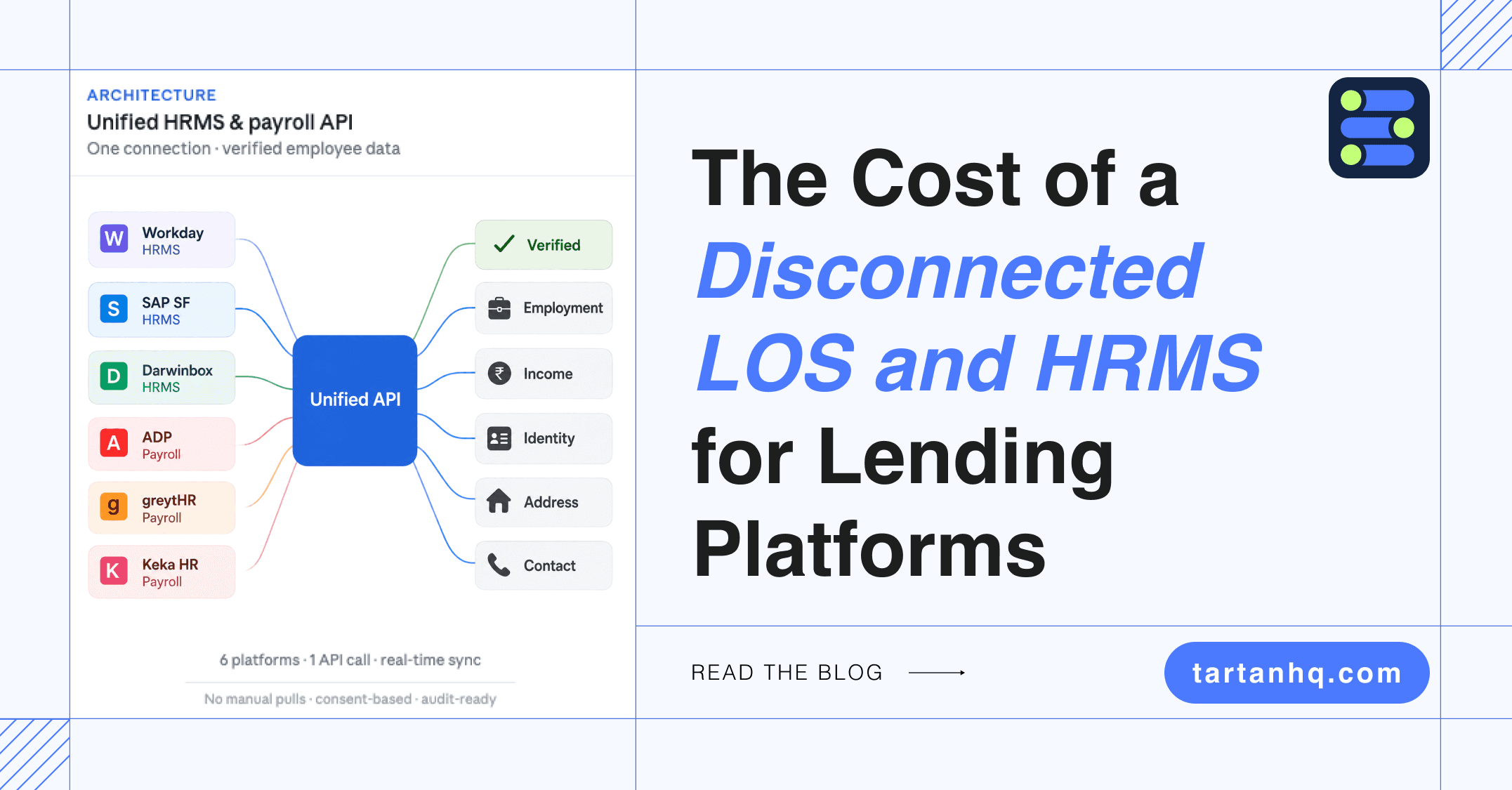
The borrower consents to the data pull as part of the application flow. The LOS hits an API that connects to the employer's HRMS - whether that's Keka, Darwinbox, GreytHR, Zoho People, SAP SuccessFactors, or any of the other payroll and HRMS platforms in the Indian market.
The HRMS returns structured employment data: current employment status, gross salary, net take-home, designation, date of joining, and relevant payroll history. The LOS ingests it directly, without transformation, and the credit engine runs.
From application submission to data-verified credit decision: minutes, not days.
There are a few things that make this technically non-trivial to build in-house. First, the HRMS landscape in India is fragmented. There are dozens of platforms with different APIs, different authentication mechanisms, different data schemas, and different levels of documentation quality. Building and maintaining direct integrations with even the top ten platforms is a significant ongoing engineering investment - new API versions, changing auth flows, support tickets when something breaks.
Second, employer consent and data governance add complexity. The employee authorises the data pull, but the employer's HRMS is the data custodian. Handling that consent layer cleanly, in a way that's compliant with data protection frameworks, is not straightforward.
Third, the data that comes back from different HRMS platforms isn't standardised. Salary breakdown fields vary. Employment status terminology varies. Date formats vary. Making all of that usable inside a LOS requires a normalisation layer that most lending teams don't have the bandwidth to build.
Who This Problem Actually Belongs To
If you're building or running the tech stack at an NBFC, the HRIS-to-LOS gap is your problem - even if it currently lives in ops. Every manual verification step that sits between application and decision is a cost centre and a conversion killer that engineering can solve.
If you're a product leader at a digital lender or a fintech with an embedded lending product, TAT is one of your primary competitive levers. Borrowers who get a decision in 20 minutes don't go comparison shopping. Borrowers who wait three days do.
If you're a Chief Risk Officer or Head of Credit, the document-based verification model you're currently running has a fraud vector baked into it. Fabricated salary slips are a known problem. Live HRMS data is not fakeable in the same way - the employer's system either confirms the employment or it doesn't.
And if you're an HR tech or payroll platform thinking about your product roadmap, HRIS-as-a-verification-layer is an emerging use case your enterprise clients will increasingly ask about. Lenders want verified employment data. Your platform has it. That's a distribution and partnership play worth thinking about seriously.
The Integration Layer You're Missing
This is exactly the problem Tartan's HRIS connectivity layer is built to solve.
Tartan provides a single unified API that connects to the major HRMS and payroll platforms operating in India - Darwinbox, Keka, GreytHR, Zoho People, SAP SuccessFactors, and more - and returns standardised, structured employment data in a format that drops cleanly into a LOS or credit underwriting system.
One integration on your side. Coverage across the HRMS landscape on ours. The normalisation, the auth handling, the API maintenance, the edge cases - all abstracted away.
For an NBFC or digital lender, the implementation path is straightforward: integrate the Tartan API into your LOS at the data ingestion step, add the employee consent flow to your application journey, and replace your manual employment verification queue with a programmatic data pull.
The ops team stops verifying documents. The credit engine starts running on live, verified data. TAT drops.
It's not a rearchitecture of your lending stack. It's a targeted fix for one of the most friction-heavy steps in it - and the ROI is measurable in days saved per application.
The Bottom Line
The HRMS has the data.
The LOS needs the data.
The document is a workaround, not a solution - and it's an increasingly expensive one as lending volumes grow and borrower expectations rise.
Direct HRIS-to-LOS connectivity isn't a futuristic concept. The integrations exist. The APIs exist. The consent frameworks exist. The only question is whether your lending stack is connected to them.
The lenders who solve this first won't just be faster. They'll be structurally harder to compete with.