Product Update — April ’24
Advance Work Email Verification
We’re introducing Advance Work Email Verification, a real-time API added to our verification suite that enables organizations to reliably validate an individual’s work identity at the moment it matters—during onboarding, underwriting, access provisioning, or eligibility checks.
As employment-linked fraud, misrepresentation, and identity spoofing continue to rise, validating whether a user genuinely belongs to a claimed organization has become a critical trust and risk control. Relying on self-declared employer details or manual validation workflows is no longer sufficient at scale.
This API allows teams to programmatically verify work emails in real time—without manual reviews, offline checks, or delayed decisioning.
What the API does
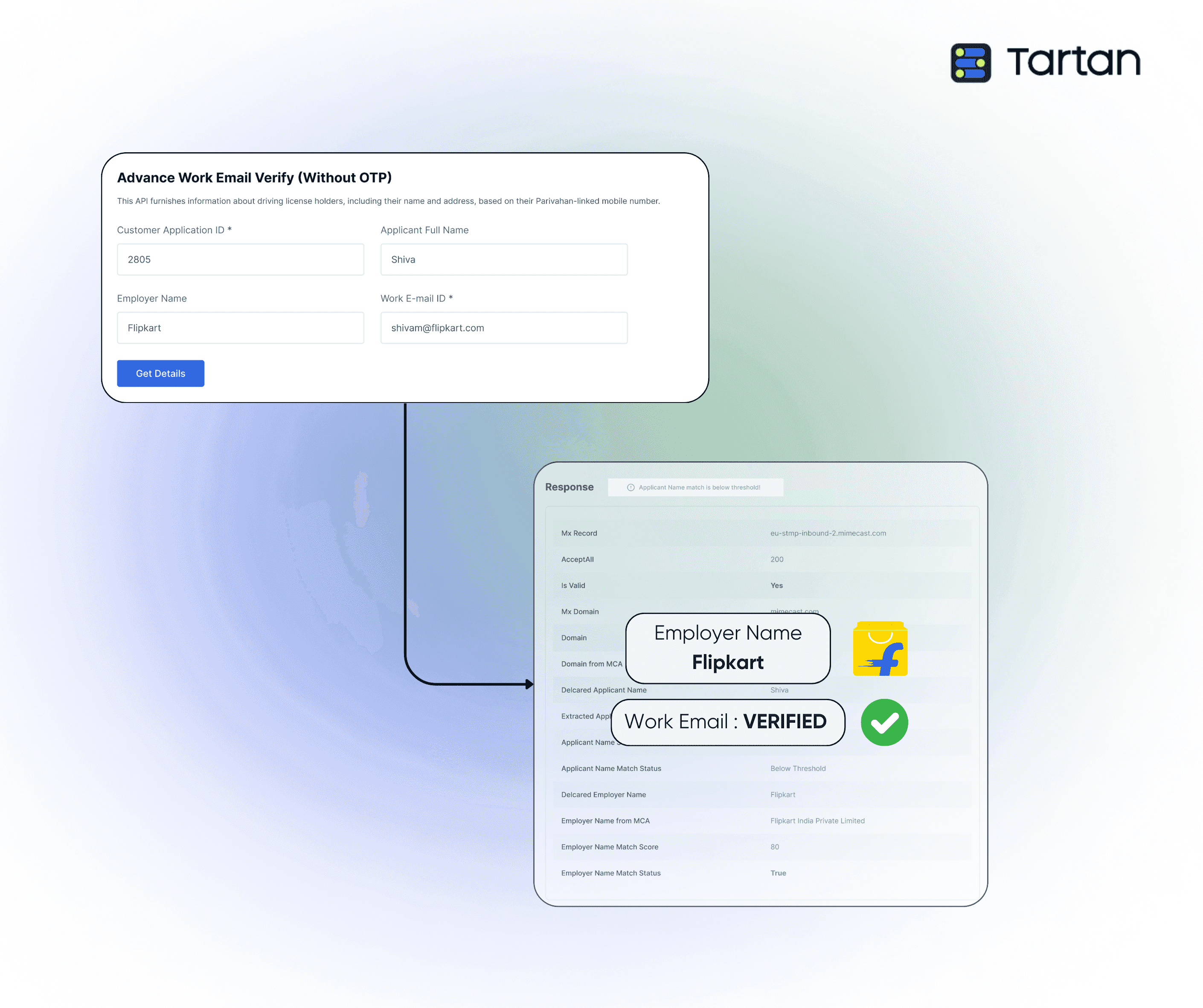
Advance Work Email Verification validates a user’s work email by combining domain intelligence with official company registry data to establish whether the email is legitimately associated with the claimed employer.
The API performs the following checks in real time:
Email domain validation to confirm domain structure, legitimacy, and usability
Domain-to-company mapping using registered corporate records sourced from MCA data
Employer name matching between the user-declared employer and the legal entity associated with the email domain
Similarity scoring to quantify how closely the declared employer name aligns with the registered company name
Together, these checks allow systems to determine not just whether a work email exists—but whether it credibly represents a real employment relationship, and with what level of confidence.
What you get in the response
The API returns clear, decision-ready signals that can be directly consumed by risk, compliance, or automation workflows:
Domain validation status
Employer name match status
Similarity score between the declared employer name and the MCA-linked legal entity
Structured outputs suitable for approve, flag, review, or escalate decisions
These signals are designed to be machine-readable and audit-friendly, enabling consistent enforcement across high-volume workflows.
Where it fits
Advance Work Email Verification is built to plug seamlessly into workflows where work identity is a gating factor, including:
Digital onboarding and KYC flows
KYB and employment verification journeys
Credit underwriting and eligibility checks
Internal access provisioning and role-based controls
Partner, vendor, and enterprise user validation
The API is stateless, real time, and designed for scale—making it suitable for both customer-facing and internal trust workflows.
Why this matters
Work identity validation has moved from a secondary check to a core trust requirement across lending, insurance, SaaS, and enterprise platforms. Fraudulent employment claims directly impact credit decisions, pricing models, eligibility criteria, and access controls—often surfacing only after losses or audits.
This shift is already visible across the ecosystem. Even large professional networking platforms have introduced work email verification to curb impersonation, resume fraud, and false employment claims.
Advance Work Email Verification brings the same level of rigor into your systems—programmatically, in real time, and at enterprise scale—without adding operational overhead.
Key benefits
Eliminate manual employer and email validation checks
Detect false or inflated employment claims early in the journey
Strengthen trust signals tied to work identity
Enable faster, automated, and consistent decision-making
Improve compliance posture and audit readiness
Use Cases
(i) Lending - For direct credit to salaried employees or early wage access, validating user’s employment details is paramount to arrive at loan approval. Therefore, verification of their work email works as a variable to help lenders in arriving at a decision quicker.
(ii) Professional Networks & Job Boards - Companies can leverage it to verify a user’s employment details in real-time and provide credibility to a networking platform with verified badges. Job boards as well can integrate this solution to filter verified candidates for recruiters.
(iii) Background Check - To verify past employment of a candidate during background checks, it is imperative to validate email id belonging to the company’s domain in order to check the authenticity of those records.
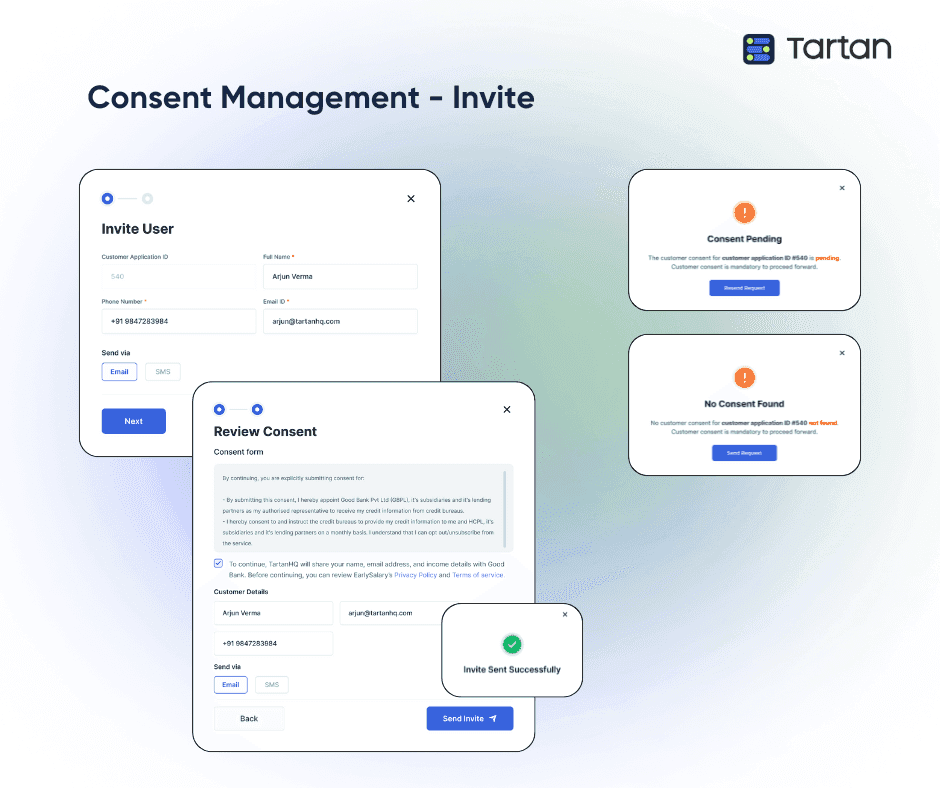
Console - Consent Management - As data security and consent become a necessity for adhering to data protection guidelines, we have introduced consent management feature in our console to ask for consent from end users before a client can begin retrieving data via any API. However, this feature can be enabled or disabled by admin account for all APIs, along with having an expiry to providing consent for any user.
For eg. if a client sends consent request to end user to fill in their details, the user while submitting their data provides soft consent to share data with client. Providing consent means the client can use the data not just to validate identity, but also for other purposes like credit decisioning, income and employment checks, business details or contact information
If the client wants to make customer consent mandatory to avoid misuse of APIs, they can use this feature. Admin can also configure the content used in consent guidelines along with choosing input fields for fetching information from users. Once admin account has enabled consent feature, all accounts under them will have to get consent of customers before extracting their information.
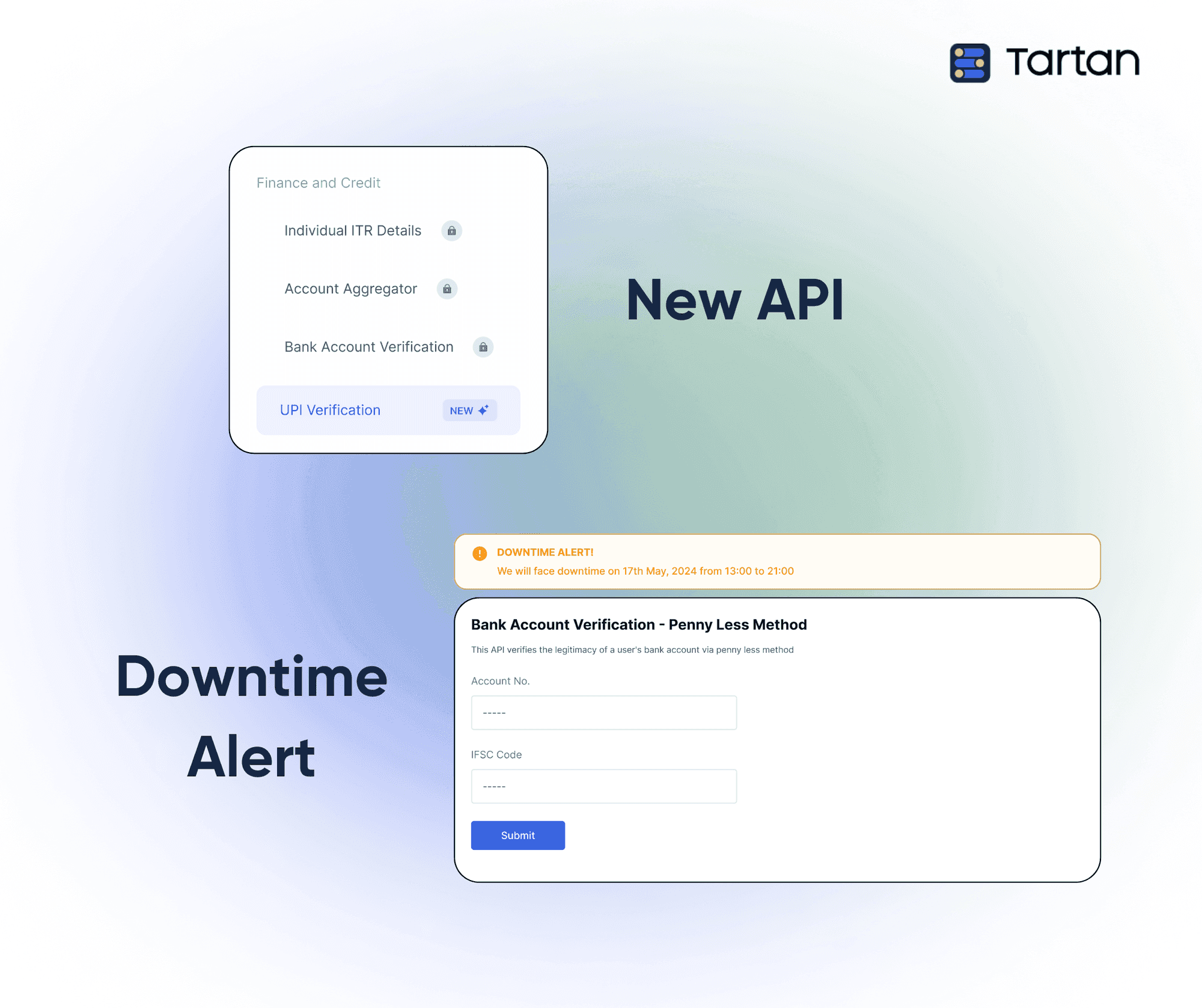
Console - Alert System - This feature has been introduced to make life easier for our clients in order to keep them updated of any recent developments or downtimes. It provides communication in real-time regarding any API downtime (local alert) or the complete console (global alert).
A notification on API page (for API integration) or a message banner on the console is displayed regarding the time period during which an API would not be serviceable, so that client could move ahead with their operations accordingly. A client POC will have the autonomy to enable alerts for all clients. Also, newly developed APIs will be having a ‘new’ badge on it, so that clients are able to try any new solutions
For eg. if a client is using the console and an update shows that PAN verification API is down till midnight, the client would not be able to send invite to customers for using that API and retrieving information for the same.
At Tartan, we are actively advancing efforts to automate user onboarding, verification and transaction processes for financial services, digital commerce and social networking organisations.