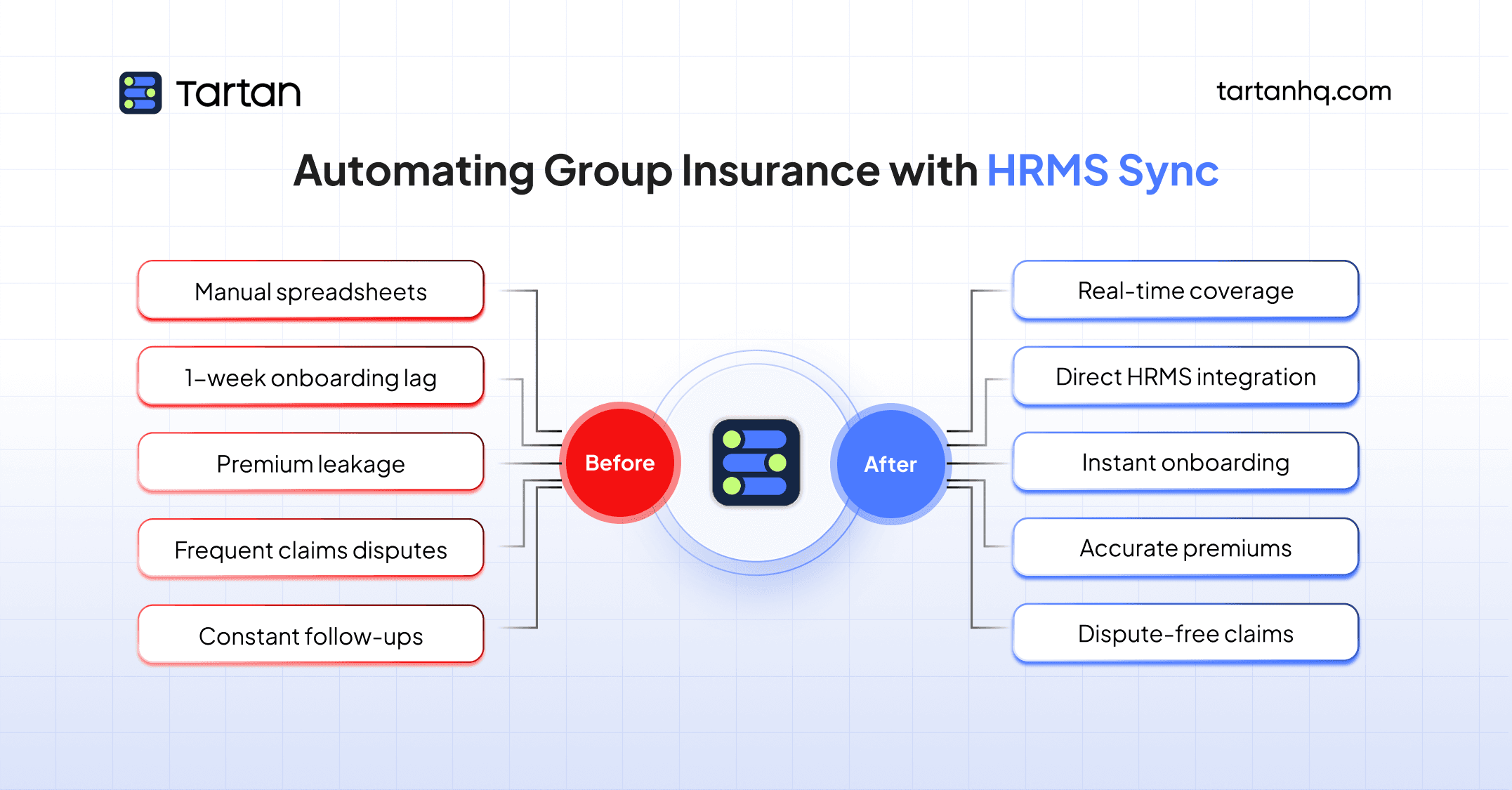
Group health insurance is one of the most valuable employee benefits a company can offer.
For the insurer, it is a volume play - one corporate client brings hundreds or thousands of covered lives in a single deal. The unit economics should work well for both sides.
And yet, operationally, group insurance enrollment is one of the most friction-heavy processes in the entire insurance value chain. Not because the product is complicated.
Because the data pipeline that feeds it - the one that tells the insurer who is covered, at what salary band, from which date - is almost entirely manual.
Most insurers and corporate HR teams have quietly accepted this as the cost of doing business.
They shouldn't.
The manual process is not just slow - it creates financial exposure, compliance risk, and customer experience failures that accumulate invisibly until something goes wrong visibly.
What the enrollment process actually looks like
When a corporate client signs a group health policy, the insurer needs an accurate employee list to issue coverage. In practice, getting that list involves asking the client's HR team to export a file from their HRMS - Darwinbox, GreytHR, Keka, SAP, or whichever platform they use - format it to the insurer's template, and send it over.
The HR team is busy. The export takes a day. The formatting takes another day. When the file arrives, it has problems - missing date-of-joining fields, salary figures in a different denomination, a few employees whose PAN details are incomplete.
Someone at the insurer's ops team flags the errors, sends a query back, and waits. A corrected file arrives. Coverage is issued.
By the time this process completes, a week has passed since the policy was signed. Some employees have joined the company during that window and aren't on the list. They are technically uninsured under the new policy - a liability nobody notices until one of them files a claim.
This is the onboarding problem. But it is just the beginning, because group insurance is not a one-time enrollment. It is a living policy that needs to reflect the current state of the employer's workforce at all times.
The mid-term endorsement problem nobody talks about enough
Every month, employees join companies and leave them. Salaries change. Dependents are added. People move between locations and role grades. Each of these events should trigger a policy update - what insurers call a mid-term endorsement. The coverage should reflect current reality, not the snapshot from the day the policy was issued.
In practice, most corporates send endorsement data to their insurer monthly at best, quarterly at worst. The HR team batches up the changes and submits another spreadsheet. The insurer processes it, usually with a lag. The policy is updated - but it has been out of sync with the actual workforce for weeks.
The financial consequences of this lag run in both directions. Employees who have left the company may still be listed as covered - meaning the corporate is paying premiums for people no longer on their payroll.
New joiners who haven't been added yet are uninsured during their first weeks of employment, the period when many health issues surface during new-job stress. Salary changes that affect the sum assured haven't been reflected, meaning coverage may be incorrectly sized.
None of this is intentional. It is simply the predictable outcome of a process built on periodic manual data exchanges rather than real-time connectivity.
"When coverage is issued based on stale data, the policy reflects a company that no longer exists - a snapshot of a workforce that has moved on. For every day that snapshot is wrong, someone carries unintended risk."
The claims problem that originates here
The enrollment data problem has a downstream consequence that is expensive and entirely avoidable: contested claims.
An employee files a hospitalisation claim.
The insurer checks the policy records.
The employee's name is there, but the listed sum assured doesn't match the current salary grade - because a salary revision was never updated.
The claim gets flagged for manual review.
Someone has to investigate whether the policy should have been amended, when the salary changed, and what the correct sum assured should have been. This takes days. The employee is waiting. The corporate HR team is fielding calls.
Or worse: an employee files a claim, and the insurer's records show them as no longer covered - because the exit was processed in the HRMS three months ago but the endorsement was never sent.
The claim is rejected. The employee escalates. The corporate client escalates.
The relationship manager spends a week resolving something that should never have happened.
These situations are not rare edge cases. In any group health portfolio of meaningful size, they are recurring. The root cause in almost every case is the same: the insurer's records did not reflect the employer's actual workforce at the time the claim was filed. And the reason they didn't is that the only mechanism for keeping them in sync was a manual, periodic, human-dependent data exchange.
What HRMS sync changes structurally
HRMS sync - connecting the insurer's systems directly to the employer's HR platform via API - changes the architecture of this problem at the source rather than patching it downstream.
When the policy is issued, the corporate client's HR admin authenticates a consent-based connection to their HRMS.
From that moment, the insurer has a live feed of employee data - current roster, active employment status, salary grades, date of joining, department. No file export. No email. No template formatting. The data comes from the system of record, in real time, in a standardised format the insurer's platform can act on directly.
New joiners are added to coverage automatically when they appear in the HRMS as active employees. Exits trigger offboarding without anyone sending a notification. Salary revisions update the sum assured in the next coverage cycle without a manual endorsement request.
The policy reflects the actual workforce because it is connected to the system that defines it.
For the insurer's operations team, this is a fundamental shift in how the group portfolio is managed. Instead of processing monthly batches of endorsement files - each requiring validation, error correction, and manual upload - the system handles the continuous flow of changes as they happen. The ops team's attention goes to exceptions and edge cases, not to routine data processing.
The premium accuracy payoff
One of the least discussed benefits of real-time HRMS sync is what it does for premium accuracy - and therefore for the insurer's own financials.
Group health premiums are typically calculated on the basis of the number of covered lives and their salary grades. When that data is stale, premiums are wrong. Sometimes in the insurer's favour - they are collecting premiums for employees who have left. More often in the corporate's favour - they are not paying the premium uplift for new joiners or salary-revised employees who haven't been endorsed yet.
Reconciling this at renewal is one of the most uncomfortable conversations in the insurer-corporate relationship.
The insurer presents a year-end adjustment. The corporate disputes some of it. Someone has to go back through twelve months of spreadsheets to agree on what the correct headcount and salary data should have been at each point in time. This reconciliation takes weeks and damages the relationship regardless of who is technically right.
With real-time HRMS sync, the premium calculation is always based on current, verified data. There is no year-end reconciliation argument because the data was never wrong. Premiums are accurate month by month. The renewal conversation becomes a discussion about coverage design and pricing, not a forensic exercise in reconstructing last year's workforce data.
What it looks like for the corporate client
The corporate HR team's experience changes substantially when enrollment is automated.
The recurring task of maintaining the insurer's data - exporting files, formatting them, sending them, following up on errors - disappears from their workflow entirely. The first month after the connection is live, the HR manager notices that no one from the insurer has called asking for an endorsement file. The second month, same. After six months, the corporate's benefit management overhead is measurably lower.
This matters commercially for insurers because HR heads talk to each other. "Our insurer connects directly to Darwinbox - we haven't touched a spreadsheet in a year" is a reference that travels in CHRO circles at Indian corporates. The insurer that has solved this is not just retaining clients more easily - they are generating referrals from the operational experience, not just the product.
It also matters at renewal time. A corporate that has spent twelve months with a frictionless insurance data process is not looking for alternatives. Switching means reconnecting, re-establishing data flows, and going back to the manual world they left. The inertia works entirely in the insurer's favour.
The HRMS diversity problem - and why it matters for insurers
One complexity insurers face when attempting to solve this: their corporate clients don't all use the same HRMS. A portfolio of 200 corporate accounts might include companies running Darwinbox, GreytHR, Keka, SAP SuccessFactors, Zoho People, and several others.
Building a direct API integration with each of these individually is not realistic for most insurers - it is a multi-year engineering commitment that falls outside the core competency of an insurance technology team.
This is the specific problem that a unified HRMS API layer solves. Rather than building platform-by-platform, the insurer connects once to a unified integration layer that already covers 80+ HRMS platforms.
The insurer's systems see one consistent data model regardless of which HRMS the corporate client is using. Adding a new corporate client - even one on a less common platform - does not require a new integration project. It requires an authorisation from the client's HR admin.
Where HyperSync fits
This is exactly the problem TartanHQ's HyperSync is built to solve for insurers. HyperSync provides a single, consent-driven API connection to 80+ HRMS platforms - covering the full diversity of HR systems that corporate clients use.
Insurers integrating HyperSync can automate enrollment, mid-term endorsements, exit processing, and premium data reconciliation across their entire corporate book, regardless of which HRMS each client runs.
The implementation is lightweight - insurers have gone live in approximately two days - and the consent model is built in from the start, which matters increasingly as IRDAI's digital data governance expectations and the DPDP Act's compliance requirements tighten.
The data flowing through is not a file someone exported and emailed. It is verified, real-time, sourced directly from the system the corporate's HR team maintains as their ground truth.
Group insurance enrollment does not have to be a monthly operations headache. It does not have to generate contested claims, stale coverage data, and renewal reconciliation arguments. The fix is architectural, not procedural - and it is available now.
The question for every insurer managing a corporate group health portfolio is straightforward: how many of your current endorsement errors, coverage gaps, and claims disputes trace back to data that was already sitting correctly in your client's HRMS - just with no way to get it to you automatically?
That number is almost certainly larger than your ops team's incident log suggests.