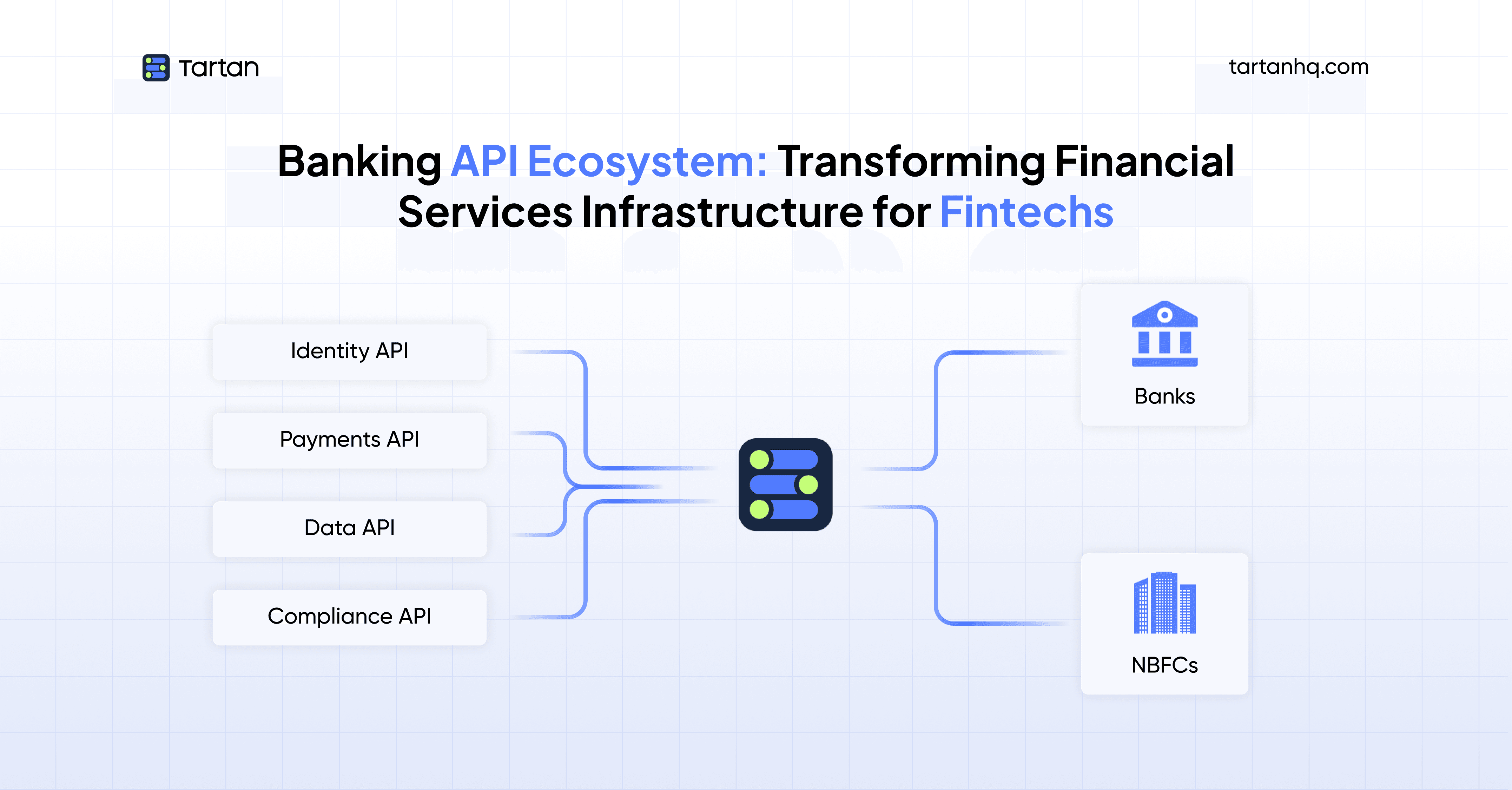
The Infrastructure Gap Holding Back Financial Innovation
Financial institutions across India - from traditional banks to NBFCs and digital-first fintechs - face a fundamental challenge: their ability to innovate and compete is constrained by legacy infrastructure that was never designed for today's digital-first, real-time operational requirements.
Banks operate core banking systems built decades ago that struggle to support modern customer experiences. NBFCs rely on third-party service providers for basic functions like account opening and payments, creating dependencies that slow product launches and increase costs. Fintechs build innovative products but lack the underlying banking infrastructure to deliver them at scale without partnering with traditional institutions.
The result is a fragmented ecosystem where even basic operations - KYC verification, account opening, loan disbursement, payment processing, collections - require manual intervention, take days instead of minutes, and create friction that drives customers to competitors offering seamless digital experiences.
Banking APIs are changing this dynamic by providing the infrastructure layer that connects financial institutions to the services they need to compete effectively in modern markets.
What Banking APIs Actually Enable
Banking APIs are not simply technical integrations. They represent a fundamental shift in how financial services infrastructure works - from monolithic, proprietary systems to modular, composable capabilities that can be assembled rapidly to meet specific business needs.
The Core Banking API Stack
Identity and Verification APIs
These APIs handle the foundational requirements of customer onboarding and ongoing identity verification. Rather than building verification systems internally or managing relationships with dozens of data providers, financial institutions access unified APIs that connect to authoritative data sources.
Key capabilities include:
PAN verification against IT department records
Voter ID, driving license, and passport verification
Video KYC orchestration with liveness detection and fraud prevention
Document verification using OCR and AI-powered validation
Corporate KYC with company registration, GST, and director verification
Ongoing monitoring for blacklist screening and regulatory compliance
What this means operationally: Customer onboarding that previously took 3-5 days with multiple manual touchpoints now completes in under 5 minutes with straight-through processing. KYC costs drop from ₹200-300 per customer to ₹15-25. False rejection rates fall dramatically as automated systems eliminate human error in document review.
Account Infrastructure APIs
These APIs provide the underlying account infrastructure that financial institutions need to offer banking services without building entire banking systems themselves.
Core capabilities:
Virtual account creation with unique identifiers for payment tracking and reconciliation
Savings account opening with regulatory compliance and account management
Current account creation for business customers with flexible fee structures
Escrow account setup for marketplace and platform businesses
Multi-currency accounts for cross-border transactions
Prepaid instrument issuance for wallet and card programs
What this means operationally: NBFCs can offer full-featured savings accounts to customers without becoming banks. Fintechs can launch new products with dedicated account infrastructure in weeks rather than years. Banks can white-label account opening capabilities to partners through APIs rather than building custom integrations for each relationship.
Payment and Transaction APIs
These APIs enable the movement of money across the financial system through multiple payment rails and channels.
Payment capabilities:
UPI payment initiation and collection
IMPS, NEFT, and RTGS transfers
Card payment processing and settlement
Mandate management for recurring payments
Virtual card issuance for digital transactions
QR code generation and payment acceptance
Payout orchestration across beneficiary types
International payment processing
What this means operationally: Loan disbursements that used to require cheque printing or manual NEFT processing now complete instantly via API-triggered transfers. Collections through UPI autopay have success rates 3-4x higher than NACH mandates. Payment reconciliation happens in real-time rather than through end-of-day batch processes.
Data Access and Aggregation APIs
These APIs provide secure access to customer financial data across institutions with customer consent, enabling better underwriting, personalization, and service delivery.
Data capabilities:
Bank statement analysis and cash flow assessment
Credit bureau data retrieval and score monitoring
GST return analysis for business credit assessment
ITR verification and income assessment
Utility and telecom payment history
What this means operationally: Credit decisions based on comprehensive financial data rather than limited bureau scores. Loan applications that complete in minutes because income verification is automated. Fraud prevention through cross-verification across multiple data sources. Personalized product recommendations based on actual financial behavior.
Lending Infrastructure APIs
These APIs provide the operational backbone for lending businesses, from origination through collections.
Lending capabilities:
Credit scoring and risk assessment using alternative data
Loan origination workflow orchestration
Documentation generation and e-signature collection
Disbursement to multiple beneficiary types
Repayment collection and mandate management
Portfolio monitoring and early warning systems
Collections automation and communication
Loan account servicing and modification
What this means operationally: Complete lending operations deployable without building core lending systems. Faster time-to-market for new loan products. Lower operational costs through automation of manual processes. Better portfolio performance through data-driven collections and monitoring.
Compliance and Regulatory APIs
These APIs handle the complex and constantly evolving compliance requirements that all financial institutions must navigate.
Compliance capabilities:
AML screening against global watchlists and PEP databases
Transaction monitoring for suspicious activity detection
Regulatory reporting automation for RBI, SEBI, and other regulators
Audit trail creation and maintenance
Customer due diligence workflows
Sanction screening for international transactions
Geographic risk assessment
What this means operationally: Compliance that scales automatically as the business grows. Reduced risk of regulatory violations through automated monitoring. Lower compliance costs through shared infrastructure rather than proprietary builds. Faster response to regulatory changes as API providers update centrally.
Why This Architecture Matters for Different Institution Types
For Traditional Banks: Modernization Without Migration
Banks face a unique challenge. They have massive customer bases, established brand trust, and regulatory licenses that newer entrants lack. But they also have core banking systems that are 20-30 years old, making it difficult to launch new products quickly, serve customers through modern digital channels, or compete with nimbler fintechs on customer experience.
Complete core banking replacement is enormously expensive (often ₹500 crore+ for large banks) and risky. Most such projects run years over schedule and billions over budget. Banking APIs offer an alternative path.
The API-First Modernization Approach
Rather than replacing core systems immediately, banks can use APIs to:
Build modern digital experiences on top of legacy cores. Customer-facing applications connect through APIs that translate between modern interfaces and legacy systems. Customers get contemporary experiences while the bank avoids risky core replacements.
Launch new products outside the core system. New lending products, savings accounts, investment offerings, and payment solutions can be built on modern API-based infrastructure while the legacy core continues handling existing products. This enables faster innovation without waiting for core system upgrades.
Extend capabilities through partnerships. Rather than building every capability internally, banks can integrate best-in-class services from specialist providers through APIs. This could include advanced fraud detection, alternative credit scoring, document verification, or collections optimization.
Create new revenue streams through Banking-as-a-Service. Banks can expose their own capabilities - account opening, payment processing, regulatory licenses - through APIs that fintechs and other partners consume. This transforms infrastructure from cost center to revenue generator.
Operational Impact for Banks:
A mid-sized private bank integrated banking APIs to launch a digital lending product for MSME customers. Previously, launching new products required 12-18 months of core system development and extensive IT resources.
Using APIs for KYC, bank statement analysis, credit scoring, disbursement, and collections, they launched in 4 months with minimal IT involvement. The product originated ₹450 crore in loans in its first year with processing costs 68% lower than their traditional branch-based business loans.
A public sector bank used APIs to offer co-branded credit cards with ecommerce and fintech partners. Rather than building custom integrations for each partner - which previously took 8-12 months per partnership - they created a standardized API interface that new partners could integrate with in 3-4 weeks. They launched 7 new co-branded programs in 18 months versus their previous capacity of 1-2 programs over the same period.
For NBFCs: Operational Independence and Product Expansion
NBFCs traditionally focus on lending as their core competency, relying on banking partners for account infrastructure, payment processing, and customer fund management. This creates several constraints.
The NBFC Dependency Problem:
Limited product flexibility. NBFCs can only offer products their banking partners support. Want to launch a new savings account product? Need partner approval and development time.
High operational costs. Banking partners charge for every transaction, account maintenance, and service. These costs scale linearly with volume, making unit economics challenging.
Customer experience compromises. The NBFC brand appears in loan products, but customers interact with partner bank brands for accounts and payments. This creates fragmented experiences and weakens brand identity.
Slow innovation cycles. New product launches require partner bank coordination, development, testing, and deployment. Timeline is controlled by partner priorities, not NBFC needs.
How Banking APIs Transform NBFC Operations:
Direct account infrastructure control. NBFCs can offer savings accounts, current accounts, and payment instruments directly to customers under their own brand without becoming banks. APIs connect to regulated banking infrastructure in the background while the NBFC controls product features, pricing, and customer experience.
Programmatic payment capabilities. Loan disbursements, refunds, and outgoing payments execute through APIs instantly without manual intervention or banking partner involvement. Incoming collections flow directly into NBFC-controlled accounts with real-time reconciliation.
Lower transaction costs. API-based infrastructure typically costs 60-75% less than traditional banking partner fees. For high-volume NBFCs, this represents millions in annual savings that flow directly to margins.
Product launch velocity. New products deploy in weeks rather than quarters because NBFCs don't need partner bank development cycles. This enables rapid testing, iteration, and market responsiveness.
Complete data ownership. All customer interactions, transactions, and behavioral data belong to the NBFC rather than being fragmented across partner systems. This enables better analytics, personalization, and customer intelligence.
Operational Impact for NBFCs:
A consumer lending NBFC integrated account infrastructure APIs to launch a savings account product for loan customers. Previously, customers received loan disbursements to external bank accounts, creating reconciliation challenges and limiting relationship depth.
With API-based savings accounts, the NBFC now disburses loans directly to customer accounts within their app, customers use the account for daily banking, and loan repayments auto-debit from the same account.
Result: Repayment success rates improved from 87% to 96%, customer engagement increased 4x, and the NBFC cross-sold insurance and investment products to 34% of loan customers through the expanded relationship.
A vehicle financing NBFC used payment APIs to transform their collections operations. Previously, they relied on NACH mandates that had 40% failure rates and required 8-12 days for setup. After implementing UPI autopay through APIs, mandate setup dropped to real-time, success rates improved to 89%, and collection costs fell by ₹42 per transaction.
For 15,000 monthly disbursements, this represented ₹6.3 lakh in monthly savings plus significant improvement in cash flow predictability.
For Fintechs: Banking Infrastructure Without Banking Licenses
Fintechs build innovative products and exceptional customer experiences, but they lack the fundamental infrastructure to deliver banking services. Getting a banking license requires years, enormous capital, and operational complexity that most fintechs cannot or should not pursue.
The Fintech Infrastructure Challenge:
No ability to hold customer funds. Fintechs cannot accept deposits, hold money in customer accounts, or provide banking services without a license or banking partner.
Dependence on banking partners. Every fintech needs relationships with traditional banks or NBFCs to provide underlying infrastructure. These relationships are expensive to establish, limited in scope, and create vendor risk.
Delayed market entry. Building partnerships, integrations, and infrastructure can take 12-24 months before the first product launches. In fast-moving markets, this delay can be fatal.
Limited differentiation. When multiple fintechs use the same banking partner infrastructure, they compete primarily on user experience with limited ability to differentiate on product features, pricing, or capabilities.
How Banking APIs Enable Fintech Innovation:
Infrastructure on demand. Fintechs access complete banking infrastructure through APIs without building it themselves or navigating complex partnerships. Accounts, payments, cards, and regulatory compliance are available through documented APIs that developers can integrate in weeks.
Rapid experimentation. New product ideas can be tested in market quickly because infrastructure is already available. Failed experiments don't leave behind expensive legacy systems or partnership contracts.
Market entry speed. Fintechs can launch from concept to live product in 6-10 weeks rather than 12-24 months. This speed is often the difference between capturing market opportunities and arriving too late.
Product differentiation. APIs provide building blocks that fintechs can assemble in unique ways. Rather than offering commoditized products, fintechs create differentiated experiences by combining infrastructure components in novel configurations.
Global scalability. Banking API platforms increasingly support multiple markets through unified interfaces. A fintech proven in India can expand to Southeast Asia or Africa by switching API endpoints rather than rebuilding entirely.
Operational Impact for Fintechs:
A B2B payments fintech launched a working capital product for small businesses using banking APIs for account creation, payment processing, and lending infrastructure. Their previous approach required partnerships with two banks and one NBFC, taking 16 months to establish and limiting them to pre-defined product features.
With APIs, they launched a differentiated product in 9 weeks that offered instant credit lines with repayment tied directly to incoming business payments - a feature impossible with their previous infrastructure. They processed ₹340 crore in working capital in their first year with gross margins 28 percentage points higher than if using traditional partner infrastructure.
A wealth management fintech used banking APIs to offer goal-based savings accounts with automated investment sweeps. Customers maintain savings accounts for emergency funds, short-term goals, and long-term wealth building, with rules-based transfers moving funds to appropriate investment products automatically. Building this required savings account APIs, payment orchestration APIs, and investment platform integration.
With traditional banking partnerships, this product would have required 18+ months of custom development. Using APIs, they launched in 11 weeks and acquired 45,000 customers in 6 months with 72% still active after 12 months.
Economic Analysis: ROI of Banking API Implementation
Direct Cost Savings
Reduced personnel costs. Manual processes requiring 12-15 FTE can often be automated to 2-3 FTE through API-based straight-through processing. For an NBFC spending ₹1.2 crore annually on onboarding operations, automation through KYC and account opening APIs can reduce this to ₹25-30 lakh - savings of ₹90 lakh annually.
Lower transaction fees. API-based payment infrastructure typically costs 60-75% less than traditional banking partner fees. An NBFC processing 50,000 monthly disbursements at ₹25 per transaction through traditional channels pays ₹12.5 lakh monthly. The same volume through APIs might cost ₹4-5 lakh - monthly savings of ₹7.5-8.5 lakh.
Eliminated reconciliation costs. Real-time API transactions with instant reconciliation eliminate end-of-day and month-end reconciliation processes that can consume 4-6 FTE in finance teams. Annual savings: ₹40-60 lakh.
Reduced fraud and error losses. Automated verification and validation through APIs reduces fraud acceptance rates and operational errors. For a mid-sized lender, this can represent ₹50 lakh to ₹2 crore annually depending on volume and previous error rates.
Revenue Expansion Opportunities
Faster time to market. Launching products 6-9 months faster means capturing market share earlier and generating revenue sooner. For a new product projected to generate ₹10 crore in annual revenue, launching 9 months earlier represents ₹7.5 crore in incremental revenue over the first year.
Higher approval rates. Better data through banking and verification APIs improves credit decisioning, approving more good customers while maintaining risk standards. A lender rejecting 40% of applications due to incomplete data might reduce rejections to 25% with comprehensive alternative data - increasing originations by 20% with no increase in acquisition spend.
Improved customer lifetime value. When financial institutions offer complete product ecosystems (accounts, payments, lending, investments) through integrated experiences, customer retention and cross-sell improve dramatically. A lender whose customers hold only loans might see 35% annual churn. If those same customers also use savings accounts and payment products, churn might drop to 12-15%. The LTV difference on a ₹5 lakh loan customer could be ₹45,000-60,000.
New business models. Banking APIs enable entirely new revenue streams like Banking-as-a-Service partnerships, embedded finance offerings, and platform business models that weren't possible with legacy infrastructure.
Total Economic Impact Example
Mid-sized NBFC implementing comprehensive banking API stack:
Initial investment:
Platform integration and setup: ₹35 lakh
Internal development costs: ₹40 lakh
Compliance and legal: ₹15 lakh
Training and change management: ₹10 lakh
Total: ₹1 crore
Annual ongoing costs:
API platform fees: ₹60 lakh
Maintenance and support: ₹25 lakh
Total: ₹85 lakh per year
Annual benefits:
Personnel cost reduction: ₹1.8 crore
Transaction fee savings: ₹95 lakh
Fraud and error reduction: ₹75 lakh
Faster collections (improved NPAs): ₹1.2 crore
Revenue from new products: ₹3.5 crore
Improved approval rates: ₹2.8 crore
Total: ₹11 crore per year
Net annual benefit: ₹10.15 crore
Payback period: 1.2 months
3-year NPV at 12% discount rate: ₹25.4 crore
These economics explain why API adoption among leading financial institutions is accelerating rapidly.
The Competitive Imperative: Why Waiting Has Costs
Financial services is undergoing fundamental transformation. Institutions that build modern, API-based infrastructure gain compounding advantages over those that delay.
Market share capture in new segments. The NTC borrower segment, gig economy workers, small businesses, and other underserved populations represent growth markets. Institutions with infrastructure to serve these segments profitably are building customer relationships that will persist for decades.
Defensive positioning in traditional segments. Even in traditional banking segments, customer expectations are shaped by digital-first experiences from fintechs and tech companies. Traditional institutions that can't match these experiences lose customers to competitors who can.
Operating leverage and margin expansion. As revenue grows, API-based infrastructure scales at minimal incremental cost. This creates operating leverage that drives margin expansion - something legacy infrastructure cannot deliver.
Optionality for future opportunities. Modern infrastructure creates options to pursue new business models, enter new markets, or launch innovative products as opportunities emerge. Legacy infrastructure limits optionality to what the existing system can support.
Talent attraction and retention. Top technical talent wants to work on modern technology stacks. Institutions running legacy infrastructure struggle to attract developers, data scientists, and product managers who can drive innovation.
The question isn't whether to modernize infrastructure - it's whether to lead the transition or be forced to follow as competitive pressures intensify.
Conclusion: Infrastructure as Strategic Advantage
Banking APIs represent more than technical modernization. They're the foundation for competing effectively in financial services over the next decade.
For banks, APIs provide the path to modernize without the risk and cost of complete core replacement. For NBFCs, they eliminate dependencies and enable product expansion previously available only to banks. For fintechs, they compress time-to-market from years to weeks and enable innovation impossible with legacy infrastructure.
The institutions winning in the market today - whether traditional banks launching digital products, NBFCs expanding beyond lending, or fintechs scaling from startups to major players - are those that have built modern, API-based infrastructure enabling them to move faster, serve customers better, and operate more efficiently than competitors constrained by legacy systems.
The opportunity is clear. The technology is proven. The economic case is compelling. The only question is whether your institution will lead in capturing this opportunity or watch competitors pull ahead while you remain constrained by infrastructure that was never designed for the market you're competing in today.