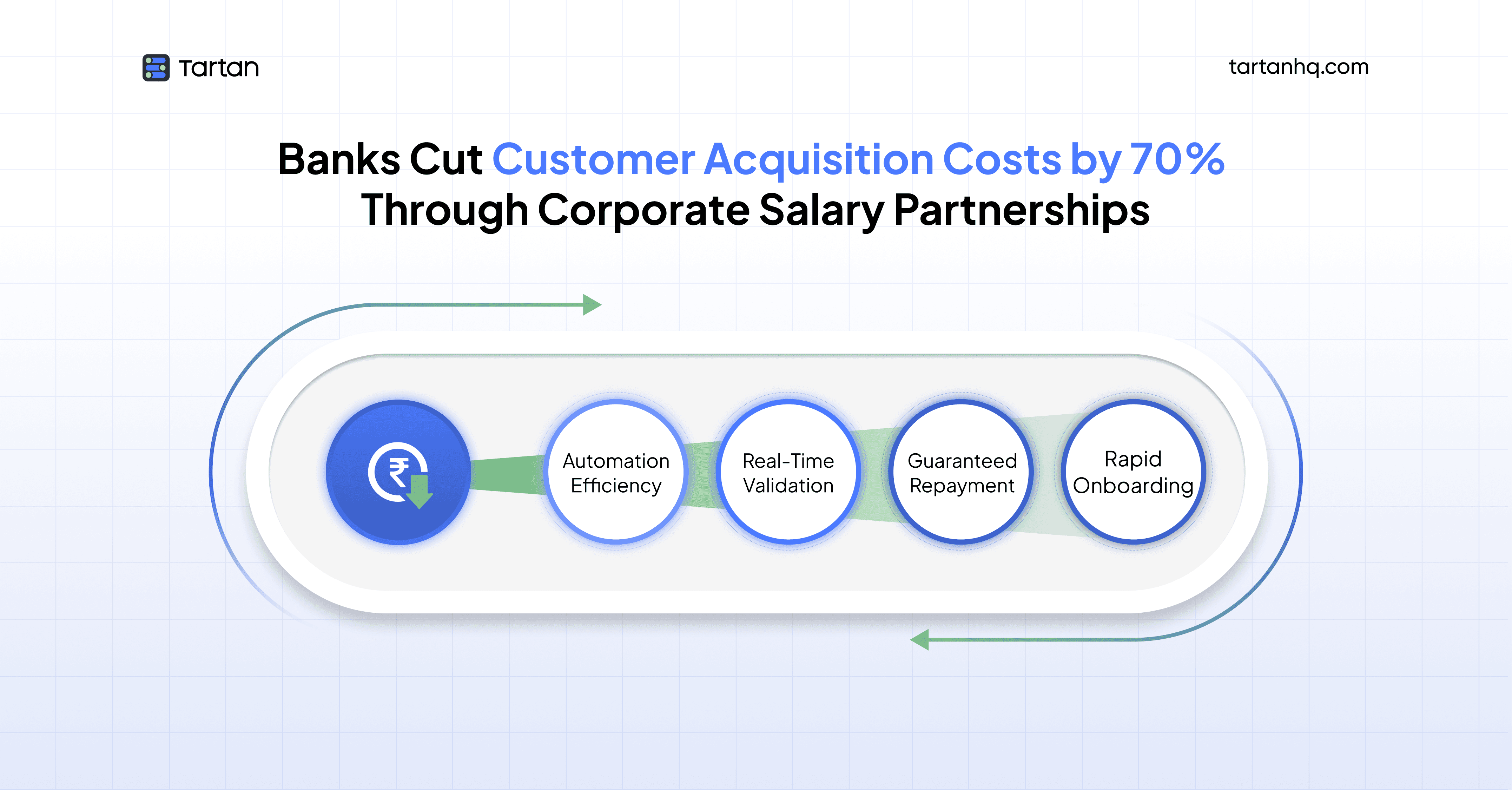
The economics of retail banking customer acquisition have reached a crisis point. Banks spend ₹2,500-4,000 acquiring each corporate salary account customer through traditional channels - relationship manager time, physical forms, manual processing, and weeks of back-and-forth with corporate HR teams. Meanwhile, conversion rates remain stubbornly low, with 25-40% of employees never completing the account opening process.
But there's a bigger problem: even when employees do open accounts, they often use them merely as passthrough vehicles - salary arrives, money immediately transfers to their primary bank elsewhere. The promised CASA deposits never materialize, and cross-sell opportunities evaporate.
This is the corporate salary banking paradox: high acquisition costs, low conversion rates, minimal deposit retention, and limited product penetration. All while the Reserve Bank of India emphasizes the need for "innovative deposit mobilization strategies" and warns about rising credit-to-deposit ratios approaching dangerous levels.
A new approach is changing this equation entirely.
The Traditional Corporate Salary Model is Broken
Consider what happens when a bank signs a corporate salary partnership with a 2,000-employee company today:
Week 1-3: Relationship manager conducts employee awareness sessions at corporate locations. Employees fill out physical forms, submit documents. Forms are couriered to processing centers.
Week 4-6: Manual data entry, verification, account creation. Error rates of 2-5% require multiple correction rounds. Debit cards manufactured and shipped.
Week 7-10: Corporate finance team manually enters new account details into their payroll system. First salary credits happen - often with delays and errors requiring reconciliation.
Total timeline: 10-18 weeks from partnership signing to first salary credit.
Total cost: ₹60,00,000 to acquire 2,000 employee accounts (₹3,000 per account) when fully loaded costs are calculated.
Actual outcome: Only 60-75% of employees complete the process. Of those who do, 40-50% maintain their primary banking relationship elsewhere, immediately transferring salary out. The bank's CASA base grows minimally, and cross-sell opportunities remain unrealized because the bank lacks real-time employment and income data for underwriting.
The B2B2E Distribution Model: A Different Approach
Leading banks are shifting to a B2B2E (Business-to-Business-to-Employee) distribution channel powered by unified API infrastructure that connects directly to corporate HRIS systems.
Here's how it works:
Corporate Partnership Layer: Bank forms partnership with employer and receives authorized, consented access to employee data from the corporate's HRIS platform (Darwinbox, Keka, Workday, SAP SuccessFactors, greytHR, etc.).
Employee Engagement Layer: Employees access a white-labeled financial services platform where they can open accounts, apply for loans, and access credit cards - all with data pre-filled from their employer's HRIS and instant eligibility verification based on real-time salary information.
Automated Integration Layer: Account openings, loan disbursals, and EMI deductions sync automatically with the corporate's payroll system through unified API connections.
The transformation is dramatic:
Timeline: 5-10 days from partnership signing to employees opening accounts (vs. 10-18 weeks)
Cost: ₹1,000 per employee account acquired (vs. ₹3,000)
Conversion: 85-90% of employees complete account opening (vs. 60-75%)
For our 2,000-employee example: ₹20,00,000 total acquisition cost, 1,800 accounts opened, completed in 10 days.
Savings: ₹40,00,000 (67% reduction in CAC)
Four Ways This Changes Banking Economics
Real-Time Underwriting Eliminates the Document Nightmare
Traditional personal loan process:
Customer applies → Bank requests 3 months salary slips, 6 months bank statements, employment letter → Customer downloads/uploads documents → Operations team verifies authenticity → Credit assessment → 5-10 days for approval.
Drop-off rate: 65% of applicants abandon before completing documentation.
New approach powered by HRIS integration: Customer applies → Platform instantly fetches verified salary data, employment tenure, designation, and current employment status from HRIS → Automated underwriting using verified income + credit bureau data → Approval in 2-5 minutes → Disbursal same day.
Conversion rate improvement: From 35% to 70% (doubling loan volumes with the same acquisition spend).
Business impact for a bank processing 10,000 loan applications monthly:
Traditional model: 3,500 loans disbursed
HRIS-integrated model: 7,000 loans disbursed
100% increase in lending volume without increasing marketing spend
CASA Growth Through Payroll Integration
The RBI's concern about "missing CASA" is fundamentally about deposit retention. Banks need stable, low-cost deposits to support lending operations and meet liquidity coverage ratio requirements effective April 2026.
Corporate salary accounts should be perfect for this - guaranteed monthly deposits from payroll. But traditional models fail because employees immediately transfer funds elsewhere.
Unified API infrastructure changes the retention dynamics:
Payroll-Linked EMI Deductions: When employees take personal loans through the platform, EMIs are automatically deducted directly from salary before they receive take-home pay. This keeps funds in the bank's ecosystem rather than requiring transfers from external accounts.
Multi-Product Stickiness: Credit card repayments, insurance premiums, and investment SIPs all tied to the salary account create multiple reasons for maintaining balances.
Predictable Deposit Pipeline: A bank with 50 corporate partnerships averaging 1,000 employees each = 50,000 salary accounts × ₹50,000 monthly salary credit = ₹250 crore monthly CASA inflow.
At 30% average balance retention (₹15,000 per account), total CASA base: ₹75 crore of stable, low-cost deposits.
Cross-Sell Powered by Employment Data
Banks traditionally struggle with cross-sell because they lack visibility into customer life events and income changes. By the time they know an employee got promoted or is ready for a home loan, the opportunity has passed.
Real-time HRIS integration enables lifecycle-triggered offers:
Promotion detected (salary increase from ₹40,000 to ₹55,000):
Credit card limit auto-increased
Pre-approved personal loan offer at better rates
Upgrade to premium banking tier
Employment tenure milestones (completing 2 years):
Home loan pre-qualification based on verified 24-month salary history
Wealth management services for high-income segments
Life event detection (dependent added to HRIS):
Joint account offers
Family health insurance
Higher credit limits
Banks using lifecycle marketing see 3-5x higher cross-sell rates compared to generic batch campaigns sent to all customers.
Reduced Default Risk Through Salary Deduction
The biggest risk in unsecured lending is EMI defaults. Traditional lending requires customers to manually transfer EMI each month - creating bounce risk when they don't have sufficient balance or deprioritize the payment.
Payroll-deducted loans change the risk profile fundamentally:
Traditional personal loans: 2-4% default rate Payroll-deducted loans: <0.5% default rate
EMI is deducted directly from salary before the employee receives take-home pay. Zero bounce risk, zero collection costs, zero customer friction.
For bank CFOs, this dramatically improves capital efficiency. Lower defaults mean higher returns on lending assets and ability to offer more competitive interest rates while maintaining margins.
The Technology Foundation: Unified APIs
The enabling technology behind this transformation is unified API infrastructure that connects banks to 100+ HRIS and payroll platforms through a single integration.
The Traditional Integration Problem: If your corporate clients use Darwinbox, Keka, Workday, SAP SuccessFactors, greytHR, Zoho People, and other platforms, you'd traditionally need to build separate custom integrations for each. That's 3-6 months of engineering effort per integration, ongoing maintenance costs when platforms update their APIs, and a scaling bottleneck that limits how many corporate partnerships you can handle.
The Unified API Solution: Integrate once with a unified API platform. Immediately gain access to employee data from 100+ HRIS systems. When a new corporate client using a different HRIS comes along, zero additional integration work required.
The unified API handles:
Authentication across different HRIS platforms
Data normalization (standardizing diverse data formats)
Real-time synchronization (detecting employee status changes, salary updates, terminations)
Bidirectional operations (both reading employee data and writing payroll deductions)
This abstraction layer enables banks to scale corporate partnerships without technical complexity limiting growth.
Why This Matters Now: Market Forces Driving Adoption
Several converging trends make this the right moment for banks to adopt B2B2E distribution:
Regulatory Pressure: RBI's emphasis on deposit mobilization and improving credit-to-deposit ratios. New LCR requirements effective April 2026. Corporate salary partnerships deliver predictable, stable CASA deposits banks desperately need.
Rising Digital Acquisition Costs: CAC through Google, Facebook, and other digital channels increasing 15-20% year-over-year. B2B2E leverages trusted employer relationships, cutting CAC by 60-70%.
Fintech Competition: Digital lenders offering instant loan approvals in minutes. Traditional 5-10 day bank processes can't compete. HRIS-integrated underwriting enables banks to match fintech speed.
Customer Expectations: Salaried employees expect seamless digital experiences - pre-filled forms, instant approvals, no document uploads. Banks that can't deliver lose market share to more modern competitors.
Data Protection Regulations: India's Digital Personal Data Protection Act (DPDP) makes CSV-based salary data sharing risky. API-based access with encryption and audit trails provides compliant alternative.
The Competitive Advantage
Banks implementing B2B2E distribution through unified API platforms are seeing:
Faster Partnership Velocity: Onboarding corporate clients in days instead of months means relationship managers close more partnerships per quarter. A bank that previously onboarded 10 corporate partnerships annually can now handle 30-40.
Higher Employee Lifetime Value: When employees open salary accounts, get instant loan approvals, use integrated credit cards, and have EMIs deducted automatically - all through one platform - they stay with the bank for years. Customer lifetime value increases from ₹25,000-30,000 to ₹80,000-100,000.
Differentiated Positioning: In competitive corporate pitches, the bank that offers "instant account opening in 5 minutes, instant loan approvals, seamless payroll integration" wins over banks still requiring physical forms and 10-week onboarding timelines.
Operational Efficiency: Eliminating manual form processing, document verification, and payroll coordination saves 70-80% of operational costs in corporate salary banking.
The Strategic Question
For Chief Growth Officers and Heads of Retail Banking, the question isn't whether B2B2E distribution will replace traditional corporate salary banking - it's whether your bank will lead this transformation or be forced to catch up when competitors have already captured market share.
The economics are compelling:
60-70% reduction in customer acquisition cost
2x improvement in loan conversion rates
₹75+ crore CASA base from 50,000 salary accounts
3-5x higher cross-sell rates through lifecycle marketing
Sub-0.5% default rates on payroll-deducted loans
The technology is mature:
Unified API platforms support 100+ HRIS systems
Integration timelines of 8-12 weeks
Enterprise-grade security and compliance built-in
The market is moving:
Fintech lenders already using instant, data-driven underwriting
Corporate employees demanding digital-first experiences
RBI pushing banks toward innovative deposit mobilization
Banks that adopt B2B2E distribution through unified API infrastructure are building sustainable competitive advantages in customer acquisition efficiency, CASA deposit growth, and lending profitability that will compound over years.
The corporate salary banking channel has always promised high-quality customers with stable income and predictable deposits. Now, for the first time, the technology exists to deliver on that promise - at scale, with efficiency, and with economics that transform it from an expensive acquisition channel into a profit engine.
The future of corporate salary banking is B2B2E. The only question is: will you lead it or follow it?