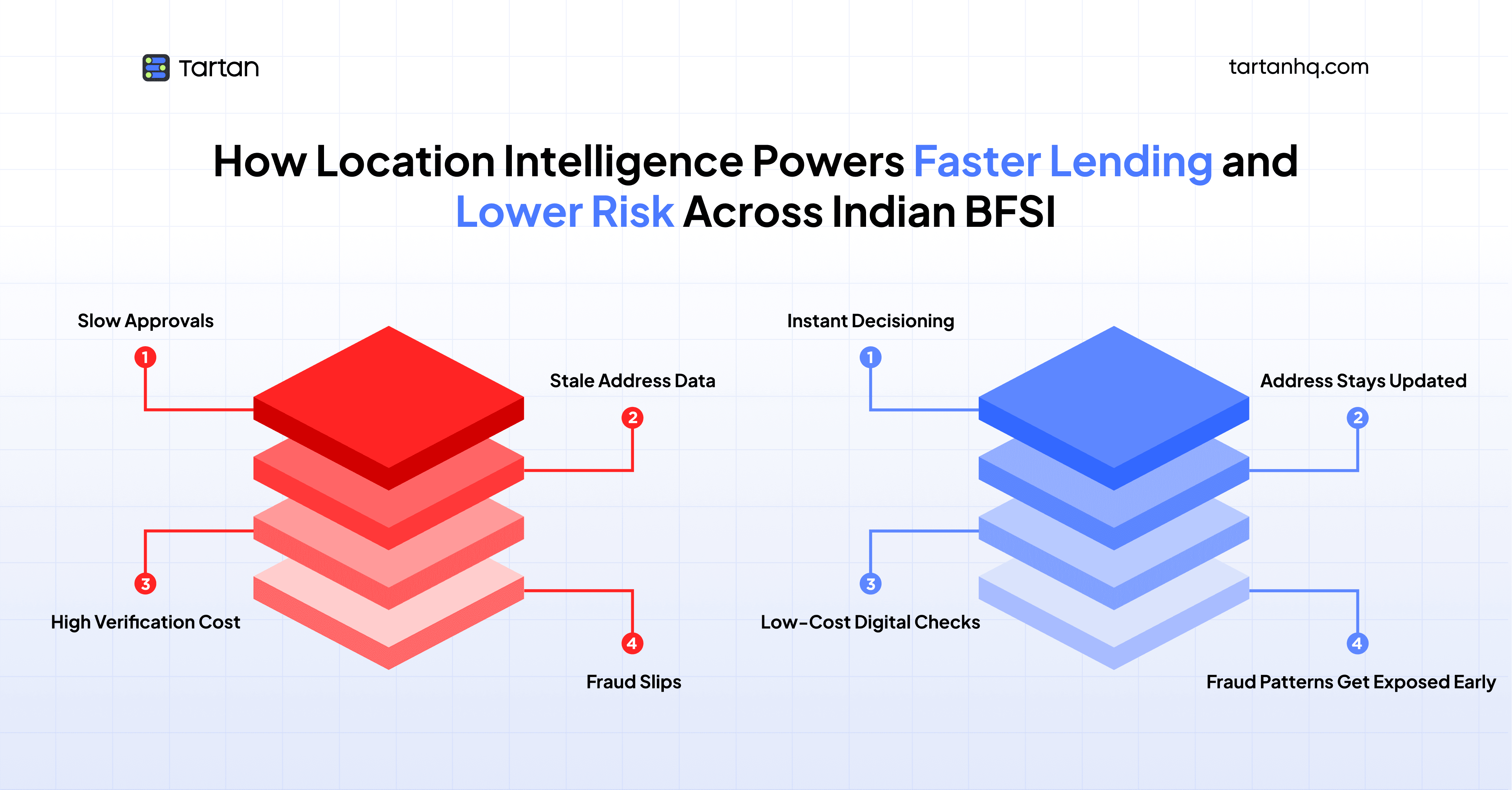
Indian lenders face a paradox: digital lending is exploding, but verification infrastructure hasn't kept pace.
A customer applies for a personal loan on their phone. The application takes 3 minutes. But behind the scenes, the lender spends days - sometimes weeks - verifying basic facts: Does this person live where they claim? Is this address genuine or a temporary rental used to game the system? Has anyone at this location defaulted before?
Meanwhile, the customer has already applied to three other lenders. Whoever approves first wins the business.
This isn't a technology problem. It's a data infrastructure problem.
And location-based intelligence is emerging as the missing layer that separates lenders who can underwrite in minutes from those still drowning in manual verification queues.
This article breaks down how Indian banks, NBFCs, and fintechs are using geospatial data and address verification APIs to cut approval times, reduce fraud, and build lending products that weren't economically viable when verification took days.
The Real Cost of Slow Address Verification
Let's start with what's actually happening when a customer submits a loan application.
Traditional verification workflow:
Customer enters address manually (often with typos, abbreviations, incomplete details)
Lender sends the address to a field verification agency
Agent schedules a physical visit (3-7 day wait)
Agent travels to location, takes photos, fills forms
Report comes back to credit team for review
If address is unclear or agent couldn't verify, the loop repeats
What this costs lenders:
Lost conversions: High-intent borrowers don't wait a week. They move to faster competitors or abandon the process entirely
Operational expense: Field verification costs ₹200-500 per case (presuming no cost inflation). For a lender processing 10,000 applications monthly, that's ₹20-50 lakhs in recurring costs
Fraud exposure: By the time physical verification happens, fraudsters have already submitted applications across multiple lenders using the same fake address
Portfolio risk: Addresses verified once during origination go stale. Customers move, circumstances change, but the lender's records don't update
The result? Credit decisions based on incomplete information, high customer drop-off, and verification costs that scale linearly with volume.
Why Address Verification Matters More in India
Indian lending has unique challenges that make address verification exponentially harder than developed markets:
Address standardization doesn't exist
There's no single "correct" format. The same location might be written as:
"Flat 203, Tower B, Prestige Gardens, Whitefield, Bangalore"
"203-B Prestige Gdns Whitefield BLR"
"Tower B 203, Prestige, ITPL Road"
Traditional systems can't reconcile these as the same address. Fraud detection fails. Duplicate checks miss obvious patterns.
Rapid urbanization creates address volatility
New buildings, renumbered streets, informal settlements, PG accommodations - addresses in Tier 2 and Tier 3 cities change faster than official records update. A customer's "permanent address" from 6 months ago might not exist anymore.
High rental mobility in metros
Young professionals in Bangalore, Pune, Mumbai, and Gurgaon change addresses every 12-18 months. The address verified during loan origination is often outdated before the first EMI is due.
Intentional obfuscation for fraud
Organized fraud rings use temporary addresses, co-working spaces, or shell locations to create multiple loan identities. Without real-time intelligence, lenders only discover the fraud after default.
These aren't edge cases. They're the baseline reality of underwriting in India. And legacy verification - physical visits, manual data entry, static address databases - can't keep up.
How Location Intelligence Changes the Economics of Lending
Location-based intelligence replaces the "send an agent to check" model with real-time data signals pulled from digital footprints.
Instead of asking "Can someone physically confirm this address exists?", location intelligence asks:
Has this address been used for recent e-commerce deliveries?
Are there active mobile connections or digital services associated with this location?
What's the historical activity pattern at this address - residential stability or high churn?
Do multiple loan applicants share suspiciously similar address patterns?
Is this a known fraud hotspot based on past default data?
This shift - from physical verification to digital signals - unlocks three core advantages:
Instant Verification at Application Time
When a customer submits their address during application, the lender can validate it in real-time:
Scenario: Personal loan application on a fintech app
Customer enters: "A-204, Sobha Dream Acres, Balagere Road, Bangalore 560087"
Behind the scenes, the system checks:
Is this a valid, deliverable address? (Not a typo, PO Box, or incomplete entry)
Is it residential or commercial? (Helps detect business loans disguised as personal loans)
Has this address received e-commerce deliveries in the last 6-9 months? (Proves recent occupancy)
Does the phone number match historical delivery records at this location? (Confirms the applicant actually lives there)
Result: Instead of waiting 5 days for field verification, the lender knows within seconds whether the address is genuine, active, and associated with the applicant.
Impact on conversion:
Digital lenders using instant address validation report 25-35% reduction in drop-off during application. Customers who get instant approvals don't shop around. They accept the offer.
Fraud Detection Through Pattern Recognition
Fraudsters rely on lenders processing applications in isolation. If you're only looking at one application, a fake address looks plausible. But when you analyze address patterns across your portfolio and external data sources, fraud becomes visible.
Red flags location intelligence can surface:
Multiple applicants, same address
Ten loan applications in three months, all listing "Flat 12B, Vaishali Apartments." Different names, different phone numbers, but same address. Without geospatial analysis, each application looks clean. With it, the pattern screams fraud ring.
Address activity mismatches
Applicant claims they've lived at an address for 2 years, but e-commerce delivery data shows zero activity in the last 18 months. Either they're lying about residence, or the address is a drop point, not a home.
Known fraud zones
Certain localities develop reputations - fraudsters cluster in areas where enforcement is weak or documentation is lax. Location intelligence can flag applications from these zones for enhanced scrutiny without rejecting legitimate customers.
Sudden address churn
A residential building that historically housed stable, long-term residents suddenly shows 15 new loan applicants in a month, all claiming recent move-ins. Could be legitimate. Or could be a compromised building being used for synthetic identity fraud.
Impact on fraud losses:
NBFCs using geospatial fraud detection report 15-20% reduction in early payment defaults (EPD) from first-time borrowers - the segment most vulnerable to identity fraud.
Portfolio-Level Risk Intelligence
Address verification isn't just about individual applications. It's about understanding geographic risk concentration across your lending book.
Use case: Managing collection efficiency
A regional NBFC has ₹500 crore in personal loans across Karnataka. Their collection team is spread thin, and default rates vary wildly by geography.
With location intelligence, they can:
Identify high-risk clusters
Geocode every borrower's address and overlay it with default data. Suddenly, patterns emerge: defaults are concentrated in three specific neighborhoods in Hubli, two localities in Belgaum, and scattered rural pockets.
Optimize collection routes
Instead of sending agents randomly, the collection team can prioritize routes based on:
Geographic density of overdue accounts
Historical recovery rates by locality
Distance optimization to reduce travel costs
Preempt defaults through early intervention
If a borrower's address shows sudden inactivity (no recent deliveries, mobile location data suggests they've moved), the lender can trigger early outreach before the account goes NPA.
Impact on collections:
Lenders using geocoded portfolio analysis report 10-15% improvement in collection efficiency - more accounts contacted per agent-day, faster resolution of soft defaults.
Real-World Applications Across Indian BFSI
Personal Loan Underwriting (Fintech, NBFCs)
The problem:
High-velocity lending (think instant personal loans, salary advances, BNPL) can't afford multi-day verification. But skipping verification invites fraud.
How location intelligence solves it:
Validate address format and deliverability to catch typos and fake addresses before they enter the system
Cross-check address against e-commerce activity to confirm recent occupancy (if someone's ordering groceries to that address, they live there)
Match phone number to address history to detect mismatches (applying with a Mumbai address but phone records show consistent Pune location data)
Outcome:
Instant decisioning without sacrificing fraud controls. Fintechs can approve loans in under 10 minutes while maintaining fraud rates under 2%.
Home Loan Origination (Banks, Housing Finance Companies)
The problem:
Home loans are high-ticket, documentation-heavy products. Customers expect branch service, but verification delays stretch timelines to 30-45 days.
How location intelligence solves it:
Verify property address accuracy before sending surveyors (saves wasted site visits for non-existent or disputed addresses)
Classify property as residential vs. commercial to ensure loan product alignment (residential home loan rates shouldn't apply to commercial property purchases)
Standardize addresses for legal documentation to avoid disputes during property registration
Outcome:
Faster turnaround times (from application to disbursal), fewer errors in legal documentation, reduced surveyor costs from failed site visits.
MSME and Business Lending (Banks, NBFCs)
The problem:
MSME borrowers often operate from unregistered or informal addresses. Field verification is mandatory, but fraud risk is high (fake businesses, shell companies).
How location intelligence solves it:
Verify business address legitimacy through delivery activity (businesses that actually operate receive shipments, supplies, documents)
Detect address reuse patterns (same business address appearing across multiple loan applications from different "companies")
Confirm address matches business vintage claims (applicant says they've operated from this location for 5 years, but address shows zero activity before 18 months ago)
Outcome:
Lower fraud exposure in MSME lending, faster verification for legitimate businesses, better credit decisions based on accurate address intelligence.
Credit Card Issuance (Banks, Fintechs)
The problem:
Credit cards are unsecured products with high fraud risk. Banks need to verify residence without slowing down instant approval experiences.
How location intelligence solves it:
Real-time address validation during digital application (customer enters address on mobile app, system confirms deliverability instantly)
Cross-reference with historical e-commerce and delivery data to confirm the applicant actually uses this address
Flag discrepancies between stated address and mobile location patterns (applying for a card with a Jaipur address but phone data shows they've been in Bangalore for 6 months)
Outcome:
Instant card approvals for low-risk customers, fraud detection before issuance, reduced physical verification costs.
What This Means for Lending Leaders
If you're running credit, risk, or operations at a bank, NBFC, or fintech, consider these questions:
What's your current cost per address verification?
If you're still sending agents for every application, you're spending ₹200-500 per case. At scale, that's crores annually. Location intelligence APIs cost a fraction - often ₹10-30 per verification - and return results in seconds, not days.
How many high-intent customers are you losing to verification delays?
Every day an application sits in "pending field verification" is a day your competitor might approve the same customer. Instant verification isn't a luxury - it's a competitive requirement in digital lending.
What fraud patterns are you missing because you analyze applications in isolation?
Geospatial analysis surfaces fraud rings, address reuse, and synthetic identities that slip past traditional checks. If you're not analyzing address patterns across your portfolio, you're leaving money on the table.
How outdated is your address data?
Verification happens once - at origination. But customers move, circumstances change, addresses go stale. Real-time location intelligence keeps your data current, improving collections and reducing write-offs.
The Shift from Verification to Intelligence
Here's the fundamental change happening in Indian BFSI:
Old model: Address verification is a compliance checkbox. Send an agent, get a report, file it away.
New model: Address data is risk intelligence. It informs credit decisions, fraud detection, collection strategy, and portfolio management.
The lenders winning in India's digital lending boom aren't the ones with the biggest field verification networks. They're the ones who've turned location data into a real-time decision-making layer.
They're underwriting faster. Detecting fraud earlier. Managing collections smarter. And they're doing it all without scaling headcount linearly with loan volume.
That's the promise of location-based intelligence - not better maps, but better lending built on geospatial data infrastructure.
Building for India's Lending Future
India's credit market is expected to grow to $5 trillion by 2030. The lenders who capture that growth won't be the ones still relying on physical verification and manual processes.
They'll be the ones who've built data rails that can:
Verify addresses in real-time, at application
Detect fraud through geospatial pattern recognition
Keep customer data current without manual intervention
Turn location intelligence into portfolio-level risk insights
Location-based intelligence isn't a replacement for underwriting judgment. It's the infrastructure that makes fast, accurate, scalable underwriting possible in a market where addresses are messy, fraud is sophisticated, and customers expect instant decisions.
The question isn't whether to adopt location intelligence. It's whether you can afford not to - while your competitors already are.