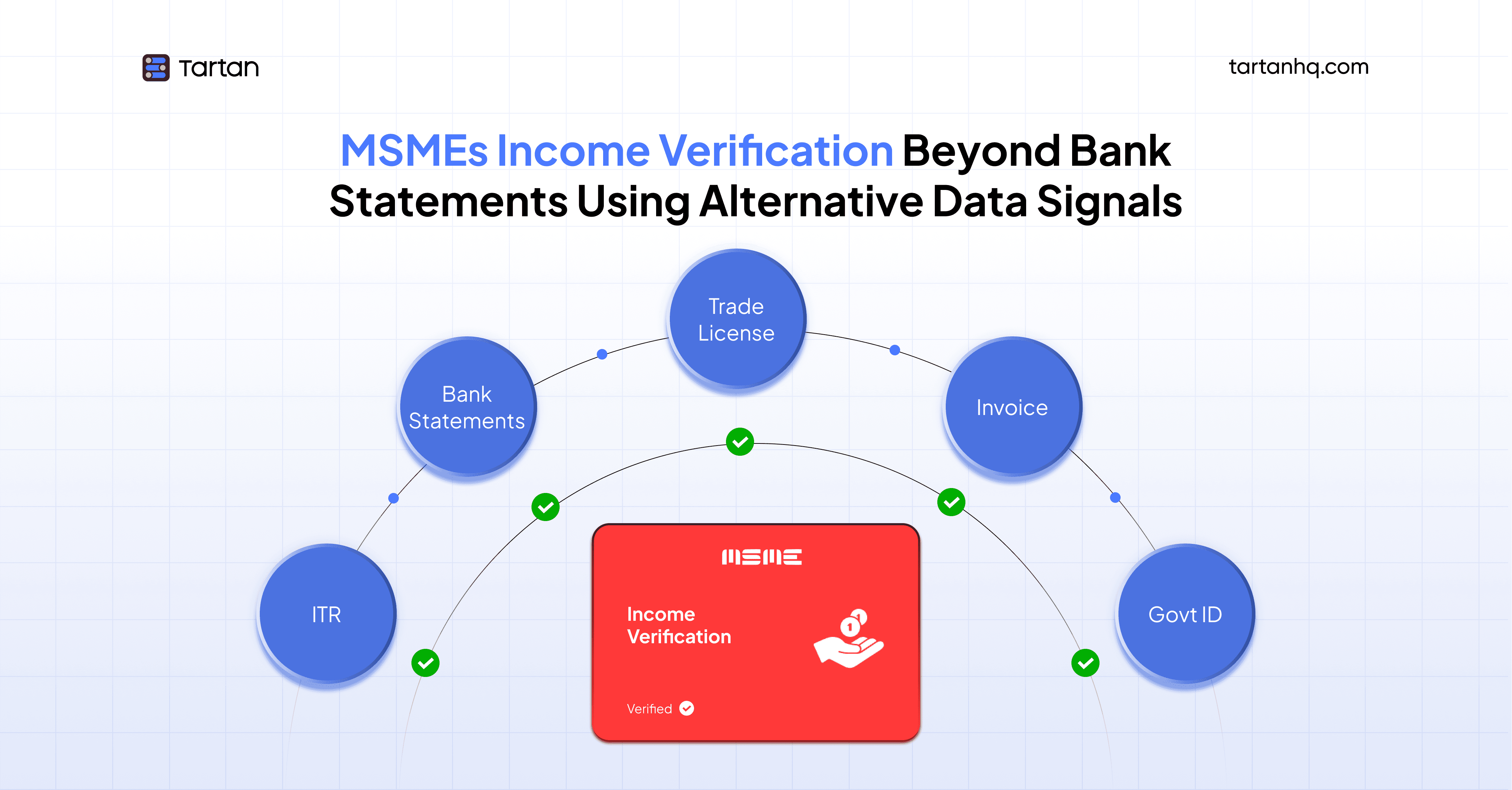
The MSME lending paradox is well-documented: millions of creditworthy small businesses need capital, but traditional underwriting models can't accurately assess their repayment capacity. The core issue isn't that these businesses lack income - it's that their income doesn't show up in the places lenders typically look.
If your underwriting process relies primarily on bank statements to verify business income, you're seeing only a fraction of the financial picture. For cash-heavy businesses, enterprises with multiple payment channels, or companies operating across formal and informal sectors, bank statements miss critical income streams that determine actual repayment capacity.
The question isn't whether these businesses can repay. It's whether your verification infrastructure can see the evidence that they can.
The Bank Statement Blind Spot
Bank statements are the foundation of income verification for good reason. They're standardized, relatively difficult to fabricate at scale, and provide a clear transaction history. But they're also fundamentally incomplete for a significant portion of MSME borrowers.
Consider a small manufacturing unit that receives 40% of payments in cash, 30% through UPI to the proprietor's personal account, and only 30% through business banking channels. Their bank statement shows one-third of their actual revenue. Traditional underwriting would either reject this application or severely underestimate their borrowing capacity.
Or think about a retail business that processes customer payments through multiple aggregators - some settling to the business account, others to linked personal accounts for operational flexibility. The bank statement fragments their income across channels that your verification system may not connect.
The consequences play out in two directions. You reject businesses that could comfortably service debt because their verified income appears insufficient. Or you approve loans based on incomplete income data and miscalculate risk, leading to defaults that were predictable with complete information.
Neither outcome serves your portfolio performance, and both stem from the same root cause: relying on a single data source that wasn't designed to capture the full complexity of MSME financial operations.
What Alternative Data Sources Reveal
Alternative data doesn't replace bank statements. It completes them. The goal is building a comprehensive income picture by triangulating multiple signals that, together, reveal repayment capacity that single-source verification misses.
GST returns provide revenue validation at scale. Every GST-registered business files returns that disclose turnover, input credits, and output liability. This data reveals business activity patterns, revenue trends, and transaction volumes that bank statements may not capture, especially when businesses maintain multiple bank accounts or receive significant cash payments.
The value isn't just in the headline revenue number. GST filing patterns tell you about business consistency. Regular, timely filings suggest operational discipline. Growing turnover indicates business trajectory. Stable input-output ratios point to established business models rather than speculative ventures.
Trade license and professional registrations confirm operational legitimacy. These don't directly verify income, but they corroborate that the business operates in the capacity it claims. A restaurant with a valid FSSAI license, a medical practice with proper registrations, or a transport business with commercial vehicle documentation - these signals add credibility to income claims by confirming the business infrastructure exists to generate stated revenue.
Utility payments demonstrate operational scale. Electricity consumption patterns correlate with manufacturing output. Commercial rent payments indicate business footprint. These aren't income verification in the traditional sense, but they're powerful corroborating signals. A business claiming ₹10 lakh monthly revenue but showing electricity bills suggesting minimal operations deserves scrutiny.
Invoice and receivables data from accounting systems provide transaction-level visibility into business operations. For B2B businesses, verified invoices to established clients offer concrete evidence of revenue streams. Receivables aging shows whether the business generates sales but struggles with collections - crucial context for assessing cash flow capacity.
Payment gateway and aggregator data capture digital transactions that may not immediately appear in business bank statements. For businesses accepting customer payments through UPI, cards, or e-commerce platforms, transaction data from these channels fills gaps that traditional bank statement analysis misses entirely.
Supplier payment history reveals operational consistency from another angle. Regular payments to established suppliers indicate steady business activity. The ability to maintain vendor relationships suggests cash flow stability, even if that cash flow doesn't route entirely through visible banking channels.
The power of alternative data emerges when you stop viewing these sources as substitutes and start treating them as pieces of a puzzle. No single alternative data point definitively proves income. But when GST returns, utility payments, invoice data, and bank statements all tell the same story, confidence in income assessment increases dramatically.
Building Income Verification Frameworks That Work
Effective alternative data verification requires structured frameworks rather than ad-hoc checks. The businesses succeeding in MSME lending are building systematic approaches to income triangulation.
Start with data availability mapping. Not every alternative data source applies to every business type. Manufacturing units generate utility data patterns that service businesses don't. B2B companies have invoice trails that retail businesses lack. Your verification framework should adapt to business models rather than forcing every applicant through identical checks.
Map which data sources are relevant for different business categories, then build verification workflows that automatically request appropriate data based on the applicant's business type. A restaurant doesn't need the same verification as a software consultancy, and your system should reflect that intelligence.
Establish data quality thresholds. Alternative data is only valuable if it's reliable. Define minimum standards for data freshness, completeness, and verifiability. GST returns from six months ago provide historical context but don't confirm current income. Invoice data without verification of the billed party's legitimacy could be fabricated.
Set clear parameters: GST data within the last quarter, bank statements covering at least six months, utility records showing consistent patterns, invoices to verified business entities. These thresholds ensure alternative data actually strengthens underwriting rather than introducing new vulnerabilities.
Create income reconciliation models. When you're pulling income signals from multiple sources, you need frameworks for reconciling discrepancies and synthesizing data into actionable underwriting insights.
If bank statements show ₹8 lakh monthly deposits but GST returns indicate ₹15 lakh turnover, that gap needs explanation. It could be legitimate - cash operations, personal account usage, payment gateway settlements. Or it could signal misreporting. Your framework should flag these gaps for review rather than ignoring them or treating them as automatic disqualifiers.
Build models that account for expected variance based on business type. A cash-heavy retail business having 30-40% of revenue outside bank statements is normal. A B2B software company showing the same pattern deserves deeper scrutiny.
Weight data sources appropriately. Not all alternative data carries equal verification value. Bank statements remain the most reliable single source for most business types. GST returns provide strong corroboration but can be delayed. Invoice data is powerful when verified but vulnerable to manipulation without proper checks.
Develop weighting systems that prioritize high-reliability data while using lower-reliability signals for corroboration. The goal is building confidence through multiple weaker signals that support stronger primary evidence, not replacing strong evidence with weaker alternatives.
Automate where possible, review where necessary. Manual income verification from multiple sources doesn't scale. The only viable approach is automated data aggregation with intelligent flagging for manual review.
Modern verification platforms can pull GST data, analyze bank statements, verify invoices, and cross-reference utility records in seconds. They can flag inconsistencies, calculate income estimates from multiple sources, and surface cases where human judgment adds value. This automation maintains speed while adding verification depth.
Practical Implementation Considerations
Moving beyond bank statements requires changes to both technology infrastructure and underwriting processes. The businesses executing this transition successfully are making deliberate choices about implementation.
API-based data aggregation is non-negotiable. Manual collection of alternative data from applicants introduces friction, delays, and verification challenges. API-based systems that pull data directly from authoritative sources - GST networks, banking systems, accounting platforms - maintain speed while ensuring data authenticity.
Evaluate verification platforms based on their data source coverage, API reliability, and ability to handle multiple verification types in parallel. Your underwriting timeline shouldn't expand because you're verifying more comprehensively.
Consent and compliance frameworks need updating. Accessing alternative data sources requires proper consent mechanisms and compliance with data protection regulations. Applicants need to understand what data you're accessing, why you need it, and how it will be used.
Build consent workflows that clearly explain alternative data requirements and provide transparency around verification processes. This isn't just regulatory compliance - it's building trust with applicants who may be unfamiliar with comprehensive income verification.
Credit decisioning models require recalibration. If you're incorporating alternative data into income verification, your credit models need updating to properly weight these inputs. Historical models built entirely on bank statement analysis won't automatically know how to interpret GST return patterns or invoice data.
This might mean developing new scorecards, adjusting existing models, or building parallel decisioning frameworks for different business segments. The data science work isn't optional - alternative data without proper analytical frameworks creates noise instead of insight.
Portfolio monitoring extends to alternative data. Income verification doesn't end at disbursement. For portfolio health management, ongoing monitoring of alternative data sources provides early warning signals of business deterioration.
Declining GST turnover, irregular utility payments, or deteriorating invoice quality can indicate trouble before it shows up in EMI defaults. Build monitoring systems that track the same alternative data points you used for initial underwriting.
The Competitive Implications
MSME lending markets are increasingly competitive, and verification capability is becoming a key differentiator. Lenders who can accurately assess income for businesses that traditional methods miss are accessing underserved segments with significant growth potential.
The businesses winning in this space aren't just adding alternative data checks to existing processes. They're rebuilding income verification from the ground up around multi-source intelligence. They're approving qualified borrowers that competitors reject due to incomplete income pictures. They're pricing risk more accurately because they understand repayment capacity more completely.
Perhaps most importantly, they're doing this at scale. Manual alternative data verification can't support the volume requirements of digital lending. Automated, intelligent verification that synthesizes multiple data sources in real-time is the only sustainable approach.
Moving Beyond Single-Source Verification
Bank statements will remain central to business income verification, and for good reason. But treating them as sufficient rather than foundational leaves money on the table and risk in your portfolio.
The MSMEs that can't neatly demonstrate income through bank statements aren't necessarily risky - they're just operating in a business environment where income flows through multiple channels. Your verification infrastructure needs to reflect that reality.
Alternative data sources exist. Integration technology is mature. The analytical frameworks for synthesizing multi-source income verification are proven. What's required now is the organizational commitment to move beyond comfortable single-source verification toward comprehensive income assessment.
The question isn't whether alternative data improves MSME underwriting - the evidence is conclusive. The question is how quickly your lending operation can implement verification systems that capture the complete income picture, because your competitors are already building theirs.