

January 16, 2026
5 min
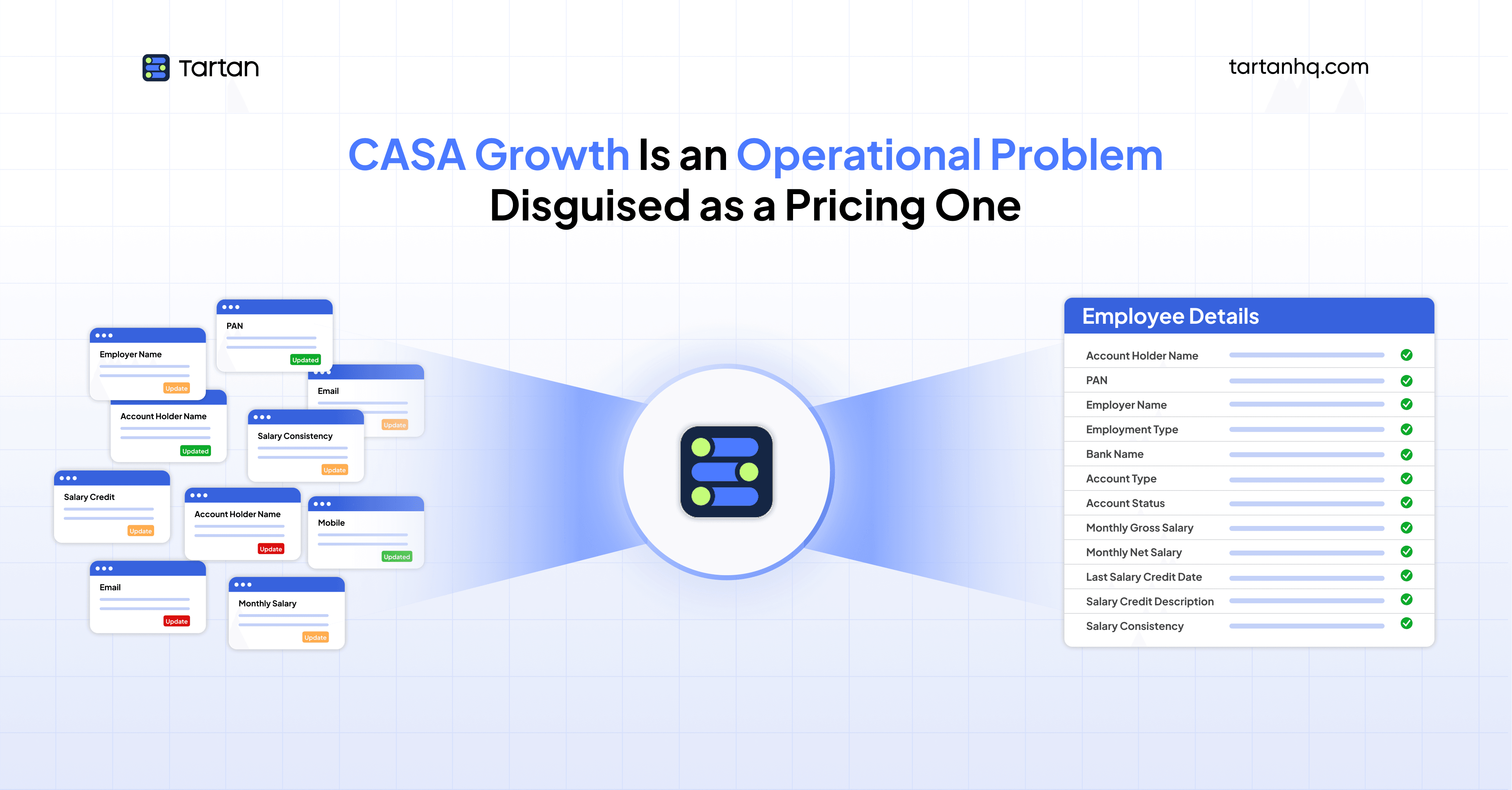
For decades, CASA growth followed a familiar playbook.
Raise savings rates marginally.
Push branches to acquire accounts.
Run periodic campaigns to "activate" balances.
That playbook is breaking down.
Despite aggressive pricing and expanding digital distribution, most banks today are seeing the same pattern: high account acquisition, low balance stickiness, and volatile CASA ratios. The issue isn't effort.
It's relevance.
And relevance, at scale, is no longer created by pricing or channels - it is created by data activation at the right moment.
CASA growth has quietly shifted from being a rate-led problem to an orchestration problem.
Why Pricing and Branch Push Are No Longer Enough
Interest rates still matter - but they are no longer decisive.
Customers today do not choose where to park money purely based on a few basis points. Their balances follow behavioral gravity:
Where income lands
Where bills auto-debit
Where credit, investments, and obligations converge
Where friction is lowest during moments of change
Branches, similarly, have become acquisition points - not balance engines. They can open accounts, but they cannot continuously respond to lifecycle events, cash flow shifts, or employer-linked income dynamics.
A branch can successfully onboard a customer earning ₹12 lakh annually, but it has no mechanism to detect when that same customer receives their first bonus three months later, or when their salary stops hitting the account because they've quietly shifted their primary relationship elsewhere.
The result is a structural gap:
Banks know who the customer is
They often don't know when to act
And CASA is fundamentally a timing game
This gap manifests in familiar patterns. A customer opens a savings account with ₹50,000. The branch celebrates the acquisition. Three months later, the average balance is ₹8,000.
The customer hasn't closed the account - they've simply chosen to keep their money elsewhere. The bank sees the declining balance in monthly reports, but by then the customer has already configured bill payments, investment SIPs, and UPI handles around a different primary account.
The window for intervention closed weeks ago.
CASA Balances Move at Moments, Not Campaigns
CASA growth doesn't happen evenly over time. It spikes around specific moments:
Salary onboarding and first credit
Employer change or role upgrade
Large inflows (bonuses, ESOP liquidity, reimbursements)
New liabilities (home loans, EMIs, dependents)
Business formation or expansion
Dormant-to-active account transitions
Most banks see these events too late, if at all.
A customer receives their first ₹95,000 salary credit on the 1st of the month. This is the single highest-leverage moment for converting a basic account into a primary banking relationship. The customer is making fresh decisions about where to set up auto-debits, where to link investment accounts, which bank's credit card to activate. They're in configuration mode.
By the 15th, those decisions are made. By the 30th, the patterns are set. By the time a relationship manager calls in week six with a "salary account upgrade offer," the customer has already established their banking architecture. The offer isn't wrong - it's late.
Data exists - but it is fragmented:
Employer data sits outside retail systems
Transaction signals are siloed in core or analytics layers
Onboarding and servicing workflows don't talk to activation engines
RM actions are manual, delayed, and inconsistent
CASA is lost not because banks don't have data - but because they cannot unify it fast enough to act.
The same fragmentation repeats across every CASA moment. A customer's transaction pattern shifts dramatically - sustained education-related payments totaling ₹3.2 lakh over 60 days. This signals an active financial need: education financing. But the transaction data lives in the core banking system's logs. The product team running education loan campaigns is working off a quarterly customer list generated by analytics. The relationship manager has no visibility into real-time spending patterns. By the time someone connects these dots, the customer has already arranged financing through a fintech platform that recognized the pattern and responded within 48 hours.
The Real Constraint: Disconnected Data Layers
In many banks, CASA strategy still assumes:
"If we launch the right product and push it hard enough, balances will follow."
But modern CASA growth requires answering harder questions in real time:
Is this customer salaried or self-employed right now?
Has income just started, increased, or stopped?
Is this account becoming the primary transaction hub - or just a pass-through?
Is this employer-linked relationship deepening or weakening?
Which customers are about to receive money - and which are about to move it out?
These questions cut across customer data, employer data, transaction data, and lifecycle events. Traditional systems were not built to reason across all four together.
Consider the complexity of a seemingly simple question: "Which customers should we target for salary account upgrades this month?"
The answer requires:
Customer master data: Account type, current balance, tenure, product holdings
Employment verification data: Current employer, employment status, verification date
Transaction data: Salary credit patterns, amount consistency, credit timing
Employer data: Company size, payroll stability, organizational changes
Behavioral data: Primary account indicators like bill payment setup, UPI usage concentration
In most banks, these data elements live in five different systems with no real-time synchronization. Analytics teams can eventually stitch this together for a quarterly campaign, but they cannot answer it at the moment a salary credit hits. And that moment - those first 24-72 hours after the money arrives - is when the customer is most receptive to engagement.
This is where CASA strategies stall - not at intent, but at execution.
CASA as an Activation Problem
High-performing banks are reframing CASA growth around one core principle:
Balances follow activation, not acquisition.
Activation means:
Triggering the right action
For the right customer
At the right moment
Across the right workflow
Not a generic campaign. Not a static rule. A coordinated response across onboarding, salary credits, servicing, and engagement.
The difference is stark. A generic campaign might identify 50,000 customers who haven't upgraded to salary accounts and send them all the same email on the same day. An activation approach identifies the 127 customers who received their first significant salary credit in the last 48 hours and triggers personalized, context-aware workflows for each - some get in-app nudges, some get RM calls with pre-populated offers, some get automated account upgrades with confirmation flows.
The campaign approach optimizes for volume. The activation approach optimizes for conversion at the moment of maximum receptivity.
This requires a unified data layer that does three things exceptionally well:
Stitches identity across customer, employer, and transaction systems
Detects meaningful lifecycle events in near real time
Triggers downstream actions automatically - without manual intervention
The first capability ensures you know not just who the customer is, but where they are in their employment journey, how their income flows, and what their transaction patterns reveal about their financial life. The second capability shifts from historical reporting to forward-looking event detection - seeing salary credits as they happen, catching balance migration before it completes, identifying life events as transaction patterns shift. The third capability closes the loop - turning insights into actions without requiring manual coordination across teams, systems, and workflows.
Where Tartan HyperSync Changes the Equation
HyperSync is not another analytics dashboard or CRM layer. Its role in CASA growth is more structural.
It acts as a unified activation layer that sits across:
Customer onboarding systems
Employer and payroll integrations
Transaction and account activity
Verification, KYC, and servicing workflows
Instead of data flowing one way into reports, HyperSync allows data to flow into decisions and actions.
1. Onboarding → Immediate CASA Anchoring
When a new customer is onboarded, HyperSync unifies identity, employment context, and account setup in one layer. This enables:
Pre-configured salary account readiness
Automated nudges for primary account designation
Early biller and mandate activation tied to the customer's profile
CASA anchoring begins on Day 1 - not after months of inactivity.
The traditional onboarding flow treats every new savings account the same: collect KYC, verify documents, open account, hand over debit card, send welcome email.
The customer leaves with a generic savings account. Whether they're a salaried professional earning ₹18 lakh annually or a student opening their first account, the initial setup is identical.
HyperSync changes this by bringing employment and income context into the onboarding moment itself. When a customer provides their employment details during account opening, HyperSync can verify the employer in real-time, assess payroll patterns, and pre-configure the account appropriately.
A verified salaried employee doesn't just get a savings account - they get a salary account with pre-approved features, appropriate limits, and relevant product bundling, all configured before they complete the onboarding process.
More importantly, HyperSync enables conditional activation.
If employment verification succeeds, trigger salary account setup.
If the customer's employer is part of a corporate banking relationship, flag for priority RM assignment.
If their stated income matches established payroll patterns, pre-approve credit products. The account isn't just opened - it's anchored to the customer's actual financial context from the first interaction.
2. Salary Credits → Dynamic Balance Capture
The first salary credit is one of the highest-leverage CASA moments. HyperSync allows banks to:
Detect salary inflows as structured events, not just transactions
Trigger contextual actions - sweep rules, savings allocations, relationship manager alerts
Personalize engagement based on income stability and employer signals
Instead of reacting after balances move, banks act as money arrives.
The power here is in event structuring. Most core banking systems see a salary credit as "transaction type: credit, amount: ₹95,000, reference: salary." HyperSync sees it as a lifecycle event with rich context: "first salary credit from verified employer TechCorp, amount consistent with stated income, account age 12 days, customer now qualifies for salary account tier 2, eligible for pre-approved credit card ₹5L limit, high retention probability if activated within 72 hours."
This context enables graduated responses. If it's the first salary credit, trigger onboarding completion workflows and primary account designation nudges. If it's a salary credit from a new employer (employment change detected), trigger relationship deepening offers and update credit risk profiles. If it's a significantly larger salary credit than historical pattern (promotion or bonus), flag for wealth management introduction. If the salary credit amount is declining or irregular, trigger early warning protocols for relationship risk.
The same transaction generates entirely different actions based on customer context, employer signals, and account lifecycle stage. But this only works if salary credits are recognized as events, not just line items in transaction logs.
3. Employer Intelligence → Scaled CASA Depth
Employer-linked data is a blind spot for most retail banks. HyperSync unifies KYB, payroll, and employee lifecycle data to:
Anticipate income changes before they reflect in balances
Coordinate corporate and retail strategies
Identify clusters of high-value CASA potential across organizations
CASA growth stops being one customer at a time - and becomes institutionally scalable.
Consider a mid-sized technology company with 800 employees. The bank has a corporate current account relationship, but only 45 employees bank with them personally. Traditional retail strategy treats each of those 45 as individual customers. HyperSync enables institutional strategy.
When the company processes annual bonuses, HyperSync knows this is happening before the money hits individual accounts. The bank can proactively reach out to those 45 customers with wealth management offers, short-term deposit products, or investment guidance - while the bonus is still pending, not after it's already been deployed elsewhere.
More strategically, the bank can target the other 755 employees with compelling salary account offers, using the credibility of the existing corporate relationship and the timing of a meaningful financial event.
Employer intelligence also reveals organizational changes that impact CASA. If a corporate relationship shows signs of stress - delayed payroll, reduced headcount, financial restructuring - the retail bank can adjust its strategy for employee relationships accordingly.
Conversely, if an employer is expanding rapidly or experiencing liquidity events (funding rounds, acquisitions, IPO), the bank can intensify CASA acquisition and deepening efforts among that employee base.
This shifts CASA growth from individual relationship building to institutional positioning. Instead of acquiring customers one at a time through branches and digital marketing, banks can activate entire employee cohorts at moments of maximum relevance.
4. Lifecycle Events → Continuous Activation
As customers change roles, take loans, start businesses, or shift geographies, HyperSync detects these transitions and:
Reconfigures CASA strategies automatically
Triggers cross-functional workflows (retail, SME, credit)
Prevents balance decay during moments of transition
CASA becomes resilient, not episodic.
Lifecycle transitions are where CASA relationships often break down. A salaried customer leaves their job to start a business. Their regular salary credits stop. The bank sees declining balances and reduced transaction velocity. Without context, the customer gets categorized as "low engagement" or "at-risk." In reality, they've moved from salaried to self-employed - a transition that should trigger entirely different CASA strategies.
HyperSync detects this transition through multiple signals: cessation of regular salary credits, change in employer verification status, shift in transaction patterns toward business-related spending, possible GST registration or business account opening. Rather than treating this as relationship deterioration, the system recognizes it as lifecycle evolution and triggers appropriate workflows.
The customer's retail relationship manager might be alerted: "Customer has transitioned to self-employment, business formation likely, refer to SME banking for current account and business credit assessment." The SME team gets context: "Existing retail customer, historical income ₹14 lakh annually, strong account conduct, early-stage business formation - high potential for business banking relationship."
The same principle applies to other transitions. A customer takes a home loan, signaling long-term geographic stability and increased liability management needs - trigger wealth advisory contact and insurance product bundling.
A customer's transaction pattern shows sudden international spending, indicating possible relocation - proactive outreach to set up NRI banking prevents balance migration. A dormant account suddenly receives a large credit after 18 months of inactivity - instead of generic reactivation campaigns, contextualized engagement based on the source and nature of the credit.
Each transition is a fork in the road. Without real-time detection and coordinated response, customers drift toward whichever bank responds most appropriately to their new context.
With HyperSync, the bank that already has the relationship can respond faster and more accurately than any competitor because they have longitudinal data and the infrastructure to act on it.
CASA growth is no longer a pricing problem. It's a data and activation problem. And the banks that solve for unified data layers, real-time event detection, and automated workflow orchestration will capture a disproportionate share of high-quality CASA deposits - not because they pay more, but because they activate better.
Tartan helps teams integrate, enrich, and validate critical customer data across workflows, not as a one-off step but as an infrastructure layer.