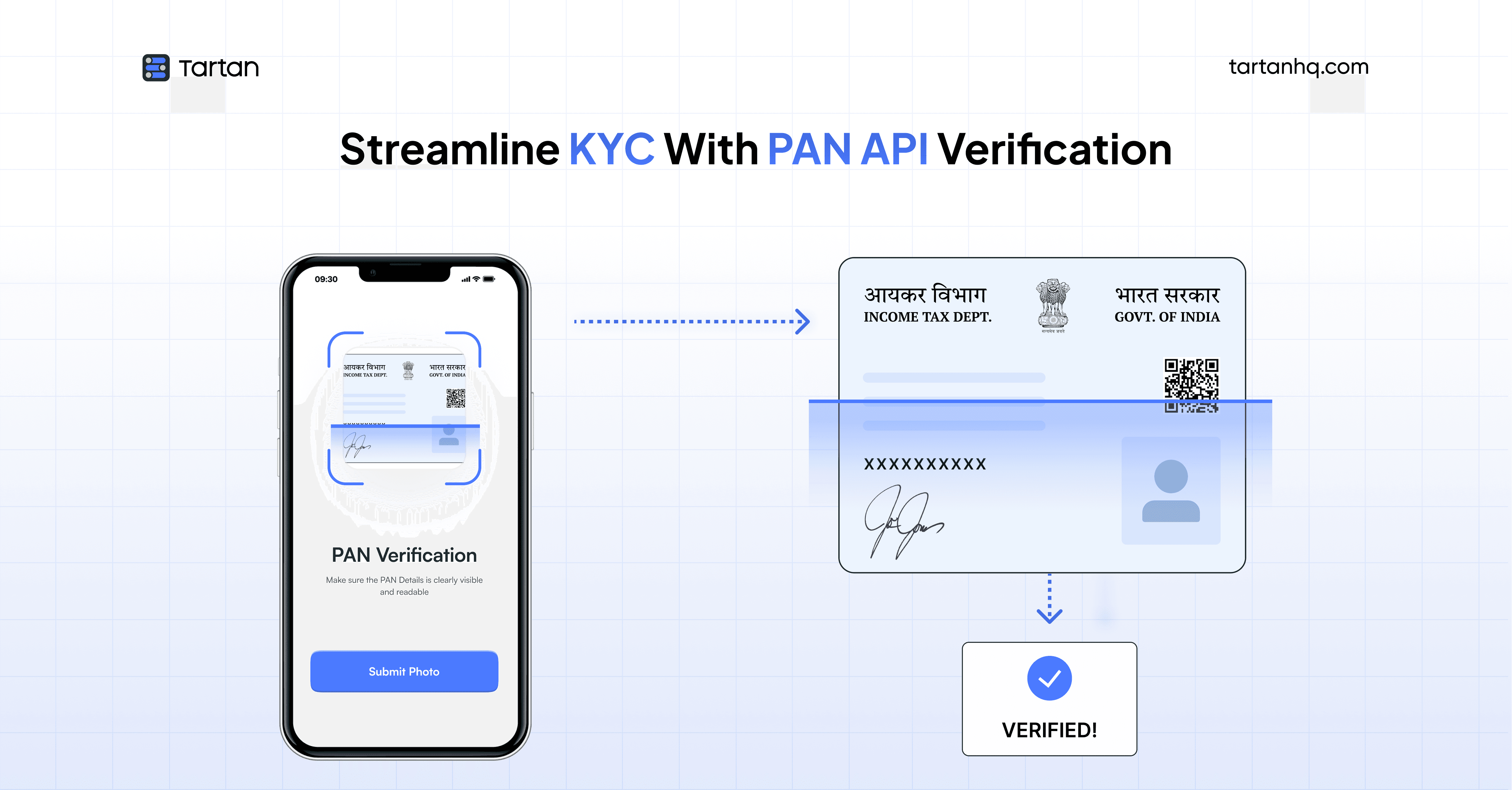
Financial institutions processing thousands of customer applications monthly face a persistent operational challenge: KYC verification remains their most significant onboarding bottleneck. Manual document verification processes that once sufficed for branch-based operations now struggle to support the scale and speed demanded by digital channels.
The cost of this inefficiency is substantial. Industry data reveals the impact:
Manual KYC processes take 3-5 business days on average
Customer drop-off rates reach 40-60% during onboarding
Operations teams must scale linearly with application volume
Each verification requires multiple manual touchpoints and quality checks
For banks, NBFCs, and fintech platforms targeting aggressive growth, these constraints directly impact revenue and market competitiveness.
PAN API verification addresses this operational bottleneck by automating identity validation at the infrastructure level. This guide examines the technical and business case for API-based PAN verification, supported by implementation use cases and quantified outcomes.
Understanding the KYC Verification Bottleneck
Traditional KYC verification creates multiple points of friction in the customer acquisition funnel. The typical workflow involves collecting physical or scanned document copies, manual data entry by operations teams, verification against government databases, quality assurance checks, and final approval routing. Each step introduces latency and error potential.
The regulatory requirement is clear: RBI guidelines mandate PAN verification for financial services onboarding. However, the implementation method significantly impacts both operational efficiency and customer conversion rates.
Organizations operating at scale cannot afford the resource intensity of manual verification while maintaining acceptable turnaround times.
How PAN API Verification Works
PAN API verification replaces manual processes with direct, programmatic access to authoritative data sources. The workflow is straightforward:
Customer enters PAN details through your application interface
System transmits data via secure API to the verification provider
API validates PAN against Income Tax Department records in real-time
System retrieves associated demographic data (name, date of birth)
Verified results return to your application within seconds
This architecture eliminates manual touchpoints while providing higher accuracy than human verification. The API integration sits within your existing technology stack, requiring minimal development effort while delivering immediate operational benefits.
Digital Lending Platform use case context
A digital lending platform processing 15,000 loan applications monthly faced a critical scaling challenge. Their manual KYC process required a 12-person operations team and averaged 48-hour turnaround time. Customer drop-off between application submission and final approval exceeded 55%.
After PAN API verification, the platform can automate the first layer of identity validation - after which the customer applications now triggers instant PAN verification, with results feeding directly into their underwriting workflow.
Measurable Outcomes:
92% reduction in KYC processing time (48 hours to under 4 hours)
60% decrease in operations team requirements
34% improvement in application completion rates
73% reduction in cost per KYC verification
Perhaps most importantly, the platform could now process applications during non-business hours, effectively operating a 24/7 onboarding pipeline without additional staffing costs.
NBFC Scaling Rural Penetration use case context
An NBFC expanding into tier 2 and tier 3 markets will encounter unique verification challenges. Rural customers lack consistent documentation, and field agents would struggle with connectivity issues during in-person verification. The manual process required agents to collect documents, upload them to headquarters, and wait for central verification teams to process applications - a cycle that could take 5-7 days.
Tartan's PAN API verification with offline-first architecture would enable customer PAN detail capture on mobile devices, queue verification requests when connectivity was available, and receive instant validation once online. The API integration included bulk verification capabilities for processing applications collected across multiple branches.
Measurable Outcomes:
Application processing time reduced
Field agent productivity increase
Reduced Error rates in demographic data collection
Improvement in rural customer satisfaction scores
The company also gained unexpected competitive advantage in rural markets, where speed of service became a key differentiator against traditional banking channels.
Neobank Customer Acquisition use case context
A neobank targeting millennial and Gen Z customers builds their entire value proposition around frictionless digital experience. Their manual KYC process, however, contradicts this promise. Customers who expect instant account opening faced multi-day verification delays, creating dissonance between brand positioning and actual experience.
A PAN API as a part of a comprehensive digital KYC stack would enhance the mobile app onboarding flow, allowing real-time validation as customers enter information.
Measurable Outcomes:
Improvement in the Onboarding completion rates
Decrease in customer acquisition cost
Reduced customer queries about verification status
Technical Integration Considerations
Implementing PAN API verification requires attention to several technical factors:
Security and compliance: Encryption in transit and at rest, meeting financial services standards
Performance: Sub-3-second response times for synchronous verification
Reliability: Robust error handling for network failures, invalid entries, and service downtime
Audit requirements: Comprehensive logging for regulatory compliance and dispute resolution
Tartan's API infrastructure addresses these requirements through enterprise-grade architecture, providing 99.9% uptime SLA, sub-2-second average response times, comprehensive webhook support for asynchronous workflows, detailed audit logs with 7-year retention, and sandbox environments for development and testing.
Regulatory Compliance Framework
PAN API verification must operate within RBI's KYC guidelines and data protection regulations. The verification process serves as a valid KYC method under the Master Direction on KYC, provided organizations maintain proper audit trails and data security measures. APIs must source data from authorized repositories to ensure validity.
Organizations should document their API verification process as part of KYC policy documentation, implement appropriate data retention and deletion procedures per regulatory requirements, and maintain audit trails demonstrating compliance with verification standards. Tartan's platform includes built-in compliance features that simplify regulatory adherence while providing the flexibility to adapt to policy changes.
Cost-Benefit Analysis
The financial case for PAN API verification extends beyond direct cost reduction. While organizations typically see 60-80% reduction in per-verification costs, the broader impact includes improved capital efficiency through faster customer onboarding and revenue recognition, reduced opportunity cost from customer drop-offs, lower compliance risk through standardized processes, and enhanced scalability without proportional headcount increases.
A typical financial institution processing 10,000 verifications monthly might spend ₹50-80 per manual verification when accounting for full loaded costs. API verification reduces this to ₹10-15 per check, generating monthly savings of ₹4-7 lakhs while simultaneously improving quality and speed.
Implementation Roadmap with Tartan
Organizations can implement PAN API verification in a phased approach. The initial technical integration typically requires 1-2 weeks for API connectivity, testing, and production deployment. Process redesign then maps existing KYC workflows to the automated model and trains teams on exception handling. Parallel running validates API results against manual processes during a transition period. Finally, full automation transitions all verifications to the API-based system.
Tartan's implementation support includes technical documentation and sandbox access, dedicated integration engineering support, assistance with compliance documentation, and ongoing optimization based on usage patterns. The platform's flexible architecture accommodates various integration patterns, from simple REST API calls to complex workflow orchestration.
Beyond Basic Verification: Additional Data Points
Modern PAN APIs provide more than binary validation. Tartan's verification response includes verified full name, date of birth for age-based eligibility checks, PAN status indicating whether the card is active or deactivated, and formatting validation to catch entry errors before submission. This enriched data supports downstream processes like credit decisioning, fraud detection, and personalized customer communication without additional API calls.
Conclusion: The Infrastructure Advantage
PAN API verification represents a shift from viewing KYC as a compliance burden to treating it as infrastructure that enables business growth. Organizations that implement API-based verification gain not just operational efficiency but strategic flexibility to launch products faster, enter new markets with lower operational overhead, and deliver customer experiences that match digital-native expectations.
For financial institutions and fintech companies processing significant application volumes, the question is not whether to implement API verification but how quickly they can deploy it relative to competitors. The operational and financial benefits compound over time, while early implementation creates customer experience advantages that become increasingly difficult for competitors to overcome.
Tartan's PAN API verification provides the infrastructure foundation for modern KYC operations. With enterprise-grade reliability, comprehensive compliance support, and straightforward integration, organizations can transform their onboarding bottleneck into a competitive advantage. The technology is proven, the ROI is clear, and the market leaders are already implementing it.
The only question remaining is whether your organization will lead this transition or follow it.