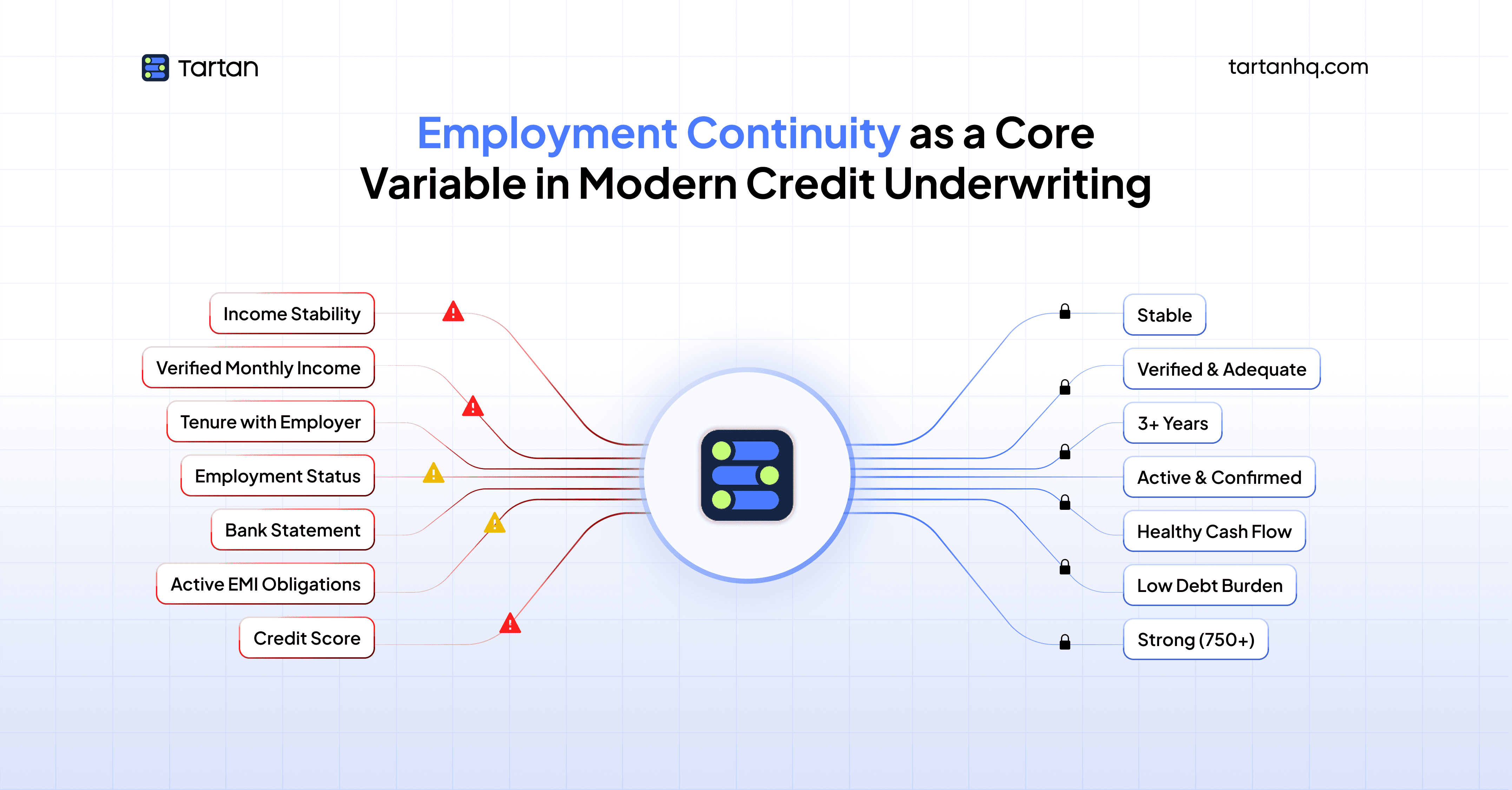
For years, underwriting models have heavily relied on two dominant data pillars: repayment history from credit bureaus and cash flow behaviour from bank statements.
Both are backward-looking.
They answer: Has this person repaid in the past? How do they manage money?
What they do not directly measure is: How stable is the applicant's income source right now?
This gap isn't academic. It's the difference between a borrower who appears creditworthy based on historical behaviour but is currently unemployed or on notice period, and a borrower with limited credit history but stable employment at a growing company. Traditional models struggle to distinguish between these scenarios until it's too late - until the default happens or the opportunity is lost.
This is where employment continuity becomes material as an underwriting variable.
The Backward-Looking Bias of Traditional Underwriting
Credit bureau data is fundamentally historical. A CIBIL score reflects how well someone has managed credit obligations over the past several years. It captures late payments, defaults, and credit utilization patterns. This data is valuable - it shows discipline, reliability, and past financial behaviour.
But it doesn't tell you whether the person still has the job that enabled all those on-time payments. A borrower with a 780 credit score who was laid off last week looks identical to one still employed and earning - until several months pass and payment patterns diverge.
Bank statement analysis adds nuance by showing cash flow patterns. Regular salary credits indicate employment. Expense patterns reveal lifestyle and financial management. Consistent savings suggest fiscal discipline.
Yet bank statements are also backward-looking. They show last month's salary credit, not this month's employment status. They reflect historical cash flow, not current income stability. By the time bank statements reveal employment disruption - a missing salary credit, depleting balances, increased cash withdrawals - the borrower's financial situation may have already deteriorated significantly.
The fundamental limitation: both credit bureaus and bank statements are lagging indicators. They're excellent at telling you what happened, but poor at telling you what's happening now or predicting what's likely to happen next quarter.
Why Employment Continuity Matters More Than Historical Repayment
Consider two loan applicants:
Applicant A has a 750 credit score, demonstrating three years of consistent EMI payments across a car loan and credit card. Bank statements show regular ₹60,000 monthly salary credits with disciplined expense management. The bureau data is pristine.
What the traditional model doesn't see: Applicant A was terminated two weeks ago. They have two months of severance pay remaining. Their bank balance still appears healthy. Their credit history remains unblemished. But their ability to service a new 24-month personal loan has fundamentally changed.
Applicant B has a 680 credit score - solid but not exceptional. Limited credit history due to being relatively new to formal credit markets. Bank statements show six months of ₹55,000 salary credits from a Tier 1 technology company. No existing EMIs.
Traditional scoring undervalues Applicant B due to thin credit file. But Applicant B's employment at a stable, growing company with consistent tenure suggests strong repayment capacity for the foreseeable future.
Employment continuity as an underwriting variable would correctly identify Applicant A as elevated risk despite strong historical data, and appropriately value Applicant B's stable income source despite limited credit history.
The core insight: future repayment capacity depends more on future income continuity than past payment behaviour. A borrower with perfect credit history but no job cannot repay. A borrower with limited history but stable employment can.
What Employment Continuity Actually Measures
Employment continuity isn't a single data point. It's a composite signal:
Current employment status: Is the person actively employed right now according to their employer's HRIS? Real-time status checks catch scenarios traditional models miss - like applicants terminated yesterday but submitting last month's salary slip.
Tenure and stability: Employment lasting three years signals different stability than three months. Tenure serves as a proxy for employment fit, performance, and reduced turnover risk.
Employer quality and sector stability: An employee at a large, established enterprise represents different risk than one at an early-stage startup. Stable employment at a creditworthy employer suggests different future continuity than precarious employment at a financially stressed company.
Income trajectory: Is salary increasing, stable, or declining? Salary growth suggests career progression and increased repayment capacity. Declining wages may signal performance issues or sector challenges.
Employment type and security: Permanent employment differs from fixed-term contracts. Full-time differs from gig work. Probation periods carry different stability implications than confirmed employment. A permanent employee past probation represents different continuity risk than a contractor on a six-month assignment.
How HyperSync Makes Employment Continuity Accessible
The challenge with using employment continuity as an underwriting variable has been data access. Banks and lenders cannot call every employer to verify current employment status for every loan applicant. Self-reported employment status is unreliable - applicants facing termination are unlikely to disclose it during loan applications.
Salary slips and employment letters are documents created at a point in time, easily outdated, and subject to fraud. They're proxies for employment continuity, not direct measures.
What makes employment continuity viable as an underwriting variable is direct, real-time access to authoritative employment data through API integration with HRIS and payroll systems.
HyperSync provides this access through a unified API layer connecting to 100+ HRIS and payroll platforms used by Indian enterprises.
When a loan applicant applies through a lender using HyperSync, the underwriting process includes:
Real-time employment verification: An API call to the applicant's employer's HRIS returns current employment status. The response is authoritative - this is what the employer's system of record shows right now. Not a document created weeks ago, but live data.
Tenure confirmation: How long has this applicant been employed at this organization? The HRIS holds the join date. Calculating tenure is deterministic, not dependent on self-reporting or document submission.
Current compensation verification: What is the applicant's current gross and net salary? Payroll systems contain definitive compensation data. No need to request salary slips that may be forged or outdated.
Employment type and status: Is this a permanent employee who has completed probation? Or a contractor? Or someone currently on notice period? These details exist in HRIS and are surfaced through HyperSync's standardized API.
Salary history: Has compensation been stable, growing, or declining over recent months? Historical payroll data enables tracking income trajectories.
This data isn't self-reported or document-based. It's pulled directly from the authoritative source with the applicant's consent. It's current - reflecting today's employment reality, not last month's payslip. And it's fraud-resistant - there's no document to forge when data flows directly from employer systems.
The Underwriting Transformation
When employment continuity becomes a reliable, verifiable underwriting variable through HyperSync integration, several shifts occur:
Risk Segmentation Improves: Lenders can accurately segment: stable employed (3+ years, permanent, growing salary) get lowest risk pricing; established employed (1-3 years, permanent) standard risk; new employed (under 1 year, post-probation) moderate risk; probationary or contract get careful underwriting. Real-time HRIS data makes this operationally viable at scale.
Early Warning Systems: Continuous employment data creates early warnings. A borrower moving from "active" to "on notice" has elevated default risk before missing payments. HyperSync-integrated systems flag this immediately, enabling proactive outreach before defaults occur.
Credit Access Expands for Thin-File Borrowers: Traditional models disadvantage borrowers with limited credit history. Employment continuity provides an alternative anchor. A borrower with minimal bureau history but two years of stable employment demonstrates repayment capacity through employment stability. This isn't relaxing standards - it's using more predictive data.
Fraud Detection Strengthens: When income verification happens through direct HRIS integration, income fraud disappears. You cannot forge an API response from a verified employer's system. Fraud attempts at the employment verification layer become structurally impossible.
Underwriting Speed Increases: Traditional verification takes days. API-based employment verification through HyperSync happens in seconds. Applications that took 3-7 days can be approved in minutes without compromising verification quality.
The Compounding Advantage of Forward-Looking Data
Employment continuity shifts underwriting from primarily backward-looking to incorporating forward-looking signals.
Credit bureaus and bank statements tell you what happened. Employment continuity tells you about current income stability and future repayment capacity. A borrower with stable employment today is more likely to have income next month, next quarter, next year - making future EMI payments feasible.
This forward-looking dimension becomes critical for longer tenures and larger tickets. A 24-month personal loan or 5-year vehicle loan requires income continuity over multiple years. Current employment stability and trajectory may be more predictive than historical repayment behavior.
When HyperSync enables continuous monitoring of employment data for existing borrowers, this advantage extends throughout the loan lifecycle. Traditional models wait for payment behavior to signal problems. Employment continuity monitoring flags risk before it manifests in missed payments - enabling intervention when it's most effective.
The Strategic Shift
For lenders, incorporating employment continuity through HyperSync integration represents a strategic shift:
From document verification to data verification. From point-in-time assessment to continuous monitoring. From reactive to proactive risk management. From thin-file exclusion to employment-anchored inclusion. From generic pricing to employment-segmented pricing.
Conclusion
The most predictive signal for future loan repayment isn't what someone did with credit last year. It's whether they'll have income next month.
Employment continuity measures this directly. Is the applicant employed? How stable is that employment? How long have they been there? Is their income growing or declining? What's the employer's stability?
These questions have always been relevant to credit risk. What's changed is the ability to answer them accurately, at scale, in real time.
HyperSync makes employment continuity viable as a core underwriting variable by providing unified API access to 100+ HRIS and payroll systems - turning what was once a manually-verified data point into reliable infrastructure.
For lenders, this isn't just adding another variable to existing models. It's fundamentally improving model predictiveness by incorporating forward-looking data about income stability alongside backward-looking data about payment history.
In credit markets where defaults cost basis points and competitive advantage comes from better risk selection, employment continuity isn't optional data.
It's foundational infrastructure for modern underwriting.