Credit decisions have always been a confidence problem.
Lenders extend capital based on a belief - that this person will repay, that their income is what they claim, that their employment is stable enough to service the obligation. For decades, that belief was built on documents: salary slips, bank statements, employment letters, Form 16. Paper trails designed to give lenders sufficient confidence to commit capital.
The problem with documents isn't that they contain wrong information. It's that they're fragile signals - point-in-time snapshots of circumstances that change continuously.
They can be fabricated.
They arrive late in underwriting after borrowers have already invested time applying.
They require human verification, creating bottlenecks precisely when speed matters most.
The question modern lenders face isn't whether to verify employment and income. It's whether there's a better way - faster, more reliable, fraud-resistant, and scalable without proportional operations headcount growth.
The answer is direct access to employment data at source.
The Fundamental Limitation of Document-Based Underwriting
For a salary slip to be a reliable underwriting signal, three things must be true: the document must be authentic, the information must be current, and verification must happen quickly enough that the decision arrives before the borrower applies elsewhere.
Document-based underwriting struggles with all three.
Authenticity is increasingly difficult to verify. Salary slip fraud is a documented and growing problem. Templates are freely available. Tools generate convincing documents with realistic employer letterheads and plausible salary figures. Operations teams trained to identify forgeries are in an arms race with fraudsters who iterate faster.
Currency is structurally limited. A salary slip submitted today might be from last month. Employment could have changed since the document was generated. Documents capture a moment that has already passed.
Speed degrades with volume. Manual document review doesn't scale. As lenders grow and acquisition campaigns drive application spikes, operations bottlenecks delay decisions, increase costs, and frustrate customers who abandon mid-funnel.
Documents are proxies for reality. When direct data access becomes possible, continuing to rely on proxies becomes a competitive liability.
What Direct Employment Data Access Changes
A direct API connection to an employer's HRIS or payroll system doesn't retrieve a document describing an employee's situation. It retrieves the situation itself.
Real-time employment verification returns:
Current employment status (active, on notice, terminated)
Current gross and net salary, including any recent revisions
Tenure with the current employer
Designation and department
Salary history showing stability or volatility over previous months
Existing payroll deductions that affect disposable income
This isn't a document generated at a point in time. It's a live query against the authoritative source. The data is as current as the last payroll run. If the employee resigned yesterday, that status is reflected immediately. If a salary increase was processed last week, the current figure is available.
The implications for underwriting are significant:
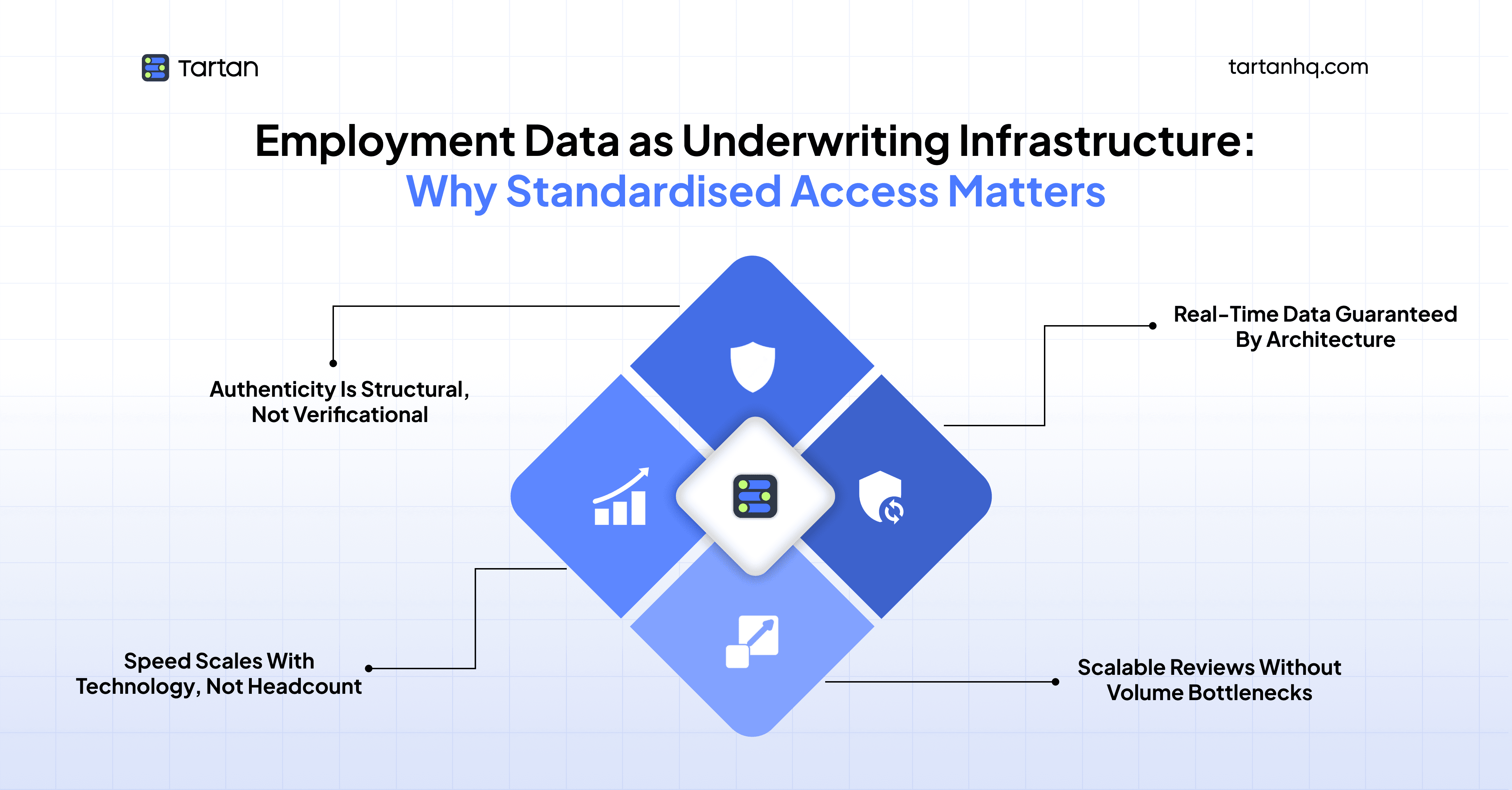
Authenticity is structural, not verificational. Data retrieved directly from an HRIS system via authenticated API cannot be fabricated by the borrower. There's no document to forge because there's no document in the process. Fraud attempts at the income verification layer disappear entirely - replaced by cryptographic certainty.
Currency is guaranteed by architecture. The data reflects current circumstances because it's pulled from operational systems at the moment of the query. Underwriting decisions are based on today's employment reality, not last month's payslip.
Speed scales with technology, not headcount. An API call returns verified employment data in milliseconds. Underwriting at scale no longer requires proportionally scaling operations teams. Ten thousand loan applications processed overnight requires the same verification infrastructure as one hundred.
The Standardisation Problem
Here's where the opportunity creates a new challenge.
Direct employment data access is unambiguously better than document-based verification. But India's enterprise HRIS landscape is fragmented across dozens of platforms. Large enterprises run Workday, SAP SuccessFactors, or Oracle HCM. Mid-market companies use Darwinbox, Keka, or greytHR. Smaller businesses rely on sumHR, HRMantra, factoHR, or sector-specific solutions. And many organisations run custom HRIS built on legacy infrastructure with unique data models.
A lender wanting to offer employment verification across their entire corporate lending book can't realistically build and maintain direct integrations with every HRIS platform their employer partners use. The economics don't work.
Each HRIS platform has different authentication protocols, different data schemas, different field naming conventions, different API versioning strategies, and different approaches to handling edge cases. An employee "on_leave" in Darwinbox might be "leave_of_absence" in Workday and "LOA" in a custom system. Gross salary might appear as a single field or decomposed into dozens of components depending on the platform.
Building a reliable direct integration with one HRIS platform takes months. Maintaining it as the platform releases updates is an ongoing resource commitment. Doing this across twenty platforms isn't a project - it's a permanent engineering function that competes with core product development for resources.
This is the standardisation problem: employment data at source exists and is valuable, but accessing it consistently across the diversity of systems where it lives requires infrastructure that most lenders can't justify building and maintaining in-house.
HyperSync: Employment Data as Infrastructure
HyperSync addresses this directly by providing a unified API layer that normalises employment data access across 100+ HRIS and payroll systems.
For lenders, this means one integration replaces what would otherwise be dozens. A single authenticated API call against HyperSync's unified endpoint returns standardised employee data regardless of whether the employer runs Darwinbox, Workday, Keka, greytHR, or any other supported platform. Field names are consistent. Data types are normalised. Edge cases are handled centrally.
The architecture operates in three layers:
Source connectivity: HyperSync maintains active integrations with 100+ HRIS and payroll platforms, handling authentication, API versioning, and platform-specific data model variations. When platforms release updates or change their APIs, HyperSync absorbs the change - connected lenders and benefit providers experience no disruption.
Normalisation layer: Raw employment data extracted from source systems is mapped to HyperSync's standardised schema. Salary components from diverse payroll structures are normalised into consistent fields. Employment status codes from dozens of platforms are mapped to unified status categories. The lender's underwriting system receives consistent data regardless of source.
Access control and consent: Every data access event is consent-gated. Employees authorise verification as part of the application process. Employers authorise HyperSync's access to their HRIS during the corporate partnership setup. Data flows are logged comprehensively for regulatory compliance - satisfying requirements under India's Digital Personal Data Protection Act and broader financial services data governance requirements.
What This Enables for Lenders
When standardised employment data access becomes infrastructure, products previously impractical at scale become viable:
Instant pre-approved offers: When a lender partners with a corporate employer, HyperSync immediately enables pre-approved lending offers. Loan amounts are calculated, personalised offers displayed, applications approved in minutes - income verification happens automatically, not through manual document review.
Salary-grade risk segmentation: Uniform data access enables risk models incorporating salary grade, employment tenure, and department alongside credit bureau data. Employees three years into stable employment at a Tier 1 company represent a different risk profile than first-year employees at an early-stage startup - models can reflect this when data is reliably available.
Dynamic credit limits: When salary revisions are detected through HyperSync's continuous sync, credit limits are automatically reassessed. Customers whose salary increases after promotion qualify for higher limits without submitting documentation.
Payroll-deducted lending: HyperSync's bidirectional capabilities allow loan repayments deducted directly from payroll, eliminating bounce risk and reducing defaults to near-zero. This product is structurally impossible through document-based underwriting - it requires active payroll integration, not just reading documents.
Real-time employment monitoring: For outstanding loan portfolios, HyperSync provides early warning signals when employment status changes. A borrower moving from "active" to "on_notice" triggers proactive relationship management before situations deteriorate into default.
The Underwriting Advantage in Practice
The practical difference between document-based and API-based employment verification isn't incremental - it's categorical.
A borrower using document-based verification submits salary slips and bank statements, waits for manual review, receives a decision in three to seven days. Motivated borrowers apply to multiple lenders simultaneously and accept the first approval.
A borrower using HyperSync sees a pre-approved offer calculated on verified salary data before they formally apply. The application completes in minutes. Approval is instant. Disbursal happens same day.
These aren't different speeds of delivering the same product. One competes on price. The other competes on certainty and speed - an experience document-dependent lenders cannot replicate without equivalent infrastructure. When verification is invisible and instant, completion rates improve dramatically. When it creates friction, significant proportions of applicants abandon.
The Compounding Advantage
Standardised employment data access compounds in value as it scales.
A lender with one corporate partnership gains marginal advantage. A lender with fifty, all integrated through HyperSync, has built a proprietary distribution channel acquiring customers at dramatically lower cost than retail channels - with better risk profiles and higher product penetration potential across the employment lifecycle.
Each partnership added through HyperSync costs the same to integrate as the first - because there is no integration cost per employer. The employer's HRIS is already supported. Partnership becomes commercial and legal, not technical. The lender's cost of adding distribution capacity decreases with scale, precisely inverting the economics of document-based lending where operational costs grow proportionally with volume.
Conclusion
Employment data is among the most predictive inputs available for credit underwriting. Stable employment at a verified employer with consistent salary history is a stronger signal than almost anything a credit bureau can provide - reflecting the current, real-world situation of the borrower rather than historical behaviour.
For decades, lenders accessed this data indirectly through documents borrowers produce, submit, and hope get verified before competitors approve them first. This approach worked - imperfectly, expensively, with persistent fraud vulnerabilities - because no better alternative existed at scale.
HyperSync removes those constraints. Standardised access to 100+ HRIS and payroll systems means employment verification is now infrastructure: fast, reliable, fraud-resistant, and scalable without proportional operational investment.
Lenders standardising on HyperSync aren't just improving a step in their current process. They're building the foundation for lending products that document-dependent competitors cannot offer - instant approvals, salary-linked repayments, dynamic credit, and lifecycle-aware customer management at scale.
In lending markets where speed, accuracy, and operational efficiency determine who wins, employment data infrastructure is no longer optional. It's the foundation.