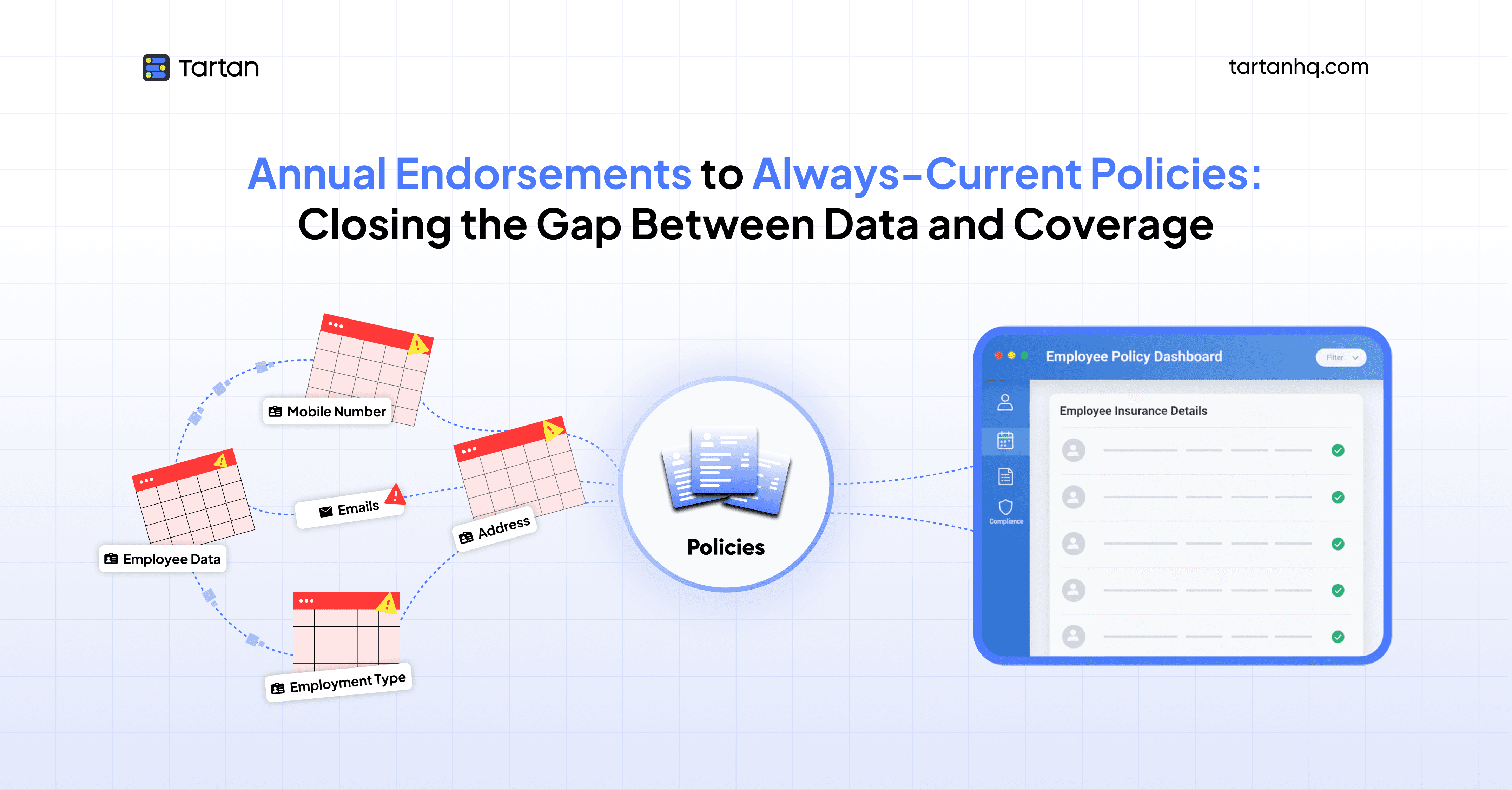
For decades, group insurance has operated on a batch-based data model that treats employer information as something collected periodically rather than managed continuously. The mechanics are familiar to anyone who's worked in policy operations: files arrive via email, ops teams manually process them, discrepancies trigger reconciliation cycles, and formal endorsements get issued weeks or months after the underlying workforce changes actually occurred.
This model emerged from practical constraints. In the pre-digital era, there was no way to maintain continuous visibility into employer workforce data.
Paper-based census forms, mailed quarterly or annually, were the only option. Even as email and spreadsheets replaced postal mail, the fundamental paradigm remained unchanged: data collection happened in discrete batches, separated by weeks or months of operational silence.
The Quarterly/Annual Cycle
The standard workflow creates a predictable rhythm across group insurance operations. Policy ops sends an email to corporate HR requesting updated employee census. Days or weeks pass. Follow-up emails begin - "just checking if you received our request" escalates to "we need this for your renewal" escalates to broker intervention when responses don't materialize. Eventually, the employer sends an Excel file with current headcount, usually in their own idiosyncratic format that bears no resemblance to what the insurer requested.
Ops teams manually review the data, reformat it to match internal templates, validate against previous census records, and identify discrepancies.
Those discrepancies trigger clarification emails back to the employer: "We show 247 employees but your file has 239 - can you confirm?" or "15 employees appear to have left but we have no termination dates." Revised files arrive. Validation repeats. Eventually, endorsements get processed, premium adjustments calculated, and policy documents issued - typically 6-10 weeks after the initial request.
This plays out across hundreds or thousands of group policies simultaneously, with each employer following their own timeline, using their own file formats, and responding on their own schedule. The operational reality is one of constant email traffic, version control chaos, manual data entry, and cross-functional coordination overhead that never quite becomes routine despite happening every quarter.
The standard workflow looks deceptively simple:
Month 1: Policy ops sends email to corporate HR requesting updated employee census
Month 1.5: Follow-up emails begin ("just checking if you received our request")
Month 2: Employer sends Excel file with current headcount, usually in their own format
Month 2-3: Ops team manually reviews, reformats, validates against previous census
Month 3: Discrepancies identified, clarification emails sent back to employer
Month 3.5: Revised file received, validation repeated
Month 4: Endorsement processed, premium adjustments calculated
Month 4.5: Endorsement issued, communicated to employer and broker
This plays out across hundreds or thousands of group policies simultaneously, with each employer following their own timeline, using their own file formats, and responding on their own schedule.
The Communication Chaos
Email becomes the primary data transport mechanism, with census files arriving via attachments to shared inboxes where they get lost or buried among hundreds of other messages. Ops teams develop elaborate folder structures and tagging systems to track incoming data, but these break down as volume increases and team members interpret categories differently.
The operational reality involves:
Email as primary data transport: Census files arriving via email attachments, often to shared inboxes where they get lost or buried
Spreadsheet format inconsistency: Every employer structures data differently - different column headers, date formats, status codes, naming conventions
Version control nightmares: "Employee_List_Final.xlsx" followed by "Employee_List_Final_v2.xlsx" followed by "Employee_List_ACTUALLY_FINAL.xlsx"
Manual data entry and reformatting: Ops teams copying from employer formats into insurer templates, introducing transcription errors
Cross-functional coordination overhead: Ops, underwriting, finance, and claims all need to be notified of updates, each with their own systems to update
The Dependency Problem
The entire model is built on high employer responsiveness, which rarely materializes:
HR teams are resource-constrained: Providing census updates to insurers competes with payroll processing, benefits enrollment, compliance reporting, and actual HR work
Providing census updates to insurers competes with dozens of higher-priority tasks and typically sits at the bottom of the queue unless it's renewal time or there's an active claim dispute creating urgency.
No standardization across clients: Each insurer has different requirements, formats, and schedules, forcing HR to manage multiple insurance data requests differently
The lack of standardization compounds the burden on employers. A large employer with five different group insurance carriers faces five different data request processes, none compatible with each other, all requiring manual extraction and reformatting from the same source HRIS system.
The HR manager who receives these requests sees them as duplicative administrative overhead with no value to their core function. This creates employer fatigue and resistance to timely data provision - not because they're uncooperative, but because they're rationally prioritizing their limited time.
Low prioritization: Unless it's renewal time or there's a claim dispute, updating the insurer's employee list sits at the bottom of the HR task queue
Communication fragmentation: Requests go to different people depending on who responded last time - sometimes HR, sometimes finance, sometimes office managers
Data requests go to whoever responded last time - sometimes the HR Director, sometimes the Benefits Manager, sometimes a Payroll Coordinator, sometimes an office administrator or executive assistant who happened to be available when the last request came in. When that person leaves the company or changes roles, the insurer's request emails bounce or go unanswered, forcing ops teams to hunt for new contacts through broker channels or by calling the company's main switchboard.
The Inevitable Staleness
The result is entirely predictable: insurers wait, follow up, escalate through broker channels, and ultimately accept that data will always be 30-90 days stale by the time it's processed. This staleness isn't an aberration or a sign of operational failure - it's the natural equilibrium state of a batch-based system where data collection is manual, voluntary, and disconnected from employers' operational systems.
Consider the timeline for a quarterly update cycle. Month 1: request sent. Month 1.5: first follow-up. Month 2: employer sends file. Month 2-2.5: ops team processes and identifies discrepancies. Month 2.5-3: clarification cycle with employer. Month 3: revised data received and processed. Month 3.5: endorsement issued. By the time the policy reflects "current" data, that data is already 6-8 weeks old, and another 10-12 weeks will pass before the next update cycle begins.
For annual update cycles, the lag is even more severe. The employee census captured in January reflects the workforce as of December. Processing takes 4-6 weeks, so the policy is updated in February or March. That data remains static until the following January, meaning that by renewal time, the policy is operating on data that's 12-15 months out of date for employees who joined or left in Q4.
Why This Model Fails at Scale
The batch update model doesn't just create friction - it creates a scaling ceiling that becomes acute as insurers grow their group business portfolios.
The Non-Linear Complexity Problem
Adding more enterprise clients doesn't scale operations linearly - it scales exponentially:
Each client becomes a custom process: Client A sends CSVs monthly, Client B sends Excel quarterly, Client C requires portal login to download PDFs, Client D insists on secure file transfer
Relationship dependency multiplies: Every account needs a dedicated ops contact who "knows how Client X works" and maintains that institutional knowledge
Exception handling compounds: When 5% of 100 policies have data issues, that's 5 problems. When 5% of 1,000 policies have issues, that's 50 simultaneous fire drills
Communication overhead grows geometrically: Coordinating updates across ops, underwriting, claims, and finance for 100 policies is manageable; for 1,000+ it becomes untenable
The People Scaling Trap
Most insurers try to solve this by adding headcount:
Ops teams grow faster than policy count: A typical group insurer needs 1 full-time ops person per 80-120 policies just for data management and reconciliation
Specialization becomes necessary: Teams develop "client specialists" who handle specific accounts because processes are too customized to generalize
Turnover creates knowledge loss: When an ops person leaves, the accumulated knowledge of "how to get census data from these 50 employers" leaves with them
Training costs escalate: New ops hires need weeks of shadowing to understand client-specific quirks and workflows
The scaling math doesn't work: revenue per policy grows slowly, but ops cost per policy stays constant or increases due to complexity.
The Technology Debt Accumulation
Attempting to automate the legacy model creates its own problems:
Point integrations proliferate: Building custom connectors to each employer's HRIS or payroll system results in hundreds of brittle integrations to maintain
Data transformation logic becomes unmaintainable: Every employer requires custom mapping rules, making the transformation layer a tangled mess of if-then logic
System update cycles break integrations: When employers upgrade their HRIS (e.g., SAP to Workday migration), custom integrations break and require rebuilding
API fatigue sets in: Engineering teams spend more time maintaining data ingestion pipelines than building product features
The fundamental issue is that automating a broken process just creates a faster broken process. The model itself needs rethinking.
The Compounding Quality Problem
As scale increases, data quality issues multiply:
Error rates stay constant, absolute errors explode: If 2% of manual data entry has errors, that's tolerable at 100 policies but catastrophic at 1,000
Stale data periods lengthen: As ops teams get overwhelmed, the time between census updates stretches from quarterly to semi-annual or annual
Reconciliation becomes forensic work: At renewal time, teams are reconstructing a year's worth of workforce changes through email archaeology and manual investigation
Customer trust erodes systematically: Enterprises notice when their insurer can't keep basic employee data current, signaling operational immaturity
The legacy model doesn't fail suddenly - it fails gradually, imperceptibly, until the operational load becomes unsustainable and growth stalls.
What "Always-Current" Actually Means
The solution isn't optimizing the batch model - it's replacing it with continuous synchronization. "Always-current" employer data represents a fundamental paradigm shift in how policy administration systems relate to workforce reality. Instead of periodic snapshots captured through manual data collection, always-current systems maintain live connections to employer data sources that reflect workforce changes as they happen.
Continuous Sync Architecture
Instead of periodic snapshots, always-current systems maintain live connections:
Event-driven updates: When an employee is hired in the employer's HRIS, that event triggers an immediate update to the policy admin system - no manual export, no email, no waiting
Automated joiner/leaver processing: New employees are added to coverage within hours of their start date; departing employees are removed the day they leave
Real-time employment status changes: Promotions, department transfers, leave of absence, status changes from full-time to part-time - all reflected immediately in policy records
Dependent and beneficiary updates: When employees add or remove family members from benefits, those changes flow through to insurance coverage automatically
The Technical Implementation
Making this work requires infrastructure that didn't exist in the legacy insurance tech stack:
Unified API layer: A single integration point that connects to 80+ HRIS, payroll, and benefits platforms (Workday, ADP, BambooHR, Namely, Gusto, etc.) through standardized interfaces
Data normalization at ingestion: Automatic transformation of diverse employer data formats into a consistent schema that policy admin systems can consume
Bidirectional validation: The system doesn't just pull data - it confirms accuracy with the source system and flags discrepancies for resolution
Consent and security frameworks: Explicit employer authorization for data access, with granular controls over what data is shared and audit logs of every sync event
Change detection and versioning: The system tracks what changed, when it changed, who authorized it, and maintains full history for compliance and dispute resolution
What Gets Synced in Real-Time
Always-current doesn't mean syncing everything - it means syncing what matters for policy administration and claims:
Core employee demographics: Name, date of birth, hire date, employment status, employee ID
Eligibility-determining factors: Employment type (full-time, part-time, contractor), department, location, salary band
Coverage tier inputs: Number of dependents, relationship status, family composition
Termination data: Exit date, termination type (voluntary, involuntary, retirement), COBRA eligibility
Leave and status changes: Medical leave, parental leave, sabbatical, furlough - anything that affects coverage status
The key is selectivity: syncing the minimum data required to keep policies accurate without overwhelming systems or violating privacy boundaries.
The Freshness Guarantee
"Real-time" in practice means different things for different data types:
Critical eligibility events (hires, terminations): Reflected within 4-24 hours
Dependent changes: Reflected within 24-48 hours to align with benefits enrollment cycles
Non-critical updates (address changes, contact info): Batched and synced daily or weekly
Bulk reconciliation: Full census validation runs weekly to catch any missed events or system discrepancies
The goal isn't instantaneous sync for its own sake - it's ensuring that when a claim is filed or a premium is billed, the underlying data is accurate to within days, not months.
Operational Outcomes: The Middle-Funnel Proof
Always-current employer data isn't a theoretical improvement - it delivers measurable operational benefits that ops and tech leaders can validate before full implementation.
Fewer Endorsements (80-90% Reduction)
When data flows continuously, the need for formal policy endorsements collapses:
Monthly auto-adjustments replace quarterly endorsements: Premium calculations happen automatically based on current active lives, eliminating the need for formal amendment processing
Joiner/leaver processing becomes invisible: Employees are added or removed from coverage without ops team intervention or paperwork
Endorsement volume drops from 4-12 per policy per year to 0-2: Only major plan design changes or employer-requested modifications require formal endorsements
Underwriting review shifts from approving changes to monitoring dashboards: Instead of reviewing endorsement requests, underwriters monitor real-time data feeds and intervene only on anomalies
Operational impact: A 500-policy portfolio that previously required 2,000-6,000 endorsements annually drops to 200-400, freeing ops capacity for growth or value-added services.
Lower Reconciliation Effort (70-85% Time Reduction)
The single biggest time sink in group insurance ops - census reconciliation - shrinks dramatically:
Elimination of monthly "census chase" emails: No more follow-ups to HR teams requesting updated employee lists
Automated discrepancy detection: When the employer's HRIS and the policy admin system disagree, alerts surface automatically with specific data points flagged
Self-healing data flows: Minor discrepancies (spelling variations, format differences) are normalized automatically without human intervention
Renewal reconciliation becomes verification, not investigation: Instead of reconstructing a year of changes from emails and spreadsheets, teams verify that automated syncs captured everything correctly
Operational impact: Ops managers who spent 15-20 hours per week on manual reconciliation spend 3-5 hours on exception handling and oversight.
Faster Claim Validation (60-75% TAT Improvement)
Claims processing speed is directly limited by eligibility verification, which becomes instantaneous with always-current data:
Eligibility determination shifts from 2-5 days to real-time: Claims adjusters no longer wait for ops teams to verify if someone was covered on the date of service
Automated pre-adjudication: System can pre-validate claims against current policy data before they even reach an adjuster
Dispute resolution accelerates: When eligibility questions arise, the system provides full audit trails showing exactly when an employee was added or removed from coverage
Customer communication improves: Instead of "we're checking with your employer," claims teams can provide definitive answers immediately
Operational impact: Claims TAT improves from 8-12 days to 3-5 days, directly improving NPS and reducing customer service load.
Improved Premium Accuracy (90%+ Billing Precision)
Billing based on always-current data eliminates the largest source of premium disputes:
Per-employee-per-month billing becomes viable: Charge for exactly who was covered each month, eliminating overage/underage reconciliations
Automatic premium adjustments: When headcount changes, next month's billing reflects it without manual intervention
Elimination of true-up cycles: No more year-end reconciliation where insurers issue massive credits or surprise invoices based on discovered discrepancies
Predictable cash flow: Finance teams can forecast revenue accurately because billing reflects actual covered lives continuously
Operational impact: Finance teams spend 60-80% less time on premium dispute resolution and manual adjustment processing.
Proactive Risk Management
Always-current data enables insurers to shift from reactive to proactive:
Early attrition detection: Sudden spikes in employee departures signal potential adverse selection or employer financial distress
Coverage gap alerts: System flags employees who should be covered but aren't yet in the policy, allowing proactive outreach before claim disputes arise
Anomaly detection: Unusual patterns (rapid hiring, salary changes, department restructuring) trigger underwriting review before renewal
Predictive loss ratio management: Real-time workforce composition data improves loss forecasting and enables mid-term pricing adjustments
Strategic impact: Underwriting teams can manage risk dynamically rather than discovering problems at renewal time when it's too late to act.
The Strategic Shift: From Policy Administration to Data-Led Policy Operations
Moving to always-current employer data isn't just an operational upgrade - it represents a fundamental rethinking of what group insurance operations should be.
Old Paradigm: Policy Administration
The traditional model treats policy operations as document management:
Policies are static contracts: Created at inception, modified through formal endorsements, renewed annually
Data is an input to processes: Census files are things that arrive, get processed, and get filed away
Ops teams are document processors: Their job is to intake data, validate it, enter it, and issue policy documents
Systems are record-keepers: Policy admin systems store snapshots of data at specific points in time
Success is measured by processing speed: How quickly can we turn an endorsement request into an issued policy amendment?
This model made sense when workforce data changed slowly and manual processes were the only option.
New Paradigm: Data-Led Policy Operations
Always-current systems flip the relationship between data and policies:
Policies are dynamic reflections of reality: The policy continuously mirrors the employer's actual workforce state
Data is the source of truth: The employer's HRIS is authoritative; the policy admin system subscribes to that truth
Ops teams are data stewards and exception handlers: Their job is to monitor data flows, resolve anomalies, and ensure system health
Systems are continuous synchronization engines: Policy admin platforms maintain live connections to employer data sources
Success is measured by data freshness and accuracy: How closely does the policy reflect reality at any given moment?
The Capability Transformation
This paradigm shift unlocks entirely new operational capabilities:
From periodic snapshots to continuous intelligence:
Ops teams have real-time dashboards showing every policy's current state
Anomalies surface automatically rather than being discovered during reconciliation
Trend analysis becomes possible: Are certain industries showing higher attrition? Are specific employer segments growing faster?
From manual processing to automated orchestration:
Routine updates happen without human intervention
Ops teams focus on strategic exceptions and relationship management
Technology handles the repetitive work that previously consumed 70% of ops capacity
From reactive problem-solving to proactive management:
Instead of waiting for employers to report changes, the system detects them automatically
Coverage gaps are identified and resolved before claims are filed
Risk signals are detected early, enabling proactive underwriting intervention
From cost center to strategic enabler:
Reduced ops overhead improves unit economics and enables portfolio growth
Faster claims processing and fewer disputes improve customer retention
Real-time data enables product innovation and new business models
The Competitive Repositioning
Insurers that make this shift differentiate themselves in enterprise sales cycles:
"We integrate with your HRIS" becomes a sales advantage: Employers prefer insurers who eliminate their admin burden
Operational excellence becomes brand: Being known for smooth, automated operations attracts enterprise accounts tired of legacy insurer friction
Data capabilities enable consultative selling: Sales teams can offer workforce analytics and insights, not just insurance coverage
Faster implementation and onboarding: New clients can be live in days rather than weeks because data flows automatically from day one
The Long-Term Implications
The shift to data-led operations is irreversible once it begins:
Customer expectations reset: Once employers experience automated data sync, they won't tolerate reverting to spreadsheet exchanges
Competitors are forced to follow: Insurers that don't modernize lose enterprise accounts to those that do
Technology investments compound: Early movers build deeper integrations, better data models, and stronger platforms over time
Talent shifts: Ops roles evolve from data entry to data analysis, attracting different skill sets and capabilities
The strategic question isn't whether to make this transition - it's whether to lead it or be disrupted by those who move first.
Key Takeaway
The fundamental problem in group insurance operations isn't verification - it's data freshness. Insurers have sophisticated processes for validating employer information, but those processes operate on stale data that's outdated the moment it's captured.
Always-current employer data doesn't just make existing operations faster - it makes entirely new operating models possible. Policies that continuously reflect workforce reality eliminate the reconciliation burden, reduce claims disputes, improve pricing accuracy, and enable proactive risk management.
The transition from annual endorsements to always-current policies is already underway. Early-moving insurers are capturing enterprise accounts frustrated with legacy operational friction, while late movers face commoditization pressure and margin compression.
For ops and tech leaders, the question is simple: Will you modernize your employer data infrastructure proactively, or will you be forced to do it reactively when customers and competitors make the legacy model untenable?
The tools exist. The ROI is proven. The only remaining variable is timing.