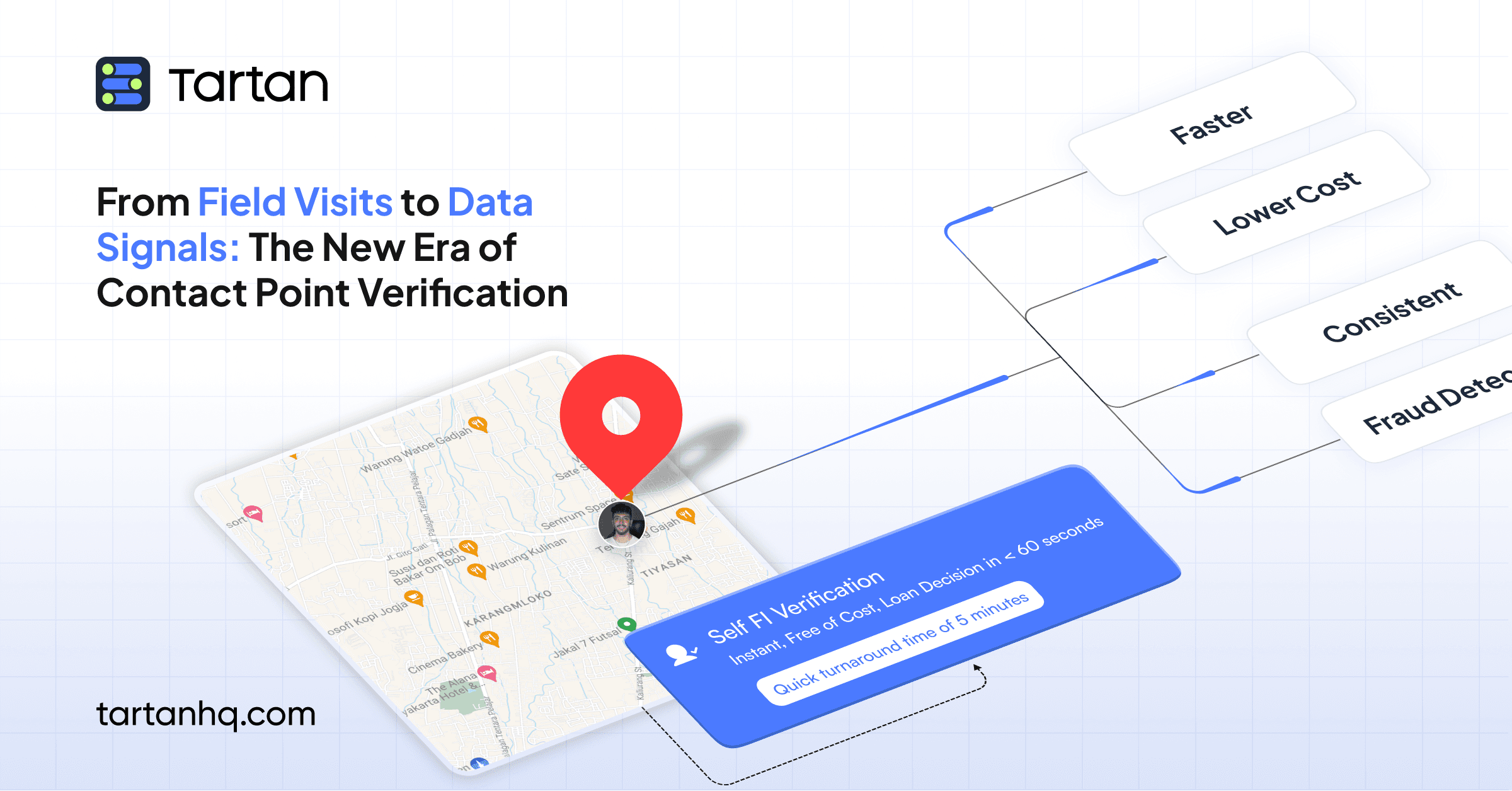
For decades, contact point verification (CPV) has meant one thing in Indian lending: a field agent showing up at a borrower's door. It was slow, expensive, and deeply inconsistent. In a country where credit demand is exploding and digital-first consumers expect decisions in minutes, the old model is no longer fit for purpose.
The shift happening right now is not incremental. It is structural. Lenders are moving from physical presence to layered digital evidence - combining address intelligence, employment data, device signals, and document forensics to build verification that is faster, cheaper, and often more reliable than anything a field agent can produce.
The question is no longer whether to move to digital verification. It is how quickly lenders can build the evidence layers to make it work.
Why CPV Exists in Underwriting
Contact point verification sits at the foundation of retail and MSME credit underwriting. It answers a deceptively simple question: does this applicant actually live and work where they claim to?
The answer matters for three distinct reasons. First, address and employment are the primary anchors of repayment capacity.
A lender extending a personal loan or a loan against property needs reasonable confidence that the applicant is reachable, employed, and not misrepresenting their financial situation.
Second, CPV is a fraud control gate - synthetic identities, ghost employees, and fabricated residences are all neutralised when verification is robust. Third, many lenders operate under internal credit policies or regulatory expectations that require documented evidence of residence before disbursement, not just an Aadhaar or utility bill on file.
In practice, CPV has historically covered three contact points: the present address, the permanent address, and the employment or office address. Each carries a different risk weight depending on the product. For a short-tenure personal loan, verifying the current residence may be sufficient.
For a secured lending product like LAP, all three may be mandatory, and the quality of evidence matters enormously.
The problem is not with what CPV tries to do. The problem is with how the field-based model tries to do it.
The Inefficiencies of Field-Based Verification
The traditional model works like this: a lender assigns a case to a field agency. The agency dispatches an agent to the stated address, typically within two to five business days. The agent attempts a visit, photographs the premises, collects a signature or verbal confirmation, and files a report. That report gets uploaded, reviewed, and fed into the credit decision.
In theory, straightforward. In practice, it breaks down at almost every step.
Turnaround time is a structural drag. The median field verification takes three to five days under normal conditions. In tier-2 and tier-3 cities, or during high-volume periods, it can stretch to a week or more.
For a borrower applying for a consumer durable loan at a retail counter, a five-day wait is often enough to kill the sale. For a lender competing on instant decisioning, it is a fundamental product handicap.
Quality variance is uncontrollable. Field agencies operate with loosely supervised workforces and high turnover. The quality of a verification report depends heavily on the individual agent - their diligence, their ability to navigate addresses without geocodes, their willingness to flag inconsistencies rather than simply close the case.
Lenders who audit their field programs at scale consistently find significant rates of visits that never happened, reports filed from the wrong location, and mismatches between what the agent recorded and what subsequent default behaviour suggested was true.
Cost economics do not scale. A single field visit typically costs a lender between ₹150 and ₹500 depending on geography and vendor tier. Across hundreds of thousands of monthly applications, this adds up fast. More importantly, it scales linearly with volume - there is no efficiency gain as a lender grows. In an environment where cost-per-loan is a key competitive metric, that linearity is unsustainable.
Fraud is easier to game than most lenders admit. A coordinated borrower, or a broker facilitating a fraudulent application, knows exactly what the field process looks for. Address proofs can be fabricated for a property where the applicant has only a temporary arrangement.
Family members can stand in. Reports can be influenced through informal channels. The opacity of the field process, which is supposed to be its strength, is also its greatest vulnerability.
What "Data Signals" Mean in Lending Verification
The phrase "data signals" is used loosely in fintech, but in the context of CPV it has a specific meaning: structured evidence, collected digitally, that a system can evaluate against defined rules to produce a confidence score or a clear pass/fail outcome.
There are four principal signal categories reshaping verification today.
Address intelligence signals form the foundational layer. These include GPS coordinates captured at the moment of verification, cross-referenced against the declared address using geocoding.
They also include OCR validation of address documents - catching mismatches between the house number on an electricity bill, the address on an Aadhaar, and what the applicant entered in the application form. Document freshness checks are part of this layer too: an address proof issued three years ago tells a different story than one from last month.
Employment and income signals come from HRMS and payroll integrations. When a lender can pull directly from an employer's HR system - confirming active employment status, designation, salary, and date of joining - it collapses the need for physical office verification in most salaried cases. The data is timestamped, sourced from the employer's own systems, and carries an audit trail that no field report can match.
Device and behavioural signals are the emerging layer. The device from which a customer completes their verification journey carries metadata: GPS location at the time of session, network characteristics, device fingerprint consistency with prior sessions. These signals do not replace document verification, but they add a behavioural dimension that is extremely difficult to fabricate at scale.
Liveness and biometric signals close the identity loop. A face match between the applicant completing the verification journey and the photo on their ID document - validated through a liveness check that confirms a real person is present - provides assurance that the field model simply cannot offer. No field agent verifies identity with the same rigour as a properly implemented liveness check.
The power of this model is not any single signal. It is the cross-checking of signals against each other. A geo-distance mismatch between live GPS and the declared address is a flag. A geo-mismatch combined with an OCR inconsistency on the address document is a strong fraud indicator. Layered signals produce outcomes that are both more confident and more explainable than a field agent's subjective report.
How DAV + Employment Data Creates a Decision-Ready Verification Layer
Digital Address Verification (DAV) is the operational framework that brings these signals together into a structured, auditable verification workflow. Understanding how it works in practice explains why lenders who have deployed it report dramatic improvements in both speed and fraud detection.
The standard DAV journey is customer-initiated and takes minutes. A lender creates a verification session and sends the applicant a secure link. The applicant opens the link on their phone, captures photos of their address proof documents, allows GPS access, and optionally completes a liveness check.
The platform runs automated validations - OCR extraction, geo-distance check, document freshness, face match - and generates a structured verification report with an evidence bundle: location data, photos, documents, and reason codes for any flags raised.
For a lender, the operational implications are significant. The three-to-five day field cycle compresses to minutes. The ₹150-500 per-visit cost drops substantially. The quality variance disappears because the same automated checks run on every case.
And the output is a standardised PDF report with a full audit trail - exactly what compliance, internal QA, and regulators ask for when they want to understand a credit decision.
Where DAV becomes particularly powerful is in combination with employment data pulled from HRMS and payroll systems.
For a salaried applicant, consider what a lender can know within minutes of application: verified current address with GPS evidence and document cross-checks; confirmed active employment with salary and tenure data sourced directly from the employer's system; and a liveness-matched identity.
That is a decision-ready verification layer. The underwriter is not waiting for a field report - they are reviewing structured, machine-validated evidence.
For MSME and secured lending, where the verification bar is higher, DAV supports configurable journeys: interior photos for property assessment, stricter document requirements, manual review flows for mixed-signal cases.
The platform routes cases that pass clean checks to straight-through processing and escalates ambiguous cases - those with a geo-distance mismatch or an OCR inconsistency - to a review queue rather than hard-failing them. That nuance matters. Not every mismatch is fraud; some are data quality issues. A system that surfaces the signal and lets an underwriter decide is more valuable than one that simply rejects.
The fraud control dimension deserves particular emphasis. DAV's multi-signal architecture makes coordinated misrepresentation significantly harder. Fabricating an address proof is one thing. Fabricating a matching GPS location, a consistent device fingerprint, a live face match, and a clean OCR result across multiple documents simultaneously is another. The combinatorial difficulty of gaming layered signals is the model's structural advantage over field verification.
The Verification Layer Lenders Are Building Toward
The end state is not the elimination of human judgment in underwriting. It is the elimination of low-quality, high-latency physical processes in situations where digital evidence can do the job better.
For personal loans and consumer durable finance, DAV with liveness and GPS validation is already sufficient for most lenders' policies. For LAP and MSME lending, the combination of DAV and HRMS-sourced employment data handles the large majority of cases, with a residual population going to enhanced review. Physical field verification does not disappear entirely - it becomes the exception for genuinely complex or high-risk cases, not the default for everything.
The lenders building this capability now are doing so for competitive reasons as much as operational ones. Faster verification means faster disbursement. Faster disbursement means better conversion at the point of sale. In a market where the borrower's experience increasingly determines which lender they return to, the verification model is no longer a back-office detail. It is a product feature.
The field visit served its purpose for a generation. The data signal layer is what comes next.