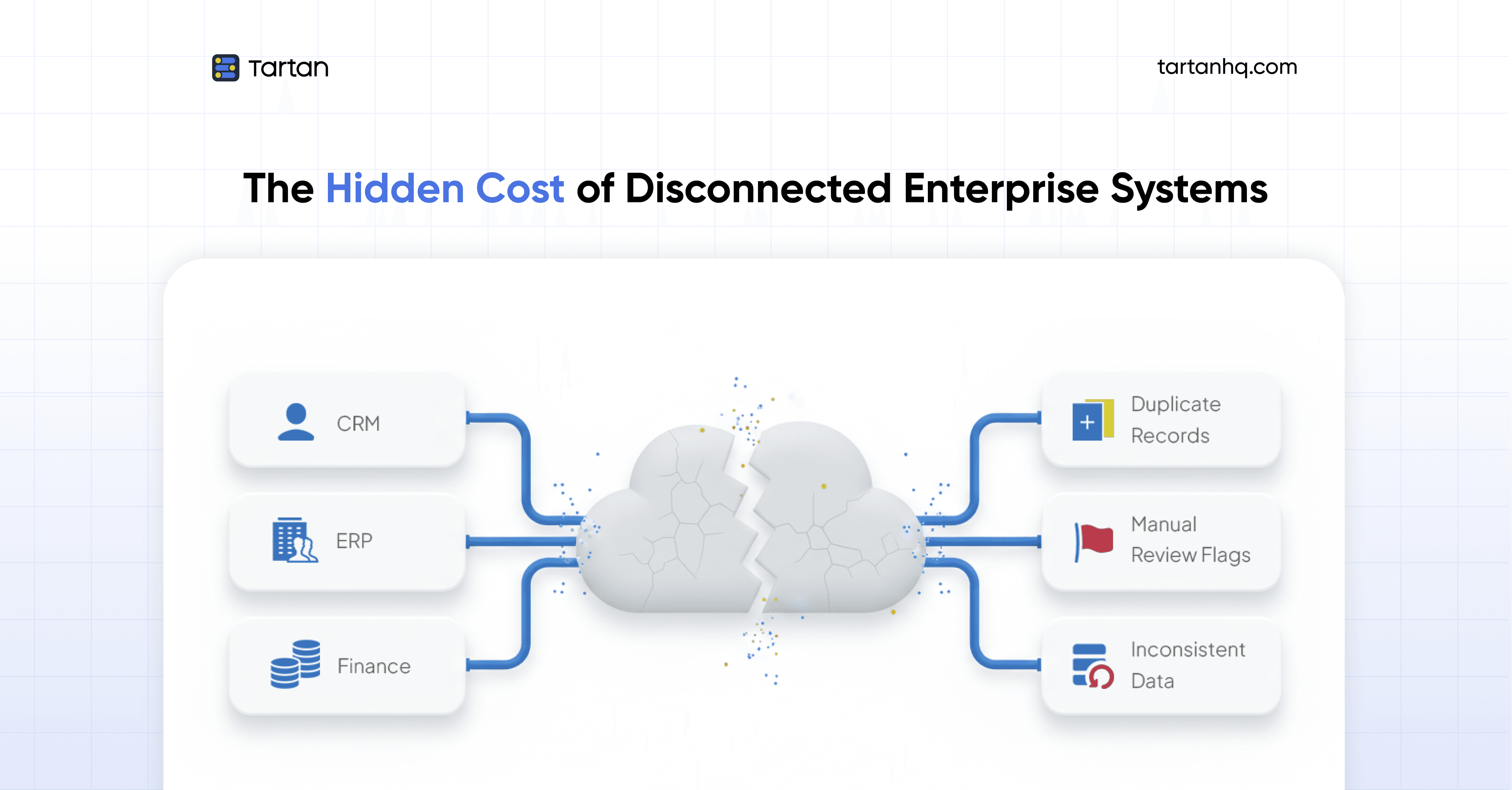
For global enterprises managing distributed teams, multi-region payroll, corporate travel programs, and complex compliance requirements, data should be an accelerant. It should compress decision cycles from weeks to hours, surface cost optimization opportunities automatically, and eliminate the administrative friction that keeps high-value teams stuck in low-value work.
Instead, for most organizations, data has become an operational anchor. Finance teams wait days for expense reconciliations that should take minutes. Compliance officers chase down inconsistencies across systems that should never have diverged. Executive dashboards display numbers that are accurate to last week's reality, not today's.
The root cause isn't a lack of data. It's that the systems containing that data operate as isolated islands, unable to communicate, validate, or synchronize with each other in ways that match the speed of modern business.
The Real Cost of Disconnected Systems
When Silos Compound Into Strategic Disadvantage
Consider what happens when your HRIS, travel management platform, expense system, payroll provider, and financial ledger don't share a common data foundation:
Expense and Travel Reconciliation Becomes a Multi-Week Process
A sales director travels to three client meetings across two countries. She books flights through your corporate travel portal, stays at approved hotels, and submits receipts through your expense platform. Meanwhile, her corporate card transactions flow into a separate reconciliation queue.
Without integration, finance teams must manually match these data points: flight bookings against card charges, hotel stays against expense reports, policy violations against approval workflows. What should be an automated close becomes a 12–15 day reconciliation cycle involving multiple team members and several rounds of back-and-forth communication.
Impact: Finance teams in disconnected environments spend 35-40% of their time on manual reconciliation activities. This translates to roughly 14-16 hours per week per finance professional dedicated to work that creates zero strategic value.
Compliance Becomes Reactive, Fragmented, and Risk-Prone
When employee data exists in six different systems with six different update schedules, compliance teams face a perpetual game of catch-up. An employee transfers from your London office to Singapore. Their HRIS record updates immediately. But their travel profile still shows UK as home country for another week. Their expense policy remains tied to London guidelines for ten days. Payroll doesn't reflect the change until the next pay cycle.
During this window, the company is operating with incomplete compliance coverage. Travel bookings may violate visa requirements. Expense submissions may be processed under the wrong tax treatment. Payroll may be calculated using incorrect jurisdiction rules.
Impact: Enterprises with fragmented systems experience data inconsistencies in 18–22% of employee records at any given time. For a 10,000-person organization, this means over 2,000 employees have at least one system showing outdated or incorrect information, creating material compliance exposure.
Decision-Making Operates on Stale Intelligence
The CFO asks a straightforward question: "What's our current travel spend run rate, and how does it compare to budget by department and region?"
In a disconnected environment, this question triggers a multi-day data gathering exercise. Someone exports travel bookings from the TMC portal. Another person pulls expense reports from the finance system. A third collects corporate card data. Then begins the painstaking work of cleaning, deduplicating, categorizing, and reconciling these datasets before any analysis can begin.
By the time leadership receives the answer, it reflects patterns from three weeks ago, not current reality. Decisions get made on lagging indicators, not real-time intelligence.
Impact: Organizations report that 60–70% of operational decisions are made using data that is at least 5–7 days old. In fast-moving business environments, this lag can mean the difference between catching a cost overrun early and discovering it after it's already materialized.
Quantifying the Scale of the Problem
The Hidden Tax of Manual Integration
Research across enterprise operations reveals consistent patterns:
Time Drain: Enterprises lose 30–40% of operational productivity to manual data reconciliation. For a finance team of 20 people, this represents 6–8 full-time equivalents doing work that should be automated.
Error Compounding: Manual data processes introduce errors at a rate of 1 in every 5–7 records. These errors cascade through downstream processes, triggering additional work to identify, correct, and validate fixes.
Decision Latency: Organizations experience 15–20% degradation in operational efficiency due to delayed access to current data. Strategic initiatives slow down. Budget reforecasts become outdated before they're complete. Optimization opportunities are identified too late to capture.
Compliance Risk: Fragmented systems create an average of 40–60 data discrepancies per 1,000 employee records. Each discrepancy represents a potential compliance gap, audit finding, or regulatory exposure.
Cost Leakage: Without real-time visibility into policy compliance, organizations lose 8–12% of their travel and expense budgets to preventable overspend - out-of-policy bookings that should have been flagged, duplicate reimbursements that should have been caught, unused tickets that should have been credited back.
Why Traditional Approaches Keep Failing
The Limitations of Legacy Integration Strategies
Most enterprises have attempted to solve the disconnected systems problem. Yet the same issues persist. Understanding why previous approaches have fallen short is essential to identifying what actually works.
Batch Sync Cycles That Can't Keep Pace
Many organizations rely on scheduled data synchronization - nightly exports, weekly refreshes, or monthly reconciliations. This architecture made sense in an era when business processes moved at a weekly cadence.
Today's operations don't wait for the batch job to run. An employee needs to book travel today based on their current home location and policy tier.
A finance team needs to close the quarter based on expenses submitted this afternoon. Compliance teams need to verify eligibility before approving a transaction, not discover a violation three days later.
Partial Datasets That Undermine Trust
When teams can only access a subset of relevant data - because it lives in another system, behind access controls, or in a format they can't easily consume - they work around the gap. They make assumptions. They use last month's data as a proxy for this month's reality. They build shadow processes to fill the void.
Each workaround introduces inconsistency. Marketing operates with one version of headcount data. Finance uses another. HR considers a third the source of truth. These discrepancies compound until no one trusts any of the numbers.
Rigid Access Controls That Create Bottlenecks
Security is critical. But in many organizations, access controls are either too permissive or too restrictive, often both at the same time.
Sensitive payroll data is exposed to managers who don't need it. Meanwhile, expense approvers can't see travel bookings to validate that the charges match approved trips. Compliance officers lack visibility into employee transfers until after they've occurred. Finance teams can't access booking data needed to forecast spend.
The result: a constant tension between security, compliance, and operational efficiency, typically resolved through manual interventions that defeat the purpose of controls in the first place.
Raw Data Without Intelligence
Organizations are accumulating massive volumes of operational data - travel bookings, expense submissions, time entries, policy exceptions, approval workflows. But most of this data sits unused because there's no practical way to transform it into actionable insight.
Finance teams can pull reports showing what was spent. They can't easily surface patterns showing where spend is trending, which behaviors are driving cost increases, or where policy changes would have the highest impact. The data exists, but the intelligence remains locked inside.
The Unified Integration Platform Approach
From Fragmentation to Flow
Forward-thinking enterprises are moving beyond point-to-point integrations and scheduled syncs to unified integration platforms. These systems don't simply move data between applications - they create an intelligent data fabric that makes information accessible, consistent, and actionable across the entire organization.
Architecture That Matches Business Reality
Unified platforms operate on fundamentally different principles:
Real-Time Synchronization: Changes propagate instantly across all connected systems. An employee update in HRIS immediately flows to payroll, travel, expenses, and compliance systems. There is no lag, no batch window, no reconciliation gap.
Bidirectional Communication: Systems don't just receive updates - they can validate, enrich, and feed information back. When a travel booking violates policy, the violation is flagged in real time, the expense system is notified, and the approval workflow adjusts automatically.
Contextual Intelligence: Rather than moving raw data, unified platforms apply business logic at the integration layer. Policy rules, compliance requirements, approval hierarchies, and cost center mappings are enforced as data flows, not after the fact.
Role-Based Access: Information is available to the right people at the right time with the right level of detail. Expense approvers see what they need to approve expenses. Finance sees what they need to close books. Compliance sees what they need to manage risk. No one sees more than necessary.
Use Case Deep Dives: Integration in Action
Corporate Travel: From Cost Center to Strategic Capability
The Traditional State
An employee books a flight through the corporate travel portal. The booking sits in the TMC's system. Days later, the charge hits the corporate card, creating a record in the card issuer's platform. When the employee submits their expense report, it goes into the expense management system. Eventually, finance manually matches these three data points, validates policy compliance, and posts to the general ledger.
This process typically takes 18–25 days and involves touchpoints from four different teams. Exceptions require even longer resolution cycles.
The Integrated Reality
With unified integration, the employee books the flight and initiates a seamless chain of automated actions:
Instant Policy Validation: As the booking is made, the system validates against current travel policy, checking fare class, advance booking requirements, preferred vendor usage, and trip justification. Policy violations are flagged immediately, not weeks later.
Automatic Expense Creation: The booking details flow directly into the expense system, creating a pre-populated expense entry that the traveler simply confirms when the trip completes. No manual data entry, no receipts to chase, no matching required.
Real-Time Card Reconciliation: When the card charge posts, it automatically links to the booking and expense entry. The three-way match happens instantly and automatically.
Immediate Ledger Posting: Once the expense is approved, the charge posts to the general ledger with the correct cost center, project code, and GL account - no manual journal entries, no month-end reconciliation backlog.
Compliance Documentation: All supporting documentation - booking confirmations, policy approvals, receipts - is automatically attached to the expense and archived according to retention policies.
Measurable Outcomes:
Reconciliation Time: Reduced from 18-25 days to real-time (effectively 0 days)
Manual Effort: Freeing finance team for higher-value work
Policy Compliance: Multifold improvement through real-time validation
Close Speed: Month-end close accelerated by days due to eliminated backlog
Cost Savings: Reduction in travel spend through better policy enforcement and duplicate prevention
HRIS Integration: One Change, Universal Update
The Traditional State
An employee receives a promotion. HR updates the HRIS with the new title, compensation, and manager. But that's just the beginning.
Finance needs to update payroll manually. The travel system needs to reflect the new policy tier. The expense system needs to update approval hierarchies. IT needs to adjust system access. Procurement needs to update spending authorities. Each of these updates happens on its own timeline, if it happens at all.
For 2-3 weeks, the organization operates with inconsistent data about this employee across a dozen systems. During this window, expenses might be routed to the wrong approver, travel bookings might apply the wrong policy, and payroll might calculate using outdated information.
The Integrated Reality
HR makes one update in the HRIS. Instantly and automatically:
Payroll Synchronization: The new compensation flows to the payroll system, ensuring the next paycheck reflects the correct amount with no manual intervention.
Travel Policy Update: The travel management system updates the employee's policy tier, fare class allowances, and preferred vendor requirements in real time.
Expense Workflow Adjustment: The expense system updates approval hierarchies, spending limits, and policy rules based on the new role.
Compliance System Notification: Compliance platforms receive the update, ensuring background checks, training requirements, and authorization levels align with the new position.
Audit Trail Creation: Every system records the change with timestamp, source, and reason, creating a complete audit trail without manual documentation.
Measurable Outcomes:
Update Latency: Reduced from 10-15 days to under 60 seconds
Data Consistency: Improved from 82% to 99.7% across systems
Manual Update Effort: Eliminated 95% of manual employee data updates
Compliance Risk: Reduced discrepancy-related compliance exposure by 88%
Employee Experience: New hires productive on day one with all systems correctly provisioned
Real-World Example: A global financial services company with 40,000 employees was processing 8,000 employee changes per month (promotions, transfers, terminations, new hires). Manual propagation of these changes across 14 connected systems consumed 3.5 FTE in HR operations, 2 FTE in finance, and created ongoing compliance risk.
After implementing unified HRIS integration:
Manual update time dropped from 14 days average to real-time
HR operations team redeployed 3.5 FTE to strategic workforce planning
Data discrepancies fell from 2,200 per month to fewer than 60
Audit findings related to access control and policy compliance dropped by 91%
Annual operational cost savings exceeded $1.8M
Scalable Process Evolution: Building for Growth
The Traditional Challenge
As organizations grow - whether through organic expansion, acquisitions, or new market entry - their operational complexity multiplies. Each new region adds payroll requirements, tax rules, and compliance frameworks. Each acquisition brings its own systems and processes. Each new product line introduces different approval workflows and cost structures.
Traditional integration approaches struggle to scale. Adding a new connection requires custom development. Modifying a workflow requires IT involvement. Expanding to a new region means rebuilding integrations to accommodate local requirements.
The result: integration becomes a constraint on growth rather than an enabler of it.
The Unified Platform Advantage
Modern integration platforms are built for evolution:
Configuration, Not Customization: New connections, workflows, and business rules are configured through administrative interfaces, not coded from scratch. This means changes happen in days or weeks, not months or quarters.
Template-Based Scaling: Common patterns - new entity setup, regional expansion, system additions - are captured as reusable templates. The second, third, and tenth times are exponentially faster than the first.
Version-Controlled Evolution: Changes to integrations, workflows, and business rules are version-controlled, tested, and deployed through managed processes. This means you can evolve without breaking what already works.
Modular Architecture: New capabilities can be added without disrupting existing integrations. Want to add automated travel forecasting? Build it on top of existing data flows without touching the underlying sync logic.
Measurable Outcomes:
New System Integration: Reduced from 6–9 months to 2–4 weeks
Regional Expansion Speed: Cut time-to-operation for new regions by 70%
Acquisition Integration: Accelerate post-merger system integration by 60%
Business Rule Changes: Implement policy or workflow updates in days vs. months
Total Cost of Ownership: Reduce ongoing integration maintenance costs by 50–70%
From Liability to Competitive Advantage
The Strategic Value of Seamless Data
When data flows seamlessly across systems in real time with built-in intelligence, the benefits compound beyond operational efficiency:
Compliance Shifts from Reactive to Proactive
Rather than discovering violations after they occur, compliance teams prevent them before they happen. Policy checks run at the point of transaction. Regulatory requirements are enforced automatically. Audit trails are created without manual effort. Risk surfaces immediately instead of during quarterly reviews.
Organizations move from "find and fix" to "prevent and assure," dramatically reducing compliance risk while eliminating the productivity drain of retrospective remediation.
Finance Teams Focus on Analysis, Not Reconciliation
When transactions are automatically matched, validated, and posted in real time, month-end close becomes a confirmation process rather than a discovery exercise. Finance professionals spend their time analyzing variances, forecasting trends, and advising business leaders instead of chasing down receipts and fixing data entry errors.
The shift from transactional work to strategic analysis transforms finance from a reporting function to a decision support function.
HR and Operations Gain Strategic Capacity
Eliminating manual data propagation across systems frees HR teams to focus on talent strategy, workforce planning, and organizational development. Operations teams can concentrate on process improvement and capability building rather than troubleshooting data discrepancies and fixing broken integrations.
Leadership Gains Decision Confidence
When executives know the numbers they're seeing are current, complete, and consistent across all systems, they make decisions faster and with greater confidence. Real-time dashboards actually reflect real-time reality. Strategic discussions focus on what to do, not whether the data is right.
This confidence accelerates the decision cycle, enabling organizations to respond faster to market opportunities and competitive threats.
The Bottom Line: Integration as Strategic Imperative
Corporate data strategies continue to fail because they were designed for a different era - one where weekly batch cycles were acceptable, manual reconciliation was unavoidable, and real-time operations weren't expected.
Today's business environment demands different capabilities:
Speed: Decisions need to happen in hours, not weeks
Accuracy: Errors are costly, both financially and reputationally
Scalability: Growth should be enabled by systems, not constrained by them
Agility: Organizations need to adapt quickly to changing markets and requirements
Trust: Leadership needs confidence that the information driving decisions is current and correct
Organizations that continue to operate with fragmented, manually-reconciled systems face compounding disadvantages:
Higher operating costs due to wasted productivity
Slower decision cycles that miss market opportunities
Elevated compliance risk from data inconsistencies
Reduced competitiveness as nimbler organizations move faster
Growing trust deficits as stakeholders lose confidence in reported information
The future belongs to organizations that make unified integration a core strategic capability. By connecting disconnected systems through intelligent, real-time integration platforms, they create operational foundations that are more agile, more compliant, more efficient, and ready to scale.
This isn't a technology project. It's a strategic transformation that turns data from a liability into your most valuable competitive asset.