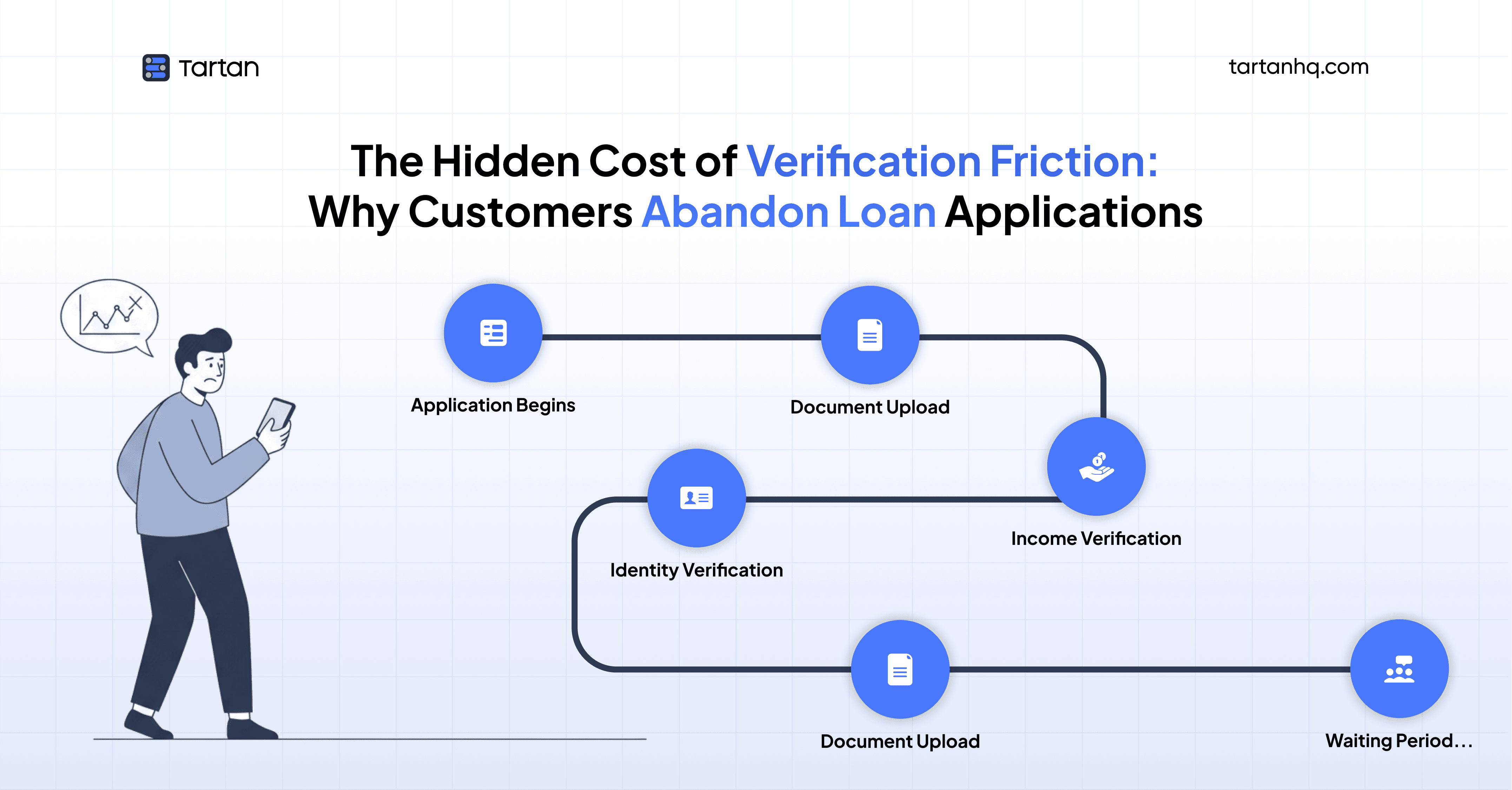
Every year, financial institutions lose billions in potential revenue to a problem that often goes unnoticed in boardroom discussions: verification friction.
While executives focus on interest rate competitiveness and marketing spend, a silent killer lurks in the loan application process itself, quietly driving away qualified borrowers before they ever reach the finish line.
The numbers tell a sobering story. According to recent industry data, the average loan application abandonment rate hovers between 60-80%, with verification and documentation requirements accounting for the largest share of drop-offs.
That means for every ten people who start your loan application with genuine intent to borrow, only two to four will actually complete it.
The rest simply walk away, often to competitors who've made the process easier.
The Real Cost of "Just One More Document"
Consider the typical customer journey. An excited, motivated loan applicant starts your application at 2 PM on a Tuesday, enters her basic information, and then hits the verification wall.
First, she needs to upload her driver's license. Then bank statements from the last three months. Then tax returns. Then proof of business ownership. Each request feels reasonable in isolation, but collectively they create a mounting sense of burden. She doesn't have her tax returns readily available, they're filed away somewhere at home. She tells herself she'll come back to it later.
She never does.
This scenario plays out thousands of times daily across lending institutions. The cost isn't just the lost loan, it's everything that went into acquiring Sarah as a lead in the first place. Marketing spend, sales team time, brand awareness efforts, and the initial application processing all become sunk costs the moment she decides the friction isn't worth the effort.
When you calculate the true financial impact, the numbers become staggering.
If your customer acquisition cost is Rs 300 per applicant and you're seeing a 70% abandonment rate, you're effectively paying Rs 1000 to acquire each completed application. Scale that across thousands of monthly applications, and you're looking at millions in wasted acquisition spend annually.
Where Borrowers Actually Drop Off
The verification journey isn't uniformly difficult. There are specific pressure points where customers consistently abandon applications, and understanding these moments is critical to addressing the problem.
The verification journey isn't uniformly difficult. There are specific pressure points where customers consistently abandon applications:
Document upload stages represent the single largest abandonment point. When customers are asked to photograph, scan, or upload documents, conversion rates typically drop by 40-50%. The reasons vary, from the simple inconvenience of finding physical documents to technical difficulties with file formats and upload interfaces.
Mobile users face even steeper challenges when toggling between banking apps, photo galleries, and your application portal.
Income verification creates another significant friction point, particularly for self-employed borrowers, gig workers, and those with non-traditional income sources. Traditional verification methods require tax returns, profit and loss statements, and bank statements covering extended periods.
For someone who files quarterly taxes or receives income through multiple platforms, assembling this documentation becomes a multi-day project rather than a simple task.
The waiting period between submission and verification represents a third critical drop-off window. In an era of instant gratification, asking customers to wait 24-48 hours while you manually review documents creates anxiety and uncertainty.
Many borrowers, especially those comparison shopping, will simply move forward with whichever lender responds first. Every hour of delay increases the likelihood that your competitor makes the offer before you do.
Identity verification, while seemingly straightforward, introduces its own friction when handled through legacy methods. Requiring customers to visit a branch for in-person verification or to notarize documents creates geographic and time constraints that many modern borrowers simply won't tolerate.
The expectation has shifted, customers now assume they can complete financial transactions entirely online, and any requirement that breaks that assumption feels archaic.
The Psychology of Application Abandonment
Understanding why customers abandon applications requires looking beyond logistics to examine the psychological factors at play:
Motivation depletion: When borrowers begin an application, they're operating in a state of high motivation and relatively low cognitive load. They've made the decision to borrow, they've chosen your institution, and they're ready to move forward. Each verification step incrementally depletes their motivation while simultaneously increasing cognitive load. The more effort required, the more opportunities for doubt to creep in. Customers begin questioning whether they really need the loan, whether the amount is appropriate, whether now is the right time. These aren't concerns they had when they started, they're concerns created by the friction itself.
Perceived distrust: Excessive documentation requests can signal to customers that you don't trust them or that approval is unlikely. When a borrower is asked for multiple forms of income verification, they may interpret this as skepticism about their financial stability, even when you're simply following standard procedures. This perceived lack of trust can damage the customer relationship before it even begins.
Completion anxiety: The longer and more complex an application becomes, the more customers worry about making mistakes or providing incorrect information. This anxiety can become paralyzing, particularly when customers are unsure whether they have the "right" documents or whether their financial situation will pass muster. Rather than risk rejection, some borrowers abandon the process entirely.
What Modern Verification Should Look Like
The solution to verification friction isn't eliminating verification, it's reimagining how verification happens. Leading digital lenders have proven that it's possible to maintain rigorous compliance and risk standards while dramatically reducing customer effort.
The shift toward API-driven verification represents the most significant advancement in reducing friction. Rather than asking customers to manually provide bank statements, modern verification APIs can securely access this information directly from financial institutions with the customer's permission.
What previously required uploading multiple PDF files now happens with a few clicks and completes in seconds.
Similarly, income verification APIs can pull data directly from payroll providers, tax filing services, and employment databases.
A customer who would previously need to track down pay stubs or tax returns can now verify their income through a simple authentication with their payroll provider. The verification is actually more reliable than documents, which can be altered or fabricated, while being exponentially easier for the customer.
Identity verification has evolved from document uploads to sophisticated multi-factor approaches. Modern solutions combine document scanning with biometric verification, database checks, and device intelligence to create a more accurate identity verification that feels less burdensome to the customer.
The technology can extract data from a driver's license photo, verify it against government databases, and confirm the person holding the document matches the photo through facial recognition, all within 30 seconds.
The key is orchestration.
The most effective implementations don't just swap manual processes for API calls, they intelligently layer verification methods based on risk, customer segment, and loan parameters. A customer applying for a small personal loan might clear all verification hurdles with just bank account authentication and identity verification.
A customer seeking a large mortgage would naturally undergo more extensive verification, but even there, the process can be streamlined through smart API integration.
Measuring the True Impact of Reducing Friction
When financial institutions successfully reduce verification friction, the results extend far beyond simple abandonment rate improvements:
Conversion gains of 30-50% are common when friction is substantially reduced. More importantly, these aren't just incremental gains among marginally interested borrowers, they often represent qualified customers who would have otherwise gone to competitors. The quality of converted applications frequently improves because customers complete the process while their motivation and financial situation are stable rather than days or weeks after initiating the application.
Processing costs decrease substantially when verification becomes automated. Manual document review, follow-up communications, and exception handling all require staff time that scales linearly with application volume. Automated verification scales without proportional cost increases, making each additional application more profitable than the last.
Customer lifetime value improves when the first experience is frictionless. A borrower who completes an application easily is more likely to return for future lending needs and more likely to recommend your services. The compound effect of retention and referrals makes friction reduction one of the highest-ROI improvements available to lending institutions.
Taking Action on Verification Friction
Addressing verification friction starts with measurement. Most lenders know their overall abandonment rate but lack visibility into where specifically customers drop off. Implementing analytics that track abandonment at each verification stage provides the foundation for improvement.
From there, the priority should be eliminating the highest-friction, highest-volume verification points. For most lenders, this means bank account verification and income verification. These two integrations alone can reduce friction for the majority of applications while delivering measurable ROI within months.
The competitive landscape continues to shift in favor of low-friction experiences. Borrowers increasingly expect lending to feel like other modern digital experiences, fast, intuitive, and mobile-friendly. Financial institutions that cling to legacy verification processes aren't just inconveniencing customers, they're actively selecting against themselves in favor of more agile competitors.
The question isn't whether to address verification friction but how quickly you can act on it. Every day of delay represents dozens or hundreds of qualified borrowers who started your application and walked away. Some of them are completing applications with your competitors right now, experiencing the streamlined verification you could be offering. The hidden cost of verification friction is only hidden until you calculate what you're actually losing.