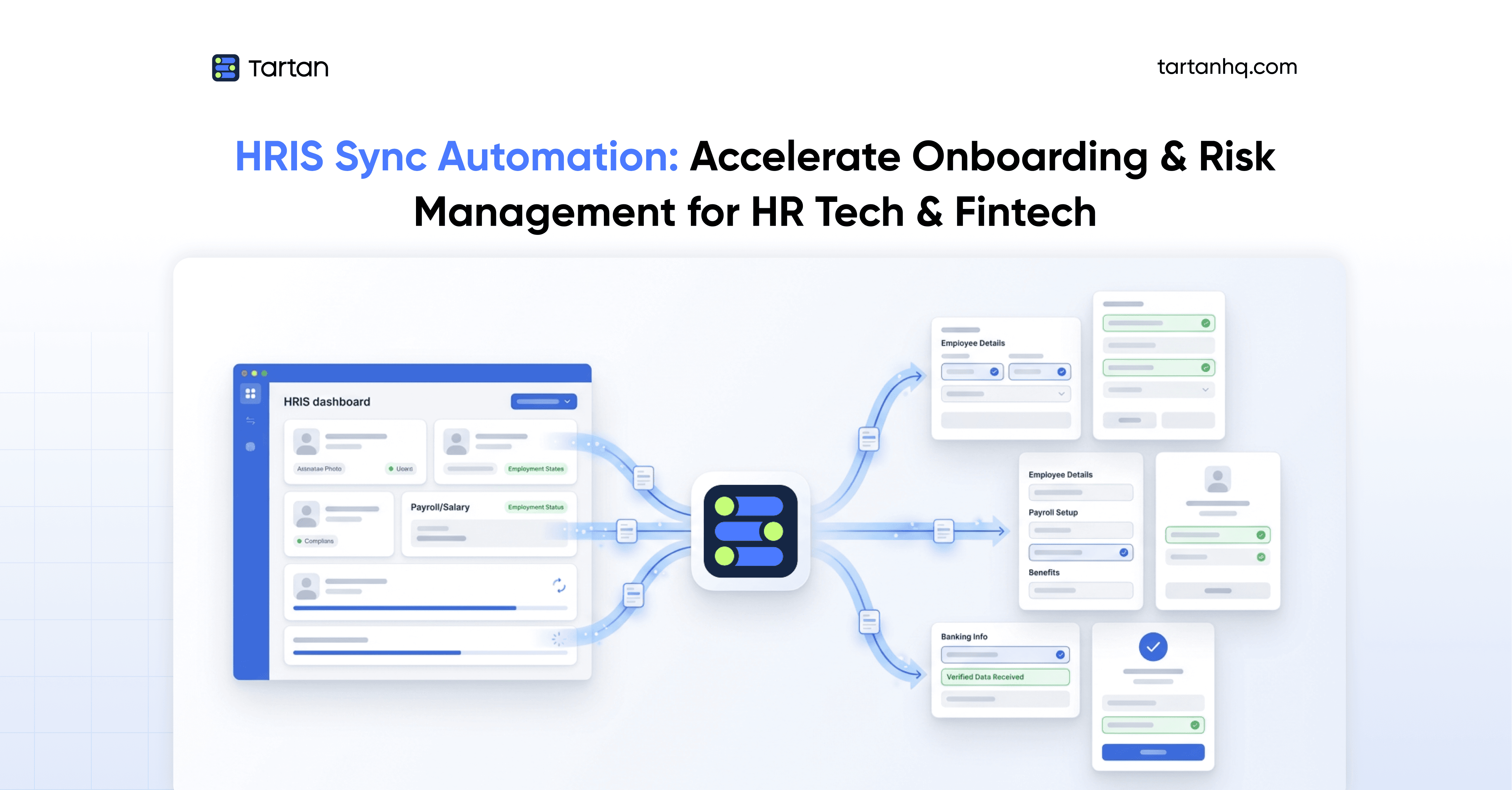
Somewhere inside every HR Tech or Fintech product, there’s a quiet operational truth that most teams don’t say aloud: your onboarding flow is only as strong as your data.
And for most platforms, the data problem doesn’t come from sophisticated AI models or complex risk rules.
It comes from something far simpler - and far more painful: Manual employee data collection.
If you’re a product leader, a CTO, a PM, or a founder in HR Tech, Payroll, Benefits, Lending, Insurance, or Workforce Management, you’ve seen this firsthand.
Product teams build extra steps, fallback states, and complicated validation rules.
Engineering teams manage exceptions, reconciliation logic, and support queries.
Ops teams fix mismatches, chase documents, and correct payroll identifiers.
Risk and compliance teams navigate inconsistent or unverifiable inputs.
HR Teams escalate because “employees are entering the wrong info again”.
This is the context in which automated HRIS-driven onboarding is no longer an enhancement.
It’s an operational unlock.
The Real Bottleneck Isn’t Adoption. It's Data Dependency.
Most companies assume onboarding friction is a UX problem.
The truth is more structural: your product relies on data that employees shouldn’t have to supply manually.
And because of that, every team in the company inherits the pain:
Product teams design fallbacks “in case the user doesn’t have their salary details handy.”
Sales teams promise enterprise clients “we’ll help employees fill the forms.”
Risk/Underwriting teams operate blind with incomplete or self-entered data.
Ops teams chase mismatches that should never exist.
This isn’t an onboarding issue.
It’s a broken data collection model.
Manual inputs create manual problems.
HRIS-synced onboarding eliminates them.
Why Mid-Funnel Buyers Need to Understand HRIS Sync at an Operational Level
At this stage of the buyer journey, your ICP is no longer asking,
“What is HRIS Sync?”
They’re asking,
“What does it solve for me internally, operationally, and strategically?”
This is where the real story unfolds.
Impact #1: Onboarding becomes a deterministic process - not a probability game
Decision-makers hate unpredictability.
Manual onboarding introduces randomness:
Will the employee type their name correctly?
Will they know their salary structure?
Will dependents match employer records?
Will they upload documents that comply?
With HRIS sync, onboarding stops being a gamble.
It becomes deterministic, consistent, and standardized.
Employee details → fetched
Salary breakups → fetched
Dependents → fetched
Identifiers → verified
Compliance fields → standardized
When onboarding is deterministic, your funnel becomes forecastable.
And forecastability is gold for product teams, revenue teams, and enterprise contracts.
Impact #2: Compliance becomes built-in instead of enforced downstream
Without verified HRIS data, your product introduces compliance risk at the very first step.
Incomplete KYC
Incorrect salaries
Wrong dependents
Mismatched joining dates
Illegible uploads
These errors eventually show up during audits, underwriting disputes, or employer escalations.
HyperSync changes this by ensuring data is:
Pulled from the employer’s source of truth
Verified through consent
Normalized across 200+ HRIS schemas
Logged with audit trails
Consistent across every user
This removes a huge operational load from compliance teams and protects you during scale.
Impact #3: Product & Engineering stop wasting time on “data plumbing”
Ask any PM or engineering leader what consumes their teams, and they’ll tell you it’s not features -
it’s cleanup, reconciliation, fallback logic, and edge cases created by incomplete data.
HRIS Sync eliminates:
User-typed field validations
Multiple onboarding states
Data mismatch tickets
Engineering workarounds
Manual mapping logic
Schema transformations
Product roadmaps finally move away from “fixing onboarding” and toward building differentiating value.
Impact #4: Enterprise sales becomes dramatically easier
Enterprise buyers ask the same questions before signing:
“Will your tool create extra work for my HR team?”
“Can employees onboard without filling forms?”
“Does this integrate with our HRIS?”
“Will my payroll/benefits/lending workflow stay accurate?”
With native HRIS sync, your sales team can confidently say:
“Yes - employee data syncs automatically.
No extra forms.
No manual mapping.
No HR involvement.”
Your platform aligns with enterprise workflows instead of interrupting them - which shortens sales cycles and deepens enterprise stickiness.
Impact #5: Underwriting, personalization, and decision engines become exponentially smarter
Products that rely on employee attributes - salary, dependents, DOJ, employment type - perform far better when the data is verified at the source.
Lenders see lower default rates.
Insurers reduce claim disputes.
Payroll & benefits apps eliminate incorrect enrollments.
Financial apps personalize more accurately.
When your decisioning engine stops relying on user-entered data, its output improves automatically.
The quality of your data becomes a moat - not a liability.
Why HyperSync Is Structurally Different (and Why That Matters to Buyers)
Your mid-funnel reader now understands the why.
Next, they need clarity on the how.
HyperSync isn’t “yet another integration.”
It’s a layer of abstraction over India’s fragmented HRIS universe.
Here’s what differentiates it:
One API works across 200+ HRIS systems
A unified schema eliminates HRIS inconsistencies
Consent-led flows ensure legal and compliance readiness
Salary, employee, and dependent data is normalized
Data refreshes in real time for time-sensitive use cases
Error handling, retries, normalization are all automated
Enterprise-grade reliability with sub-second fetch times
To a decision-maker, this isn’t just a feature.
It’s removal of uncertainty across the entire onboarding journey.
The Hidden ROI: Operational Relief Across Every Team
You Solve | You Increase |
Drop-offs during onboarding | Conversion |
Time to activation | Data reliability |
HR/escalation tickets | User satisfaction |
Data mismatch issues | Sales win rates |
Compliance deviations | Speed of underwriting |
Engineering overhead | Enterprise-readiness |
Employer frustration | Automation and Cross-system data unification |
This is not a marginal improvement.
It’s structural optimization across your entire product org.
The Final Shift: From “Added Convenience” to “Strategic Infrastructure”
By the time the reader reaches this point, they must internalize one thing:
Automated HRIS data sync is not an onboarding feature. It is the infrastructure that determines whether your onboarding - and therefore your product - can scale.
Because every downstream action your user takes depends on accurate employee data.
If the foundation is manual, the entire workflow inherits friction.
If the foundation is synced and verified, your entire product unlocks velocity.
And this is the moment you realizes:
“This isn’t something we can postpone. This is something we need before our next growth stage.”