Corporate NPS enrollment should be straightforward: employees opt in during onboarding, contributions begin automatically, and retirement savings accumulate over decades. The reality for most HR teams looks different.
Employees receive paper subscriber registration forms requiring PAN copies, address proofs, photographs, bank details, and nominee information. Forms sit incomplete for weeks. When submitted, documents are blurry, outdated, or mismatched. HR teams spend hours chasing corrections.
Once collected, manual verification begins: cross-checking PAN against government databases, validating address proofs, scrutinizing photographs for PFRDA compliance. Then comes submission to the Point of Presence via courier. More waiting. More rejections for minor discrepancies.
PRAN cards arrive 4-6 weeks later - often after the first salary has been processed. Employer contributions that should have started day one are delayed. Employees lose months of tax-advantaged savings. HR teams field frustrated inquiries.
For organizations hiring 50-200 employees monthly, this paperwork-heavy process creates a persistent administrative burden.
The KYC Compliance Bottleneck
PFRDA regulations require strict KYC compliance. Employees must prove:
Identity: PAN card mandatory for tax linkage and claiming Section 80CCD benefits.
Address: Utility bills, Aadhaar, voter ID, or passport proving current residence.
Photograph: Passport-sized photo meeting specific dimensions for PRAN cards.
Bank account: Proof of account for eventual withdrawals, preventing fraud.
Nominee details: Beneficiary information with names, relationships, and allocation percentages.
Each document must meet format requirements. Scanned copies must be clear. Signatures must match. Any discrepancy triggers rejection and the cycle repeats.
This compliance rigor protects subscribers and maintains system integrity. But manual processes create enormous friction.
Why Manual Processes Fail at Scale
Administrative burden: 100 monthly enrollments means 500+ documents to collect, hours reviewing submissions, following up with 30-40% who submitted incomplete forms, managing courier costs and rejections.
Employee friction: Employees must print documents, get photographs, track down address proofs, fill forms manually. Delayed PRANs mean delayed contributions and frustration.
Compliance gaps: Expired documents between submission and processing. Data entry errors causing failures. Fragmented audit trails across physical files, scans, and email records.
Escalating costs: 45 minutes per enrollment × 100 monthly = 75 hours of HR time. 20-30% rejection rates multiply rework. Each month of delay means lost employer contributions and employee tax benefits.
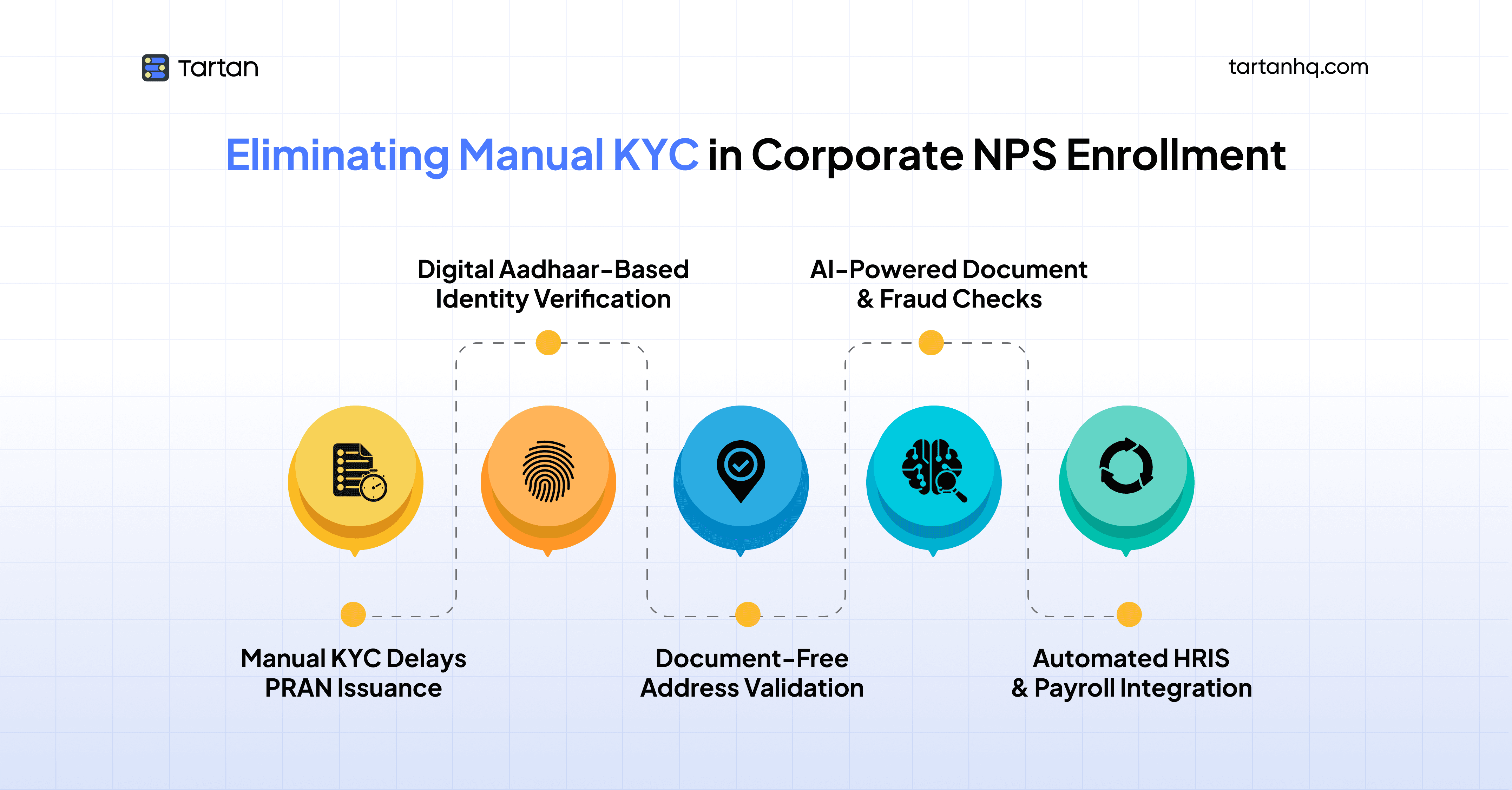
Digital KYC: The Technology Solution
Digital KYC transforms corporate NPS enrollment by automating identity, address, and document verification while maintaining full regulatory compliance.
Aadhaar-Based Identity Verification
India’s Aadhaar infrastructure enables instant digital identity verification. When an employee provides their Aadhaar number and completes OTP-based authentication, their identity is verified against UIDAI’s database in seconds - no physical PAN card photocopies required.
This verification:
Confirms the employee’s name, date of birth, and photograph match Aadhaar records
Validates that the person initiating enrollment is actually the Aadhaar holder (via OTP sent to registered mobile)
Creates an audit trail of the verification timestamp and method
For organizations, this eliminates manual PAN card verification while actually improving authentication quality - Aadhaar verification is more secure than visual inspection of photocopied documents.
Digital Address Validation
Rather than requiring employees to submit utility bills or rental agreements, digital address verification validates current addresses through:
Postal database matching: Entered addresses are validated against official postal codes and location databases to ensure they’re legitimate, deliverable addresses.
Geolocation verification: Mobile device location data can confirm the employee is actually at the claimed address when enrollment occurs, adding another layer of validation.
Document-free updates: When employees change addresses, digital systems can verify new addresses without requiring fresh address proofs - the validation happens through databases rather than document submission.
This approach reduces enrollment friction (no hunting for address proofs) while maintaining verification integrity.
AI-Powered Document Processing
When documents are required - bank account proofs, nominee relationship certificates - AI-powered document processing extracts and validates data automatically:
Optical character recognition (OCR): Scans uploaded documents and extracts text with high accuracy. Bank account numbers, IFSC codes, names - all captured without manual data entry.
Document type detection: Automatically identifies whether an uploaded file is a bank statement, cancelled cheque, or passbook scan, then applies appropriate validation logic.
Fraud detection: Analyzes documents for signs of tampering or forgery. Inconsistent fonts, editing artifacts, or metadata anomalies trigger alerts for manual review.
Field validation: Extracted data is validated against known patterns. IFSC codes are checked against bank databases. Account numbers are verified for correct length and format.
HR teams receive processed, validated data instantly rather than spending hours manually reviewing and transcribing information.
Photograph Verification
Digital systems handle photograph compliance through:
Selfie capture: Employees submit photographs via smartphone selfies rather than visiting photo studios. The system validates photo quality, dimensions, and clarity automatically.
Biometric matching: Captured selfies are matched against Aadhaar photographs to confirm the same person appears in both, preventing impersonation fraud.
PFRDA compliance checks: Photos are automatically validated against PFRDA requirements - proper dimensions, clear visibility, neutral background. Non-compliant photos are rejected immediately with specific guidance on corrections.
This eliminates the common rejection scenario where physically submitted photographs don’t meet technical specifications.
The Digital Enrollment Experience
Employee journey (10 minutes total):
Receives digital enrollment link during onboarding
Enters Aadhaar number, completes OTP verification (identity confirmed, data auto-filled)
Uploads bank proof (AI extracts account details, validates against databases)
Captures selfie (system validates quality, matches Aadhaar photo)
Enters nominee details (system validates allocations)
Reviews and e-Signs
PRAN issued within 24 hours, contributions begin first salary
HR admin journey:
Configure enrollment parameters once (contribution %, eligibility, default fund)
Monitor real-time dashboard during enrollment period
Review exceptions only (less than 5% vs. 100% in manual processes)
Automated contribution reports for payroll integration
The Business Impact
Organizations implementing digital NPS enrollment see dramatic operational improvements:
Enrollment completion rates: Manual processes see 60-70% completion within first month as employees procrastinate paperwork. Digital processes achieve 90%+ same-day completion because friction is eliminated.
Time to PRAN: Reduced from 4-6 weeks to 24-48 hours. Employees start receiving contributions from their first salary.
HR productivity: 75+ hours monthly saved per 100 enrollments. HR teams redeploy this capacity to strategic initiatives rather than document processing.
Compliance confidence: Complete digital audit trails, automated validation against regulatory requirements, reduced risk of non-compliant enrollments slipping through.
Employee satisfaction: Benefits activation happens instantly rather than after frustrating delays, improving overall onboarding experience and employer brand.
Tartan HyperSync: Purpose-Built Infrastructure for Corporate NPS
While digital KYC capabilities exist in various forms, implementing them effectively for corporate NPS enrollment requires specialized infrastructure that integrates identity verification, address validation, and document processing while connecting to HRIS and payroll systems.
Tartan HyperSync provides this purpose-built platform for corporate benefits administration, with deep NPS enrollment capabilities:
Unified verification layer: Identity verification via Aadhaar, address validation through postal databases, document processing with AI-powered OCR, and fraud detection - all accessible through a single API integration.
HRIS integration: Connects to Darwinbox, Keka, Workday, greytHR, and 100+ other HRIS platforms through unified API. When a new employee is added to HRIS, NPS enrollment workflow triggers automatically. No manual roster uploads.
Payroll synchronization: After PRAN issuance, contribution amounts sync automatically to payroll systems. Employer and employee NPS deductions process each cycle without manual intervention.
Regulatory compliance: Built-in validation against PFRDA requirements ensures every enrollment meets regulatory standards. Audit trails maintained automatically for compliance reviews.
White-label employee interface: Customizable enrollment portal that matches corporate branding. Employees experience seamless NPS enrollment as part of their company’s benefits ecosystem, not a disconnected third-party form.
Organizations using HyperSync for NPS administration eliminate the paperwork bottleneck entirely. New hires complete enrollment in minutes during onboarding. PRANs issue within 24 hours. Contributions begin with first salary. HR teams spend minutes on exception management rather than hours on document processing.
Conclusion
Corporate NPS represents one of the most valuable retirement benefits Indian employers can offer - employer contributions deductible up to 14% of salary under Section 80CCD(2), employee contributions eligible for additional ₹50,000 deduction under Section 80CCD(1B), and market-linked growth potential creating long-term wealth.
Yet manual KYC processes have made enrollment so administratively burdensome that many organizations struggle to realize this value. HR teams spend hundreds of hours processing paperwork. Employees wait weeks for PRANs. First-month contributions are lost. The benefit that should enhance employee satisfaction becomes a source of frustration.
Digital identity verification, address validation, and document processing remove these bottlenecks while strengthening compliance through automated validation and comprehensive audit trails. This isn’t about cutting corners on regulatory requirements - it’s about meeting those requirements more effectively through technology.
For HR and payroll teams managing corporate NPS programs, the shift from paper forms and courier cycles to digital workflows delivers measurable impact: 75+ hours monthly saved per 100 employees, enrollment completion rates above 90%, PRAN issuance within 24 hours, and contributions beginning with first salary. More importantly, it transforms employee benefits from administrative burden to strategic advantage.
When NPS enrollment happens seamlessly during onboarding, when contributions begin immediately, when employees receive their PRANs within a day rather than waiting weeks - the benefit program delivers on its promise. Employees build retirement security from day one. Employers provide meaningful value that strengthens retention. HR teams operate strategically rather than being buried in document verification.
Tartan HyperSync’s unified verification platform makes this transformation achievable for organizations of any size. By combining digital KYC capabilities with deep HRIS and payroll integration across 100+ systems, it enables corporate NPS administration that scales effortlessly while maintaining PFRDA compliance.
The question for corporate benefits leaders isn’t whether to digitize NPS enrollment - the operational case is clear, the technology is proven, and employee expectations for digital-first experiences are non-negotiable. The question is how quickly they can eliminate the manual bottlenecks preventing their workforce from accessing one of India’s most powerful retirement savings vehicles from the day they join the organization.