Claims disputes rarely originate at the claims desk.
They are the downstream consequence of fragmented, time-boxed verification decisions made earlier in the policy lifecycle.
Most insurance enterprises still treat verification as a point in time compliance step executed at onboarding, occasionally refreshed at underwriting, and then re-performed during claims. Each phase operates with different data, vendors, assumptions, and audit trails.
This evidence discontinuity is structural, not incidental.
Verification outputs generated at onboarding are typically stored as static artifacts PDFs, images, or pass/fail flags without preserving how, when, and with what confidence those facts were established.
When a claim is filed months or years later, claims and investigation teams cannot rely on this legacy data because it lacks context, versioning, and defensibility.
Verification outputs created at onboarding are usually stored as static artifacts or binary flags. This evidence discontinuity is structural:
Facts verified at onboarding are not reliably reusable at claims
Risk signals decay but are not re-validated
Investigations restart from scratch due to lack of trusted historical context
When these changes are not monitored or captured through consented, trusted sources, insurers lose visibility into when the change occurred. At claims stage, any mismatch appears as misrepresentation because there is no verified record separating pre-issuance facts from post-issuance changes.
The result is predictable:
Higher claim disputes
Longer investigation cycles
Increased repudiation risk
Regulatory and audit exposure
Rising claims handling cost per policy
Continuous verification addresses this structural gap by ensuring that every verified fact remains usable beyond the moment it was captured. Evidence is preserved with source, consent, and confidence, and is progressively updated when material changes occur.
This allows insurers to rely on the same verified record across onboarding, servicing, renewals, and claims, instead of re-establishing truth under dispute conditions.
What “continuous verification” means in an insurance context
Continuous verification is not about running checks more frequently.
It is about persistently maintaining the validity of verified facts that materially impact risk, coverage, and claim eligibility.
Continuous verification addresses the structural gap by converting verification from a one-time gate into a persistent control layer. Instead of treating identity, address, employment, income as static inputs, these attributes are maintained as living evidence tied to the policy.
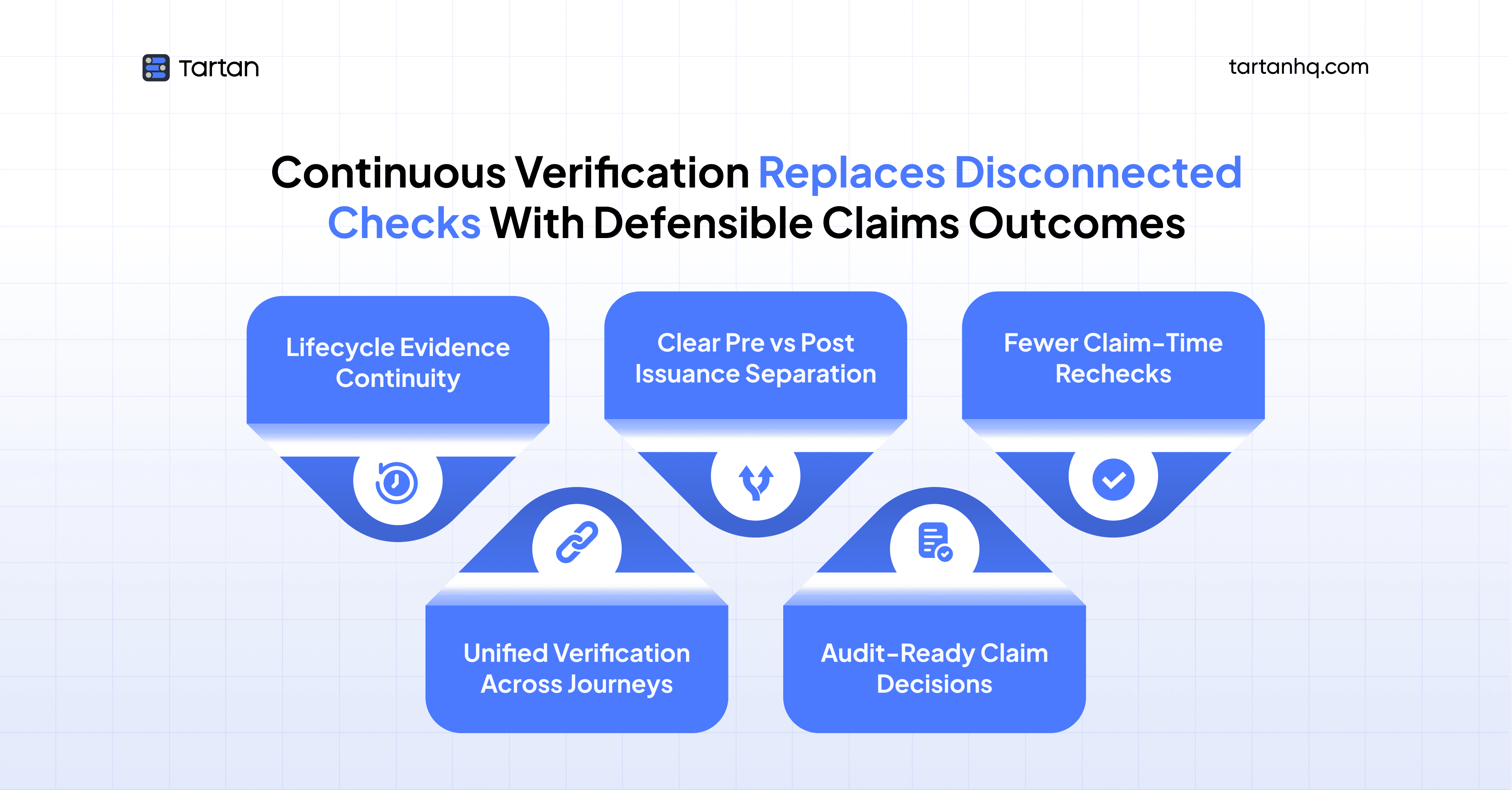
From an insurance control perspective, continuous verification enables:
Clear separation of pre-issuance facts and post-issuance changes
Verification refreshed only on material risk changes
One consistent risk view across underwriting, servicing, and claims
Fewer claim-time rechecks, faster settlements
Audit-ready evidence for regulators
The practical outcome is not more verification activity, but better reuse of verified information. Claims decisions rely on accumulated evidence rather than last-mile snapshots.
Why claims disputes increase as verification stacks fragment
Insurance verification stacks evolve reactively because risk, regulation, and product expansion rarely follow a single architectural roadmap. Each new fraud pattern, regulatory clarification, or line of business is addressed locally to protect speed and compliance.
As a result, insurers accumulate parallel verification capabilities that do not interoperate or reinforce each other:
Multiple identity vendors with inconsistent matching and acceptance standards across journeys
Isolated address checks run separately at onboarding, servicing, and claims
Siloed income, and employment checks limited to specific products or rules
Claims teams run separate checks because earlier verification cannot be reused
This fragmentation creates verification asymmetry across journeys. A customer can be verified enough to issue a policy but “insufficiently verified” to settle a claim.
When the same attribute is validated using different sources, vendors, or standards at different stages, discrepancies are inevitable. The operational consequence is that claims disputes rise even when fraud rates remain stable.
1. Verified facts are not reusable across journeys
In most insurance enterprises, verification performed at onboarding or underwriting is not usable at claims because it was designed for entry approval, not downstream defensibility. Outputs are captured as documents or binary decisions, without preserving decision context, confidence, or temporal validity.
When a claim is filed, this information does not satisfy claims or investigation thresholds, so it cannot be relied on for adjudication.
As a result, claims teams are structurally forced to re-establish facts:
Identity, address, and employment are revalidated at claims, even if previously accepted
Investigations depend on new data pulls, not historical verification
Claims decisions are based on claim-time snapshots, not lifecycle evidence
Any discrepancy between past acceptance and current validation escalates into a dispute
This is not a process gap. It is a verification architecture issue where evidence is generated but not preserved in a form that supports claims-stage decisioning, regulatory scrutiny, or dispute resolution.
2. Risk attributes decay but are not monitored
Risk in insurance is not static after policy issuance, but verification frameworks are.
In reality, several material risk variables change during the policy term, especially in long-duration life and health products and employer-linked covers. When these changes are neither monitored nor captured through trusted data sources, insurers lose clarity on whether a mismatch at claims represents fraud, non-disclosure, or legitimate post-issuance change.
This creates predictable exposure across products:
Occupation changes shift risk but are rarely tracked after issuance
Income changes break sum-assured and pricing assumptions
Address changes disrupt location-based risk and eligibility
Employer exits invalidate group coverage without timely updates
When these shifts surface only at claim time, insurers lack temporal evidence to determine when the risk changed and whether the insurer was aware or should have acted.
Claims teams are then forced to interpret data gaps as potential misrepresentation, escalating disputes and investigations. This is not a customer behavior issue; it is a control gap caused by static verification applied to dynamic risk.
3. Static verification data undermines lifecycle claims defensibility
For every disputed claim, the insurer must establish what information was available at the time of policy issuance, what information changed during the policy term, and whether those changes were disclosed, detected, or acknowledged.
In most insurance systems, verification overwrites prior data instead of preserving it. Updated addresses, employment details, income records replace earlier values without retaining historical context.
At the claims stage, insurers can see the latest state, but not the evolution of risk. This collapses the distinction between pre-issuance facts and post-issuance changes, which is the core determinant in non-disclosure disputes.
The absence of verification creates predictable exposure:
No discrepancy timeline
No proof of prior acceptance
Claim-time view only
Regulatory bias toward policyholder
Weak decision traceability
Without time-stamped, versioned evidence, insurers are forced to defend decisions using incomplete context. This increases dispute rates and prolongs investigations not because claims are invalid, but because evidence continuity is missing.
4. Claims investigations run without lifecycle signal history
Claims investigations rely on claim-time data because prior verification cannot be reused. Earlier checks may exist, but they are not structured, comparable, or trusted enough to support decisions. Investigators therefore assess risk using the latest snapshot, not the policy’s verification history.
What this means in practice:
Earlier verification is not admissible for claims decisions.
Investigators re-run basic checks instead of analysing anomalies.
Risk is assessed without knowing what was accepted earlier.
Any mismatch is treated as suspicious due to missing context.
Verification data is built for policy issuance, not for future scrutiny. It is stored without decision context, confidence, or timing, making it unusable at claims. When a claim arises, teams cannot rely on prior acceptance and must re-verify from scratch. This turns missing context into investigations and investigations into disputes.
Evidence continuity: the missing control layer in insurance operations
Evidence continuity is the missing operational control between underwriting decisions and claims outcomes.
Insurers verify customers at entry to issue policies, but they do not preserve those decisions in a form that can be reused, defended, or audited later. As a result, claims teams cannot rely on what was previously accepted and are forced to reassess facts without historical context.
This means each verified attribute is stored with enough context to be reused and defended later:
Source – which system, authority, or dataset validated the fact
Confidence score – how reliable the verification was at that time
Validity window – how long the verification remains usable
Journey linkage – how the same fact applies across onboarding, servicing, renewals, and claims
Instead of treating verification outputs as disposable checkpoints, insurers maintain a single evidence record per policy that evolves over time. Each verified fact - identity, address, occupation, income, medical disclosure, eligibility is stored with its original acceptance context and retained even when updates occur. New information does not replace earlier data; it is layered on top of it.
Facts are versioned, not overwritten, so insurers can see what was verified at issuance, what changed later, and when that change occurred. Operationally, this creates a continuous decision trail. Claims and investigation teams can reference the exact state of evidence that underwriting relied on, rather than reassessing facts in isolation.
Continuous verification reduces non-disclosure disputes by preserving decision context
The dispute usually hinges on whether a fact was inaccurately declared at policy issuance or whether it changed later without insurer visibility. Traditional verification models cannot answer this clearly because they capture facts at a single point and lose context over time.
High-impact dispute triggers that HyperVerify directly addresses include:
Identity inconsistencies that surface between onboarding and claims
Address changes that affect eligibility, fraud linkage, or policy applicability
Income mismatches that break sum-assured or coverage assumptions
Employment or employer changes that impact group policy eligibility
HyperVerify reduces these disputes by maintaining continuity of verification across the policy lifecycle. Identity, address, income, and employment are captured with source-level evidence at onboarding and preserved with timestamps, confidence, and consent.
When changes occur, they are logged as updates rather than overwrites, ensuring the insurer retains a clear record of what was verified, when it was accepted, and what changed later.
At claims or investigation stage, insurers can rely on this evidence trail to establish:
What customer information was verified and accepted at issuance
Which attributes remained stable across the policy term
What changed post-issuance, and when the insurer became aware
Whether eligibility or fraud risk was impacted by those changes
This removes ambiguity from claims decisions. Instead of re-verifying basic customer facts, claims teams operate with a defensible, time-bound evidence record. Disputes reduce because decisions are anchored in preserved verification context, not claim-time reinterpretation.
Continuous Verification Across the Insurance Lifecycle
Continuous verification ensures that customer facts verified at one stage of the policy are usable, defensible, and trusted at every subsequent stage. Instead of re-verifying the same attributes repeatedly, insurers operate on a single, evolving evidence layer that supports underwriting decisions, servicing actions, renewals, and claims adjudication.
Proposal and Onboarding
The proposal stage sets the foundation for every downstream decision. Errors or weak verification at entry propagate into underwriting assumptions, eligibility checks, and claims disputes later. Continuous verification focuses on capturing only decision-critical attributes and preserving them with full context.
Key verification domains
Identity and KYC to establish a unique, fraud-resistant customer profile
Address and location stability to validate eligibility, risk linkage, and fraud exposure
Income and employment (where applicable) to support coverage relevance and group eligibility
Continuous verification impact
Verified facts are stored with versioning, not overwritten
Each attribute carries a confidence score, not a binary pass/fail
Validity windows define how long a verification remains reliable
This ensures onboarding evidence is not just compliant, but reusable.
Underwriting
Underwriting relies on the assumption that declared and verified inputs are accurate at the time of decision. Continuous verification strengthens this assumption by structuring evidence in a way that can be referenced later.
Enhancements enabled
Cross-verification of declared attributes across trusted sources
Early detection of inconsistencies before policy issuance
Structured evidence records linked to underwriting decisions
Operational outcomes
Clear, defensible rationale for acceptance or loading
Reduced exposure to future disputes over misrepresentation
Underwriting decisions that remain explainable at claims stage
Underwriting moves from judgment-heavy to evidence-backed.
Claims and Investigations
Claims are where verification gaps surface most visibly. When prior evidence is unavailable or unusable, claims teams are forced to re-verify basics, increasing delays and disputes. Continuous verification removes this dependency.
With lifecycle evidence available
Claims teams access verified onboarding and servicing evidence directly
Investigations focus on anomalies and risk shifts, not basic validation
Decisions rely on time-bound evidence, not claim-time snapshots
Resulting impact
Faster claim adjudication
Narrower investigation scope
Fewer disputes due to stronger decision defensibility
Claims move from re-underwriting to evidence-based adjudication.
Continuous Verification Is a Claims Strategy, Not a Compliance Upgrade
Continuous verification shifts verification design from policy issuance to claim defensibility. Insurance enterprises that consistently reduce claims disputes do not do it by adding more verification checks or tightening claim-time controls. They do it by changing how evidence is created, preserved, and reused across the policy lifecycle.
Traditional verification investments are framed as compliance or fraud-prevention initiatives. Their success is measured at onboarding: pass rates, SLA adherence, or regulatory coverage.
Claims outcomes are treated as a separate operational problem. This disconnect is why insurers end up re-verifying customers at the most expensive and contentious point in the journey when a claim is filed.
Continuous verification reverses this logic. It treats verification as a forward-looking control, designed to support future claims decisions.
From an operating model perspective, continuous verification delivers four direct outcomes that matter to CXOs:
One set of facts across underwriting, servicing, and claims
Clear evidence at dispute time, not interpretation
Fewer claim-time rechecks, focused investigations
Defensible decisions for regulators and customers
Claims efficiency in insurance is not driven by speed alone. It is driven by decision certainty at scale. When evidence is fragmented, every claim becomes an exception and costs compound across operations, disputes, and regulatory exposure.
Continuous verification creates a single, reusable evidence layer that underwriting, servicing, and claims can rely on. This is not a claims add-on. It is infrastructure that reduces rework, lowers dispute risk, and allows claims operations to scale predictably as volumes grow.