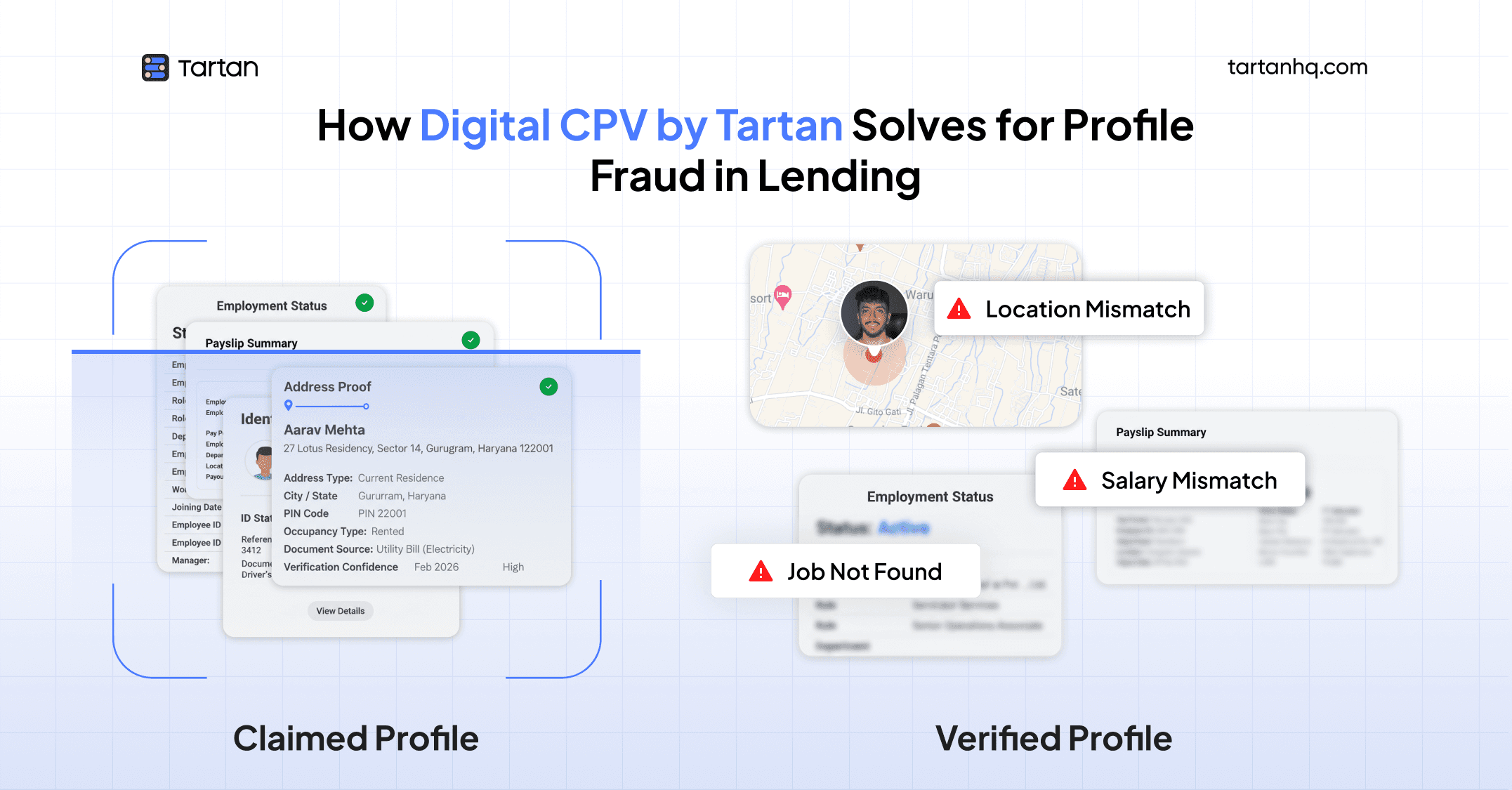
Profile fraud is one of the most expensive problems in retail and MSME lending - and one of the most underreported. Borrowers misrepresent where they live, where they work, what they earn, and sometimes who they are entirely. By the time a lender discovers the misrepresentation, the loan is disbursed, the borrower is unreachable, and the address on file leads to an empty plot or someone who has never heard the applicant's name.
Traditional field-based CPV was supposed to catch this. It largely doesn't. The same opacity that makes field verification hard to scale makes it easy to game. Tartan's Digital CPV flips that equation - replacing subjective agent reports with layered, machine-validated evidence that is structurally harder to fabricate and infinitely easier to audit.
What Profile Fraud Actually Looks Like in a Loan Application
Before understanding how Digital CPV solves the problem, it helps to be precise about what profile fraud looks like in practice. It rarely involves a single, obvious lie. More commonly, it involves a stack of small misrepresentations that individually pass basic checks but collectively paint a false picture.
The most common patterns lenders encounter:
Address fabrication or borrowing. The applicant provides an address where they have a temporary or informal arrangement - a relative's house, a rented room used only for document purposes, or in organised fraud rings, a single address used across dozens of applications. Field verification misses this because agents confirm the address exists and someone is present, not whether the applicant actually lives there.
Ghost employment. Salary slips are edited, offer letters are fabricated, and in some cases entire employer entities are invented. An applicant claiming ₹80,000 monthly income from a company that does not employ them - or does not exist - is a profile fraud case that employment verification is designed to catch but often doesn't, especially when the check is just a document review.
Identity layering. The applicant is real, the documents are real, but they belong to different people - a form of synthetic identity construction that becomes visible only when face matching and liveness checks are applied against the ID document.
Coordinated broker fraud. A broker or DSA submits multiple applications with slightly varied details across lenders, using a shared template of fabricated or borrowed proofs. The individual application looks plausible; the pattern only emerges when signals are cross-checked.
How Tartan's Digital CPV Catches What Field Visits Miss
Tartan's Digital CPV is built around a core principle: no single document or datapoint should be trusted in isolation. The platform is designed to cross-check multiple signals simultaneously, so that fabricating one element does not automatically produce a passing verification.
GPS and geo-distance validation is the first fraud gate. When a customer completes their verification journey, the platform captures their live GPS coordinates and compares them against the declared address.
A significant geo-distance mismatch - where the customer's device places them kilometres away from the address they are verifying - is flagged immediately. For field verification, this check simply does not exist. An agent visits an address; they have no way of knowing whether the applicant has ever set foot there.
Cross-document OCR matching closes the document fabrication gap. The platform extracts address information from multiple documents - Aadhaar, utility bills, rental agreements - using OCR, then checks for consistency across them.
A house number that appears one way on the electricity bill and differently on the address proof, or a pin code that does not match the GPS location, surfaces as a discrepancy. Individually these might be data entry errors; combined with other flags they indicate misrepresentation.
Document freshness checks address a specific fraud pattern: submitting legitimate documents from a previous address to verify a current one.
The platform checks the issuance date of address proofs against the lender's defined policy window. A two-year-old electricity bill for a current address is not inherently fraudulent, but it warrants scrutiny - particularly in combination with other signals.
Face match and liveness verification solve the identity layering problem. The applicant completes a liveness check during the verification journey; the resulting image is matched against the photo on their submitted ID document.
This confirms that the person completing the verification is the same person whose documents have been submitted - a check that field agents perform inconsistently at best.
Key Use Cases Where Digital CPV Changes the Outcome
Personal loans and BNPL at point of sale. These products are most exposed to address fabrication because the pressure to approve quickly limits verification depth. Digital CPV compresses the verification cycle to minutes while running more checks than a field visit would. A borrower who has borrowed an address for document purposes will typically fail the geo-distance check at the moment of verification.
LAP and secured lending. Higher loan values justify stricter verification, and Tartan's configurable journey supports this - interior photographs, multi-address verification covering present, permanent, and office addresses, and manual review routing for mixed-signal cases. The evidence bundle produced is far more defensible in a dispute or recovery proceeding than a field agent's report.
MSME lending. Business address verification for MSME applicants is particularly vulnerable to fabrication because business premises are less standardised and harder to validate from documents alone. Digital CPV combines GPS verification of the business location with employment data cross-checks on the promoter, producing a layered picture that field verification cannot replicate efficiently.
Repeat fraud detection across applications. Because Digital CPV produces structured, machine-readable outputs with consistent reason codes, lenders can identify patterns across their portfolio - the same address appearing across multiple applicants, consistent geo-distance failures from a particular pin code, or a cluster of document freshness failures that suggest a coordinated submission pattern.
Digital CPV vs. Field Verification: The Practical Differences
Field-Based CPV | Tartan Digital CPV | |
Turnaround time | 3-5 days | Minutes |
Cost per verification | ₹150-500 | Significantly lower |
Fraud signal coverage | Address presence only | GPS, OCR, liveness, employment, document freshness |
Quality consistency | Agent-dependent | Standardised, automated |
Audit trail | Paper report, variable quality | Structured PDF with full evidence bundle |
Scalability | Linear cost increase | Scales without proportional cost growth |
Fraud gaming difficulty | Low - single point to manipulate | High - multiple simultaneous signals required |
The last row is the critical one. Field verification has one failure mode that fraudsters understand well: get the right person at the right address on the right day. Digital CPV requires a fraudster to simultaneously fabricate a matching GPS location, pass OCR cross-checks across multiple documents, complete a successful liveness and face match, and clear employment data pulled directly from an HRMS. The combinatorial difficulty of gaming all of these at once is the structural advantage.
The Ops Advantage: From Verification to Decision
Beyond fraud control, Tartan's Digital CPV is built for lending operations teams who need to move fast without creating compliance gaps.
The workflow is straightforward: create a verification session, send a link to the applicant, track completion status from the ops console, and receive a standardised report with reason codes and an evidence bundle. Cases that pass all checks move to straight-through processing. Cases with mixed signals - a single flag that may be a data quality issue rather than fraud - route to a review queue rather than an automatic rejection. Cases with multiple compounding flags are escalated.
This tiering matters. A lender that hard-rejects every application with an address discrepancy will decline good customers. A lender with no systematic way to surface and escalate mixed-signal cases will approve bad ones. The platform's routing logic is designed to put the right cases in front of a human reviewer, not to replace underwriter judgment but to focus it where it is actually needed.
The output - a PDF verification report with GPS data, document images, OCR extracts, face match result, liveness status, and employment confirmation - is also audit-ready from day one.
When a regulator, an internal auditor, or a recovery team needs to understand why a loan was approved, the evidence is structured, complete, and retrievable.
Profile fraud does not announce itself.
It hides in the gap between what an applicant claims and what the evidence actually shows - a gap that field verification has never been equipped to close reliably. Digital CPV by Tartan is built specifically for that gap.