Insurance enterprises today operate some of the most extensive verification stacks in the industry.
Across onboarding, underwriting, servicing, and claims, multiple checks are executed to validate identity, address, income, employment, banking relationships, device integrity, bureau records, document authenticity, AML exposure, sanctions status, and location signals.
Despite increasing verification spend, expanding vendor footprints, and higher operational complexity, fraud incidence and loss ratios have not reduced proportionally. In several insurance segments, they continue to trend upward.
This gap highlights a structural issue: verification volume has increased, but verification effectiveness has not.
The problem is not a lack of checks, it is the absence of a unified, signal-driven verification architecture that converts fragmented inputs into actionable risk intelligence.
The Limits of Multi-Vendor Verification Models in Insurance
Most insurance organizations did not architect their verification stack as a unified risk system.
What exists today is the outcome of incremental decision-making over multiple years, driven by regulatory pressure, emerging fraud patterns, point-solution procurement, and short-term operational fixes.
The result is not intentional complexity but structural fragmentation.
Verification capabilities were added reactively, not cohesively. Each new check solved a narrow problem at a specific point in time, without re-evaluating how it interacted with existing signals or downstream risk decisions.
In practice, verification stacks evolve in a predictable way:
A new fraud pattern is identified
A point solution is added to address that specific risk
The solution is integrated into a single journey in isolation
Results are consumed as simple pass/fail outcomes
No broader redesign is done to connect signals across the stack
This approach scales vendor count, not detection capability. Each incremental addition is intended to close a specific gap, yet collectively they do not compound into stronger fraud control. Instead, they increase the number of integrations, decision points, and failure modes—without improving how risk is assessed or managed at a portfolio level.
Over time, insurers typically accumulate 10–25 independent verification services, each operating within its own functional boundary and decision logic. These services are optimized around vendor-specific objectives—such as completion rates, uptime SLAs, response latency, and contractual data coverage—rather than insurer-defined outcomes like fraud loss reduction, underwriting accuracy, or claims integrity.
From a leadership perspective, this creates several structural limitations:
Risk signals do not compound. Each service validates a narrow attribute in isolation, with no mechanism to reinforce or degrade confidence based on adjacent signals.
Control becomes fragmented. Decision quality varies by journey, volume, and edge case, depending on which vendors are triggered and how they behave under failure conditions.
Accountability is diffused. When fraud outcomes deteriorate, root cause analysis spans multiple vendors, contracts, and teams, delaying corrective action.
At scale, this architecture shifts risk management away from policy intent and governance toward vendor behavior and integration logic. While coverage appears broad on paper, actual detection capability remains flat, and loss exposure becomes visible only after fraud materializes—often at the most expensive stages of the lifecycle.
In effect, the organization carries the operational and financial cost of a complex verification ecosystem, without achieving proportional gains in fraud detection or risk control.
Typical Fragmented Insurance Stack
Most digital insurance journeys across onboarding, servicing, and claims—use a combination of the following checks:
Identity & document verification
Address verification
Employment or income checks
AML and sanctions screening
Bank account verification
On paper, this appears comprehensive. In execution, it is deeply fragmented.
Why These Systems Do Not Work as a Cohesive Risk Layer
Each component in the verification stack operates in isolation, with no shared understanding of context, confidence, or downstream risk impact. While integrations exist at a technical level, decision-making remains fragmented.
Key structural disconnects include:
One vendor’s “verified” may be probabilistic, another deterministic yet all are treated equally in decision logic.
Some services retry silently, others degrade coverage, others default to pass under SLA constraints.
Completion rates and uptime are optimized at the vendor level, not fraud outcomes at the portfolio level.
The verification stack continues to operate and meet process requirements.
However, it does not operate as an integrated risk system and therefore does not materially improve fraud detection outcomes at scale.
From a leadership standpoint, this creates a false sense of control - verification appears complete, audits are satisfied, and workflows move forward. Yet risk decisions are made without a unified view of signal strength, inconsistency, or confidence. As volumes increase, this gap becomes more pronounced: operational complexity grows, fraud exposure shifts downstream, and corrective action is triggered only after losses surface. The organization remains compliant, but not meaningfully more protected.
The Core Design Flaw
The fundamental issue is not the choice of vendors or the absence of checks.
It is that verification has been implemented as a set of disconnected compliance steps, not as an integrated signal orchestration layer.
Without correlation, prioritization, and confidence management:
More checks do not translate into better detection
More data does not translate into better decisions
More vendors increase complexity without increasing control
This is why many insurers experience rising verification costs and operational burden without a commensurate reduction in fraud or claims leakage. Spend increases across vendors, integrations, and operational oversight, but risk outcomes remain largely unchanged. Over time, leadership sees higher run-rate costs, slower change cycles, and greater exception handling - without clear evidence of improved loss control or underwriting precision.
The problem is not insufficient verification; it is fragmented design. Risk controls exist, but they are not coordinated or governed as a single system, limiting their effectiveness as fraud pressure and volumes scale.
Why More Vendors Can Increase Fraud Risk
As verification stacks expand, control weakens.
Each additional vendor introduces its own execution and failure logic, which is rarely standardized or centrally governed. Instead of increasing assurance, this creates inconsistent enforcement across journeys and predictable variance in decision outcomes.
Fraud risk is no longer driven solely by policy rules, but by how individual services behave under edge conditions.
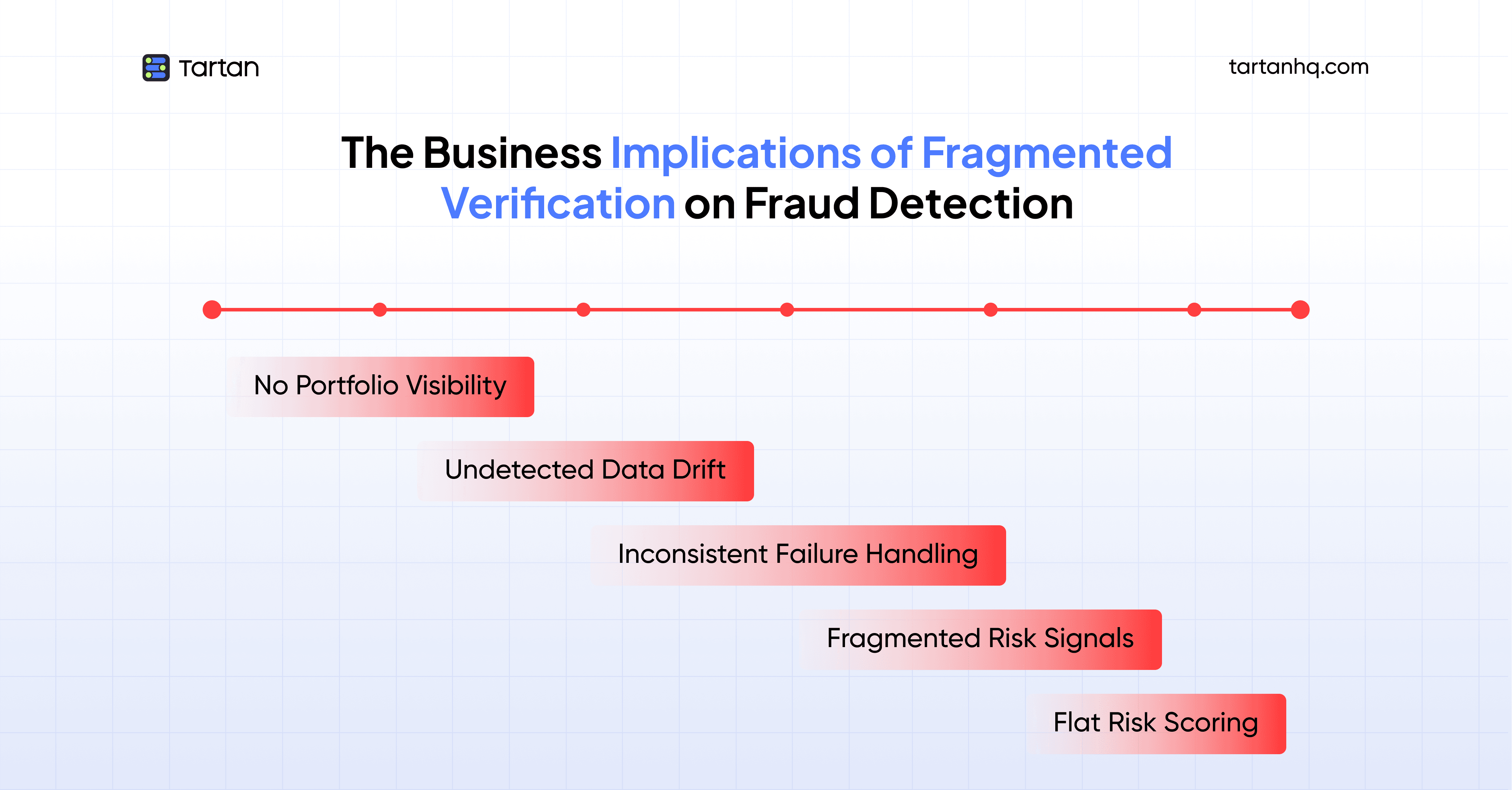
1. Inconsistent Failure Handling Creates Exploitable Gaps
In multi-vendor verification environments, failure handling is rarely standardized or centrally governed. Each provider applies its own logic to timeouts, partial responses, and service degradation. While these differences appear operational, they materially affect risk outcomes at scale.
Different vendors fail differently:
Hard failure: requests time out or return errors
Indeterminate responses: results such as “unable to verify” are issued
Permissive defaults: requests are treated as successful to meet SLA constraints
Common exploitation tactics include:
Reaching verification paths that return inconclusive results
Causing the system to fall back to less stringent checks
Repeating attempts until a service returns an approval
When failure handling is not centrally controlled, failure paths effectively become alternate approval paths. What begins as an operational exception gradually turns into a structural weakness, where approvals depend on vendor behavior rather than risk policy.
Over time, this erodes confidence in verification outcomes, increases variability across journeys and regions, and shifts fraud detection downstream. As a result, fraud prevention weakens as a business control, not just a technical safeguard - reducing leadership’s ability to predict, manage, and contain risk at scale.
2. Verification Decisions Become Binary, Not Probabilistic
In most insurance organizations, verification outputs are consumed in their simplest form. Regardless of the underlying data quality or signal strength, results are normalized into binary states:
Pass / Fail
Verified / Not verified
This simplification is operationally efficient, but it strips away information that is critical for effective risk management.
As a result:
Weak positives are treated as confirmed signals, increasing false approvals.
Underwriters lack visibility into confidence and assumptions behind outcomes.
Fraud models train on noisy data, reducing detection accuracy over time.
At a business level, binary decisioning creates a false sense of certainty. Verification appears complete, but risk remains partially assessed shifting fraud detection downstream and increasing the cost of remediation.
3. Data Drift Goes Undetected Across Vendors
Every verification provider experiences data drift over time. Data sources evolve, coverage changes, and fraud behavior adapts often without clear or immediate indicators.
Common forms of drift include:
Underlying data sources change or degrade, impacting accuracy without clear signals
Geographic coverage fluctuates, creating uneven risk control across regions
Fraud patterns adapt, reducing the effectiveness of static checks
In a fragmented setup, this drift is difficult to detect:
Performance degradation is not visible in real time and surfaces only through manual reviews or post-loss analysis
There is no shared baseline to compare signal quality across vendors or over time
High completion or success rates mask declining verification quality, creating a false sense of reliability
At a business level, this results in misplaced confidence in verification controls. Checks continue to be trusted because they meet SLA and throughput expectations, even as their actual contribution to fraud detection diminishes. Over time, this silent erosion increases loss exposure and delays corrective action until risk materializes in claims or portfolio performance.
As a result, insurers continue to trust checks that appear stable operationally, even as their actual risk-detection value erodes.
Hidden Costs of Multi-Vendor Verification
While individual vendors may appear cost-effective in isolation, the aggregate operational burden grows non-linearly as more services are added.
These costs are rarely visible in a single budget line and are often absorbed across risk, operations, compliance, and customer support functions.
At a structural level, fragmentation introduces ongoing overhead:
Multiple commercial contracts and renewal cycles: Each vendor brings its own pricing model, volume thresholds, renewal timelines, and negotiation effort.
Separate SLAs, monitoring, and escalation paths: Service reliability is tracked vendor by vendor, not journey by journey.
Repeated integrations and long-term maintenance: Engineering teams build and maintain parallel integrations, handle version changes, manage credentials, and resolve vendor-specific issues.
Disparate logs, dashboards, and audit trails: Verification evidence is spread across systems, formats, and retention policies.
These structural costs translate directly into operational friction:
Ops teams must manually interpret conflicting or unclear verification results, increasing turnaround time and operational errors.
Inconsistent verification outcomes lead to avoidable customer escalations, rework, and drop-offs in digital journeys.
Teams lack a clear explanation of decisions, underlying signals, and confidence levels across multi-vendor checks.
From a leadership perspective, multi-vendor verification does not fail immediately it fails progressively. Its cost structure, risk exposure, and operating friction remain manageable at low to moderate scale, but compound rapidly as volumes grow.
Over time, decision control shifts from policy and governance to vendor behavior, change velocity slows, and margins erode through indirect costs and delayed risk detection. By the time these effects surface in loss ratios or customer experience metrics, remediation is both disruptive and expensive.
HyperVerify: Designed for Signal Integrity, Not Vendor Count
HyperVerify was built on an operating principle: fraud detection improves when verification signals are contextual, correlated, and centrally controlled.
In insurance environments, risk does not emerge from individual checks failing in isolation, it emerges from inconsistencies, contradictions, and weak confirmations across multiple data points. HyperVerify is designed to preserve signal integrity across this lifecycle, ensuring that verification outcomes strengthen risk decisions instead of fragmenting them.
One unified decisioning layer
Multiple verification rails underneath
Risk-aware signal correlation
The result is a verification architecture that prioritizes decision quality over vendor count, enabling insurers to scale verification coverage without increasing operational risk.
How HyperVerify Solves Fragmentation in Insurance
1. Unified Verification Orchestration Layer
HyperVerify sits between insurance journeys and verification providers.
It controls:
Which checks run first
Which checks are skipped
When fallbacks are allowed
How confidence is accumulated
Instead of static flows, insurers get:
Risk-tiered verification paths
Context-aware retries
Consistent failure handling
This strengthens enforcement consistency across verification paths.
2. Signal Correlation Across Identity, Income, Location, and Behavior
HyperVerify does not treat verifications as isolated events.
It correlates:
Identity data with device behavior
Address with geo-signals and employment
Income claims with bank and payroll patterns
Historical attempts with current journeys
This enables:
Detection of contradictions, not just failures
Early fraud flags before policy issuance
Explainable risk signals for underwriting
3. Built-in failure intelligence
HyperVerify treats verification failures as risk signals, not operational noise. Instead of absorbing failures into downstream workflows, it systematically captures and analyzes failure behavior across the verification lifecycle.
This includes:
Geographic failure concentration, highlighting regions where data quality or fraud pressure is degrading
Vendor-specific performance drift, identifying silent drops in signal reliability over time
Repeated fallback usage, indicating structural weakness or abuse of permissive paths
Abnormal retry patterns, which often precede coordinated fraud attempts
As a result, failures function as early warning indicators of emerging risk, rather than remaining undetected gaps that surface only after losses occur.
Fraud Control Requires System Design, Not More Vendors
Insurance fraud does not persist because insurers lack verification data.
It persists because verification data is distributed across multiple vendors, evaluated in isolation, and applied without consistent control. In such environments, risk decisions are shaped by integration boundaries rather than by signal quality.
The prevailing multi-vendor approach was adopted to increase coverage. In practice, it has introduced fragmentation:
Each vendor optimizes for its own completion metrics, not portfolio-level risk outcomes
Signals are consumed independently, without correlation or shared context
Decision engines absorb noise alongside genuine risk indicators
Operational effort increases, while detection accuracy plateaus
As a result, insurers incur higher verification costs, operational complexity, and limited incremental reduction in fraud exposure.
A unified verification suite changes this dynamic.
By consolidating verification execution, interpretation, and control within a single orchestration layer, insurers shift from vendor-led checks to system-led decisions. Signal correlation replaces signal accumulation.
From a business perspective, this transition enables insurers to:
Improve fraud detection efficiency
Strengthen underwriting confidence
Reduce operational overhead
Support regulatory and audit requirements
Scale verification volumes
In that context, insurers that move from fragmented, multi-vendor verification stacks to a unified verification suite will be better positioned to control risk, manage cost, and operate at scale without sacrificing detection quality.
As fraud pressure increases and verification volumes scale, incremental improvements are more likely to come from improving signal coherence and decision consistency than from adding additional vendors or checks.