The Enterprise Reality Insurers Face
Group insurance operations live at the intersection of three forces that create persistent data chaos: portfolio complexity, technology fragmentation, and workforce volatility. Each force alone is manageable. Together, they create an operational environment where manual reconciliation becomes the default state and data accuracy becomes aspiration rather than reality.
Multiple Employers, Each a Unique Integration Challenge
A mid-sized group insurer managing 800 corporate policies isn’t managing 800 identical units - they’re managing 800 distinct data relationships. Each employer has different systems, rhythms, and constraints. One runs Workday with strict data governance, another relies on spreadsheets and slow email responses. Some are juggling multiple payroll systems post-acquisition, others are scaling rapidly with frequent HR leadership changes. Large distributed employers see workforce composition shift weekly due to high attrition.
The challenge isn’t just employer diversity - it’s that every difference forces custom handling at every touchpoint. Data requests must be tailored, timed differently, and routed to different stakeholders. Data arrives in inconsistent formats, at uneven cadences, with varying quality.
Traditional group insurance ops try to standardize this complexity through templates, processes, and SLAs. But employers don’t adapt their internal operations for insurers. The result is a constant layer of manual translation - performed by ops teams, at scale, every day.
Multiple HR Systems Creating a Fragmented Data Landscape
The HRIS and payroll market is fragmented across dozens of major platforms and hundreds of smaller vendors, each serving different market segments with different capabilities. Large enterprises predominantly use Workday, SAP SuccessFactors, Oracle HCM Cloud, or ADP Workforce Now. Mid-market companies favor BambooHR, Namely, Paylocity, Paycom, or UKG. Small businesses often use Gusto, Rippling, Zenefits, or industry-specific platforms.
Each platform has its own data model. Workday organizes information around worker records with complex organizational hierarchies. ADP structures data around pay groups and employment events. BambooHR prioritizes employee self-service and focuses on profile completeness. QuickBooks treats payroll as a financial transaction stream with employee records as metadata.
These architectural differences manifest as incompatible data schemas when insurers try to collect census information:
Field naming conventions vary: What Workday calls "Worker_ID" might be "Employee_Number" in ADP, "EmpID" in BambooHR, or "Personnel_Code" in SAP
Date formats differ: Some systems export dates as MM/DD/YYYY, others as DD/MM/YYYY, still others as YYYY-MM-DD, creating validation failures and misinterpretation risks
Employment status taxonomies are inconsistent: "Active" in one system might mean something different from "Regular" in another, while "On Leave" could be coded as active, inactive, or a separate status depending on platform
Dependent information structures diverge: Some systems maintain dependent records linked to employees, others store family data as text fields, some don't track dependents at all
The result is that every employer using a different HRIS requires custom data extraction, transformation, and validation logic. Insurers can't build one integration that works across their portfolio - they need platform-specific integrations for major systems, plus custom handling for smaller vendors and legacy on-premise systems that lack APIs entirely.
Constant Workforce Movement Making Data Stale Immediately
Even if insurers could perfectly standardize data collection across employers, the data would still decay quickly due to modern workforce dynamics. The stable employment patterns that once supported annual or quarterly census updates no longer exist.
Take a 500-employee company with 25% annual attrition - common in knowledge industries. That’s 125 workforce changes a year, or about 10 per month. With quarterly updates, insurers process 30 retroactive changes at a time, meaning their data is, on average, 45 days stale.
In high-turnover sectors, the problem escalates. A 2,000-employee retailer with 40% attrition sees 800 changes a year - 200 per quarter. Each update becomes a reconciliation exercise, reconstructing eligibility, billing, and claim rights after the fact.
Staleness compounds when multiple attributes change together - role, eligibility tier, dependents, location, premiums. If January changes are processed in March, coverage, pricing, and claims decisions are all based on outdated status.
Workforce change also clusters around organizational cycles - year-end exits, January hiring spikes, mid-year restructures. Quarterly snapshots miss these dynamics entirely, undermining both operational accuracy and underwriting assumptions.
What HyperSync Does - Plain English
HyperSync eliminates manual census collection and periodic reconciliation by maintaining continuous, automated synchronization between employer HR systems and insurer policy administration platforms. Instead of requesting data, processing spreadsheets, and issuing endorsements in quarterly or annual cycles, HyperSync creates a live data pipeline that keeps policy records current as workforce changes happen.
Direct Connection to Employer Data Sources
HyperSync connects directly to an employer’s HRIS or payroll system via APIs, using employer-approved credentials and granular permissions. It subscribes to employment events as they occur in the source system.
When a new hire is added in Workday, that event is triggered in near real time. HyperSync receives it, validates and normalizes the data, and updates the insurer’s policy admin system automatically. The employee appears on the policy roster within hours - no census requests, no emails, no manual entry, no endorsement delays.
The same applies to exits. When a termination is recorded in BambooHR, the status change flows through HyperSync to remove the employee from active coverage, stop premium billing, and close eligibility in line with the actual last working day - not the next scheduled update.
By connecting directly to the source system, HyperSync removes the communication layer that causes lag. The HR system becomes the single source of truth, and the policy admin system stays continuously in sync instead of relying on periodic data snapshots.
Continuous Synchronization Across Employment Events
HyperSync goes beyond syncing hires and terminations — it keeps all employment attributes that affect coverage and pricing continuously aligned. Status changes flow automatically: full-time to part-time shifts, leaves of absence, contractor-to-employee conversions, and role or department changes that impact eligibility.
Demographic updates sync as they happen — address or name changes, dependent additions after life events, and beneficiary updates. Compensation changes also flow through for products tied to salary, ensuring coverage amounts and premiums stay accurate as employees move across bands or receive raises.
Where needed, synchronization is bidirectional. Insurers can flag discrepancies back to employer systems, and employer-initiated bulk corrections update policy records automatically.
Because changes propagate in real time, there’s no quarterly update or annual reconciliation — only the current state. When data stays continuously in sync, reconciliation disappears by design.
Elimination of One-Off Data Requests and File Uploads
The most immediate operational impact is that HyperSync makes census collection obsolete. Ops teams no longer send quarterly emails requesting employee lists. They don't chase HR contacts through follow-up emails and broker escalations. They don't receive Excel files in unpredictable formats that require manual reformatting and validation. They don't maintain tracking spreadsheets to monitor which employers have submitted data and which are overdue.
The entire apparatus of manual data collection - the email templates, the escalation procedures, the relationship management overhead - becomes unnecessary. The operational energy that previously went into extracting data from employers redirects to higher-value activities: proactive customer outreach, claims support, policy optimization, revenue growth initiatives.
For employers, the administrative burden disappears as well. HR teams no longer receive insurance census requests competing with their actual work. They don't need to export data from their HRIS, reformat it to match insurer templates, verify accuracy, and send files through secure channels. They don't field follow-up questions about discrepancies or clarification requests about employee status. Their HRIS simply shares relevant employment data automatically, with their approval and oversight, requiring zero ongoing effort.
This mutual elimination of administrative overhead is where HyperSync creates leverage - it doesn't just make insurers more efficient, it also makes being a customer less burdensome, which directly impacts retention and expansion. Employers who experience frictionless insurance administration are more likely to renew, less likely to shop competitors, and more receptive to coverage expansion conversations.
Measurable Outcomes - a CXO Viewpoint
The operational and financial impact of moving from periodic manual updates to continuous automated sync manifests across multiple metrics that matter to executive decision-makers. These aren't aspirational improvements - they're measurable outcomes that insurers achieve within quarters of implementation.
Reduced Endorsement Volume: 80-90% Decline
Traditional group insurance operations generate 4-12 formal endorsements per policy per year to document workforce changes, coverage modifications, and premium adjustments. Each endorsement requires underwriting review, ops processing, document generation, customer communication, and often broker coordination. At scale, this creates substantial processing overhead.
HyperSync collapses endorsement volume because routine workforce changes - hires, terminations, status changes - process automatically without requiring formal policy amendments. Premium adjustments happen monthly based on current active census, eliminating the need for interim endorsements to true-up billing.
The math: A 500-policy portfolio generating 8 endorsements per policy per year produces 4,000 endorsements annually. At 30-45 minutes of processing time per endorsement (including review, documentation, and communication), that's 2,000-3,000 hours of ops capacity consumed by endorsement administration. Post-HyperSync, endorsement volume drops to major plan design changes and employer-requested modifications - roughly 1-2 per policy per year, or 500-1,000 total endorsements requiring 250-750 hours of processing time.
Faster Claim Approvals: 60-75% TAT Reduction
Claims processing velocity is directly limited by eligibility verification. In traditional workflows, when a claim arrives, the adjuster must confirm that the employee was covered on the date of service. If the policy data is stale, this requires reaching out to ops teams to verify current status, which often requires contacting the employer to confirm employment status, creating days or weeks of delay before the claim can be adjudicated.
HyperSync makes eligibility verification instantaneous. The policy admin system has always-current data about who's covered, when coverage started, and when it ended. Adjusters can validate eligibility in real-time during claim intake, enabling immediate claim processing for straightforward cases and faster exception handling for complex scenarios.
The operational shift: Claims that previously took 8-12 days to process (including 2-5 days waiting for eligibility confirmation) now process in 3-5 days. For high-volume claims portfolios processing 10,000+ claims annually, this TAT improvement translates to measurably better customer satisfaction scores and reduced customer service volume from "where's my claim?" inquiries.
Strategic impact: Faster claims processing directly improves Net Promoter Score, which correlates with retention. In group insurance where customer acquisition costs are high and growth depends on retention and expansion, NPS improvements have compounding value over multi-year customer lifetimes.
Lower Ops Headcount Pressure: 40-60% Capacity Liberation
The most direct financial impact is reduced headcount requirements to manage the same or larger policy portfolios. Traditional group insurance ops require approximately one FTE per 80-120 policies for data management, reconciliation, and endorsement processing. This ratio doesn't improve with scale because each policy represents unique complexity.
HyperSync fundamentally changes the ops leverage ratio. With continuous automated sync handling routine updates, ops teams shift from manual processing to exception handling and oversight. The same FTE can manage 200-300 policies because the work is qualitatively different - monitoring dashboards and resolving anomalies rather than chasing census files and processing endorsements.
Growth implications: An insurer planning to grow from 1,000 to 2,000 policies over two years would traditionally need to hire 8-12 additional ops FTEs. With HyperSync, the same growth requires 3-4 additional hires focused on exception handling and customer success.
Alternative deployment: Some insurers choose not to reduce headcount but to redeploy ops capacity to revenue-generating activities. FTEs freed from manual reconciliation can focus on proactive customer outreach, coverage optimization consulting, claims advocacy, or new business onboarding - shifting the ops function from cost center to revenue enabler.
Cleaner Renewals and Pricing Confidence: 95%+ Data Accuracy
Renewal cycles in traditional group insurance operations are fraught with data reconciliation challenges. Underwriters pricing renewals work from census data that might be 6-12 months stale, requiring extensive validation before confident pricing decisions can be made. Discrepancies between insurer records and employer records create negotiation friction and delay finalization.
HyperSync enables renewals based on always-current data. Underwriters see real-time active census, accurate composition of coverage tiers, and complete employment status distribution. Pricing models run against actual current exposure rather than stale snapshots, eliminating the "true-up shock" when renewal reconciliation reveals significant variance between assumed and actual covered lives.
Renewal cycle compression: Traditional renewals require 60-90 days of back-and-forth reconciliation and pricing iteration. With clean, current data, renewal cycles compress to 30-45 days - faster turnarounds that reduce broker frustration, improve customer experience, and free up underwriting capacity for new business.
Pricing accuracy: When loss ratio analysis and renewal pricing are based on accurate census data rather than estimates, pricing confidence increases and adverse selection risk decreases. Underwriters can defend pricing decisions with data rather than assumptions, reducing unprofitable renewals and improving portfolio loss ratios over time.
Cross-Functional Impact: How Different Teams Benefit
HyperSync's value isn't confined to operations - it creates positive externalities across every function that touches group insurance administration. Understanding these cross-functional benefits helps build organizational alignment for adoption.
Operations: From Manual Chase to Strategic Oversight
The operations team experiences the most dramatic transformation. The daily rhythm shifts from reactive firefighting - chasing late census submissions, reconciling data discrepancies, processing emergency endorsements for coverage gaps discovered weeks after they occurred - to proactive management where most updates happen automatically and ops teams focus on strategic exceptions.
Work that disappears:
No more monthly email cycles requesting census updates from hundreds of employers
No more manual data entry reformatting employer spreadsheets into policy admin formats
No more weeks-long reconciliation projects comparing employer data against policy records
No more emergency endorsements to backdate coverage for employees who should have been added months ago
Work that emerges:
Monitoring automated sync health through dashboards that flag anomalies requiring investigation
Resolving data quality issues surfaced by automated validation (mismatched employee IDs, unexpected status codes)
Proactive outreach to employers when sync detects unusual patterns (sudden attrition spikes, large hiring waves)
Strategic account management focusing on coverage optimization and customer satisfaction
The psychological shift is significant. Ops professionals move from feeling perpetually behind - always chasing, always reconciling, always fixing yesterday's problems - to feeling in control, with real-time visibility into portfolio health and capacity to prevent problems before they materialize.
Finance: Premium Accuracy and Revenue Capture
Finance teams benefit from dramatic improvements in billing accuracy and revenue recognition confidence. Traditional group insurance billing operates on estimates that get trued-up quarterly or annually, creating unpredictable cash flow variance and frequent disputes with customers over overage charges or underage credits.
HyperSync enables per-employee-per-month billing that reflects actual covered lives at any point in time. When an employee starts mid-month, partial month premium calculation is based on actual coverage days. When someone terminates, billing stops immediately rather than continuing until the next reconciliation cycle.
Revenue leakage reduction: In traditional models, 8-15% of potential premium revenue is lost to delayed updates where headcount growth isn't captured for months. HyperSync captures this revenue in real-time - if an employer grows from 100 to 120 employees, premium billing reflects all 120 lives immediately rather than continuing to bill for 100 until the next quarterly update.
Dispute volume decrease: Premium disputes consume finance team time and create customer relationship friction. When billing is based on always-current data that both parties can verify, disputes drop dramatically. Customers can see exactly which employees were covered each month and validate that charges match reality, eliminating the "you billed us for employees who left in March" conversations that plague traditional operations.
Cash flow predictability: CFOs value predictable revenue streams for forecasting and investor reporting. When billing accuracy improves from 85% to 98%, revenue forecasts become more reliable and variance explanations to boards and investors become simpler.
Sales: Competitive Differentiation and Faster Wins
Sales teams gain tangible differentiation in competitive enterprise deals. The ability to promise "no manual census updates required - we integrate directly with your HRIS" is a concrete operational benefit that resonates with CFOs and HR leaders tired of insurance administrative overhead.
Faster implementation cycles: Traditional group insurance onboarding requires weeks of data collection, validation, and system setup. HyperSync implementations can go live within days once employer HRIS access is authorized, compressing sales cycles and accelerating time-to-revenue.
Reduced implementation friction: Prospect objections about "we don't have time for another insurer integration project" dissolve when the insurer can demonstrate that the employer's IT team doesn't need to build anything - HyperSync handles the integration, requiring only authentication credentials and permissions approval.
Enterprise stickiness: Once an employer experiences automated data sync, reverting to manual census updates with a competitor feels like technological regression. This creates switching costs that aren't contractual but operational - the hassle of going back to quarterly spreadsheet submissions makes customers sticky even if competitor pricing is slightly lower.
Reference-ability: Satisfied customers become powerful references. When prospects hear from peers that "we haven't sent them a census file in 18 months and coverage has been perfect," it builds credibility that's hard to achieve through sales presentations alone.
Customer Experience: Invisible Operations That Just Work
Customer-facing teams benefit from operations that become invisible. The best insurance administration is the kind customers don't think about because it just works - coverage is accurate, claims process smoothly, billing makes sense.
HyperSync creates this invisibility by eliminating the touch points where operational friction surfaces to customers:
Fewer claim disputes: When coverage eligibility is always current, the "we can't find your employee in our system" or "coverage wasn't active on that date" scenarios that create negative customer experiences essentially disappear.
No census request burden: HR teams at customer companies stop receiving quarterly requests for data, stop spending time extracting and formatting census files, stop fielding insurer follow-up questions about discrepancies.
Proactive coverage gap identification: Because the insurer has real-time visibility into workforce changes, customer success teams can proactively flag situations where employees might not be covered - "we noticed you hired 15 people last month, let's make sure they're all enrolled in benefits" - rather than discovering coverage gaps only when claims are denied.
Faster response to customer inquiries: When a customer calls asking "is my new employee covered?" or "when did coverage end for this person who left?", customer service can answer definitively in seconds rather than "let me check with ops and get back to you."
The cumulative effect is that insurance administration becomes background infrastructure that operates reliably rather than a periodic administrative burden requiring customer attention and effort.
Why This Scales: The Compounding Advantage
The traditional group insurance operating model has a scaling ceiling - growth requires proportional headcount increases because each policy is a bespoke operational relationship. HyperSync breaks this scaling constraint by creating leverage that compounds as portfolios grow.
New Employer ≠ New Process
In legacy operations, each new employer relationship requires establishing communication patterns, understanding their data formats, documenting their quirks, and building institutional knowledge about how to work with their specific HR team. This means the 501st policy is as operationally complex to onboard as the first - there's no learning curve advantage.
HyperSync inverts this dynamic. Once the integration infrastructure is built and the platform supports an HRIS vendor, every new employer using that HRIS vendor is zero marginal integration work. The 50th employer using Workday requires no more technical effort than the first - authentication credentials are provided, permissions are approved, data starts flowing.
This creates true economies of scale: the fixed cost of building and maintaining HRIS integrations gets amortized across an ever-growing policy base. The integration investment that might seem expensive for 100 policies becomes incredibly cost-effective at 1,000 policies and transformatively economical at 5,000+ policies.
One Sync Layer Across the Entire Portfolio
Traditional operations require policy-specific process knowledge: how to get data from Employer A, how to work with Employer B's systems, when to contact Employer C for updates. This knowledge fragmentation prevents standardization and creates operational silos.
HyperSync creates a unified operational layer where the same synchronization infrastructure serves all employers regardless of their HRIS platform. Ops teams monitor one dashboard showing sync health across all policies, handle exceptions through standardized workflows, and build expertise in data stewardship rather than relationship management.
Operational consistency: Instead of 800 different data collection processes (one per employer), there's one synchronization platform with consistent monitoring, exception handling, and resolution patterns. New ops hires can become productive in weeks rather than months because they're learning one system rather than hundreds of employer-specific quirks.
Knowledge portability: When an ops team member moves from managing 100 accounts to managing 200 accounts, their operational expertise transfers completely - the sync infrastructure, exception patterns, and resolution workflows are identical across the portfolio.
Technology leverage: Investments in improving the synchronization platform - better anomaly detection, smarter validation rules, faster exception resolution - improve operations across all policies simultaneously rather than requiring policy-by-policy implementation.
The Marginal Cost of Growth Approaches Zero
The most profound scaling advantage is that marginal operational cost per new policy approaches zero as portfolios grow. In traditional operations, the 1,000th policy requires approximately the same ops effort as the 100th - same data collection effort, same reconciliation time, same endorsement processing overhead.
With HyperSync, the marginal ops cost of the 1,000th policy is nearly zero. The integration infrastructure already exists, the synchronization runs automatically, routine updates process without intervention. The only marginal cost is exception handling - and exception rates don't increase with portfolio size, they often decrease as data quality patterns become more predictable.
Growth economics transformation: An insurer growing from 1,000 to 3,000 policies over three years would traditionally need to double or triple ops headcount to maintain service quality. With HyperSync, the same growth might require 30-40% headcount increase focused on exception handling and customer success, fundamentally changing the unit economics of growth.
Profitability improvement: As ops cost per policy decreases while premium per policy remains constant (or grows), operating margin improves structurally. This margin expansion funds further technology investment, competitive pricing, or bottom-line profit improvement.
Strategic optionality: Insurers with low marginal cost of growth can pursue market segments that would be unprofitable under traditional operating models - smaller employers, high-turnover industries, price-sensitive segments - expanding addressable market and competitive positioning.
Closing Takeaway: From Periodic Data Problem to Continuous System
The fundamental limitation of traditional group insurance operations isn't technology or process design - it's the periodic batch paradigm that treats workforce data as something captured occasionally rather than maintained continuously. This paradigm creates systematic staleness that undermines every downstream function: underwriting prices against ghost populations, claims teams adjudicate eligibility using outdated rosters, finance bills for employees who left months ago, customer service fields complaints about coverage gaps that stem from data lag.
HyperSync doesn't optimize the periodic model - it replaces it entirely with continuous synchronization that keeps policy administration systems aligned with workforce reality in near real-time. This isn't incremental improvement; it's categorical transformation.
The operational benefits are measurable and material:
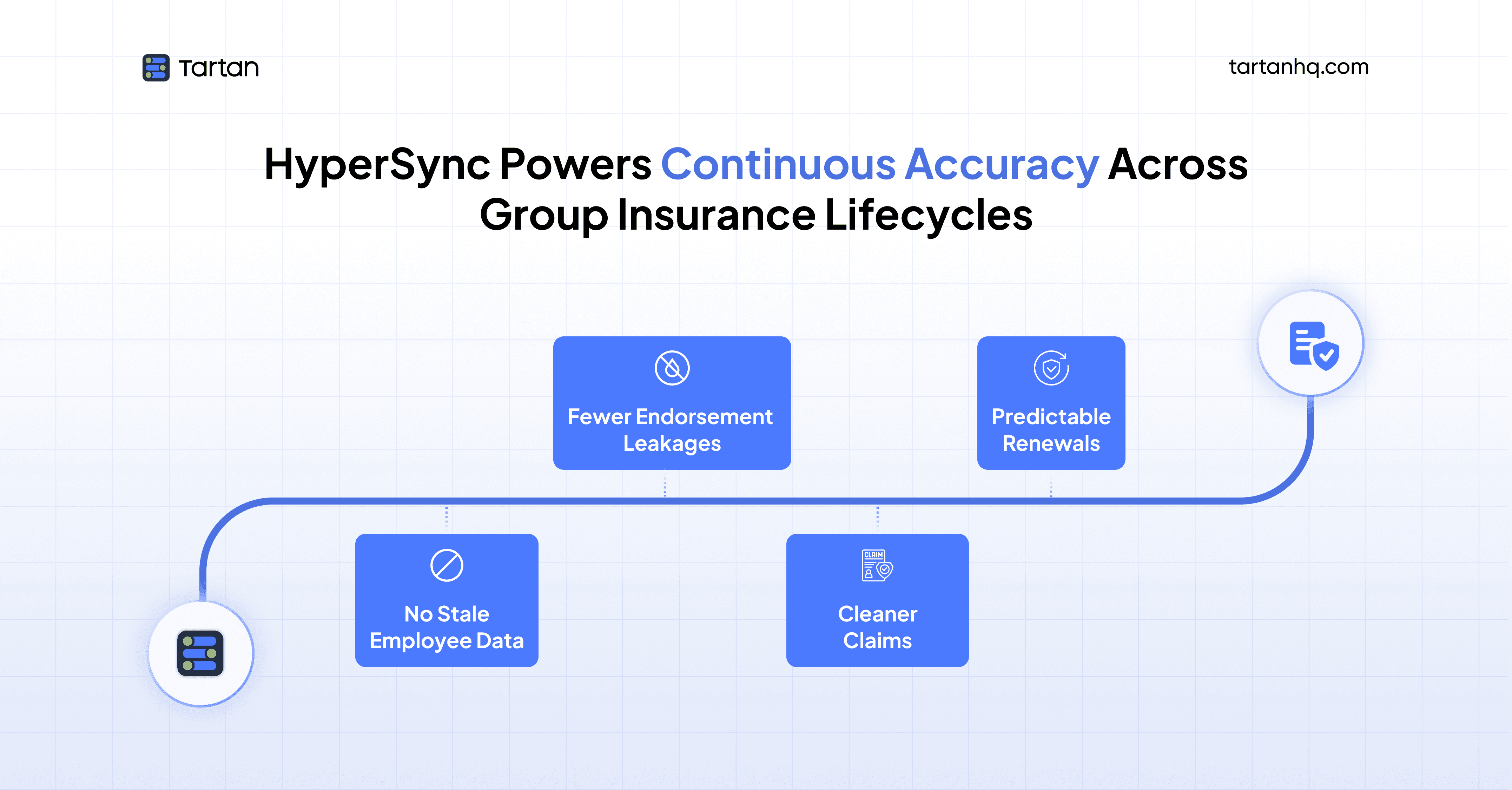
80-90% reduction in endorsement volume,
60-75% faster claims processing,
40-60% ops capacity liberation,
95%+ billing accuracy.
The financial impact compounds as portfolios scale: avoided ops hiring, captured premium leakage, improved loss ratios, compressed renewal cycles.
For CXOs evaluating whether to modernize employer data infrastructure, the decision framework is straightforward:
The cost of inaction is compounding: Every quarter that passes with manual operations is another quarter of premium leakage, customer dissatisfaction, and competitive vulnerability to insurers who've already modernized.
The alternative to modernization is margin compression: Competitors with lower operational costs can price more aggressively, forcing a choice between losing market share or accepting profitability deterioration.
The path forward is proven: Multiple insurers have successfully made this transition, and the implementation playbook is established - pilot validation, scaled rollout, operations transformation.
The question isn't whether continuous employer data sync will become table stakes in group insurance - it will, because the operational and financial advantages are too significant for the market to ignore. The only variable is timing: will you lead the transition and capture first-mover advantages, or will you follow reactively when customers and competitors make the legacy model untenable?
HyperSync turns group insurance from a periodic data problem into a continuous system. The infrastructure exists. The ROI is proven. The only remaining decision is when to start.