Picture this: a mid-sized insurer has just closed a group health policy with a 500-person company. Great news. Now comes the less glamorous part - onboarding that company's employees into the system.
Someone sends an email to the client's HR manager asking for an employee data export. The HR manager is busy. Three follow-ups later, a spreadsheet arrives - with inconsistent formatting, missing fields, and data that's already two weeks out of date. The insurer's ops team manually cleans the file, maps the columns, and uploads it. Then a new employee joins the company. The cycle starts again.
This is not a fringe scenario. It's Tuesday at most insurance companies in India.
The good news? It doesn't have to be. HRMS APIs - and specifically, unified APIs - are quietly transforming how insurers handle corporate onboarding. And the results are hard to ignore: companies using this approach are cutting onboarding time by up to 70%.
The real cost of manual onboarding
Before we get into the solution, it's worth understanding just how expensive the old way actually is - not just in time, but in every direction.
There's the obvious cost: ops bandwidth. Every corporate client that comes onboard requires someone to send emails, receive files, validate data, and upload it. At scale, that's a meaningful chunk of your team's day, every day.
Then there's the hidden cost: data quality. When an insurer is working off a spreadsheet that was exported two weeks ago, they're working with stale data. Employees who have left the company may still be enrolled. New joiners aren't covered from day one. Salary brackets used to price the policy may have shifted. Every one of these discrepancies is a potential liability.
And then there's the cost you feel later: client experience. Corporates today expect their insurance partners to be as seamless as the rest of their enterprise software stack. When onboarding drags on for days - or worse, when an employee shows up at a hospital and finds their coverage hasn't been activated yet - trust erodes fast.
"What previously took days of manual effort - chasing HR teams for data uploads - is now handled seamlessly through API-based HRMS connections."
What is an HRMS API, and why does it matter for insurers?
An HRMS (Human Resource Management System) is where a company manages its employee data - headcount, salaries, departments, joining dates, exits. Platforms like Darwinbox, GreytHR, Keka, SAP SuccessFactors, and dozens of others store this information.
An HRMS API is simply a way to read that data programmatically - without anyone having to manually export it. Instead of an HR manager downloading a CSV and emailing it over, the insurer's system connects directly to the HRMS and pulls exactly what it needs, in real time, with the appropriate consent.
Now, here's the complication: there are 50+ HRMS platforms in active use across Indian enterprises today. Each one has its own data format, authentication method, and API structure.
Building a direct integration with even five of them is a substantial engineering project. Building and maintaining integrations with all of them? That's a full-time job for a team.
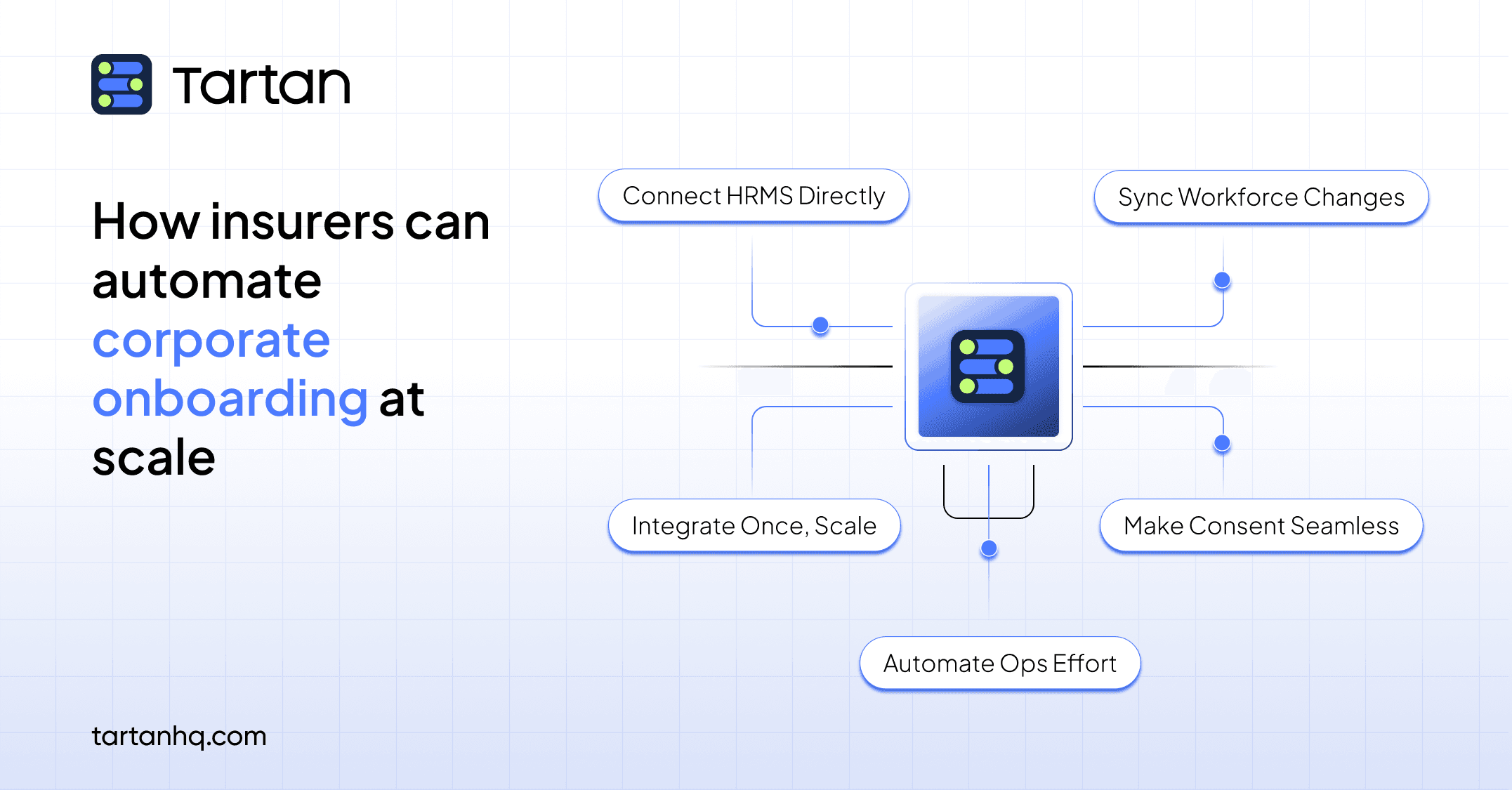
This is where a unified HRMS API layer changes the equation. Instead of connecting to each HRMS individually, the insurer connects once to a unified API - and that single connection covers 80+ HRMS platforms automatically.
The data comes back in a standardized format regardless of which system the client uses.
What the onboarding workflow actually looks like
Here's what automated corporate onboarding looks like in practice when it's built on a unified HRMS API:
When a new corporate client signs a group policy, they're sent a simple consent link - not a data form, not an email asking for files. The HR admin at the client company clicks the link, authenticates with their HRMS credentials, and grants the insurer permission to sync employee data. This takes a few minutes, not days.
From that point on, the insurer's system pulls the employee roster directly from the HRMS. New joiners are automatically added to coverage. Exits trigger offboarding. Salary changes update the coverage tier without anyone lifting a finger. The data is always current because it comes directly from the source of truth.
For the insurer's ops team, this is transformative. They go from spending hours on data wrangling to monitoring an automated pipeline. The system surfaces exceptions - like an employee whose data is incomplete - rather than requiring manual review of every record.
70% reduction in onboarding time | 2 days typical go-live after integration | 80+ HRMS platforms covered |
The compliance and consent angle
Any insurer reading this will immediately ask the right question: what about data privacy? Employee data is sensitive. You can't just pull it without clear authorisation.
This is actually one of the strongest aspects of the API-first approach. Consent is baked into the flow.
The corporate client's HR admin explicitly authorises the connection, defines the scope of data being shared, and can revoke access at any time. Every data pull is logged and auditable. Compare this to the old model, where a spreadsheet with hundreds of employee records is bouncing around someone's inbox - the API approach is demonstrably more secure and more compliant.
For insurers operating under IRDAI guidelines or preparing for evolving data protection requirements under the DPDP Act, this audit trail is increasingly important.
Beyond onboarding: what else becomes possible
Once you have a live, real-time connection to a corporate client's HRMS, onboarding is just the beginning of what you can automate.
Premium reconciliation becomes significantly more accurate. When you know exactly how many employees are covered at any given moment - and their current salary bands - billing becomes a real-time calculation rather than a monthly manual exercise prone to disputes.
Upsell and cross-sell become data-driven. If an employee gets promoted to a senior role, their coverage needs may change. If a company's headcount grows rapidly, that's a signal to proactively offer expanded cover.
All of this intelligence is sitting in the HRMS data you're now connected to.
Renewal conversations get easier too. Instead of scrambling to get up-to-date employee numbers before a renewal, you walk into the conversation already knowing the current state - workforce size, attrition patterns, demographics. That's a very different negotiating position.
What implementation actually looks like
For insurers wondering about the lift required, the reality is much lighter than most expect.
Platforms like Tartan offer both no-code and low-code deployment options, meaning insurers don't need to rebuild their core tech stack to take advantage of this.
The integration timeline - from decision to live - is typically around two days for the technical setup.
The harder part is usually the internal process change: getting ops teams comfortable with a system that works in the background rather than one they actively manage.
The ROI case is also relatively straightforward to build. If your ops team currently spends 30% of their time on data collection and validation tasks, and that drops to near-zero for automated corporate accounts, the payback period on the integration cost is measured in weeks, not quarters.
The window is now
There's a competitive dimension worth noting here. Corporate HR and finance teams are becoming more sophisticated buyers.
They're used to tools that integrate with their existing systems without friction.
When an insurer shows up with an API-based onboarding flow that connects directly to their HRMS, it signals operational maturity. It's a differentiated pitch in a market where most players are still trading spreadsheets.
The insurers who move first on this will lock in a significant operational advantage - not just in efficiency, but in the quality of data they hold about their corporate book and the quality of service they can deliver against it.
Manual corporate onboarding had a good run. But the spreadsheet era is ending, and the APIs are already here.