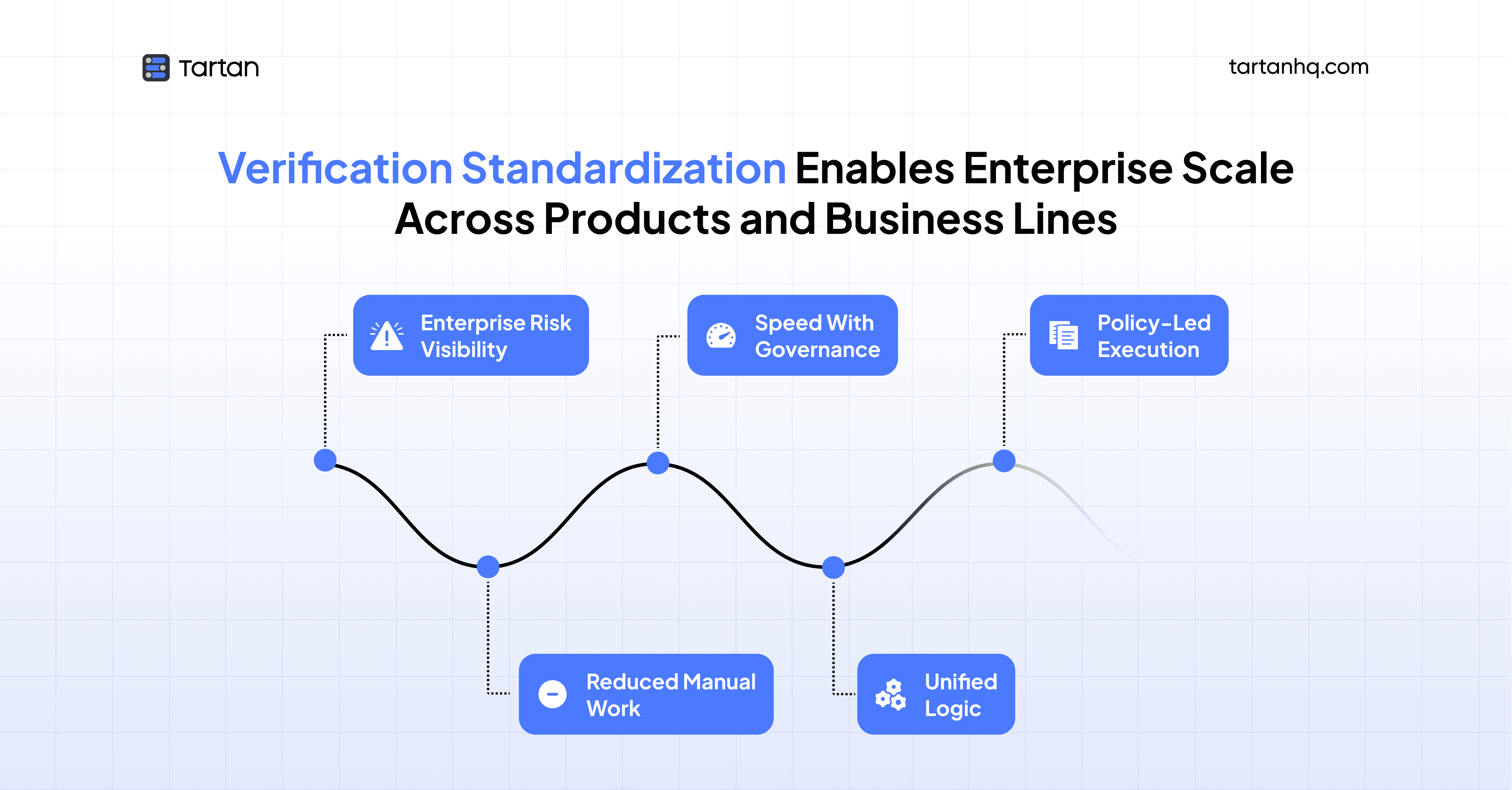
Verification is no longer a support function.
In large enterprises, it becomes a real constraint on cost, risk, and growth. Every customer journey that drives revenue now depends on verification.
Onboarding, underwriting, servicing, claims, renewals none of them move without clearing identity, income, address, documents, and fraud checks. These controls sit directly on the path to revenue, not after it.
Verification dictates how fast customers move through the funnel.
It decides whether transactions move forward or get stuck.
It defines how much manual effort is required to complete a journey.
It defines the enterprise’s actual exposure to fraud, leakage, and regulatory scrutiny.
At scale, verification stops being an operational detail.
It becomes either a structural drag or a competitive advantage depending on how it is designed and governed.
The reason most organizations struggle here is not intent, but history. As businesses scaled, verification decisions were pushed down to individual products to protect speed. Teams optimized locally approval rates, SLAs, regulatory interpretations, vendor choices. Each decision made sense in isolation.
Over time, those choices added up. Parallel verification stacks emerged, each functioning on its own terms, without a shared risk or control framework. What was meant to protect agility gradually turned into a source of inconsistency and hidden risk.
Verification is now at an inflection point.
It can no longer live as ad hoc logic inside products.
It must be defined, governed, and enforced as an enterprise control, designed deliberately to scale with the business.
The Hidden Cost of Product-Led Verification Decisions
Most enterprises do not deliberately design fragmented verification systems. Fragmentation emerges as an unintended outcome of scale.
In practice, this fragmentation manifests in subtle but consequential ways. The same customer may be approved for one product and stalled or rejected for another, even when underlying data is identical.
An address or income signal that fails in one journey may be bypassed or substituted in another. Risk flags raised in one system often do not propagate beyond that product boundary, limiting their usefulness as enterprise risk signals. Operations teams compensate by maintaining separate playbooks for similar verification outcomes, increasing manual effort and variability in resolution.
Yet despite its strategic importance, most enterprises still manage verification as a product-level implementation detail, not as an enterprise-wide capability.
This is rarely a conscious design choice.
It is a consequence of scale, speed, and organizational structure. Verification logic accretes incrementally as new products are launched, new regulations emerge, and new edge cases surface.
What Fragmentation Actually Looks Like in Practice
At an enterprise level, verification fragmentation is rarely visible in dashboards or quarterly reviews. On the surface, each product appears to function correctly, SLAs are met, and compliance checklists are satisfied.
The problem only becomes apparent when verification outcomes are examined across products, journeys, or time. It is at this intersection where customers move between offerings, channels, or lifecycle stages that inconsistencies surface and systemic weaknesses emerge.
When verification logic, failure handling, and risk interpretation are embedded within individual products, the enterprise loses the ability to enforce consistency, learn from patterns, or apply risk intelligence horizontally.
This is not a tooling limitation or a vendor shortfall. It is an architecture and governance problem, where verification operates as disconnected components rather than as a single, enterprise-grade control system.
Siloed Verification Logic Creates Inconsistent Risk Outcomes
When verification logic is designed and executed at the individual product level, risk decisions stop being enterprise decisions. Each product embeds its own assumptions, thresholds, and fallback rules based on local priorities - speed, conversion, or operational convenience.
Over time, this leads to a situation where verification exists everywhere but operates without a single, unified definition of acceptable risk.
Verification outcomes then become a function of how a journey is built rather than what the enterprise intends to permit. Two customers with identical profiles can experience materially different outcomes depending on which product they apply for, which verification sequence is triggered, or how a failure is handled. From a leadership perspective, this introduces uncertainty into one of the most critical control layers of the business.
When verification logic is embedded inside individual products:
Risk thresholds vary without enterprise-level calibration or oversight
Verification failures are interpreted and resolved differently across journeys
Escalation paths depend on product workflows rather than risk severity
Exceptions are absorbed locally instead of being governed centrally
This creates a clear control gap: The organization cannot consistently or confidently explain why a customer was approved in one context and rejected in another.
Why This Directly Weakens Enterprise Risk Posture
Enterprise risk management relies on consistency and comparability. Leadership must be able to assess exposure across products, enforce a coherent risk appetite, and ensure that controls operate uniformly. When verification decisions are made independently across business lines, these capabilities erode.
As a result:
Risk teams struggle to enforce uniform standards across the organization
Product teams unintentionally dilute enterprise risk intent while optimizing locally
Compliance and audit teams face fragmented, non-standardized evidence
Risk signals generated in one part of the business fail to inform decisions elsewhere
The cumulative effect is structural. Risk governance shifts from being preventive and designed into the system to being reactive and investigative. Issues are addressed after inconsistencies surface during audits, incidents, or escalations rather than being prevented through shared logic and controls.
Business Impact: What Leadership Actually Experiences
For senior leadership, the impact of inconsistent verification is tangible and recurring. It shows up not as a single failure, but as a pattern of friction, higher loss adjustments, slower decision cycles, and increasing dependence on manual intervention to reconcile gaps between systems.
This leads to:
Elevated fraud or leakage that cannot be traced to a single breakdown
Slower, more complex regulatory responses due to fragmented explanations
Reduced confidence in approval rates and portfolio-level metrics
Increased reliance on manual overrides to compensate for inconsistency
Most importantly, leadership loses a clear line of sight into how risk is actually being taken across the enterprise. Decisions still occur, but they become harder to justify and harder to improve systematically.
Outcome: From Fragmented Decisions to Defensible Risk Control
Enterprises that address this issue do not attempt to eliminate complexity; they impose discipline on it. By standardizing verification logic, escalation criteria, and failure handling at an enterprise level, they ensure that:
Risk decisions remain consistent across products, even when journeys differ
Outcomes are explainable, auditable, and defensible
Risk appetite is applied deliberately rather than implicitly
Product teams retain flexibility without weakening enterprise controls
In practical terms, this confidence translates into faster approvals for the right customers, fewer downstream corrections, and a materially lower cost of control.
Verification shifts from being a source of friction and second-guessing to a predictable, governed layer that leadership can rely on when scaling products, entering new markets, or defending decisions under scrutiny.
The Operational Drag Created by Fragmented Verification
In most enterprises, verification is assumed to be largely automated. In reality, every verification flow generates operational work especially when outcomes are not clean.
At low volumes, this work is manageable. At scale, it becomes one of the largest hidden drivers of cost to serve.
Every verification failure typically triggers:
Manual reviews and secondary checks
Customer follow-ups and clarification requests
Document re-submissions and re-processing
Exception handling and internal escalation
At scale, this work becomes a structural operating cost rather than an exception. It absorbs capacity that could otherwise be deployed toward growth, risk improvement, or customer experience.
The enterprise ends up paying repeatedly to correct verification outcomes after the fact, instead of designing them to be consistent and predictable upfront.
Why Verification Costs Evade Leadership Attention Until They’re Structural
Verification related costs rarely surface as a single line item or decision point. They accumulate incrementally across teams, budgets, and workflows, making them difficult to attribute or challenge. By the time they become visible at an enterprise level, they are already embedded into how the organization operates.
At enterprise scale:
Exception handling becomes a steady-state workload
Manual intervention turns into an assumed dependency
Ops headcount grows without a proportional improvement in outcomes
By the time leadership focuses on optimization, the cost base is already locked in.
Business Impact: Where the Margin Erosion Actually Shows Up
For CXOs, the impact of duplicated verification operations rarely appears as a single, obvious failure. Instead, it manifests through a set of second-order effects that accumulate quietly across the organization. Each effect on its own may appear manageable or justified. Together, they create sustained pressure on margins, execution speed, and leadership confidence in operational scalability.
Over time, enterprises also develop a growing dependence on human judgment to bridge system gaps. Operations teams learn where systems fail and how to work around them. While this keeps the business running, it transfers decision authority from governed processes to individuals.
This introduces variability, reduces audit defensibility, and makes outcomes harder to predict as volume grows or teams change.
the impact of duplicated verification operations shows up in second-order effects:
Rising cost-to-serve without a corresponding reduction in risk
Slower turnaround times despite increased automation spend
Inconsistent customer experience during failure scenarios
Growing reliance on human judgment to compensate for system gaps
Most critically, operational effort shifts away from managing outcomes toward reconciling inconsistencies. Teams spend time explaining and fixing decisions instead of preventing issues upstream.
Enterprise Outcome: Cost Reduction with Higher Leverage
The net result of standardized verification is not just lower operating cost, but higher operational leverage. Verification ceases to be an expanding safety net compensating for fragmented design and becomes a controlled enterprise function with measurable efficiency gains.
When enterprises standardize verification across products and business lines, the operating profile changes in a fundamental way. The objective is not to create a frictionless or failure-free system - at scale, exceptions are inevitable.
By reducing the number of ways verification can fail and defining in advance how those failures are handled, organizations replace uncertainty with predictability.
For leadership, this translates into:
Greater trust in approval and risk metrics
Faster scaling of new products and markets
Reduced reliance on post-facto corrections
Clear accountability for verification outcomes
Instead of reacting to verification outcomes after they occur, leadership gains the ability to design outcomes upfront. Verification stops behaving like an open-ended process and starts functioning as a governed enterprise control.
In practice, standardization produces several measurable shifts.
Standardization Enables Flexibility - It Does Not Eliminate It
standardization is frequently equated with rigidity. There is a concern that standardizing verification will slow product teams down, force uniform customer journeys, or constrain business lines with different risk profiles. This perception is understandable but inaccurate.
In practice, enterprises that struggle with verification fragmentation often delay standardization precisely because they fear losing flexibility. The result is the opposite.
Without standardization, flexibility exists only locally, while the enterprise accumulates inconsistency, duplication, and unmanaged risk at scale.
Standardizing verification does not mean:
Using the same verification vendor across all products or geographies
Applying identical rules, thresholds, or approval logic everywhere
Forcing diverse customer journeys into a single, rigid verification flow
These approaches tend to fail because they ignore legitimate differences in product design, customer segments, and regulatory context.
Where Standardization Actually Applies in Enterprise Verification
In practice, enterprises converge on standardizing a finite set of foundational components not to homogenize decisions, but to make them consistent, comparable, and governable at scale.
They standardize verification primitives, such as:
Identity signals: core identifiers and match confidence logic, ensuring that identity strength is interpreted consistently regardless of channel or product
Address and location checks: normalization, confidence scoring, and validity criteria, rather than a single method of verification
Income and employment validation: definitions of income types, freshness thresholds, and reliability tiers across sources
Document authenticity: common standards for document integrity, tamper detection, and acceptability, independent of capture method
Device and behavioral indicator: shared interpretation of device trust, velocity, and anomaly signals
These primitives act as reusable building blocks. Products can compose them differently based on context, but the enterprise retains a common understanding of what each signal represents and how much trust it carries.
In addition, mature organizations standardize response strategies, defining upfront:
What constitutes a hard failure versus a recoverable or deferrable outcome
Where and when fallback mechanisms are permissible and when they are explicitly disallowed
Which scenarios require escalation or manual review based on risk exposure, not operational convenience
This removes ambiguity from failure handling and prevents exceptions from quietly becoming alternate approval paths.
Business Impact: Control Without Uniformity
Control comes from shared definitions, governance, and accountability; flexibility comes from allowing products to apply those controls in ways that fit their commercial and customer context. The enterprise defines how decisions should be made and defended, while products retain autonomy over where and when they are applied.
Products retain the freedom to:
Design differentiated customer journeys without re-implementing verification logic or compromising enterprise controls
Optimize for specific segments, ticket sizes, or use cases, while operating within clearly defined risk boundaries
Move quickly and iterate without creating new verification silos or operational dependencies
This ensures product velocity is preserved, but no longer at the cost of long-term consistency or scale.
For CXOs, this balance is the real value. Verification shifts from a collection of product-specific decisions to a governed enterprise capability.
It scales across products without forcing uniform journeys, and gives leadership confidence that growth is supported by consistent, reliable controls.
Outcome: Faster Growth With Stronger Governance
When standardization is applied at the right layer, it removes friction instead of creating it. Enterprises can launch new products without rebuilding verification logic, respond to regulatory changes without one-off fixes, and lower operational cost while improving consistency across journeys.
Most importantly, standardization realigns speed with control. Product teams move faster without weakening enterprise safeguards, and leadership gains confidence that growth is being supported by decisions that are consistent, defensible, and scalable across the business.
When standardization is applied at the right layer, it becomes an enabler rather than a constraint. Enterprises are able to:
Launch new products without duplicating verification work
Adapt to regulatory changes without fragmented fixes
Reduce operational overhead while improving consistency
Defend verification decisions with clarity and confidence
Most importantly, standardization restores alignment between product velocity and enterprise control. The organization no longer has to choose between speed and discipline, it can achieve both through a shared verification foundation.
Verification as an Enterprise Capability, Not a Product Feature
In most organizations, verification evolves inside products. It is implemented to solve immediate delivery needs -
Onboarding a new customer,
Meeting a regulatory requirement,
Unblocking a specific flow.
While effective in the short term, this approach anchors verification too close to individual journeys and too far from enterprise intent.
High-performing enterprises make a deliberate shift. They stop treating verification as something each product does and start treating it as something the enterprise provides. Verification becomes a shared capability designed once, governed centrally, and applied consistently wherever the business needs it.
In this structure, verification operates as:
A shared infrastructure layer, available across products, channels, and business lines, rather than rebuilt repeatedly
Jointly owned by risk, operations, and platform teams, ensuring that controls, scalability, and execution remain aligned
Configured by product teams within defined guardrails, allowing flexibility without compromising enterprise standards
The critical change is structural. Verification moves from being embedded logic inside products to an orchestrated enterprise capability that products consume and configure, rather than redefine.
What This Enables at Scale
This architectural shift produces clear, measurable enterprise outcomes.
Faster product launches: New products reuse existing verification capabilities, reducing time-to-market without weakening controls.
Consistent customer experience: Verification behaves predictably across products and channels, with fewer exceptions and escalations.
Enterprise risk visibility: Leadership gets a unified view of verification outcomes and risk signals across the portfolio.
Clear ROI on verification spend: Costs and impact are measured centrally, not fragmented across individual products.
Governance Designed for Scale, Not Friction
As enterprises grow, the instinctive response to fragmentation is to centralize control. Verification governance is pulled into a single function risk, compliance, or platform with the intent of improving consistency and oversight.
Centralization fails when it turns governance into a gating mechanism. Product teams are forced to wait for approvals, changes require manual sign-off, and even minor adjustments trigger cross-functional dependencies. Over time, governance becomes associated with delay rather than enablement.
When this happens:
Product velocity slows as teams queue for approvals
Workarounds emerge outside formal processes
Local teams re-embed logic to avoid dependency
Central teams become bottlenecks instead of control points
The result is predictable. Governance is bypassed, not because teams are reckless, but because the operating model cannot keep up with the pace of the business.
What Product Teams Control: Product teams retain autonomy where context matters most. They are closest to customers, use cases, and commercial trade-offs, and are therefore best positioned to configure how verification is applied.
Within approved boundaries, product teams can:
Choose which verification components to apply for a given journey
Adjust sequencing and combinations based on risk tier or ticket size
Optimize customer experience without compromising enterprise intent
Iterate quickly without requesting approval for every change
Verification Is a Design Choice
Verification outcomes are not determined solely by data quality, vendor accuracy, or the number of checks performed. Over time, they are shaped by a series of design decisions where verification logic lives, how failures are handled, who owns outcomes, and whether controls are enforced systematically or negotiated locally.
Leading enterprises are now recognizing that verification is not a tooling problem to be patched, it is an enterprise system that must be intentionally designed.
They are redesigning verification as:
A shared capability, consumed consistently across products rather than rebuilt in isolation
A governed system, where rules, failure handling, and accountability are defined centrally and enforced by design
A measurable driver of business outcomes, with clear visibility into cost, risk impact, and operational efficiency
This shift allows verification to support growth instead of constraining it. Decisions become consistent, exceptions become predictable, and leadership regains confidence in how risk is being taken across the business.
Where HyperVerify Fits Into This Redesign
TartanHQ HyperVerify is built for enterprises making this transition from fragmented verification implementations to a deliberate, enterprise-grade verification system.
Instead of replacing individual verification providers, HyperVerify sits above them, providing:
A unified orchestration layer to apply consistent logic across products
Centralized control over sequencing, fallback, and failure handling
Enterprise-wide visibility into verification outcomes and risk signals
Governance by design, without slowing product execution
This enables organizations to preserve vendor flexibility and product differentiation while eliminating inconsistency, duplication, and unmanaged risk.
In effect, HyperVerify ensures that verification intent is designed once and executed everywhere, rather than redefined repeatedly at the product level.
For CXOs, the question is no longer whether verification matters. It is whether verification is being designed intentionally or allowed to evolve reactively.
Organizations that treat verification as a series of disconnected product features will continue paying for fragmentation through higher operational cost, inconsistent risk decisions, and slower, less confident growth.
Verification is not just an operational necessity. At enterprise scale, it becomes a design decision that directly shapes how the organization grows.