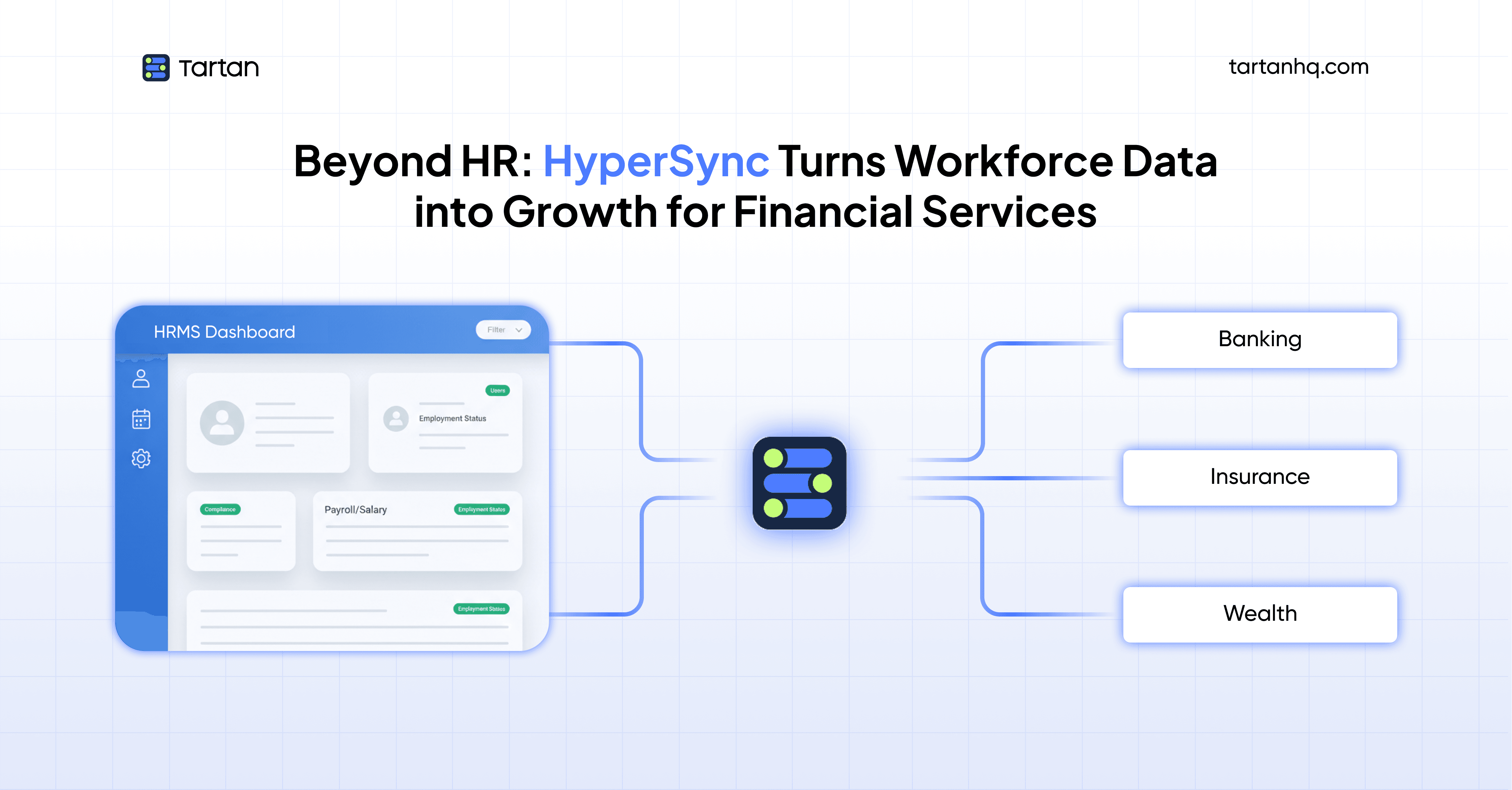
Most teams think of workforce data APIs as "HR tools."
They're not wrong - employment verification, payroll sync, and benefits administration are foundational use cases. But that framing misses the bigger picture.
HyperSync isn't just connecting to HRMS platforms. It's creating data rails between enterprises and financial services, turning employment and income records into the infrastructure that powers faster underwriting, smarter risk models, and frictionless customer experiences across banking, insurance, and wealth management.
This article breaks down how financial institutions are using unified workforce data APIs to remove revenue blockers, reduce operational costs, and build products that weren't economically viable before real-time integrations existed.
The Revenue Problem: Manual Verification Kills Conversion
Here's the pattern that plays out across financial services:
A customer applies for a loan, tries to open an investment account, or enrolls in group insurance. The institution needs to verify their income or employment status. So they ask for:
Pay stubs (PDFs, often outdated)
Bank statements (privacy concerns, incomplete picture)
Employer letters (slow, requires HR involvement)
Tax returns (annual snapshots, not real-time)
What happens next?
Applications stall for days or weeks
Customers abandon mid-flow (drop-off rates spike)
Operations teams manually chase documents
Fraud risk increases (documents are easy to forge)
Credit decisions get made on stale data
The cost isn't just operational inefficiency. It's lost revenue where the customers who needed credit yesterday are gone due to a slower TAT, confusion between steps, data uploading issues.
Insurance carriers miss enrollment windows.
Wealth advisors can't onboard clients fast enough during market opportunities.
HyperSync replaces this entire workflow with a single API call that pulls verified employment and income data directly from the source systems companies already use - payroll platforms, HRMS tools, accounting software.
Banking: Turning Credit Decisions from Days into Minutes
The Traditional Bottleneck
When banks evaluate loan applications, they're trying to answer one question: Can this person afford to repay?
Traditionally, that meant:
Waiting for applicants to upload income documentation
Manually reviewing scanned PDFs for authenticity
Cross-checking bank statements against stated income
Calling employers for verification (which often don't respond)
Result? Loan approvals that should take minutes stretch into 7-14 days. High-intent borrowers lose interest. Competitors with faster processes win the customer.
How HyperSync Changes the Math
With real-time payroll integration, banks can:
1. Verify income instantly during application
Instead of asking for documents, the bank prompts: "Connect your payroll account to verify income." The customer authenticates once (OAuth-style consent), and HyperSync pulls:
Current salary or hourly wages
Employment status and tenure
Pay frequency and next expected payment
Year-to-date earnings
2. Underwrite with live data, not snapshots
A pay stub from last month doesn't tell you if someone just got laid off. Real-time HRMS sync does. Banks using HyperSync can check employment status at the moment of underwriting, reducing default risk from undetected job changes.
3. Automate income recertification for revolving credit
For lines of credit or ongoing lending relationships, manual income reverification every 6-12 months is standard (and painful). With consent-driven data rails, banks can automatically refresh income records when payroll systems update - no customer action required.
Revenue Impact:
Faster time-to-funded: Applications that took 10 days now close in under 24 hours
Higher conversion rates: Removing document upload steps reduces abandonment by 30-40%
Lower fraud losses: Source-verified income is exponentially harder to fake than uploaded PDFs
HDFC Bank and similar institutions aren't using this to build "better HR tools." They're using it to originate more loans, faster, with better risk profiles.
Insurance: Solving the Group Coverage Enrollment Nightmare
Why Insurance Carriers Struggle with Employer-Sponsored Plans
Group health, life, and disability insurance should be straightforward: an employer sponsors coverage, employees enroll, premiums get deducted from payroll.
In practice? It's a mess.
Eligibility verification delays: Carriers wait weeks for HR to send census files (often Excel spreadsheets with errors)
Payroll deduction failures: Contribution amounts don't match because employee salary data is outdated
Enrollment windows missed: By the time manual data exchange happens, coverage effective dates have passed
Reconciliation chaos: Finance teams spend weeks matching premium invoices to actual enrolled employees
Every delay costs the carrier revenue. Every mismatch creates disputes. Every manual touchpoint increases operational overhead.
The HyperSync Solution
Insurance platforms integrate once with HyperSync and instantly gain access to 80+ payroll and HRMS systems - ADP, Workday, Gusto, BambooHR, Paychex, you name it.
What this enables:
1. Real-time eligibility checks
When an employee tries to enroll in benefits, the system confirms:
Are they still employed?
Do they meet eligibility criteria (full-time status, tenure requirements)?
What's their current compensation (for premium calculations)?
No waiting for HR. No spreadsheet uploads. The data flows directly from the company's HRMS.
2. Automated payroll deduction sync
Once enrolled, contribution amounts sync automatically:
New hires get added to deductions immediately
Salary changes trigger premium adjustments
Terminations stop deductions without manual intervention
3. Continuous census updates
Instead of quarterly or annual census file exchanges, the carrier's system stays in sync with the employer's HRMS in real-time. Every job change, salary adjustment, or termination reflects instantly.
Revenue Impact:
Faster policy issuance: Coverage becomes effective immediately instead of waiting for manual verification
Higher retention: Fewer billing disputes and premium errors reduce policy cancellations
Lower operational costs: Finance teams reclaim hundreds of hours per year previously spent on reconciliation
For benefits platforms competing to serve mid-market and enterprise employers, multi-HRMS support isn't a nice-to-have. It's a sales requirement. If your platform doesn't support the employer's existing payroll system, you lose the deal. HyperSync solves that in a single integration.
Wealth Management: Building Financial Plans on Real Income, Not Estimates
The Advisor's Data Problem
Financial advisors need accurate, current income information to build effective wealth plans. They need to know:
How much is the client earning today?
How stable is their income (salary vs. variable compensation)?
When do they receive bonuses or stock vesting events?
Traditionally, advisors rely on client self-reporting. The client says "I make around $150K" or "I think my company matches 5%." Then months later, when reviewing account statements, the advisor realizes:
Actual income is different
The client underestimated their bonus structure
Tax withholding was misconfigured
Plans built on estimates create suboptimal outcomes. Clients don't maximize tax-advantaged contributions. Advisors can't model cash flow accurately. Opportunities get missed.
How Wealth Platforms Use HyperSync
Forward-thinking wealth management platforms now let clients connect their payroll accounts during onboarding.
What this unlocks:
1. Precise cash flow modeling
Instead of asking "What's your take-home pay?", the platform pulls:
Gross income
Pre-tax deductions (HSA, insurance premiums)
Post-tax deductions
Net deposit amounts and frequency
This enables advisors to model exactly how much discretionary cash flow is available for investing, debt paydown, or emergency fund building.
2. Automated retirement contribution optimization
The platform can see:
Employer match structure (e.g., "100% match on first 5%")
Year-to-date contributions toward IRS limits
If the client isn't capturing the full match, the system flags it immediately. If they're on track to under-contribute for the year, automated alerts prompt course correction.
3. Dynamic financial planning based on income changes
When a client gets a raise, switches jobs, or experiences a compensation change, their connected payroll data updates automatically. The wealth platform can:
Recalculate savings rates
Adjust investment timelines
Update tax projections
Trigger advisor review for major changes
Revenue Impact:
Better client outcomes: Plans built on real data perform better, increasing client satisfaction and AUM retention
Faster onboarding: Collecting accurate financial data during signup takes minutes, not weeks of back-and-forth
Proactive advisory opportunities: Automated alerts when clients experience income changes create natural touchpoints for advisors to add value
For wealth management firms competing on "personalized financial planning," real-time income data is the difference between generic advice and precision guidance.
The Common Thread: Data Rails as Competitive Infrastructure
Banking, insurance, and wealth management face the same core challenge - they need verified, real-time data from enterprise systems they don't control.
Before unified APIs like HyperSync, the only options were:
Build direct integrations (expensive, slow, doesn't scale past 5-10 systems)
Ask customers for documents (slow, error-prone, terrible UX)
Use proxies like bank statements (incomplete, privacy concerns, easy to manipulate)
All three options create revenue drag:
Slow processes lose customers to faster competitors
Manual verification burns operational capacity
Bad data leads to bad decisions (fraud losses, missed opportunities)
HyperSync changes the economics. A single API integration gives financial institutions instant access to 80+ payroll and HRMS platforms. Employment and income data flows in real-time, with customer consent, directly from the source.
This isn't about replacing HR teams or building better employee management tools. It's about removing the friction between financial institutions and the workforce data that powers their core products.
Why This Matters for Product and Revenue Teams
If you're building financial products, consider:
What revenue are you leaving on the table because verification is too slow?
Every day an application sits in "pending document review" is a day your competitor might close the customer.
How much does manual operations cost you per customer?
Teams spending hours chasing pay stubs, reconciling spreadsheets, or calling employers for verification are expensive. Those costs scale linearly with volume.
What products could you build if real-time data were available?
Earned wage access, instant underwriting, dynamic pricing, proactive financial planning - all require live workforce data. Without it, these products are economically unviable.
How many enterprise deals are you losing because you don't support their systems?
"We use Workday" or "We're on ADP" shouldn't be reasons you lose a sale. Multi-system support is table stakes for enterprise buyers.
HyperSync removes these blockers. One integration. Real-time data. 80+ systems covered.
What "Beyond HR" Actually Means
The workforce data layer - employment status, income, payroll records, job history - was built for HR departments. But its highest-value use cases live outside HR.
Banks use it to underwrite credit.
Insurance carriers use it to enroll and price coverage.
Wealth managers use it to build financial plans.
Fintechs use it to enable earned wage access.
Background check platforms use it for continuous verification.
Travel companies use it for policy enforcement.
The companies winning in these categories aren't treating employment data as "HR information." They're treating it as revenue infrastructure - the data layer that makes their core products faster, more accurate, and more competitive.
That's what HyperSync unlocks. Not better HR software. Better financial services, built on real-time workforce data.