
3 min read
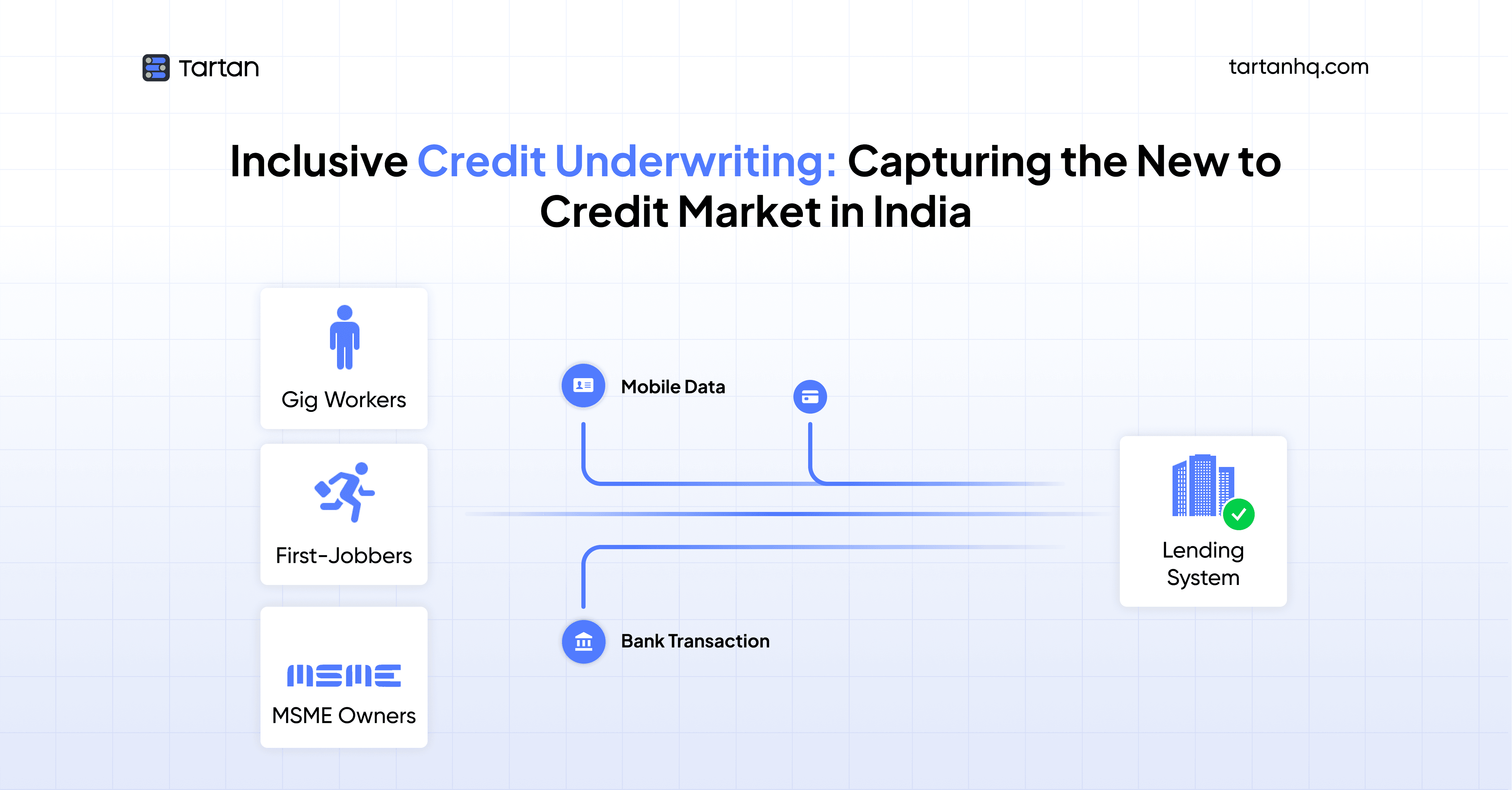
The Untapped Credit Opportunity
India adds 12 million people to its workforce every year. Most have stable incomes, responsible financial habits, and the ability to repay loans. Yet the majority lack access to formal credit because traditional underwriting methods can't evaluate them without credit bureau history.
For lenders, this represents both a challenge and an opportunity. Financial institutions that develop the capability to assess New to Credit (NTC) borrowers are building relationships with customers at the start of their financial journeys - creating lifetime value that compounds over decades.
Understanding the New to Credit Segment
Who Are NTC Borrowers?
New to Credit borrowers have never held a credit card, taken a loan, or established any formal credit relationship. They're invisible to traditional credit bureaus, but they're not financially irresponsible - they simply haven't had the opportunity to build a credit history.
Key NTC segments in India:
Young professionals entering the workforce for the first time with stable employment but no credit history
Gig economy workers earning consistent income through platforms like Uber, Swiggy, Zomato, and freelance marketplaces
Migrants moving from rural to urban areas for employment opportunities with steady jobs but no formal banking relationships
Women entering the workforce or seeking financial independence who have been historically excluded from credit markets
Small business owners operating in the informal economy who are ready to formalize and scale their operations
Why Traditional Underwriting Fails These Borrowers
Traditional credit scoring relies on credit bureau data - payment history on loans and credit cards, credit utilization ratios, length of credit history, and types of credit accounts held. For NTC borrowers, none of this data exists.
This creates a circular problem: lenders can't extend credit without credit history, but borrowers can't build credit history without access to credit. The result is systematic exclusion of millions of creditworthy individuals who could be profitable, loyal customers.
The Business Case for Serving NTC Borrowers
Market Expansion
India's credit penetration remains significantly lower than developed markets. The growth from 110 million borrowers in 2015 to 200 million in 2020 demonstrates both the scale of demand and the speed at which markets can expand when access barriers are removed.
Lenders who can accurately assess NTC borrowers gain access to this expanding market ahead of competitors. More importantly, they establish relationships with customers at the beginning of their financial journeys, positioning themselves as the primary financial partner as these customers' needs evolve over time.
Lifetime Customer Value
The economics of NTC lending become compelling when viewed through a lifetime value lens rather than a single-product perspective.
The typical NTC customer journey:
First credit product: Small personal loan or credit card with modest limit to establish credit history
Year 2-3: Vehicle loan for two-wheeler or car to support employment and family needs
Year 3-5: Higher-value personal loans for education, marriage, or home improvement
Year 5-10: Home loan, business loans, and premium credit products as income and credit profile strengthen
Year 10+: Wealth management, investment products, insurance, and family banking relationships
When a lender provides someone's first credit product and ensures a positive experience, they create the foundation for a multi-decade relationship spanning multiple high-value products. The customer acquisition cost for that first loan is amortized across this entire relationship.
Competitive Differentiation
As traditional lending markets become saturated and competition intensifies, NTC borrowers represent one of the few remaining greenfield opportunities for customer acquisition. Lenders who develop distinctive capabilities in this segment create defensible competitive advantages that are difficult for competitors to replicate quickly.
Alternative Data: Building a Complete Picture of Creditworthiness
Traditional credit bureau data tells you what someone did with credit in the past. Alternative data tells you how someone manages their entire financial life right now.
Key Alternative Data Sources for NTC Assessment
Employment and Payroll Data
Direct integration with employer payroll systems provides verified information about income stability, employment tenure, salary growth trajectory, and regularity of income. For salaried employees, this is often the most reliable indicator of repayment capacity.
Outcome: A fintech lender integrated with payroll platforms serving IT services and BPO companies. They reduced income verification time from 7 days to real-time and decreased false rejections by 34%, approving 2,400 additional qualified borrowers monthly who were previously rejected due to inability to verify income quickly.
Rental Payment History
For many NTC borrowers, rent is their largest monthly financial obligation. Years of consistent on-time rent payments demonstrate financial discipline and repayment capacity that traditional credit scores completely ignore.
Outcome: A housing finance company incorporated rental payment data from property management platforms. They found that borrowers with 24+ months of consistent rent payments had default rates 40% lower than their portfolio average, despite having no traditional credit history. This insight allowed them to expand lending to an additional 15,000 first-time home buyers annually.
Utility and Bill Payments
Electricity, water, mobile phone, internet, and other recurring bills provide longitudinal data about payment behavior. Consistent payments over extended periods indicate financial responsibility and money management skills.
Outcome: A regional bank partnered with utility providers to access payment history data. Borrowers with 18+ months of on-time utility payments showed 3-month delinquency rates of just 1.8% - better than their prime credit segment. They used this insight to launch a "utility-scored" personal loan product that approved 8,000 NTC borrowers in its first six months.
Digital Transaction Data
Banking APIs and account aggregation platforms provide visibility into cash flow patterns, account balance trends, savings behavior, and spending categories. This real-time financial behavior data is far more predictive than static credit scores for assessing current repayment capacity.
Outcome: A digital lender used banking API data to analyze cash flow patterns for gig economy workers. They discovered that borrowers maintaining average monthly balances above 2x their loan EMI amount had default rates comparable to salaried employees with traditional credit scores above 750. This enabled them to approve 60% more gig worker applications while maintaining portfolio quality.
Platform Economy Data
For gig workers earning through Uber, Ola, Swiggy, Zomato, and similar platforms, earnings data directly from these platforms provides verified income information that traditional employment verification cannot capture.
Outcome: A mobility-focused NBFC integrated directly with ride-sharing platforms to assess driver income and consistency. They developed a scoring model based on rides per month, average earnings, and platform tenure. This allowed them to extend two-wheeler and four-wheeler loans to 45,000 gig economy drivers who had been rejected by traditional lenders, with portfolio performance meeting their risk-adjusted return targets.
Use Case Deep Dives: Alternative Data in Action
Use Case 1: Young Professional with First Job
Borrower Profile:
24-year-old software engineer
First formal job after graduation, employed for 8 months
Monthly salary: ₹60,000
Lives in shared accommodation in Bangalore
No credit cards, no prior loans, no credit bureau file
Traditional Underwriting Result: Rejected - no credit history available to assess
Alternative Data Assessment:
Payroll integration: Verified 8 months of consistent salary deposits, zero missed payments
Rental payments: 8 months of on-time rent payments via digital payment apps
Utility bills: Mobile and internet bills paid consistently for 14 months
Banking data: Maintains average balance of ₹25,000, regular savings deposits
Digital behavior: Consistent transaction patterns, no overdrafts, responsible spending
Outcome: Approved for ₹200,000 personal loan at competitive rates. Used loan for higher education course to advance career. After 12 months of on-time payments, credit score established at 782, enabling access to premium credit cards and higher loan amounts. Customer lifetime value projected at ₹45 lakhs across multiple products over 15 years.
Lender Impact: This lender now processes 3,500 similar applications monthly. First-year default rate: 2.1% - in line with their overall portfolio average. Customer acquisition cost recovered within 18 months through both direct loan profitability and cross-sell opportunities.
Use Case 2: Gig Economy Delivery Partner
Borrower Profile:
28-year-old delivery partner for food delivery platform
2.5 years on platform, full-time
Average monthly earnings: ₹35,000 (variable based on deliveries completed)
Supporting family, reliable work history
No formal employment, no credit history
Traditional Underwriting Result: Rejected - irregular income, no verifiable employment, no credit bureau record
Alternative Data Assessment:
Platform earnings: Directly verified 2.5 years of platform activity with ₹8.5 lakhs total earnings
Income stability: Completed 250+ deliveries per month consistently with low month-to-month variance
Digital wallet data: Regular deposits to family, bill payments, savings behavior visible
Rental history: 30 months of on-time rent payments
Mobile/utility: All bills current, no defaults
Outcome: Approved for ₹100,000 two-wheeler loan to upgrade vehicle and increase earning capacity. Monthly EMI structured at ₹6,500 to align with typical low-earning weeks. After 6 months, offered upgrade to ₹150,000 limit based on payment performance.
Lender Impact: Expanded this model to gig economy workers across platforms. Portfolio of 12,000 borrowers with 3.2% NPL rate - slightly higher than prime but within acceptable risk parameters. These borrowers show exceptionally high loyalty, with 68% returning for second product within 24 months versus 41% for traditional segments.
Use Case 3: First-Time Woman Entrepreneur
Borrower Profile:
32-year-old starting home-based catering business
Previously homemaker, no formal employment history
Husband's income stable, family financially secure
Active savings account for 4 years
No credit history, no collateral
Traditional Underwriting Result: Rejected - no income, no credit history, no collateral
Alternative Data Assessment:
Banking data: Joint account showing household income stability, consistent savings pattern of ₹10,000/month for 4 years
Digital payments: Growing volume of customer payments for catering services via UPI, demonstrating business traction
Utility bills: All household bills paid consistently by applicant
Business indicators: Social media presence showing 200+ catering orders completed, strong customer reviews
Financial discipline: Zero overdrafts or bounced payments across 4 years
Outcome: Approved for ₹300,000 business loan for commercial kitchen equipment and working capital. Loan structured with 3-month moratorium to accommodate business ramp-up, then standard EMI. Business grew 180% in year one. Borrower became advocate, referring 8 other women entrepreneurs from her network.
Lender Impact: Developed specialized women entrepreneur program using this model. 4,500 loans disbursed in 18 months. Default rate: 1.6% - lowest across all lending segments. Program featured in media, enhancing brand reputation and attracting deposits and customers beyond lending.
Use Case 4: Rural-to-Urban Migrant Worker
Borrower Profile:
26-year-old factory worker, migrated from rural Bihar to industrial area near Mumbai
Stable factory employment for 18 months, monthly income ₹22,000
Sending ₹10,000 monthly to family in home village
Basic smartphone, limited financial literacy
No credit history, no urban references
Traditional Underwriting Result: Rejected - insufficient address proof, unable to verify background, no credit history
Alternative Data Assessment:
Employer verification: Factory HR confirmed employment tenure and salary
Remittance pattern: 18 months of consistent ₹10,000 monthly transfers to same family account, demonstrating financial responsibility
Mobile wallet history: Regular small savings, bill payments, recharge patterns showing stable usage
Digital footprint: Phone usage patterns consistent with stable work schedule
Micro-behaviors: Never missed mobile recharge, consistent spending patterns
Outcome: Approved for ₹50,000 personal loan for family medical emergency. Loan structured with 6-month tenure to match savings capacity. Repaid in full 2 weeks early. Customer immediately eligible for ₹75,000 pre-approved limit. Subsequently took two-wheeler loan for ₹80,000 to improve commute.
Lender Impact: This model enabled serving migrant worker segment previously considered "unbanked." Built portfolio of 8,500 migrant worker borrowers across industrial zones. Higher touch servicing required initially, but default rates stabilized at 4.1% after refined scoring model. This segment shows exceptional loyalty - 92% repayment rate and 71% repeat borrowing within 36 months.
Technology Infrastructure: Making Alternative Data Work at Scale
Serving NTC borrowers with alternative data isn't just about collecting more information - it requires a complete technology infrastructure that can securely access, validate, analyze, and act on diverse data sources in real time.
Essential Technology Components
Banking APIs and Account Aggregation
Direct integration with banking systems through API frameworks enables real-time access to transaction history, account balances, and cash flow patterns with customer consent. This eliminates manual bank statement collection and provides up-to-date financial behavior data.
Required capabilities: Secure consent management, multi-bank connectivity, transaction categorization, cash flow analysis algorithms, and fraud detection mechanisms.
Payroll System Integration
Direct connections to employer payroll platforms provide verified income data instantly, eliminating the need for salary slips, employment letters, and manual verification processes that delay decisions and increase operational costs.
Required capabilities: Employer authentication, data standardization across payroll formats, income trend analysis, and employment stability scoring.
Utility and Bill Payment Data Access
Partnerships with utility providers, telecom companies, and digital payment platforms enable access to payment history data that demonstrates financial discipline across multiple obligation types.
Required capabilities: Multi-provider integrations, payment history consolidation, behavioral scoring models, and data quality validation.
Platform Economy Integrations
Direct APIs with gig economy platforms (ride-sharing, delivery, freelance marketplaces) provide verified earnings data for non-traditional workers whose income doesn't flow through conventional employment structures.
Required capabilities: Platform authentication, earnings verification, income stability calculation for variable earnings, and activity pattern analysis.
Alternative Credit Scoring Models
Machine learning models that can evaluate creditworthiness using alternative data inputs, generating risk scores that are as predictive as traditional credit bureau scores but work for borrowers without credit history.
Required capabilities: Model development infrastructure, ongoing model validation and refinement, explainable AI for regulatory compliance, and bias detection and mitigation frameworks.
Implementation Considerations for Lenders
Data Privacy and Consent Management
All alternative data access must be governed by explicit customer consent with clear disclosure of what data is accessed, how it's used, and how long it's retained. Compliance with data protection regulations is non-negotiable.
Regulatory Alignment
Alternative data underwriting must align with RBI guidelines on fair lending practices, data usage, and credit assessment methodologies. Work closely with regulators to ensure innovative approaches meet compliance requirements.
Operational Integration
Alternative data capabilities must integrate seamlessly with existing loan origination systems, credit decision workflows, and portfolio monitoring tools. Standalone solutions that don't integrate create operational friction that undermines efficiency gains.
Staff Training and Change Management
Credit officers trained on traditional bureau-based underwriting need education on alternative data interpretation, new risk indicators, and different conversation approaches with NTC borrowers who may need more guidance.
Risk Management: Maintaining Portfolio Quality While Expanding Access
A common concern about NTC lending is whether it compromises portfolio quality or increases default risk. When properly implemented with robust alternative data and appropriate risk management, NTC lending can deliver portfolio performance comparable to traditional segments.
Risk Mitigation Strategies
Start with Conservative Limits and Graduate
Initial credit limits for NTC borrowers should be conservative - enough to meet their need and establish credit history, but not so high that default would be catastrophic for either borrower or lender. As borrowers demonstrate repayment capability, limits can be increased.
Lenders using graduated limit approaches report lower loss-given-default on NTC portfolios compared to static limit approaches, as smaller initial exposures limit losses from the small percentage of borrowers who do default.
Match Product Structure to Cash Flow Patterns
Gig workers with variable income need different repayment structures than salaried employees with predictable paychecks. Flexible payment dates, variable EMI options, or bullet payments aligned to seasonal income patterns improve repayment rates.
A lender offering flexible payment dates (any day between 1st-15th of month rather than fixed date) for gig workers will see a drop in delinquency rates with no change in credit policy - simply by accommodating income variability.
Invest in Financial Literacy and Support
First-time borrowers benefit from education about credit products, repayment obligations, and credit score implications. Proactive customer support and early intervention when payment issues arise prevent delinquencies from escalating to defaults.
Lenders with dedicated NTC customer success programs report 35-50% lower progression from 30-day delinquency to 90-day default compared to those treating NTC borrowers identically to experienced credit users.
Monitor and Refine Models Continuously
Alternative data models should be validated continuously against actual performance data. As portfolios mature, models can be refined to better identify risk factors and improve approval accuracy.
A digital lender's initial NTC model approval & default rate improvement directly results in expanding access and improving portfolio quality.
Measuring Success: Key Metrics for NTC Lending Programs
Financial institutions building NTC lending capabilities should track both traditional credit metrics and specific indicators that reflect the unique characteristics of this segment.
Portfolio Performance Metrics:
Default rates compared to overall portfolio and initial projections
Vintage analysis showing how NTC cohorts perform over time
Loss-given-default rates for NTC versus traditional segments
Risk-adjusted returns on NTC portfolio
Market Penetration Metrics:
NTC borrowers as percentage of total loan originations
Growth rate of NTC portfolio compared to traditional segments
Geographic and demographic reach within target NTC populations
Market share within specific NTC segments (gig economy, young professionals, etc.)
Customer Lifetime Value Metrics:
Repeat borrowing rates for NTC customers
Time to second product for NTC borrowers
Cross-sell success rates for additional products
Customer tenure and long-term profitability
Operational Efficiency Metrics:
Application-to-approval time for NTC applications
Straight-through processing rates using alternative data
Cost per application for NTC versus traditional borrowers
Customer acquisition cost and payback period
Social Impact Metrics:
Number of first-time borrowers enabled
Women borrowers as percentage of NTC portfolio
Geographic distribution showing reach into underserved areas
Progression of NTC borrowers to higher credit tiers
Conclusion: From Financial Exclusion to Inclusive Growth
The 200 million Indians who gained access to credit between 2015 and 2020 demonstrate both the scale of demand and the pace at which markets can expand when access barriers are removed.
Yet millions more remain excluded - not because they lack financial discipline or repayment capacity, but because traditional credit assessment methods can't evaluate them.
For financial institutions, these NTC borrowers represent an enormous opportunity. They're building relationships with customers at the beginning of their financial journeys, creating lifetime value that compounds over decades.
They're differentiating themselves in competitive markets by serving segments others ignore. They're building brand value as institutions that enable financial inclusion and economic opportunity.
The tools to serve this market already exist. Banking APIs, alternative data sources, and modern credit models provide the technological foundation. Early movers have proven that NTC lending can deliver attractive returns while expanding financial access.
The only question is whether your institution will lead in capturing this opportunity or watch competitors build these relationships first.
The future of lending in India belongs to institutions that can assess creditworthiness accurately regardless of credit bureau history. Those capabilities aren't just socially responsible - they're commercially essential for growth in India's rapidly evolving financial services market.
Tartan helps teams integrate, enrich, and validate critical customer data across workflows, not as a one-off step but as an infrastructure layer.