Life insurance is supposed to protect families when income disappears.
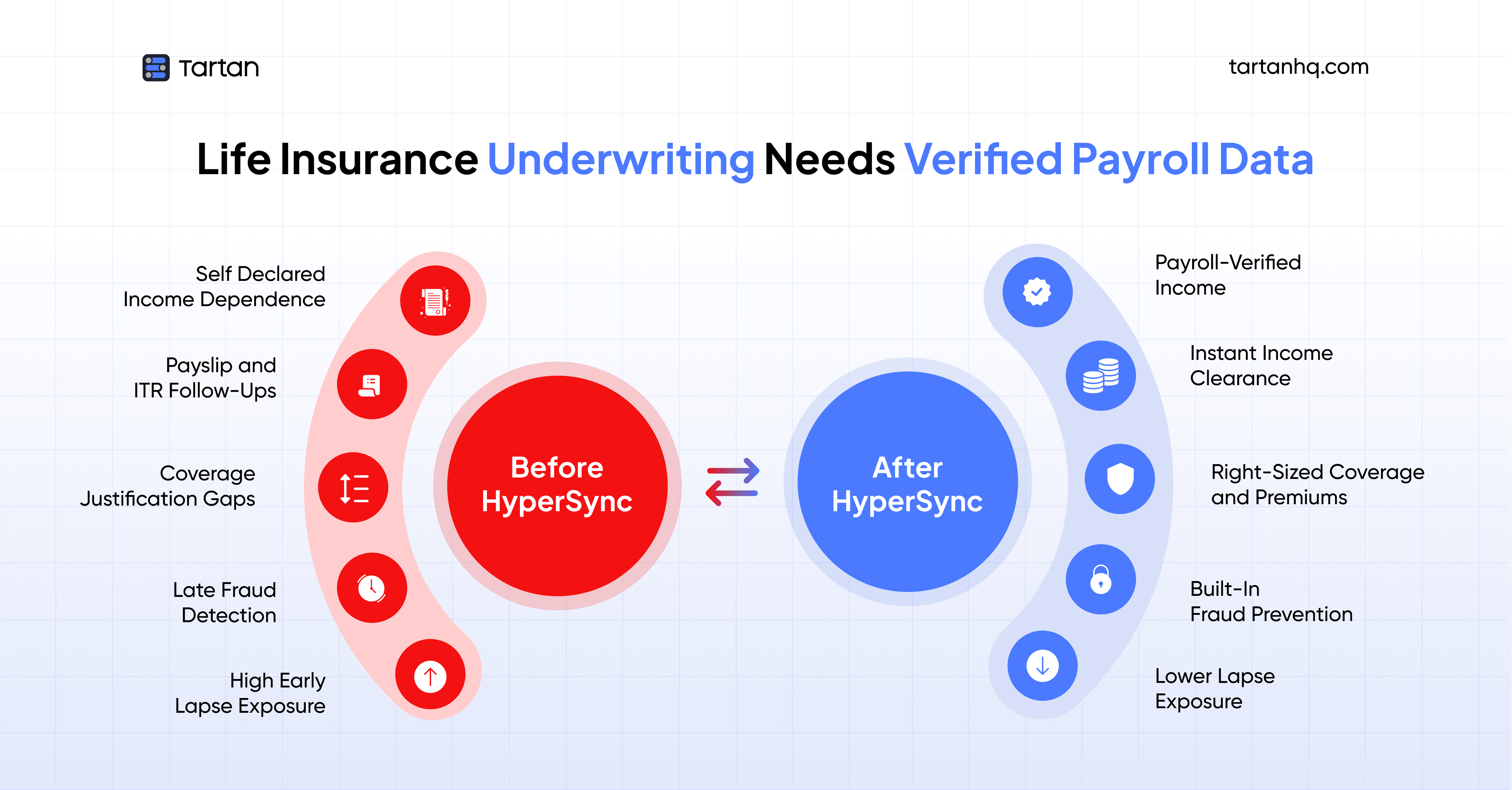
Yet the industry has a paradox at its heart: the income figure that determines coverage amounts and premium affordability is almost never verified.
Insurers rely on what applicants tell them, crossed-checked against broad employment categories and crude estimation models.
The result? Systematic under-insurance that fails families, over-insurance that leads to policy lapses, and fraud that costs the industry billions annually.
This is where HyperSync is opening new possibilities - connecting insurance underwriting directly to payroll systems to base coverage and premiums on verified, real-time income data rather than self-reported estimates.
The Income Verification Gap in Insurance Underwriting
When someone applies for life insurance, underwriters ask detailed health questions, order medical tests, review prescription histories, and verify driving records. But income? That's typically just a box the applicant fills in, maybe cross-referenced against their stated occupation using industry salary benchmarks.
This creates three fundamental problems that plague the insurance industry:
Under-insurance epidemic: Studies consistently show that 50-60% of Indian households are significantly under-insured. A major reason? Coverage recommendations based on self-reported income that applicants underestimate, either from modesty, privacy concerns, or simple uncertainty about how to calculate their total compensation.
Lapse risk from over-insurance: On the flip side, some applicants overstate income to qualify for higher coverage, then struggle to maintain premium payments when reality hits. These policies lapse within 2-3 years, creating losses for insurers and leaving families unprotected.
Application fraud: Insurance fraud investigators estimate that 10-15% of term insurance applications contain material income misrepresentations - inflated figures to justify higher coverage amounts that beneficiaries can later claim.
What Traditional Income Verification Looks Like
The standard insurance underwriting process treats income verification as a compliance checkbox rather than a core underwriting factor:
Self-declaration: Applicant states their annual income on the application form
Occupation matching: Underwriter compares stated income against salary ranges for the declared profession
Red flag checks: Only if income seems wildly inconsistent with occupation does verification begin
Document requests: For high-coverage policies (typically ₹1 crore+), insurers request salary slips or ITR
Manual review: Operations team reviews submitted documents for obvious fraud indicators
Basic validation: Check that documents look legitimate, numbers seem plausible
This process has obvious vulnerabilities. Salary slips can be forged. ITR doesn't capture recent income changes or full compensation structure. Occupation-based benchmarks are crude averages that miss individual variation. And for the vast majority of policies, no real verification happens at all.
The Cost of Getting Income Wrong
Income errors in insurance underwriting create problems that ripple through the entire policy lifecycle:
Problem | Impact on Insurer | Impact on Policyholder |
Under-insurance | Smaller premium revenue, lower customer lifetime value | Family receives inadequate coverage when needed most |
Over-insurance | High early lapse rates (policies drop before profitability) | Struggle to maintain premiums, policy lapses, wasted premium payments |
Fraud - Inflated Income | Fraudulent claims paid on coverage that shouldn't have been issued | Criminal exposure for applicants involved in fraud schemes |
Incorrect Risk Pricing | Mispriced policies that don't match actual risk profile | Some pay too much, others too little for their actual risk |
Coverage Mismatch | Higher claims ratio when coverage doesn't match actual needs | Financial goals unmet due to wrong coverage amount |
Poor Persistency | Policies lapse when premiums become unaffordable | Families lose protection and invested premiums |
The financial impact on insurers is substantial. Early policy lapses typically occur before the insurer recoups acquisition costs. Fraudulent claims based on income misrepresentation can run into crores for individual cases. And systematic under-insurance means the industry captures less premium than it should for the actual protection families need.
Enter HyperSync: Payroll-Verified Insurance Underwriting
HyperSync transforms insurance income verification by connecting underwriting systems directly to employer HRMS and payroll platforms. With applicant consent, insurers can pull verified income data in real-time - not what the applicant claims to earn, but what their employer actually pays them.
This includes granular compensation details that self-reporting can never capture:
Base salary: Fixed monthly compensation from payroll records
Total CTC: Complete cost-to-company including all components
Variable components: Bonuses, commissions, incentives with payment history
Deductions: Existing insurance premiums, loan EMIs, PF contributions
Take-home accuracy: Actual monthly credited amount after all deductions
Income stability: Historical salary data showing consistency or volatility
Employment tenure: Verified date of joining and continuous employment status
The data comes normalized from HyperSync regardless of which HRMS the employer uses - SAP, Workday, local payroll systems - insurers get a consistent API format they can integrate once and use across all employer systems.
Accurate Coverage Recommendations Based on Real Income
The most immediate impact of payroll-verified data is finally being able to recommend appropriate coverage amounts based on actual income rather than guesswork.
Traditional rule-of-thumb approaches suggest "10x annual income" for life coverage, but applying this to self-reported income that's 20-30% off creates systematic errors. HyperSync enables precision:
Verified income baseline: Start with actual annual compensation from payroll data
Component-level understanding: Factor in variable pay stability when calculating replacement needs
Liability visibility: See existing employer insurance, loan deductions that affect net income needs
Family obligation context: Match coverage to actual take-home that supports family lifestyle
Future income trajectory: Use employment data (promotions, tenure) to project income growth
This results in coverage recommendations that actually protect families adequately. A software engineer with ₹15 lakhs base salary but ₹25 lakhs total CTC including stock and bonuses should have coverage based on the ₹25 lakhs figure - but only if you can verify it. HyperSync makes that verification instant and automatic.
Dynamic Premium Models Linked to Income Changes
Here's where insurance can learn from usage-based auto insurance models: what if premiums adjusted based on verified income changes, creating sustainable, long-term policy relationships?
With HyperSync's continuous monitoring capabilities, insurers can track income changes post-policy issuance:
Income increases: Proactively offer coverage top-ups when salary rises significantly
Income decreases: Adjust premium payment schedules or offer reduced coverage options before lapse
Employment changes: Detect job transitions that might affect income stability and risk profile
Variable compensation volatility: Recognize when bonus-heavy compensation becomes unstable
This enables innovative product structures:
Income-Indexed Term Plans: Premium amounts that adjust annually based on verified income changes, keeping coverage affordable as financial situations evolve while maintaining protection levels appropriate to actual earnings.
Salary-Linked Premium Schedules: Premium payment dates that align with salary credit dates, reducing payment friction and improving persistency.
Dynamic Coverage Riders: Automatic coverage adjustments based on verified income milestones - coverage increases with promotions, decreases temporarily during career breaks, all based on actual payroll data rather than customer requests.
The persistency impact alone justifies this approach. Policies that adapt to real income changes rather than being based on one-time income declarations show significantly lower lapse rates.
Fraud Prevention in Term Insurance Applications
Insurance fraud costs the industry billions annually, and income misrepresentation is one of the most common fraud vectors in term insurance. HyperSync makes this fraud vector obsolete.
Traditional fraud patterns HyperSync eliminates:
Income inflation: Applicants claiming ₹50 lakhs annual income when payroll shows ₹30 lakhs
Occupation mismatch: Stated job title that doesn't match actual HRMS designation
Employment fabrication: Claiming employment at companies where no payroll record exists
Fake documentation: Forged salary slips that look legitimate but don't match actual payroll data
Ghost employees: Insurance applications for people not actually on employer payrolls
When underwriting is based on direct payroll verification, these fraud schemes simply don't work. You can't forge HRMS data that the insurer pulls directly from the source system via API.
Fraud detection advantages:
Impossible to fake: Data comes from employer systems, not borrower documents
Real-time verification: Fraud attempts caught immediately at application stage
Historical validation: Past salary data shows if claimed income trajectory is realistic
Cross-reference capability: Employment status, designation, and compensation must all align
Automated red flags: System-level detection of discrepancies that manual review misses
For high-coverage policies (₹1 crore+) where fraud risk is elevated, payroll verification isn't just faster than document review - it's categorically more reliable.
Instant Underwriting for Term Insurance
Speed matters in insurance. Application abandonment rates in term insurance are notoriously high, often because the process drags on for weeks as underwriters chase income documentation.
HyperSync enables instant income verification that transforms the application experience:
Traditional term insurance timeline:
Day 1: Application submitted with self-declared income
Day 3-5: Operations requests income proof documents
Day 7-10: Applicant submits salary slips and ITR
Day 12-15: Manual review of documents, possible clarifications needed
Day 18-21: Income verification cleared, proceed to medical underwriting
HyperSync-powered timeline:
Minute 1: Applicant consents to payroll data access
Minute 2: Income verified automatically from HRMS
Minute 3: Coverage calculated, premium quoted, proceed immediately to medical
The same process that took 2-3 weeks now takes 2-3 minutes. For healthy applicants with straightforward medical profiles, this means same-day policy issuance becomes practical.
The conversion impact is significant. Every day of delay in insurance underwriting increases abandonment risk. Instant income verification removes the single biggest source of application delays.
Post-Issuance Portfolio Risk Management
Insurance relationships don't end at policy issuance - that's when they begin. Yet insurers typically have zero visibility into changes in policyholder circumstances until a lapse occurs or a claim is filed.
HyperSync enables continuous monitoring of key income and employment indicators that signal emerging risk:
Employment termination: Immediate alert when policyholder's employment status changes to "inactive"
Significant income reduction: Detection of salary drops that might affect premium payment capacity
Job changes: Notification of employment transitions that could impact stability
Promotion or income increases: Opportunity signals for coverage upgrades and cross-sell
Proactive portfolio strategies this enables:
Retention interventions: When employment or income changes signal lapse risk, reach out with premium holiday options, reduced coverage alternatives, or flexible payment plans before the policy lapses.
Revenue optimization: When income increases are detected, proactively offer coverage top-ups and additional product cross-sell at exactly the right moment.
Claims investigation: For death claims, having historical employment and income data helps validate that coverage was appropriate and detect potential fraud in the application.
Risk pool management: Identify segments where income volatility is higher than expected and adjust pricing for new business accordingly.
Insurers using continuous monitoring report 15-25% improvement in policy persistency because they can intervene early when policyholders face financial stress.
Employer Group Insurance Administration
Group insurance through employers represents a massive market, but administration is operationally intensive. HR teams struggle to manage eligibility, coverage calculations, and ongoing updates as employees join, leave, or experience salary changes.
HyperSync automates the entire group insurance lifecycle:
Enrollment automation:
Pull complete employee roster from HRMS for eligibility verification
Calculate coverage amounts based on actual salary bands automatically
Pre-fill enrollment forms with employee data, reducing completion time
Ongoing administration:
Automatic coverage adjustments when salaries change
Immediate updates when employees join or leave
Premium calculations that reflect real-time payroll data
Claims processing:
Instant verification of employment status and coverage eligibility
Access to salary data for benefit calculation
Automated beneficiary validation against HRMS records
This transforms group insurance from a high-touch administrative burden into a streamlined, automated process. HR teams no longer manually update spreadsheets or coordinate with insurers on every salary change - the systems stay synchronized automatically.
Implementation Reality: Faster Than You Think
One concern insurers raise about HRMS integration is implementation complexity. HyperSync addresses this with pre-built connectors and a normalized API:
Single integration point: Connect your underwriting system once to HyperSync's API
Broad employer coverage: Immediately support applicants across hundreds of employer HRMS systems
Normalized data model: Get consistent income data regardless of source system differences
No ongoing maintenance: When employer systems update, HyperSync handles it without your involvement
Configuration-based setup: Implementation measured in days or weeks, not months
For insurers concerned about technology investment, the ROI timeline is remarkably short. Labor savings from eliminating manual income verification plus fraud prevention benefits typically cover costs within the first quarter.
The Regulatory and Privacy Perspective
A common question: what about data privacy and regulatory compliance for accessing payroll data?
HyperSync operates on a consent-driven model that aligns with insurance regulations and data protection requirements:
Explicit consent: Applicants explicitly authorize income data access
Purpose limitation: Data accessed only for stated insurance underwriting purposes
Minimal data: Only income and employment fields necessary for underwriting
No data storage: HyperSync processes and returns data without storing sensitive payroll information
Audit trails: Complete logging of what data was accessed when and by whom
This is actually more privacy-preserving than traditional document submission, where sensitive payroll documents are stored permanently in insurance company systems. With API-based verification, insurers get the answers they need without storing comprehensive payroll records.
The Competitive Advantage Window
Insurance is at an inflection point. Digital-first insurers are emerging with faster, more accurate underwriting powered by verified data. Traditional insurers relying on self-reported income and manual verification are losing market share to competitors who can approve policies in minutes instead of weeks.
The advantage of payroll-verified underwriting compounds over time:
Acquisition cost advantage: Higher conversion from faster underwriting and better experience
Persistency advantage: Better matched coverage and dynamic premium models reduce lapses
Claims ratio advantage: More accurate income verification means better initial risk assessment
Fraud cost advantage: Dramatic reduction in fraudulent applications and claims
Distribution advantage: Employer partnerships enabled by seamless group insurance administration
Insurers who implement HyperSync today gain 12-18 months of competitive advantage before payroll-verified underwriting becomes table stakes. Those who wait risk becoming the industry laggards struggling to catch up with more agile competitors.
The Income-Aware Insurance Future
The insurance products of tomorrow will look fundamentally different from today's one-size-fits-all policies. Income-linked, dynamically adjusting coverage that evolves with policyholder circumstances - this is only possible with real-time access to verified income data.
HyperSync enables entirely new product categories:
Income-protection insurance that pays benefits based on verified salary loss
Career-stage insurance with coverage that automatically adjusts as income progresses
Micro-insurance products with premiums calculated from actual daily or weekly earnings
Earned wage access integration where insurance coverage and salary advance products work together
Financial wellness platforms that use verified income to recommend optimal insurance within complete financial planning
The insurers building on this foundation today will define the industry standards of tomorrow. Those still relying on self-reported income verification will increasingly look like relics of an analog era.
For insurance companies serious about digital transformation, the question isn't whether to implement payroll-verified underwriting - it's how quickly you can get it in place before the competitive gap becomes impossible to close.