In mid-ticket unsecured lending (₹50K-₹5L), income is the single most influential input in credit decisioning. It determines eligibility, loan sizing, pricing, and downstream risk exposure.
Yet, in many digital NBFC workflows, income still enters the system as a self-declared value supported by static documents.
This is not a story about organised fraud.
Most income risk comes from small inaccuracies - outdated salary figures, inflated variable pay, informal income estimates - that compound when scaled across thousands of applications. At portfolio level, these inaccuracies manifest as higher early delinquencies, increased manual reviews, and unstable approval rates.
The core issue is not borrower intent.
It is that underwriting systems are forced to trust data that was never designed to be trusted.
The operational response - and why it fails
Risk teams typically respond by tightening credit policies. Ops teams respond by adding manual checks. Both actions are rational, and both create second-order problems.
Tighter policies reduce approval rates and limit growth. Manual checks increase turnaround times, operational cost, and inconsistency in decisioning. During peak demand, these controls break down further, creating backlogs and SLA breaches.
Most importantly, neither approach fixes the root cause: income data remains unverified at the point where it matters most—before it influences credit decisions.
Where underwriting systems actually break
Modern lending stacks are built for automation. Credit models assume consistent signal quality. When unverified income flows into these systems, three things happen:
Credit models lose predictive stability, especially near approval thresholds.
A growing percentage of applications spill into exception handling.
Manual overrides increase, weakening governance and auditability.
At scale, this is not an edge-case problem. It is a structural inefficiency.
The use case: income and employment verification at onboarding
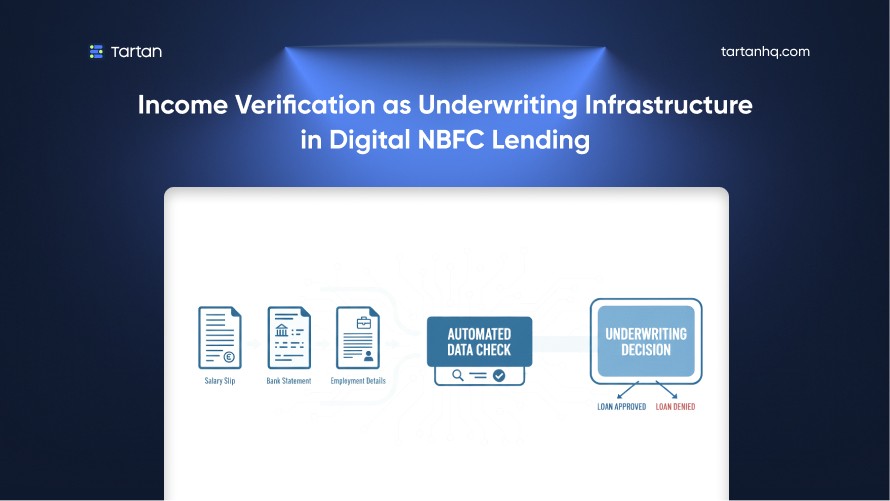
Income and employment verification shifts underwriting from document trust to signal trust. Instead of relying on uploaded artefacts, income is confirmed against reliable data sources that establish whether it is real, current, and attributable to the applicant.
When implemented at onboarding, verification ensures that only validated income enters the decisioning layer. This changes the role of underwriting from correcting data to interpreting it.
What changes in credit decisioning
Verified income improves signal quality across the stack. Eligibility bands tighten naturally, without aggressive policy constraints. Approve/decline boundaries stabilise. Fewer applications require manual escalation.
Credit teams gain confidence that approved loans are sized appropriately, not optimistically. This leads to more predictable portfolio behaviour and reduces early-stage volatility.
Impact on speed, scale, and operations
By removing the need for repetitive manual checks, verification shortens approval timelines and lowers cost per application. More importantly, it decouples growth from operational headcount.
Lenders can scale volumes without proportionally increasing risk operations, while maintaining consistent decision quality across channels and demand cycles.
Risk, compliance, and audit readiness
Verified income and employment data also creates a clear audit trail. Each decision can be traced back to the source, time, and outcome of the verification process.
This strengthens internal governance, simplifies regulatory reviews, and reduces friction during audits or dispute resolution.
How Tartan enables this use case
Tartan embeds income and employment verification directly into digital lending workflows, rather than positioning it as a downstream check or an operational overlay. Applicant data is enriched at the point of ingestion, before it flows into underwriting, pricing, or risk models.
This ensures that decisioning engines operate on validated inputs instead of self-reported or document-derived values, reducing noise at the most critical stage of the lending lifecycle.
Through its integration layer, Tartan connects to multiple authoritative data sources across income, employment, identity, and financial signals.
These inputs are standardised and normalised into consistent, machine-readable attributes that can be consumed across systems without custom handling. This removes fragmentation and simplifies how verification is operationalised across the stack.
Specifically, Tartan:
Ingests and validates income and employment signals from multiple sources
Normalises disparate formats into consistent attributes for underwriting systems
Enriches applicant records before they enter decisioning engines
Crucially, Tartan persists verification outcomes alongside supporting metadata, including:
Source attribution
Time of verification
Confidence and consistency indicators
This creates a durable verification record that supports auditability, internal governance, and regulatory review, without requiring manual justification or repeated checks.
By operating at the infrastructure layer, Tartan enables lenders to treat verification not as a discrete step, but as a foundational capability. Verification becomes consistent, repeatable, and scalable - supporting automation, improving decision integrity, and reducing operational complexity as lending volumes grow.
The takeaway
In digital lending, speed and scale are no longer differentiators on their own. Reliability is.
Income verification is not a fraud control or an operational add-on. It is foundational to building lending systems that grow predictably, operate efficiently, and withstand regulatory scrutiny.
For digital NBFCs issuing unsecured credit at scale, verified income is no longer optional—it is underwriting infrastructure.