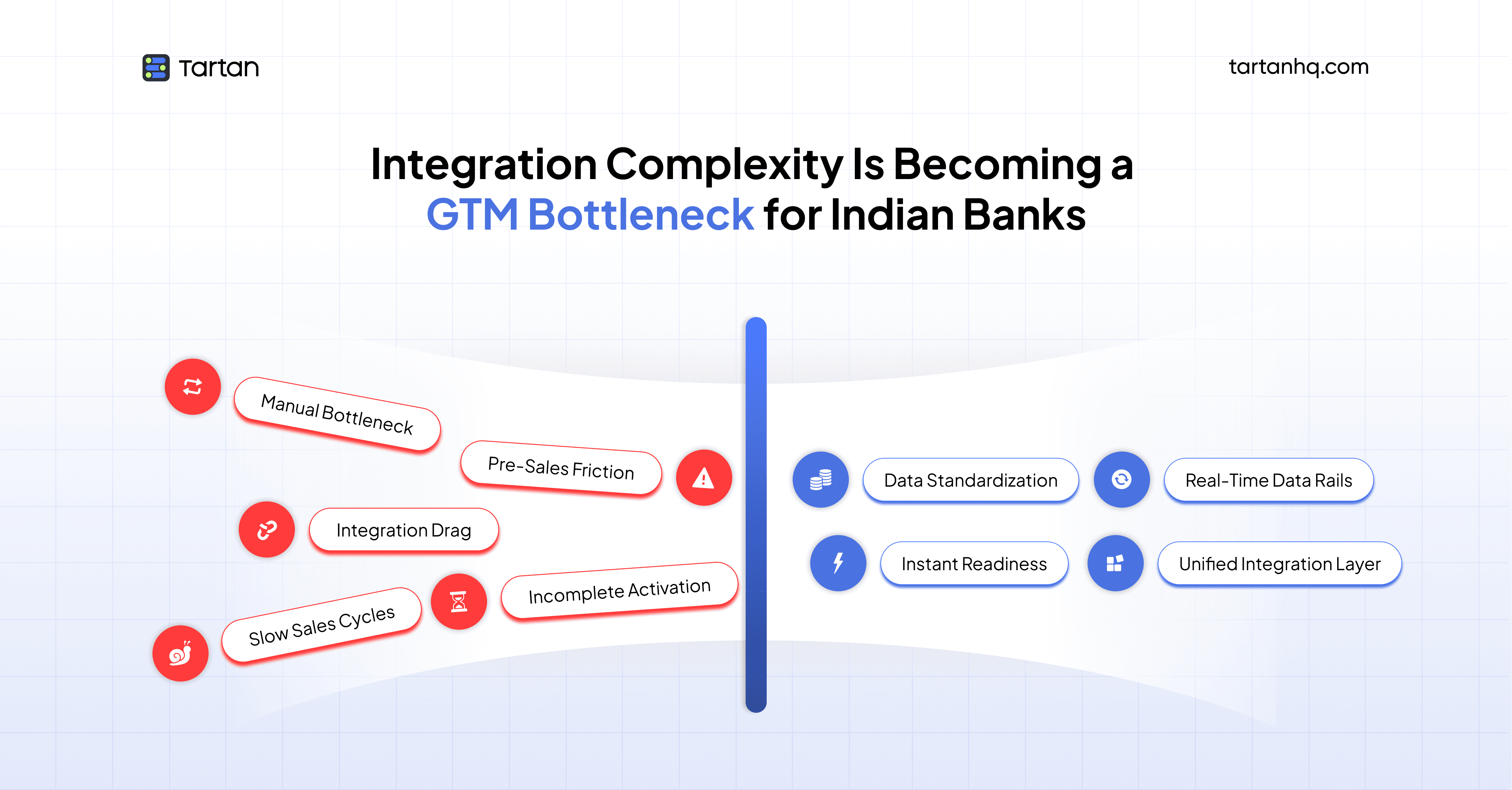
Why sales, onboarding, and activation now fail because systems don't talk
For Indian banks, GTM failure no longer starts in the market. It starts inside the bank's own systems.
Sales teams are closing deals. Relationship managers are pushing products. But onboarding stalls, activation drags, and revenue realization slips - not because of demand, but because integration complexity has quietly become the biggest GTM bottleneck.
The irony is stark. Indian banks have spent the last five years investing heavily in digital transformation: new core banking systems, cloud migrations, API banking initiatives, partnerships with fintechs. Yet the last-mile problem of actually connecting to the enterprise systems where customer data lives remains largely unsolved. And it's this unsolved problem that's now choking growth.
The New Reality: GTM Is Now a Systems Problem
In the Indian BFSI context, every modern GTM motion depends on external enterprise data flowing seamlessly into bank systems.
Corporate salary accounts depend on live HRMS and payroll data to onboard employees, verify income, manage mandates, and track employment changes.
SME lending depends on ERP systems and GST portals to assess business health, verify revenues, and monitor ongoing creditworthiness.
Group insurance products depend on accurate employee master data to calculate premiums, process claims, and manage policy changes.
Treasury services, CASA deepening, and cross-sell opportunities depend on clean, current enterprise records that reflect the real-time state of corporate relationships.
Yet most banks still run GTM on a brittle foundation built for a pre-digital era. File-based data exchange remains the norm: HR teams email spreadsheets, reconciliation happens manually, and errors compound with every handoff.
One-off integrations get built for the largest corporate clients, creating a patchwork of custom connectors that are expensive to maintain and impossible to scale. Manual follow-ups with employers or partners become necessary at every step because automated data flows don't exist.
Static data snapshots taken at onboarding go stale within weeks, leaving banks operating on outdated information while pretending they have current visibility.
The result?
Sales says "yes", but systems say "wait". And in competitive markets where speed matters, waiting means losing.
Where GTM Actually Breaks (Banking Lens)
1. Sales Slows Down Before It Even Starts
In India, enterprise sales cycles already face significant friction from trust-building requirements, compliance documentation, pricing negotiations, and multi-stakeholder approvals. Integration friction compounds these existing challenges in ways that directly impact deal velocity.
Each corporate prospect asks the same question during technical evaluation: "Can you integrate with our HR and payroll systems?"
It's not a nice-to-have query. It's a deal qualifier.
Companies have learned from painful past experiences that if the bank can't integrate smoothly with their existing systems, the promised benefits of salary accounts, seamless onboarding, or automated lending will never materialize operationally.
The bank's answer depends entirely on whether they've already built a connector to that specific platform. If the prospect uses SAP SuccessFactors or Workday, and the bank has integration experience with those systems, the conversation proceeds. If the prospect uses Darwinbox, Keka, greytHR, or any of the dozens of other HRMS and payroll platforms common in the Indian mid-market, the answer becomes complicated.
GTM Stage | Traditional Approach (Indian Banks) | With Unified Integration (HyperSync-style) | Business / Cost Impact |
Sales Cycle Duration | 90–120 days | 45–60 days | ~50% faster deal closure |
Technical Evaluation | 3–4 weeks per deal | 2–3 days | ~85% reduction in evaluation time |
Deal Win Rate (Competitive) | 35–40% | 55–65% | 50%+ improvement in win rates |
Addressable Market Coverage | 20–30% of prospects (limited by existing integrations) | 85–90% of prospects | ~3× expansion in serviceable TAM |
Sales Team Productivity | 60% on selling, 40% on internal scoping & coordination | 85% on selling, 15% on coordination | ~40% productivity gain |
Cost per Acquisition (Corporate) | ₹45,000–65,000 | ₹25,000–35,000 | ~45% reduction in CAC |
Sales teams find themselves having to hedge:
"We'll need to evaluate the technical feasibility."
"Our integration team will scope the effort required."
"It might take additional time and potentially custom development costs."
These aren't answers that inspire confidence or accelerate deals. They're red flags that signal implementation risk.
The "long tail" of Indian HRMS, ERPs, and regional vendors becomes a systematic deal blocker. Banks can afford to build custom integrations for Fortune 500 companies bringing thousands of salary accounts.
But the economics don't work for mid-sized companies with 200 employees using platforms the bank has never integrated with. The total addressable market for any corporate banking product becomes artificially constrained not by customer demand, but by integration coverage.
Competitors with faster integration capabilities win even with weaker products. A slightly inferior salary account product that can integrate with 80 enterprise platforms in days will consistently beat a superior product that requires three months of custom integration work. Speed has become a feature. Integration coverage has become a competitive moat.
Outcome: Sales teams lose momentum in late-stage deals when integration questions arise, pipeline velocity slows as technical evaluation extends sales cycles, and market coverage shrinks because entire customer segments become unreachable due to their system choices.
2. Onboarding Becomes the Choke Point
Even after a corporate deal closes and contracts are signed, the celebration is premature. The real bottleneck emerges during onboarding, where the promise of digital banking meets the reality of enterprise data integration.
Employer data arrives via the traditional channels: spreadsheets attached to emails, CSV files uploaded to portals, or occasionally printed lists couriered to branch offices. The formats vary wildly across vendors and across different departments within the same organization.
HR sends employee IDs in one format, payroll uses a different identifier, and the bank's existing customer records use yet another scheme. Date formats differ. Salary components are structured differently. Employment status codes don't align.
Operations teams become the human middleware layer, manually reconciling data, validating information against partial records, and re-uploading corrected data into core banking systems.
Every discrepancy requires investigation. Every correction necessitates another round trip with the employer's HR team. Each iteration adds days to the onboarding timeline.
In Indian banks, where onboarding volumes are high and margins per account are tight, this manual reconciliation model creates compounding problems. A mid-sized bank onboarding 50 corporate clients per quarter, with an average of 300 employees each, is processing 15,000 employee records quarterly through manual workflows.
If reconciliation and correction add even three days per corporate client, that's 150 days of aggregate delay in a 90-day quarter-more than the entire quarter's duration spread across the portfolio.
The operational costs are substantial but often hidden. Banks don't typically track "cost per salary account opened" with full burden allocation, but when you factor in ops team time, rework, escalations, and delayed account activation, the unit economics deteriorate significantly. What was sold as a high-margin corporate relationship becomes operationally expensive to service.
The experience impact is equally damaging. Corporate HR teams and CFOs judge the bank's digital capabilities based on onboarding smoothness. When they're repeatedly asked to resubmit files, correct formats, or clarify data discrepancies, their perception of the bank's technological sophistication drops. The first impression, meant to showcase digital excellence, instead highlights operational friction. This affects renewal decisions, wallet share allocation, and referrals to peer organizations.
Outcome: Weeks of onboarding delays become the norm rather than the exception, operational cost per account acquisition rises beyond projections, and poor first impressions with enterprise clients undermine the relationship before it's properly begun.
3. Activation Never Truly Completes
This is the most insidious failure mode because it's silent. Accounts open, systems show "active" status, and everyone moves on to the next deal. But true activation-where the bank has current, accurate data enabling proactive service and cross-sell-never actually happens.
Employee data goes stale within weeks of onboarding. New joiners enter the company, and the bank doesn't know they exist until the next quarterly file upload, if one happens at all. By then, those employees have already opened accounts elsewhere, chosen other financial products, and formed banking relationships the bank has no visibility into. Employees exit the organization, but the bank's records still show them as active. Mandates remain in place for people who've moved on. Collections teams chase separated employees. Risk models operate on outdated employment information.
Salary changes, promotions, transfers between locations or business units-all of these events that represent opportunities for the bank to deepen the relationship or mitigate risk-happen invisibly. The bank finds out months later through indirect signals or not at all. Upsell triggers get missed because the data infrastructure can't detect them in real-time.
Banks believe they've "activated" customers because accounts are open and initial deposits have cleared. In reality, they've created a static snapshot that immediately begins decaying. They're operating a corporate salary account program with fundamentally the same data visibility they had in the pre-digital era, just stored electronically instead of in file cabinets.
The downstream impacts cascade across the banking relationship. CASA utilization remains lower than projections because employees who should have accounts don't, and employees who shouldn't still do. Customer engagement metrics disappoint because personalization and proactive outreach depend on current data the bank doesn't have. Cross-sell conversion rates underperform because the bank is making offers to the wrong people at the wrong time based on outdated information. Revenue leakage occurs systematically as opportunities pass unrecognized and risks materialize undetected.
Outcome: Lower-than-expected CASA balances and utilization, weaker engagement scores as communications miss the mark, missed cross-sell and upsell opportunities worth crores annually across the corporate portfolio, and persistent revenue leakage that's difficult to measure but compounding in impact.
Why This Problem Is Worse in India
The enterprise integration challenge isn't unique to India, but several factors make it significantly more acute in the Indian banking context than in more consolidated markets.
India's enterprise software ecosystem is uniquely fragmented. There are hundreds of HRMS and payroll platforms in active use. Some are global products like SAP, Workday, and Oracle with significant market share among large enterprises. Others are India-focused platforms like Darwinbox, Keka, greytHR, sumHR, and Razorpay Payroll that dominate the mid-market and SME segments. Regional vendors serve specific industries or geographies. And custom implementations remain common, especially among older enterprises that built internal systems before packaged solutions were viable.
ERP stacks vary dramatically by company size, industry vertical, and regional presence. Manufacturing companies use different systems than services companies. Export-oriented businesses have different requirements than domestic-focused ones. Family-owned enterprises that professionalized recently often run hybrid environments mixing modern cloud platforms with legacy on-premise systems.
Standardization is the exception, not the rule. Even companies using the same underlying platform often implement it differently, customize workflows, add proprietary fields, and structure data according to their specific business processes. Two companies both using SAP might expose completely different data schemas depending on their implementation choices.
The regulatory and compliance landscape adds another layer of complexity. PAN, Aadhaar, UAN, GST numbers, and various other identifiers need to be validated and linked correctly. Data residency requirements mean some information must stay in India. Consent frameworks are evolving, creating uncertainty about what data can be accessed and how.
Traditional integration approaches that work in more consolidated markets simply don't scale in India. Point-to-point integrations don't cover the long tail-you can't economically build custom connectors for every platform. Engineering teams become bottlenecks as integration backlogs grow faster than they can be worked down. Every new vendor relationship adds weeks of scoping, development, testing, and deployment effort. Product launches get delayed waiting for integration coverage. Customer acquisition is constrained by which systems you can connect to.
The fundamental equation is broken. GTM speed, which should be determined by sales effectiveness and customer demand, is instead capped by integration velocity. The bank's ability to grow is limited not by market opportunity but by engineering capacity to build and maintain connectors.
The Integration Maturity Framework for Indian Banks
Banks typically evolve through four stages of integration maturity, each representing different capabilities and GTM performance:
Stage 1: Manual & File-Based (Where most banks still operate)
Characteristics: Spreadsheet exchanges, email-based data transfer, quarterly updates
GTM Impact: Long sales cycles, high onboarding friction, stale data
Integration Coverage: 5-10 major platforms through custom builds
Competitive Position: Losing deals to faster competitors
Stage 2: Point-to-Point Integration (Early digitization)
Characteristics: Custom APIs for top 15-20 enterprise platforms, still file-based for long tail
GTM Impact: Faster for large corporates, still slow for mid-market
Integration Coverage: 15-25 platforms, 40-50% market coverage
Competitive Position: Can compete in enterprise segment, weak in mid-market
Stage 3: Unified Integration Infrastructure (Modern approach)
Characteristics: Single API layer connecting to 80+ platforms, real-time data flows, standardized schemas
GTM Impact: Fast sales and onboarding across segments, high activation quality
Integration Coverage: 80-100 platforms, 85-90% market coverage
Competitive Position: GTM advantage across all segments
Stage 4: Intelligent Data Ecosystem (Future state)
Characteristics: AI-driven data enrichment, predictive signals, ecosystem orchestration
GTM Impact: Proactive banking, predictive cross-sell, automated risk management
Integration Coverage: Comprehensive with continuous expansion
Competitive Position: Market leadership, premium pricing power
Most Indian banks are stuck between Stage 1 and Stage 2. The competitive gap is widening as Stage 3 banks capture market share through superior GTM execution.
The Shift Banks Are Making: From Integrations to Integration Infrastructure
Progressive banks are recognizing that the problem isn't any single integration. The problem is treating integration as a series of point solutions rather than as foundational infrastructure.
Instead of asking "Can we build this integration?" for each new corporate client or product launch, leading banks are asking fundamentally different questions: "How do we create real-time data rails between our systems and the enterprise platforms our customers use-by default, at scale, without custom engineering for each relationship?"
This mindset shift is crucial. Integration isn't a feature to be built incrementally. It's infrastructure that enables the entire GTM motion. Just as banks don't build their own payment rails or core banking systems from scratch anymore, they're realizing that building enterprise integration infrastructure internally doesn't create competitive advantage. The differentiation comes from what you do with the data, not from your ability to fetch it.
This is where unified API platforms fundamentally change the economics and speed of enterprise banking.
HyperSync as a GTM Enabler (Not Just an Integration Layer)
In the banking context, HyperSync functions as integration infrastructure specifically designed to remove systems friction from GTM motions. It's not merely a technical layer-it's a strategic capability that transforms how fast and how broadly banks can execute in corporate banking segments.
1. One Unified Access Layer
Banks integrate once with HyperSync's unified API and immediately gain access to workforce and business data across 80+ HRIS, payroll, CRM, and ERP systems commonly used in India's enterprise landscape.
This architectural shift removes multiple sources of GTM friction. Vendor-by-vendor dependency disappears-sales teams don't need to check whether engineering has built a connector to the prospect's specific platform before committing to timelines. Coverage gaps during the sales process are eliminated-when asked "do you support our systems," the answer is comprehensively yes across the major platforms representing 90%+ of the addressable market. Custom scoping for every deal is no longer necessary-implementation timelines become predictable and compressed because integration is already solved.
For relationship managers and sales teams, this translates directly to competitive advantage. They can pursue any corporate prospect regardless of their technology stack. They can commit to fast onboarding timelines confidently. They can compete on product merit and relationship strength rather than technical capabilities.
For product managers, this removes the constraint on addressable market. Launching a new corporate lending product no longer requires first building integration coverage. The infrastructure already exists. Time-to-market compresses from quarters to weeks.
2. Standardization at Scale
HyperSync automatically normalizes messy, inconsistent data formats from different enterprise platforms into a clean, predictable schema. Whether the source is SAP, Darwinbox, or greytHR, the bank receives employee records, salary components, and employment data in consistent structure with standardized field names and formats.
For banks, this standardization creates multiple operational benefits. Onboarding workflows can be built once and work universally instead of requiring system-specific variations. Ops teams no longer need specialized knowledge of each platform's quirks and formats. Reconciliation errors decrease dramatically because data arrives pre-normalized. Downstream systems like core banking, risk engines, and analytics platforms receive consistent input regardless of source.
The impact on operational efficiency is substantial. Manual intervention drops from nearly every onboarding to handling only genuine exceptions. Processing time per corporate relationship decreases by 60-80% as automated validation replaces manual checking. Error rates fall as humans are removed from routine reconciliation tasks. Ops teams can scale to handle higher volumes without proportional headcount increases.
Data quality improves systematically. Standardization isn't just about format-it includes validation, completeness checking, and basic sanity tests applied consistently across all sources. Banks receive data they can trust for underwriting, risk monitoring, and compliance reporting.
Ops stops firefighting data issues and starts focusing on customer service. GTM starts flowing smoothly because the data foundation is reliable.
3. Real-Time, Consent-Driven Data Rails
The most transformative aspect of unified integration infrastructure is replacing static file exchanges with live data flows.
Instead of quarterly spreadsheet uploads, HyperSync establishes real-time data rails where updates trigger automatically when records change in the source system. A new employee joins the company and gets added to the HRMS-the bank knows within hours and can proactively reach out to open an account. An employee's salary increases following a promotion-the bank's credit models update automatically, potentially enabling pre-approved lending offers.
An employee exits the organization-mandate cancellations happen immediately, collections strategies adjust, and risk exposure is reevaluated in real-time.
Joiners, movers, and leavers are reflected instantly in bank systems instead of languishing in data staleness for months. This transforms both the customer experience and the bank's operational efficiency.
New employees receive welcome communications and account setup guidance at the optimal moment when they're thinking about financial matters during onboarding. Internal transfers between locations or business units are visible to the bank, enabling relationship managers to maintain continuity. Exits are known immediately, preventing embarrassing situations where the bank markets products to separated employees.
Compliance and audit trails stay intact throughout these automated flows. Every data access is consent-driven, logged, and traceable. Regulatory requirements around data minimization, purpose limitation, and consent management are built into the infrastructure rather than bolted on as afterthoughts.
Activation transforms from a one-time event into a continuous state. Instead of activating accounts at onboarding and then slowly losing data currency, the bank maintains fresh, accurate information throughout the entire customer lifecycle. This enables fundamentally different banking models where proactive service, dynamic risk management, and timely cross-sell become possible because the data foundation supports them.
The Real Impact: GTM Without Friction
Banks implementing unified integration infrastructure see structural changes in how their corporate GTM motions perform across the entire lifecycle.
Sales velocity increases measurably. Deal cycles that previously took 90-120 days from first meeting to contract signature compress to 45-60 days because technical evaluation happens faster when integration isn't a variable. Win rates improve in competitive situations where implementation speed differentiates otherwise similar products. Sales teams spend less time in internal technical scoping sessions and more time with customers understanding business needs.
Onboarding scales without linear ops headcount growth. A bank that previously needed one ops person per 10 corporate relationships due to manual reconciliation burden can now handle 30-40 relationships per person because automation does the heavy lifting. Time from contract signature to first account activation drops from 6-8 weeks to 1-2 weeks. Customer satisfaction with onboarding experience improves, creating positive momentum in new relationships.
Activation quality improves fundamentally because data stays fresh throughout the lifecycle. Cross-sell conversion rates increase by 30-40% when offers are based on current information rather than stale snapshots. CASA balances per corporate relationship grow as the bank knows about new employees and can engage them proactively. Risk management becomes more dynamic and accurate because employment changes are visible in real-time.
Revenue per corporate relationship increases as better activation and data currency enable deeper wallet share. A salary account relationship expands into insurance cross-sell, personal loans, investment products, and cards because the bank has the data visibility to make relevant offers at the right time.
Risk and Finance teams trust the data because it comes directly from source systems through documented, auditable flows rather than through manual processes prone to error and manipulation. Credit decisioning improves. Provisioning becomes more accurate. Regulatory reporting is cleaner.
Most importantly, GTM success decouples from internal engineering capacity. Product launches aren't delayed waiting for integration coverage. Market expansion into new customer segments doesn't require months of technical preparation. Partnership opportunities with corporate ecosystems can be pursued aggressively because connectivity is solved.
Banks move from being constrained by their integration capabilities to being limited only by their sales effectiveness and product-market fit. That's the shift that matters.
The Strategic Implications
The banks winning in corporate banking over the next five years will be those that recognized integration infrastructure as a strategic priority, not a technical detail.
They'll have made the decision to treat integration as foundational infrastructure similar to core banking or payment systems-critical, standardized, and sourced from specialists rather than built internally. They'll have established real-time enterprise data rails that give them visibility and responsiveness that competitors operating on static data can't match. They'll have removed system friction from every GTM motion, making sales faster, onboarding smoother, and activation more complete.
The competitive dynamics are already shifting. Banks with modern integration infrastructure can pursue corporate relationships that were previously economically unviable due to integration costs. They can launch products faster in response to market opportunities. They can deliver customer experiences that feel genuinely digital rather than digitized versions of manual processes.
The laggards will continue struggling with the same problems: sales cycles constrained by integration uncertainty, onboarding bottlenecks limiting growth, and activation quality that undermines product economics. They'll keep staffing up ops teams to handle manual data processing while competitors automate the same workflows. They'll watch addressable market opportunities pass by because they can't connect to the systems where those customers' data lives.
Common Objections & Reality Checks
"We'll Build Integration Capabilities Internally"
The Objection: Our engineering team can build these integrations. We maintain control and customize to our exact needs.
The Reality: Building one integration is feasible. Building 80+ integrations, maintaining them as APIs change, handling versioning, managing uptime, and continuously adding new platforms turns your engineering team into an integration factory. The opportunity cost is enormous—every sprint spent maintaining connectors is a sprint not spent on differentiated banking products.
The Math: If each integration takes 3 weeks to build and 2 hours/month to maintain, supporting 50 platforms means 150 weeks of initial development (3 years with one team) plus 100 hours/month of ongoing maintenance. That's 1.5 FTE just maintaining integrations, forever.
"Our Corporate Clients Will Provide Data Files"
The Objection: Large corporates are used to file-based processes. They'll send us quarterly employee data. This isn't really a problem.
The Reality: File-based processes create systematic data staleness that undermines product economics. By the time you receive quarterly files, 8-12% of the data is already outdated. New joiners have been employed for 2-3 months without accounts. Exits happened weeks ago but mandates are still active. You're always operating on yesterday's information in a market that rewards real-time responsiveness.
The Impact: A 1000-employee corporate with 15% annual attrition means 150 employment changes per year. In a quarterly update model, you're discovering these changes 6-12 weeks after they happen. That's 150 missed opportunities for proactive service and 150 risk events detected late.
"Integration Is an IT Problem, Not a GTM Problem"
The Objection: Our technology team handles integrations. This doesn't affect sales, product, or customer experience—it's infrastructure.
The Reality: Integration capability directly determines addressable market, sales cycle length, onboarding speed, and activation quality. Every corporate deal involves integration questions. Every product launch is constrained by integration coverage. Every customer experience promise depends on data availability.
The Evidence: Banks with modern integration infrastructure close corporate deals 50% faster, onboard clients in 25% of the time, and achieve 60-80% higher CASA balances per relationship. This isn't an IT problem - it's the difference between GTM success and GTM stagnation.
Final Thought
For Indian banks, integration complexity is no longer a backend technical problem that IT teams handle independently. It is a front-line GTM risk that determines competitive outcomes in corporate banking.
The winners will be banks that treat integration as infrastructure, build real-time enterprise data rails as a strategic capability, and systematically remove system friction from sales, onboarding, and activation.
Because in today's market, the fastest bank to integrate is the fastest bank to grow. And speed is everything when opportunity windows are measured in quarters, not years.
The banks that solve integration infrastructure now will shape the corporate banking landscape for the next decade. The ones that don't will spend that decade explaining why their GTM motions keep stalling despite having good products and strong relationships.
The choice is becoming binary. And the window to make it is closing.