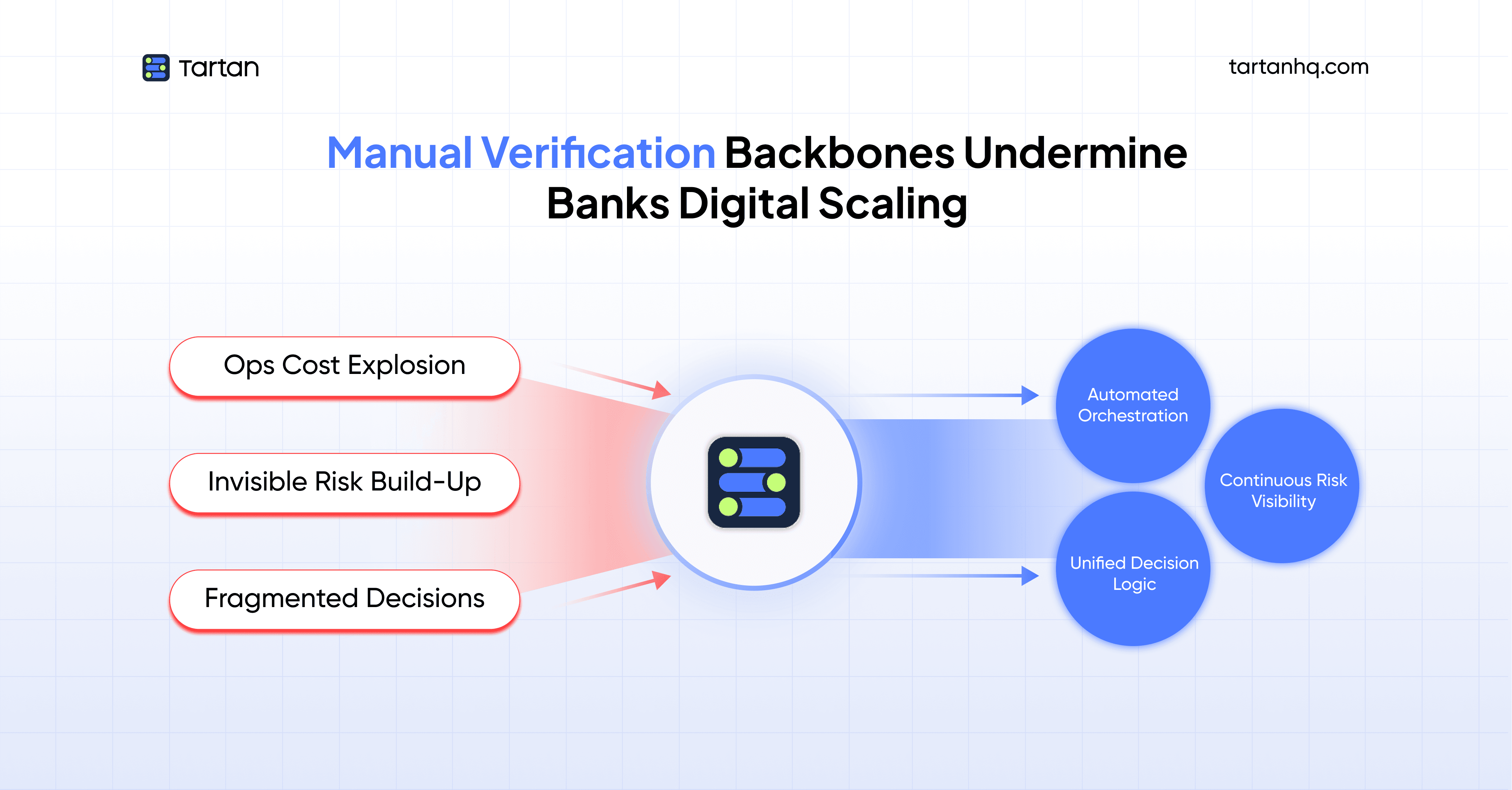
Banking products scale fast at the front end and break silently at the back end.
At the front end, banks and fintechs have made significant progress in digitising customer journeys. Account opening timelines have reduced. Credit applications are completed through digital channels. Insurance, payments, and lending products are increasingly delivered through APIs and partner platforms.
Behind most digital products, core verification processes continue to rely on manual or semi-manual workflows - including static rules, vendor-dependent checks, and human intervention for exceptions.
These systems were originally designed for lower volumes and predictable growth, not for high-throughput digital demand.
This gap between front-end digitisation and back-end verification capability is structural. As volumes increase, the underlying verification backbone becomes a limiting factor driving higher operating costs, inconsistent outcomes, and gradual risk accumulation.
This is one of the primary reasons banks struggle to scale digital products sustainably, despite strong customer demand.
Why “Digital Scale” Is Often Misinterpreted
Many banks, NBFCs, and fintechs assess digital scale based on improvements in customer-facing workflows. Common indicators include:
Reduced onboarding timelines
API-based integrations at the application layer
Faster turnaround times reported in SLAs
These improvements are real and necessary. However, they do not, by themselves, indicate that a product or platform is truly scalable.
In practice, these changes often sit on top of verification systems that were designed for lower volumes and manual oversight. As a result, while customer journeys appear faster, the underlying operating model remains largely unchanged.
What Scale Means in a Banking and Lending Context
For regulated financial institutions, scale is not defined by speed alone. It is defined by the system’s ability to handle growth without disproportionately increasing cost, risk, or operational complexity.
At an infrastructure level, scale requires:
Operational elasticity: The ability to process higher volumes without a linear increase in headcount or manual intervention.
Consistent decision-making at volume: Identical customer profiles should result in identical outcomes, regardless of time, channel, or product line.
Controlled risk exposure: As throughput increases, risk should remain observable, measurable and within defined policy thresholds.
Predictable unit economics: Cost per onboarding, per verification, or per credit decision should improve or at least remain stable as volumes grow.
The First Breaking Point: Ops Cost Does Not Scale Linearly
Manual and semi-manual verification systems deliver a sub optimal performance when transaction volumes are low or growing gradually. At this stage, operational teams are able to manage verification queues, exceptions are limited, and service levels appear stable. This often creates a false sense of readiness for scale.
As transaction volumes surge, legacy systems hit a critical threshold where manual rework and process delays create a non-linear spike in operational drag.
As transaction volumes rise:
Spiking Intervention Rates - Rising volumes cause data errors and system glitches to cluster, forcing staff to fix problems much faster than the business grows.
Overwhelming Task Backlogs - Error queues grow so quickly that hiring more people can't keep up with the complex training and supervision needed.
Constant Delay Cycles - Backlogs turn occasional delays into a permanent habit, forcing teams to focus on managing crises rather than improving speed.
Growth-Stifling Bottlenecks - Verification becomes a wall instead of a bridge, where limited human capacity actively stops you from launching new products or partners.
Hidden Operational Costs
One of the reasons this problem persists is that verification related operational cost is rarely visible as a single line item. Instead, it is fragmented across multiple teams and functions, making its true impact difficult to quantify.
Manual verification effort is typically spread across:
KYC and onboarding operations teams
Credit underwriting support functions
Risk and fraud review teams
Vendor management and reconciliation teams
Compliance, audit, and reporting support staff
Each verification that does not resolve fairly often touches several of these teams. Even when the customer experiences a single delay, the internal effort involved can span multiple handoffs, systems, and reviews.
This fragmentation creates several layers of hidden cost:
Rework costs from repeated checks, document follow-ups, and vendor retries
Coordination costs from internal escalations, approvals, and cross-team communication
Opportunity costs from delayed account activation, loan disbursal, or policy issuance
Management overhead from queue monitoring, SLA reporting, and exception governance
The Second Breaking Point: Inconsistency at Scale
At limited volumes, inconsistencies in verification outcomes are difficult to detect.
As volumes increase, however, the same inconsistencies stop being isolated events and begin to form patterns. What was previously invisible becomes measurable, repeatable, and systemic.
The verification system no longer produces uniform outcomes for similar risk profiles, and decision-making begins to drift away from defined policy intent.
Manual verification systems introduce inconsistency because outcomes depend on execution, not policy intent.
This typically results in:
Different decisions for similar customers, driven by verification paths, vendor responses, or case handling.
Product-wise silos where the same customer is verified differently across loans, accounts, or insurance.
Regional variation, caused by differences in workload, training, and manual judgement.
Vendor-dependent outcomes, where risk decisions reflect vendor behaviour rather than customer risk.
At scale, these inconsistencies weaken decision reliability and make verification outcomes difficult to defend.
As operational load increases:
Some high-risk cases pass through because teams are focused on clearing queues rather than deep scrutiny
Some low-risk customers are rejected or delayed due to rigid interpretation of incomplete data
Risk thresholds shift informally during peak volumes, campaigns, or seasonal spikes
Human judgement is influenced by fatigue, time pressure, and escalation urgency
This creates a situation where risk decisions are no longer driven purely by policy or data, but by operational context.
The downstream impact is material:
Credit quality deteriorates with pockets of risk concentrated in specific cohorts
Fraud controls weaken as repeatable loopholes emerge across products or regions
Customer trust erodes particularly when similar applicants receive different outcomes
Regulatory defensibility weakens as institutions struggle to explain why comparable cases were treated differently
From a governance perspective, inconsistency is more damaging than conservatism.
Conservative policies can be justified and defended. Inconsistent outcomes cannot.
As scale increases, decision drift becomes one of the most significant yet least visible risks embedded within manual verification backbones.
The Third Breaking Point: Risk Accumulates Invisibly
In manual and semi-manual verification systems, risk rarely enters the portfolio as a sudden spike. Instead, it builds gradually through small, repeated weaknesses in verification processes.
This typically includes:
Incomplete or weak verification signals being accepted through overrides
Repeat use of the same verification gaps across large customer volumes
Exceptions becoming routine, rather than triggering process improvement
Certain customer segments remaining insufficiently verified
Over time these patterns embed structural risk into the portfolio.
Why Risk Is Detected Late
Because most outcomes appear acceptable in the short term, risk often remains hidden until it manifests at a portfolio or regulatory level. Discovery typically occurs only when:
Portfolio performance deteriorates, revealing underwriting or onboarding weaknesses
Fraud exploit repeatable verification gaps, scaling abuse faster than controls can adapt
Regulators identify systemic issues, rather than isolated failures
Audits expose weak or unverifiable decision trails, especially around overrides and exceptions
The Cost of Late Discovery
Late-stage risk detection significantly raises remediation cost. Corrective actions often require retrospective reviews, customer re-verification, tightened policies, and regulator engagement.
At this stage, the challenge is no longer preventing risk, it is containing damage.
Banking Products Demand Verification Infrastructure, Not Checks
As digital volumes grow, verification can no longer function as a series of isolated checks embedded inside individual journeys. That model was designed for compliance completion, not for sustained scale.
To support large scale digital products, verification must be treated as infrastructure, a system that operates continuously, consistently, and independently of any single product or channel.
This shift requires a fundamental change in how verification is designed and operated:
Verification must function as a continuous system, not a one-time step.
Failures must be treated as signals, not dead ends
Fallback logic must be designed upfront, not handled manually
Most banking and fintech enterprises struggle at this point because their verification stack evolved incrementally vendor by vendor, product by product without being designed as a unified system. This creates a capability gap that becomes increasingly visible as digital scale & acquisition increases.
TartanHQ HyperVerify: Verification Built for Scale, Not Just Compliance
HyperVerify is designed around a simple premise: Verification must scale operationally, defensibly, and intelligently without increasing human dependence.
Instead of isolated checks, HyperVerify functions as a verification orchestration layer across identity, income, employment, banking, address, and risk signals.
How HyperVerify Addresses the Core Scaling Failures
1. Ops Cost Compression Through Automation Intelligence
HyperVerify reduces ops load by:
Automatically retrying across alternate rails
Invoking secondary data sources on failure
Classifying failures into resolvable vs true exceptions
Eliminating manual retries and follow-ups
Result:
Fewer cases enter human queues
Ops teams focus only on genuine risk
Cost per verification decreases with scale
2. Consistent Decisioning Across Products and Volumes
HyperVerify enforces:
Unified verification logic across products
Standardized confidence scoring
Policy-aligned outcomes independent of volume spikes
Result:
Identical profiles yield identical decisions
Risk appetite is encoded, not inferred
Growth does not dilute governance
3. Risk Visibility and Accumulation Control
HyperVerify surfaces risk in real time by:
Tracking partial failures and degraded signals
Maintaining longitudinal customer verification states
Creating verifiable decision trails for audits
Instead of discovering risk months later, banks gain:
Early warning signals
Portfolio-level verification health metrics
Defensible, explainable risk decisions
Real-World Use Cases Where Manual Systems Break First
Digital Lending at Scale
As lending volumes increase, income and employment verification become one of the earliest pressure points. Manual and single-source verification models struggle to handle variation in employer data, income formats, and data availability.
This typically results in:
Spikes in income and employment verification failures
Inconsistent bank statement parsing and interpretation
Growing dependence on manual overrides to maintain approval rates
HyperVerify enables:
Multi-rail income verification across payroll, bank, and alternate data
Automated fallbacks when primary sources fail, without ops intervention
Higher approval rates while maintaining defined risk thresholds
Salary Account and CASA Onboarding
Salary account and CASA onboarding depend heavily on accurate employer and income validation. Manual verification introduces delays when employer data does not match internal records or when dependencies between systems are not resolved automatically.
Common outcomes include:
Employer data mismatches and repeated follow-ups
Delayed account activation due to unresolved verification steps
High customer abandonment during manual follow-ups and retries
HyperVerify ensures:
Faster onboarding through automated employer and income validation
Fewer drop-offs by reducing manual touchpoints
Continuous verification beyond Day 0, supporting lifecycle use cases
Verification as Infrastructure: Turning an Operational Bottleneck into a Scalable Advantage
For banks and large fintechs, verification is no longer a back-office function. It is a foundational capability that directly determines how far and how safely finance products can scale.
Institutions that move from manual verification backbones to scalable verification infrastructure consistently see structural business benefits:
Lower unit economics at higher volumes, as automation absorbs growth without linear increases in operational cost
Faster product rollouts, without repeated re-engineering of ops and risk processes
Improved portfolio quality, driven by consistent decisioning and fewer false positives
Stronger regulatory posture, supported by clear audit trails and defensible verification logic
Higher customer conversion, without compromising defined risk thresholds
In this way, verification no longer constrains growth. It enables it.
Closing Perspective
Financial products cannot scale beyond the infrastructure that supports them.
Manual verification backbones were designed for an earlier banking environment - one defined by lower volumes, slower cycles, and compliance-first workflows. They are not suited for real-time, high-throughput, API-led financial systems.
HyperVerify represents a shift from verification as an operational cost to verification as scalable infrastructure designed to support growth, consistency, and risk control at enterprise scale.
For banks focused on sustainable digital expansion, the verification backbone matters more than the interface.