Digital lending fraud isn't a rising problem - it's a structural failure in how verification works.
Every forged salary slip that passes review. Every synthetic identity that clears KYC. Every inflated income claim is accepted without employer confirmation.
These aren't isolated incidents.
They're symptoms of verification infrastructure built around documents instead of data, manual review instead of source verification, and batch processing instead of real-time validation.
The traditional model - collect documents, manually review them, cross-check for inconsistencies, call employers for confirmation - was designed for branch-based lending where underwriters had days to complete due diligence. It doesn't scale to digital lending volumes. It doesn't stop sophisticated fraud. And it creates borrower experiences so friction-heavy that legitimate customers abandon applications halfway through.
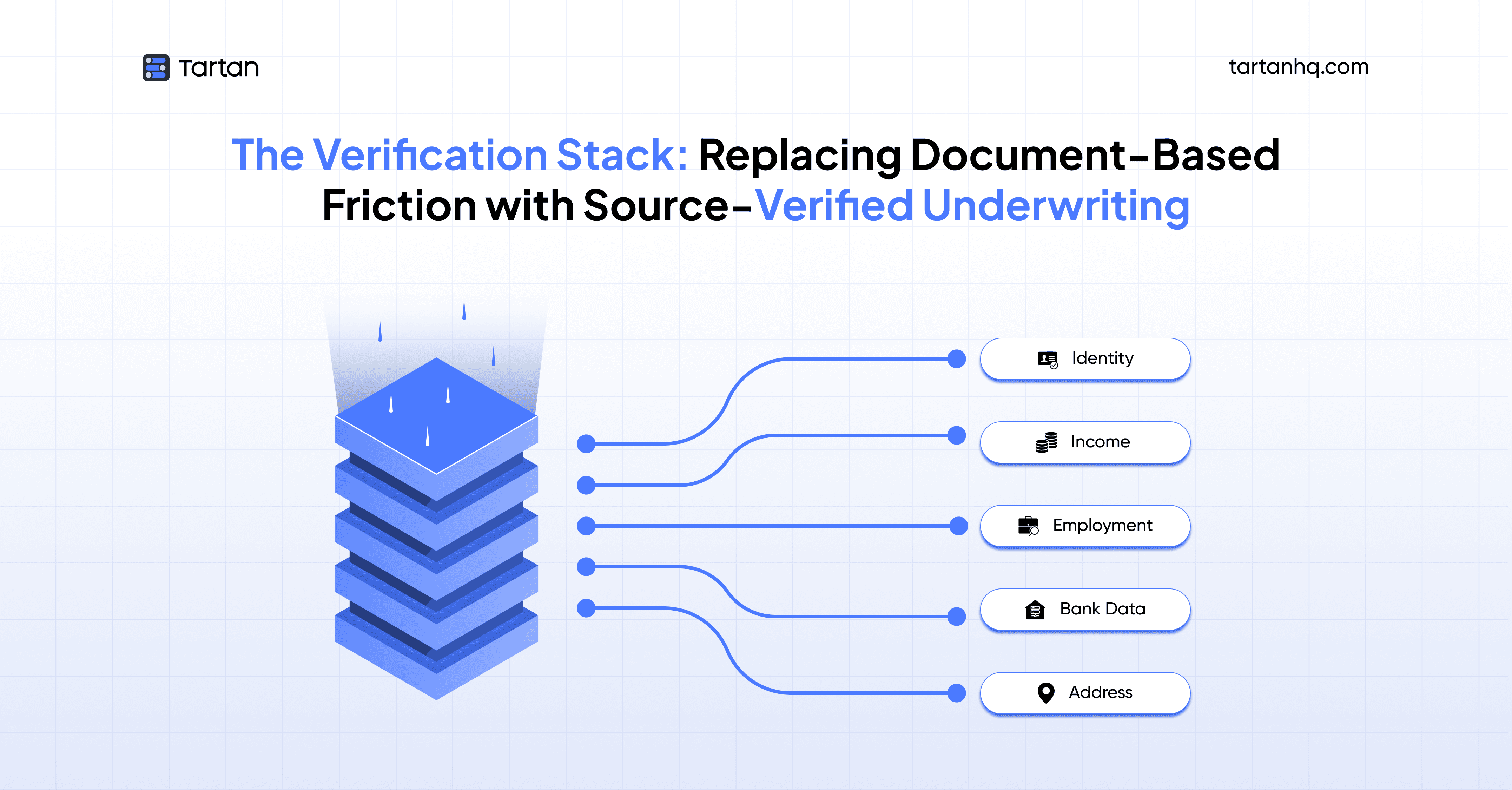
Modern lenders are solving this with verification stacks - integrated infrastructure layers that verify identity, income, employment, financial behavior, and creditworthiness in real-time, without document submission, without manual intervention, and with fraud resistance built into the architecture.
Why Document-Based Verification Breaks
The core issue with traditional verification isn't effort. Lenders invest heavily in document processing teams, fraud detection tools, OCR systems, and manual review protocols. The issue is that documents - salary slips, bank statements, employment letters, identity proofs - are artifacts created outside the lender's systems, mediated through borrowers, and increasingly easy to manipulate.
Consider what happens at each verification step:
Identity Verification: Borrower uploads Aadhaar card, PAN card, address proof. Operations team checks for formatting anomalies, validates PAN syntax, cross-references address details. Sophisticated forgeries using legitimate templates pass these checks. Stolen identity credentials produce authentic-looking documents. The verification confirms the document appears legitimate, not that the person is who they claim to be.
Income Verification: Borrower submits salary slips for the last three to six months, bank statements showing salary credits, Form 16 or ITR documents. Operations team manually cross-checks consistency - do salary amounts match across documents? Do bank credits align with salary slip dates? Are deduction calculations correct? This takes days. And it's vulnerable to coordinated forgery where salary slips and bank statements are fabricated together to show matching amounts.
Employment Verification: Lender calls the employer's HR department to confirm employment. This requires finding the right contact, navigating phone systems, waiting for callbacks, dealing with verification request backlogs. Response times vary from same-day to never. Meanwhile, fraudsters have created shell companies with functioning phone numbers specifically to confirm fake employment.
Banking Behavior Analysis: Bank statements submitted as PDFs are manually reviewed or processed through OCR to assess transaction patterns, existing obligations, bounce history, cash flow stability. This works when statements are authentic. When borrowers submit statements from accounts they closed yesterday or statements with transaction histories edited in design software, the analysis is based on fiction.
The verification burden is enormous, the timelines are slow, the fraud resistance is weak, and the borrower experience is terrible. Every additional document requested increases abandonment rates. Every manual review step adds days to approval cycles. Every verification phone call creates operational overhead.
This model doesn't scale. And it's failing to stop fraud.
What the Verification Stack Actually Is
The verification stack is a unified infrastructure layer that connects lenders to authoritative data sources for real-time verification across five critical dimensions:
Identity Layer: Verifies that the person applying for credit is who they claim to be, using Aadhaar-based eKYC, biometric authentication, video KYC, and liveness detection. Instead of reviewing uploaded documents, lenders verify identity directly against UIDAI databases with biometric matching. The verification happens in seconds. And it's tamper-proof - there's no document to forge.
Employment Layer: Confirms current employment status, tenure, role, and employer details through direct HRMS integration or employment verification services. Instead of calling HR departments, lenders query employment verification APIs that return structured data: active or inactive status, joining date, current designation, employment type. The response is instant and cryptographically authenticated.
Income Layer: Accesses verified income data directly from employer HRMS systems, employment verification platforms, or through tax data for self-employed borrowers. Instead of accepting salary slips, lenders retrieve current compensation details from authoritative sources with employee consent. The data is real-time, employer-verified, and immune to salary slip forgery.
Financial Behavior Layer: Analyzes transaction patterns, cash flows, existing credit obligations, and repayment behavior through Account Aggregator framework integration with customer banks. Instead of requesting bank statement PDFs, lenders access consented, real-time transaction data through AA. The data flows directly from banks to lenders in encrypted, structured format. No documents. No manual processing. No forgery risk.
Credit Layer: Assesses credit history, outstanding obligations, repayment track record, and credit utilization through bureau integration. This is already automated in most lending workflows, but modern verification stacks integrate bureau data alongside the other four layers to create comprehensive credit profiles in real-time.
The stack operates on a single architectural principle: verification happens at the source, not through intermediary documents. Identity is verified with UIDAI. Employment and income are verified with employers or employment verification platforms. Banking behavior is verified with banks. Credit history is verified with bureaus. The borrower provides consent and authentication. The lender receives verified data directly.
No documents. No manual processing. No forgery surface area.
How Each Layer Eliminates Fraud Vectors
Identity Fraud Resistance
When identity verification happens through Aadhaar eKYC with biometric authentication, the fraud vectors collapse. Stolen Aadhaar numbers don't work without matching biometrics. Forged Aadhaar cards are irrelevant because the lender isn't looking at cards - they're verifying directly with UIDAI databases. Synthetic identities created with real Aadhaar numbers but fake demographic details fail biometric matching.
Video KYC adds another layer. The applicant proves liveness and matches their face to the Aadhaar photo in real-time. Deepfake attempts fail liveness detection. Identity theft fails face matching. The verification confirms the person physically applying is the person whose Aadhaar credentials are being used.
Employment and Income Fraud Resistance
This is where platforms like Tartan HyperVerify fundamentally change the equation.
Traditional employment verification requires lenders to either trust employee-submitted documents or manually call employers - both methods vulnerable to fraud and operationally expensive. HyperVerify provides real-time employment and income verification through a unified API that connects to authoritative employer data sources.
When a borrower applies for credit and provides consent, HyperVerify verifies:
Current employment status: Is the person actively employed, on notice period, or already terminated?
Employment tenure: How long have they been with this employer?
Verified income details: What is their actual current salary as per employer records?
Role and designation: What position do they hold?
Employment type: Full-time, contract, probation period status?
The verification happens in seconds. The data comes from employer systems of record - HRMS platforms or employment databases - not from documents the employee submits. The borrower cannot inflate their income by editing PDFs because HyperVerify bypasses PDF submission entirely. The borrower cannot claim employment at companies where they don't work because verification fails at the source.
More importantly, HyperVerify provides current employment and income data. A borrower might have a six-month-old salary slip showing higher income, but their actual current salary is lower after a company-wide pay cut. Document verification sees outdated numbers. HyperVerify sees current reality.
For self-employed borrowers, verification shifts to tax data and GST transaction records. Instead of self-submitted income declarations, lenders access verified income data from tax authorities. The fraud resistance comes from verifying against government-maintained records rather than applicant-submitted documents.
Financial Behavior Fraud Resistance
Account Aggregator framework integration eliminates bank statement forgery entirely. When lenders access transaction data through AA, they receive encrypted data feeds directly from the borrower's banks. These feeds are tamper-proof, real-time, and structured. The borrower can't edit them. The borrower can't submit statements from accounts they've already closed. The borrower can't hide bounce histories or existing EMI obligations.
Moreover, AA data provides richer behavioral signals than static bank statements. Lenders can see regular salary credits, systematic EMI outflows, bill payment patterns, bounce instances, and account balance trends over time. This data flows continuously, enabling lenders to monitor repayment capacity even after loan disbursement.
The Speed Transformation
Fraud resistance is critical, but speed is what makes the verification stack transformative for customer experience and unit economics.
Traditional document-based verification for a personal loan typically unfolds over seven to ten days:
Borrower submits application with identity documents, salary slips, bank statements
Operations team reviews documents, flags discrepancies, requests additional documentation
Borrower submits missing documents, team re-reviews
Employer verification calls, waiting for callbacks
Final review, credit decision
Completion rates hover around fifty to sixty percent. Many borrowers abandon the process during document request cycles.
Verification stack-enabled underwriting for the same loan compresses this to minutes:
Borrower provides Aadhaar eKYC authentication, completes video KYC
System queries HyperVerify for employment and income verification
Borrower provides AA consent, system accesses real-time banking transaction data
Bureau pull, credit scoring, automated underwriting decision
Loan approved, funds ready for disbursement
The entire cycle completes in under five minutes. Completion rates improve to eighty-five to ninety-five percent.
The difference isn't marginal. It's the difference between losing customers to friction and activating them before they leave the application flow. For digital lenders, this translates directly to conversion rates, customer acquisition cost, and competitive positioning.
Building the Verification Stack: Integration Architecture
The challenge most lenders face isn't understanding what the verification stack should do - it's implementing it without massive engineering overhead.
Each layer requires different integration approaches:
Identity Layer: Integration with eKYC providers, DigiLocker, video KYC platforms. These integrations are relatively standardized since they connect to government databases (UIDAI) or regulated service providers.
Employment and Income Layer: This is where complexity traditionally exploded. Connecting to employer HRMS systems at scale meant building custom integrations for dozens of platforms - Darwinbox, greytHR, Keka, SAP SuccessFactors, Workday, Zoho People, homegrown systems. Each has different APIs, data models, and authentication mechanisms.
Tartan HyperVerify solves this by operating as a unified employment and income verification layer. Instead of building point-to-point integrations with each employer or HRMS, lenders integrate once with HyperVerify and gain access to verified employment and income data across the ecosystem.
How HyperVerify works in the stack:
Lender Integration: The lending platform integrates HyperVerify's verification API into their underwriting workflow
Borrower Consent: During loan application, the borrower provides consent for employment and income verification
Real-Time Verification: HyperVerify queries authoritative employment data sources and returns structured verification results
Instant Response: The lender receives verified employment status, tenure, income details, and role information in seconds
Decisioning: Verified data flows directly into credit decisioning engines
From the lender's perspective, HyperVerify is a single API call that returns comprehensive employment and income verification. The underlying complexity - connecting to diverse employer systems, normalizing data across platforms, handling authentication and consent - is abstracted away.
Financial Behavior Layer: Integration with Account Aggregator participants. The AA framework provides standardized protocols, so integration complexity is manageable once lenders become AA participants themselves or work with AA-enabled platforms.
Credit Layer: Bureau integrations are mature and well-established in most lending operations.
The key insight is that lenders don't need to build every layer themselves. They compose the stack from specialized providers for each verification dimension, with platforms like HyperVerify handling the employment and income verification component that historically required the most custom engineering work.
What This Means for Different Lender Types
Digital-First Lenders and Fintechs
Platforms offering instant personal loans, salary advances, BNPL, or consumer durables financing gain the most from verification stack adoption:
Instant Approval as Competitive Advantage: When competitors require multiple days for document verification, you approve in under sixty seconds. The borrower gets credit while still in the application flow. Conversion rates improve dramatically purely from speed.
Lower Fraud Losses, Better Unit Economics: Verification stack-enabled underwriting substantially reduces fraud rates. When fraud losses drop, the margin improvement flows directly to profitability. For high-volume lenders, this represents significant prevented losses annually.
Operational Cost Reduction: Eliminating document processing teams, manual verification workflows, and employer calling operations reduces cost per loan substantially. These savings scale linearly with volume.
Traditional Banks and NBFCs
Institutions with established underwriting processes can layer verification stack capabilities strategically:
Fast-Track Lanes for Verified Borrowers: Customers who provide consent for real-time verification through platforms like HyperVerify and AA get instant approvals. Customers who prefer document-based verification follow existing workflows. Over time, the verified path becomes default, legacy path becomes exception.
Risk Differentiation Based on Verification Quality: Borrowers with employer-verified income through HyperVerify and AA-validated banking behavior qualify for better rates and higher limits than those relying on self-submitted documents. Risk-based pricing reflects verification quality.
Portfolio Monitoring Capability: For existing credit lines and term loans, continuous verification enables early detection of employment changes, income reductions, or notice periods. Early warnings trigger proactive retention or recovery conversations while borrowers are still employed.
Embedded Lending Platforms
Fintechs offering credit within ecosystems - e-commerce BNPL, health finance, education loans - benefit from verification stack integration that matches their distribution model:
Point-of-Sale Instant Credit: When a customer applies for financing at checkout, verification stack enables real-time credit approval without leaving the purchase flow. Identity verified via Aadhaar. Employment and income verified via HyperVerify. Banking behavior verified via AA. Decision in under thirty seconds.
Seamless User Experience: Borrowers don't fill lengthy forms or upload documents. They authenticate identity, provide consent for verification, and receive instant credit decisions. The friction that typically kills embedded lending conversion rates disappears.
The Implementation Path
Adopting verification stack architecture doesn't require replacing existing systems overnight. The approach is incremental:
Phase 1 - Add Identity and Employment Verification: Integrate Aadhaar eKYC for identity verification and HyperVerify for employment and income verification. Run parallel to existing document-based process initially. Measure fraud reduction, approval speed improvement, completion rate changes.
Phase 2 - Add Financial Behavior Layer: Integrate Account Aggregator for banking transaction data. Enable borrowers to choose: submit bank statements (slow path) or provide AA consent (fast path). Track adoption and conversion rate differences.
Phase 3 - Shift to Verification Stack Default: Make API-based verification the primary workflow. Document-based verification becomes fallback for edge cases where real-time verification isn't available.
Phase 4 - Continuous Optimization: Use verified data to build more precise credit models. Implement dynamic credit limits based on real-time employment and cash flow data. Enable instant credit line increases when verified income increases.
The key is starting with one or two layers, proving value through measurable outcomes, and expanding systematically.
Why Now
The infrastructure for real-time, source-verified, consent-based data access exists. The regulatory environment supports it. The fraud economics demand it. The customer experience improves dramatically with it.
India's digital public infrastructure - Aadhaar for identity, Account Aggregator for financial data, UPI for payments - reflects a consistent pattern: moving from document-based proofs to API-enabled verification. Employment and income verification is following this same trajectory.
Platforms like HyperVerify make this transition operationally feasible. Instead of each lender building custom employer integrations that take months and don't scale, they integrate once with a verification platform and access employer-verified data across the ecosystem.
The lenders who build verification stacks now - integrating identity verification, employer-verified income through platforms like HyperVerify, banking behavior through AA, and real-time credit assessment - create compound advantages:
Fraud losses decrease while portfolio quality improves
Approval speeds increase while operational costs decrease
Customer conversion improves while acquisition costs decline
Credit models become more accurate while risk-adjusted returns improve
The difference between lenders with verification stacks and those still processing documents won't be incremental. It will be the difference between instant, fraud-resistant underwriting and slow, fraud-vulnerable processes that customers abandon.
The verification stack isn't a future possibility. It's operational infrastructure is available today. The question is whether your institution will lead the transition or react to competitors who already have.