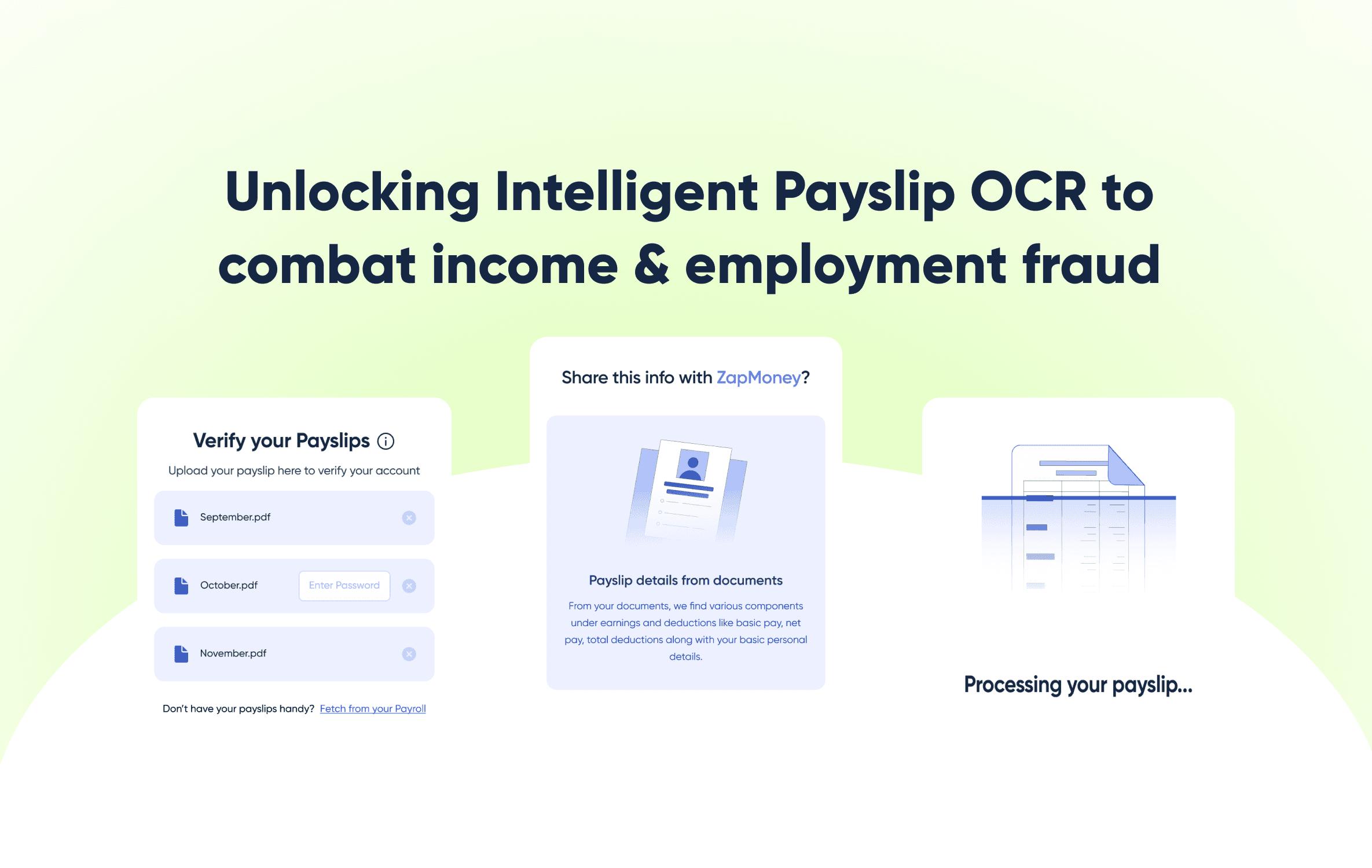
Income verification determines whether loans get approved, credit limits get set, and portfolios remain healthy. Yet across BFSI and Fintech, this critical control point remains vulnerable to a pervasive, costly threat: fake payslips.
For every 100 loan applications your institution processes, industry data suggests 8-12% contain income misrepresentation. Most won't get caught until they default.
At Tartan, we work with leading lenders processing over 50,000 applications daily. The pattern is consistent: manual payslip verification creates the illusion of control while systematically missing sophisticated fraud.
This isn't just a verification bottleneck. It's a portfolio risk that compounds over time, degrading credit models, inflating loss provisions, and forcing expensive manual interventions at scale.
The Real Cost of Fake Payslips: Beyond the Bad Loan
When fraudulent income data enters your lending system, the damage extends far beyond individual defaults:
Immediate Portfolio Impact
Credit exposure inflation: A borrower claiming ₹60,000 monthly income instead of ₹35,000 receives 70% higher credit limits, multiplying potential loss
Mispriced risk: Customers segmented into wrong risk bands receive inappropriate pricing, eroding margins on good customers while subsidizing bad ones
Approval rate distortion: False positives in income verification artificially inflate approval rates, masking underlying portfolio deterioration
Systemic Decision Degradation
Model contamination: ML models trained on fraudulent data learn incorrect patterns, perpetuating bad decisions across thousands of future applications
Risk calibration drift: Default probability models lose accuracy when trained on misrepresented income, requiring costly recalibration
Regulatory exposure: Income verification failures create audit trails that trigger regulatory scrutiny and potential penalties
Operational Cost Spiral
Manual review explosion: As fraud leaks through, teams increase manual checks, creating bottlenecks that slow approval TAT by 40-60%
Collection inefficiency: Recovery teams spend disproportionate time on accounts where income was never verified, reducing overall collection effectiveness
Customer friction: Legitimate applicants face delays while teams attempt to verify suspicious documents, damaging conversion rates
Long-Term Business Consequences
A mid-sized NBFC we worked with discovered that 11% of their delinquent accounts in the 90+ DPD bucket had income verification issues at origination. The financial impact:
₹127 crore in stressed assets directly traceable to income misrepresentation
2.3% higher portfolio NPAs than risk models predicted
18% increase in manual underwriting costs to catch fraud downstream
The real cost isn't the fraudulent loan, it's the systematic degradation of your entire credit decision infrastructure.
Why Traditional Payslip Verification Fails at Scale
Most financial institutions rely on one of three approaches, all fundamentally inadequate:
Manual Visual Inspection
Risk teams review uploaded payslips, checking for obvious signs of tampering: mismatched fonts, alignment issues, calculation errors.
Why it fails: Sophisticated fraud uses authentic payslip templates with only data modified. A trained eye cannot distinguish a well-executed fake from a genuine document. At 500+ applications daily, consistency becomes impossible.
Business impact: 60-70% manual review costs, 48-72 hour verification TAT, 15-20% false negative rate (fraud passing through).
Rule-Based OCR Systems
Basic OCR extracts text from payslips, applying simple validation rules: salary calculations, tax deductions, employer name formats.
Why it fails: Rules require constant maintenance as payslip formats evolve. They catch obvious errors but miss contextual fraud, correct calculations on fake employer details, legitimate formats with inflated amounts.
Business impact: 30-40% false positive rate (legitimate documents flagged), requires extensive manual override workflows, cannot detect template-based fraud.
Outsourced Verification Services
Third-party agencies manually verify payslips, sometimes calling employers or checking basic details.
Why it fails: Slow (3-5 days typical TAT), expensive (₹50-150 per verification), inconsistent quality, no structured data output for decisioning systems.
Business impact: Breaks instant approval workflows, adds verification cost to every application, provides binary yes/no instead of data-rich inputs for risk models.
What Modern Income Verification Actually Requires
Effective payslip verification in a digital lending context must deliver three outcomes simultaneously:
1. Fraud Detection at Submission
Identify manipulated, template-generated, or mismatched documents before they enter decisioning workflows, not weeks later during collections.
Business requirement: Real-time fraud signals with 95%+ accuracy, integrated directly into application flow.
2. Verified Data Extraction
Convert unstructured payslip PDFs into standardized, validated data fields that feed directly into credit models, underwriting rules, and eligibility engines.
Business requirement: Structured output matching internal data schemas, normalized across 10,000+ payslip format variations.
3. Authoritative Cross-Verification
Validate employment, income, and identity claims against government registries and verified employer databases, not just the document itself.
Business requirement: API-level integration with EPFO, income tax systems, and employer databases for instant verification.
Traditional approaches deliver none of these at the speed, scale, and accuracy modern lending requires.
Tartan's Intelligent Payslip OCR: From Document to Decision-Ready Data
Tartan's Intelligent Payslip OCR is purpose-built for high-volume lending operations where income verification determines approval decisions, credit limits, and portfolio quality.
How the System Works
Step 1: Deep Format Recognition The system is trained on 1.2 million+ Indian payslips across 15,000+ employer formats, from large corporates to MSMEs, government departments to startups. It automatically recognizes payslip structure, identifies field locations, and handles format variations without manual template configuration.
Business impact: No setup time for new employer formats, automatically adapts as payroll systems evolve.
Step 2: Intelligent Data Extraction Advanced OCR extracts 40+ structured fields:
Employee identity: Name, employee ID, designation, date of joining, department
Income components: Basic salary, HRA, DA, transport allowance, special allowances, bonuses, arrears
Deductions: EPF, professional tax, income tax (TDS), ESI, loan deductions
Employment markers: UAN, PAN, bank account details, paid days, leave balance
Employer information: Company name, address, establishment ID, payroll period
Each field is normalized to standard formats, enabling direct integration with lending management systems.
Business impact: Eliminates manual data entry, reduces approval TAT by 80%, enables straight-through processing for verified cases.
Step 3: Multi-Layer Validation The system doesn't just extract data, it validates authenticity:
Calculation verification: Cross-checks that gross pay, deductions, and net pay calculations are accurate
Consistency analysis: Validates that salary components align with typical structures for the designation and industry
Historical pattern matching: Flags anomalies when current payslip deviates significantly from typical profiles
Template forensics: Detects signs of PDF manipulation, editing, or generation from common fake payslip tools
Business impact: Catches 92% of manipulated documents automatically, reduces fraud leakage by 70-80%.
Step 4: Authoritative Cross-Reference Critical validation step that separates Intelligent OCR from basic text extraction:
EPFO verification: Matches UAN against official employment records, validates employer linkage, confirms contribution history
Employer database validation: Cross-references employer name and establishment ID against verified employer registries
Identity confirmation: Validates PAN linkage to employee name and other identity markers
This layer answers the fundamental question: Does this payslip represent verified employment at a real organization?
Business impact: Eliminates ghost employer fraud, validates employment stability, provides defensible income verification for regulatory compliance.
Step 5: Risk-Scored Output The API returns:
Complete structured data in JSON format
Fraud risk score (0-100) with specific red flags identified
Verification status for each critical field (verified/unverified/flagged)
EPFO employment confirmation
Decision recommendation (approve/manual review/reject)
Business impact: Enables automated decisioning for 80-85% of applications, reserves manual review for genuine edge cases.
The Data That Powers Better Decisions
Intelligent Payslip OCR transforms payslips from image files into rich, verified data that enhances every stage of the credit lifecycle:
For Instant Approval Engines
Income stability signals: Employment tenure, salary consistency, deduction patterns indicate financial stability
Credit capacity calculation: Verified net income enables accurate EMI affordability assessment
Risk segmentation: Employer type, designation, and salary structure inform risk-based pricing
For Underwriting Rules
Eligibility verification: Minimum income thresholds validated against verified data, not self-reported figures
Debt service coverage: Existing deductions (loans, tax) reveal actual take-home pay for obligation calculations
Employment quality signals: PF contributions, formal tax deductions indicate organized sector employment
For Credit Models
Feature richness: 40+ verified data points vs. single "stated income" field improve model predictiveness
Data quality: Training on verified vs. self-reported income improves model calibration by 25-30%
Reduced noise: Eliminating fraudulent training data improves model accuracy across all segments
For Portfolio Monitoring
Early warning indicators: Income deduction patterns (increasing tax/PF vs. decreasing) signal employment status changes
Collection prioritization: Verified income history helps predict recovery probability
Audit trail: Complete verification records demonstrate diligence in income verification for regulatory review
Target Use Cases: Where Intelligent Payslip OCR Delivers Maximum ROI
1. Unsecured Personal Loan Origination
Challenge: Processing 5,000-10,000+ daily applications where payslips are the primary income proof, manual verification creates 48-72 hour delays, 10-15% fraud rate in salaried segment.
Implementation:
Payslip OCR integrated directly into loan application flow
Automated verification completes in 8-12 seconds
High-confidence cases (fraud score <20, EPFO verified) auto-approved
Medium-risk cases (score 20-60) flagged for targeted review
High-risk cases (score >60) auto-rejected or require additional documentation
Business outcomes:
Approval TAT reduction: 72 hours → 15 minutes for straight-through cases (85% of volume)
Fraud prevention: 11.2% fraud rate → 2.1% fraud rate in salaried segment
Operational efficiency: 70% reduction in manual verification headcount
Portfolio quality: 1.8 percentage point reduction in 90+ DPD rate for cohorts originated with automated verification
Revenue impact: 35% increase in same-day disbursals drives higher conversion and customer satisfaction
ROI calculation (for lender processing 200,000 annual applications):
Manual verification cost saved: ₹2.4 crore annually
Fraud losses prevented: ₹8.7 crore (based on prevented fraudulent approvals)
Revenue uplift from faster TAT: ₹12 crore (improved conversion)
Total annual impact: ₹23+ crore
2. Credit Card Issuance & Limit Setting
Challenge: Credit limits set based on self-declared income, frequent limit disputes, high-limit frauds clustered in income misrepresentation cases.
Implementation:
Payslip OCR validates income at application and limit enhancement requests
Verified net income (after deductions) used for credit limit calculation vs. gross salary
Employment stability (tenure, PF history) factors into approval decision
Automated limit increase approvals for verified income increases
Business outcomes:
Accurate limit setting: Credit limits aligned to actual repayment capacity, reducing overlimit defaults by 40%
Fraud reduction: 68% reduction in high-limit frauds (₹5L+ limits based on fake income)
Revenue optimization: Proper income verification enables confident limit increases for genuine customers, 22% improvement in credit utilization
Risk-adjusted pricing: Verified employment quality enables granular pricing, 1.2% margin improvement
Specific impact for new-to-credit (NTC) customers:
Many NTC applicants have limited bureau history but formal employment
Verified payslip + EPFO validation provides strong approval signal where bureau is thin
45% increase in NTC approvals while maintaining portfolio quality
Opens addressable market among young professionals with stable income but short credit history
3. Consumer Durable Financing & BNPL
Challenge: High application volumes (15,000-25,000 daily), thin margins require instant decisions, income verification must happen at point of sale without breaking customer experience.
Implementation:
Customer uploads payslip via mobile during checkout
OCR + verification completes in <15 seconds while sales associate processes other details
Instant approval for verified cases (no customer wait time)
Automated financing limit calculated from verified net income
Business outcomes:
Conversion rate improvement: 18% higher approval-to-disbursal conversion from eliminating verification delays
Fraud control: Despite instant approval, fraud rate maintained at <1.5% vs. 3.2% industry average
Operational scalability: Process 25,000 daily applications with same ops team size that handled 8,000 with manual verification
Merchant satisfaction: Instant approvals at POS increase merchant participation and transaction values
4. MSME/Business Loan Assessment
Challenge: MSME proprietors often draw salary from their company, verification requires validating both individual income and business legitimacy.
Implementation:
OCR validates proprietor's personal payslip as proof of business operations
Cross-references employer (proprietor's company) against GST, MCA databases
PF contributions signal formalized operations with employee base
Income consistency validates business stability
Business outcomes:
Business legitimacy validation: Payslip + EPFO linkage confirms operating business, not just registered entity
Income proxy: Regular salary draw indicates consistent business cash flows
Formal sector identification: PF contributions separate informal operators from formal MSMEs, enabling risk-based pricing
TAT improvement: Automated salary verification as one component of broader MSME underwriting reduces overall decision time by 30-40%
5. Co-Lending & Partnership Lending Models
Challenge: Bank partners require income verification audit trails, inconsistent verification processes create disputes, manual verification delays partnership disbursals.
Implementation:
Fintech collects and verifies payslips via Intelligent OCR
Structured verified data + fraud scores + EPFO validation shared with bank partner
Comprehensive audit trail (OCR confidence scores, validation checks passed) satisfies bank compliance requirements
Disputes minimized through shared verification standards
Business outcomes:
Partnership velocity: 50% faster approval cycles improve capital deployment for fintech, utilization rates for bank
Dispute reduction: Shared verification infrastructure reduces income-related chargebacks by 75%
Regulatory confidence: Auditable, systematic verification process satisfies both parties' compliance requirements
Scalability: Standardized verification enables rapid onboarding of new bank partners without custom integration
Implementation & Integration: Built for Modern Lending Stacks
Tartan's Intelligent Payslip OCR integrates seamlessly into existing lending workflows:
API-First Architecture
RESTful API with 99.9% uptime SLA
Synchronous response in 8-12 seconds for most payslips
Webhook support for asynchronous processing of large batches
Comprehensive error handling and retry logic
Flexible Integration Patterns
Direct integration: API calls from lending management system, mobile app, or web portal
Middleware layer: Integration via existing decisioning engines or workflow platforms
Batch processing: Bulk verification for portfolio reviews or retroactive fraud checks
Data Security & Compliance
SOC 2 Type II certified infrastructure
End-to-end encryption for document transmission and storage
Configurable data retention policies (instant deletion to long-term storage)
Complete audit logs for regulatory compliance
Developer Experience
Detailed API documentation with code samples in 6+ languages
Sandbox environment with test payslips covering edge cases
SDKs for rapid integration (Node.js, Python, Java, PHP)
Dedicated implementation support with typical go-live in 2-3 weeks
Beyond OCR: Building Comprehensive Income Verification
While Intelligent Payslip OCR handles document-based verification, comprehensive income verification often requires multiple data sources:
Complementary Verification Layers
Bank statement analysis: Validates salary credits match payslip declarations, identifies irregular income patterns
EPFO direct data: For applicants comfortable sharing UAN, direct EPFO integration provides employment and contribution history
Form 16 validation: Annual income tax statements provide year-over-year income verification
Employer verification APIs: Direct validation with employer HR systems for large corporate employers
Tartan's unified Income Verification platform combines these sources, with Intelligent Payslip OCR as the fastest, most universally applicable verification method.
Fraud Triangle Coverage
Effective fraud prevention requires validating three elements:
Identity: Is this person who they claim to be? (KYC, PAN validation)
Employment: Do they work where they claim? (Payslip OCR + EPFO verification)
Income: Do they earn what they claim? (Payslip validation + bank statement analysis)
Intelligent Payslip OCR addresses points 2 and 3, significantly reducing fraud surface area.
Why Intelligent Payslip OCR Is Now Critical Infrastructure
Digital lending has reached an inflection point. The institutions that will dominate the next decade are those that can:
Process applications in minutes, not days - while maintaining underwriting quality
Scale volume without scaling fraud - through intelligent automation, not larger ops teams
Confidently serve thin-file segments - using verified alternative data, not just bureau scores
Adapt to regulatory evolution - with auditable, systematic verification processes
Income verification sits at the center of all four imperatives.
Manual payslip verification, regardless of team quality, cannot deliver the speed, scale, accuracy, and auditability modern lending requires. It's a structural limitation, not an execution gap.
Intelligent Payslip OCR is not optional infrastructure for digital lenders. It's the foundation of trustworthy, scalable income verification in a world where manual processes cannot keep pace with application volumes, fraud sophistication, or customer expectations.
Ready to transform income verification from a bottleneck into a competitive advantage?
Let's discuss how Intelligent Payslip OCR can strengthen your credit decisioning while accelerating approvals.
Contact Tartan to schedule a detailed discussion on implementation, ROI modeling, and pilot program options tailored to your lending model.