Every lender and insurer eventually runs the same evaluation. Field verification is slow but familiar. Video KYC feels modern but was built to confirm identity, not address. Digital contact point verification is newer and less understood, which makes it the hardest of the three to evaluate on reputation alone.
This comparison looks at what each method actually captures, how each one behaves under volume, and which one produces evidence that survives a regulatory audit. By the end, the differences stop being about preference and start being about what the workflow actually requires.
The Three Methods, Defined
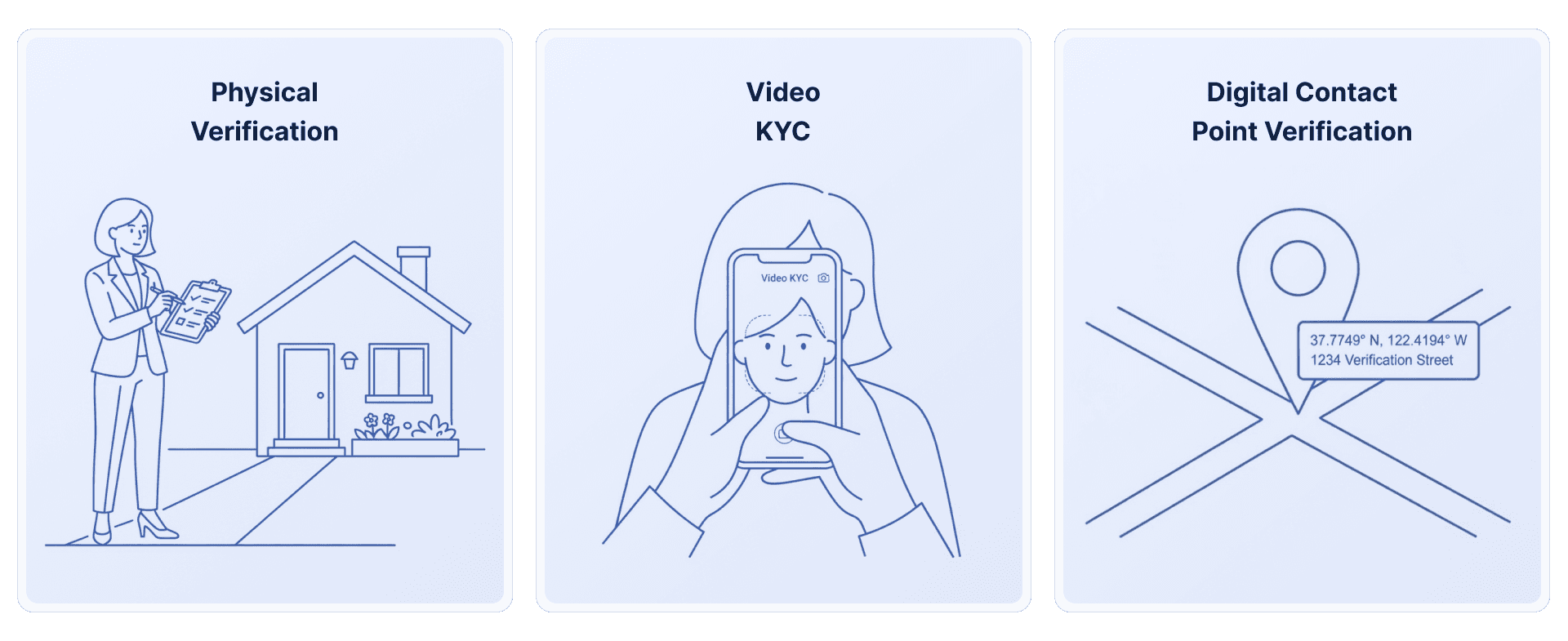
Physical verification
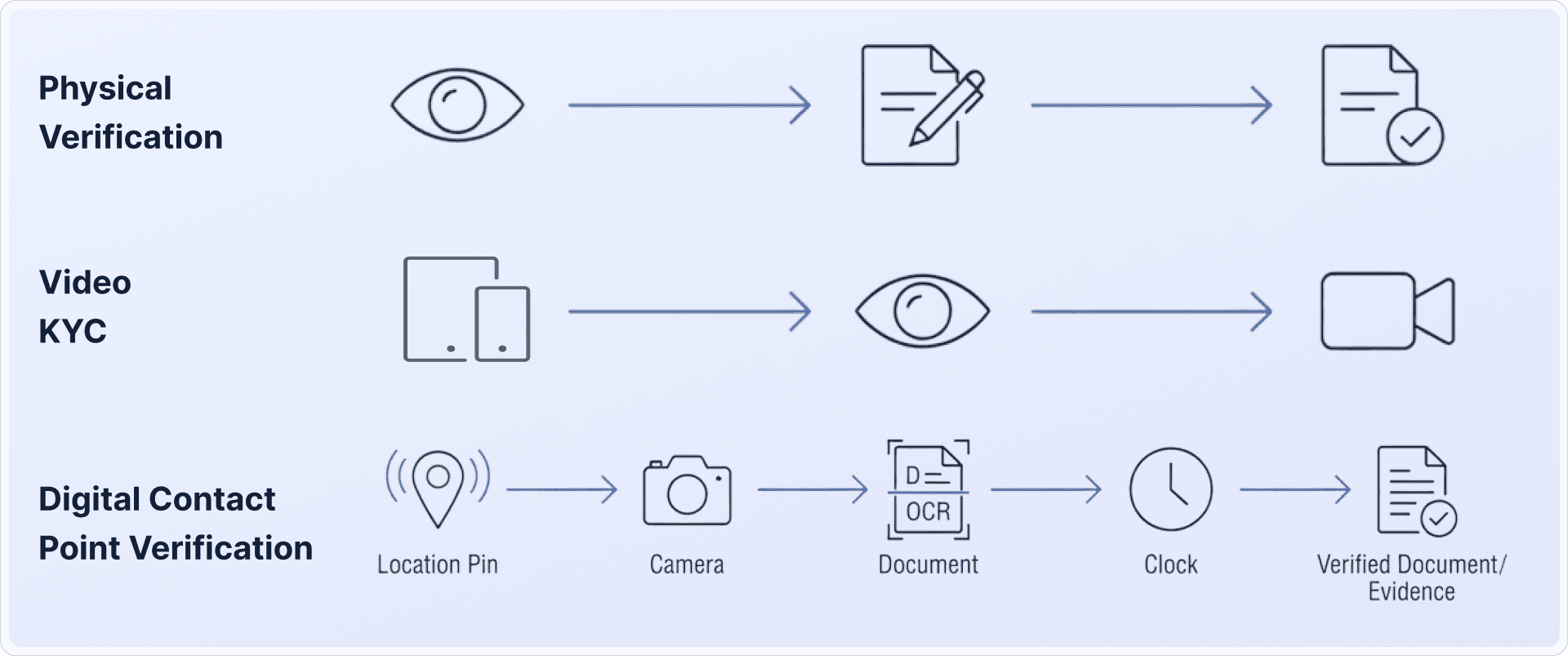
A field agent visits the applicant’s address in person, observes the property, and files a report. This has been the default method for decades because it puts a human at the location. It also means the process only moves as fast as the agent’s schedule allows.
Video KYC
An applicant joins a video call with an agent who confirms identity documents and asks verification questions in real time. This method was designed primarily to verify who someone is, not where they live. Address confirmation, when it happens at all, relies on what the applicant says on the call rather than independent evidence.
Digital contact point verification
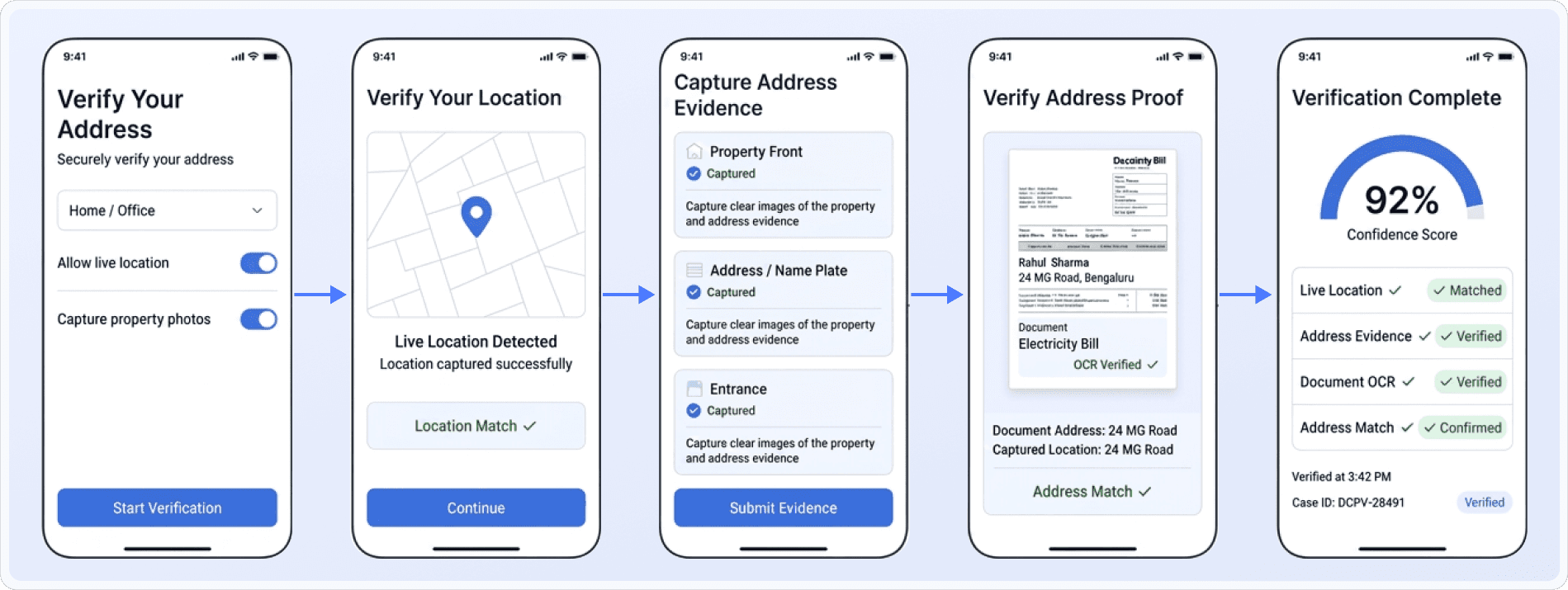
The applicant completes a guided, asynchronous flow that captures live location data, address evidence photos, and OCR-verified documents, without a field visit or a scheduled call. The evidence is system-generated rather than self-reported, and the process runs on the applicant’s own time.
Turnaround Time: Days vs Hours vs Minutes
Field verification typically takes 2 to 5 or more days once scheduling, travel, and any necessary revisits are factored in. Video KYC moves faster than a field visit but is still limited by agent availability, since every case needs a live human on the call. Digital contact point verification runs asynchronously, with no scheduling dependency, and typically completes in minutes to hours.
For any lender or insurer where turnaround time affects conversion, this gap alone often decides the outcome before evidence quality or audit readiness even enter the conversation.
Evidence Quality: What Each Method Actually Captures
Field verification produces an agent’s observation, which is only as consistent as the individual filing the report. Video KYC produces what the applicant says during a call, which confirms identity but tells a reviewer very little about the address itself. Digital contact point verification produces live location data, address photos, and OCR-verified documents captured directly from the applicant’s device at the moment of verification.
The distinction matters because two of these methods rely on a person’s account of events, while the third relies on system-level evidence generated in real time. Evidence that can be independently checked holds up differently than an observation or a statement, particularly when a case is disputed later.
Scale: What Happens When Volume Increases
Field verification carries a linear cost. Every additional case requires another agent visit, so volume growth translates directly into longer queues or higher headcount. Video KYC is capped by agent bandwidth in a similar way, since every case still needs a live human on a call. Digital contact point verification is async and link-based, which means volume increases without a proportional increase in staffing or turnaround.
This is the point where the three methods diverge most sharply for any institution processing meaningful case volume rather than a handful of applications a day.
Risk Signal: Pass/Fail vs Identity-First vs Confidence Scoring
Field verification typically returns a binary outcome, pass or fail, with no indication of how confident that outcome is. Video KYC is built around identity confirmation first, which leaves address risk under-addressed even when the call itself goes smoothly. Digital contact point verification replaces the binary outcome with a confidence score, so low-risk cases move straight through and high-risk cases get flagged with the specific evidence behind the concern.
A confidence score gives underwriting and risk teams a level of nuance that a pass/fail check cannot provide, particularly for cases that sit close to the decision boundary.
Audit Trail: What Holds Up Under Review
Field verification produces manual notes that vary in detail and format depending on who filed them. Video KYC produces a recording, which confirms a call happened but does little to explain the reasoning behind a specific decision. Digital contact point verification produces a timestamped, evidence-linked trail for every step, tied directly to the decision it supports.
When a regulator or internal auditor asks why a specific case was approved or rejected, a timestamped trail answers that question directly. A recording or a manual note usually does not.
Side-by-Side Comparison
Dimension | Physical Verification | Video KYC | Digital contact point verification |
Turnaround | 2 to 5+ days | Hours, limited by agent bandwidth | Minutes to hours, async |
Evidence type | Field agent observation | What the applicant says on a call | Live location, address photos, OCR documents |
Scale | Linear cost per case | Capped by agent headcount | Async, supports bulk volumes |
Risk signal | Pass/fail, no nuance | Identity-first, not address-first | Confidence score |
Audit trail | Inconsistent, manual notes | Recording only | Timestamped, evidence-linked |
Why Digital Contact Point Verification Wins for High-Volume, Regulated Workflows
The comparison consistently comes down to the same pattern. Field verification and video KYC both depend on a person, an agent’s schedule or an agent’s presence on a call, which caps how fast and how far either method can scale. Both also produce evidence that is harder to independently verify and harder to defend during an audit.
Digital contact point verification removes the human bottleneck from the verification step itself, without removing the rigor. It produces evidence that can be checked, a risk score that carries nuance, and a trail that holds up when someone asks why a decision was made.
How This Works in Practice
Tartan’s Digital Contact-Point Verification is built around this exact set of gaps. It replaces field visits and call-based checks with a guided, asynchronous flow that captures live location, address evidence photos, and OCR-verified documents directly from the applicant. Every case returns a confidence score instead of a binary outcome, and every step is logged with a timestamp linked to the evidence behind it.
The result runs in minutes to hours, scales without added headcount, and produces an audit trail built for regulatory review rather than reconstructed after the fact.
Talk to TartanHQ Team About Switching to Digital Contact Point Verification
If your current verification process depends on field agent scheduling or call-based checks, the comparison above shows exactly where that dependency costs you time, scale, and audit defensibility. Connect with the Tartan team to see how Digital Contact Point Verification fits into your existing onboarding workflow.