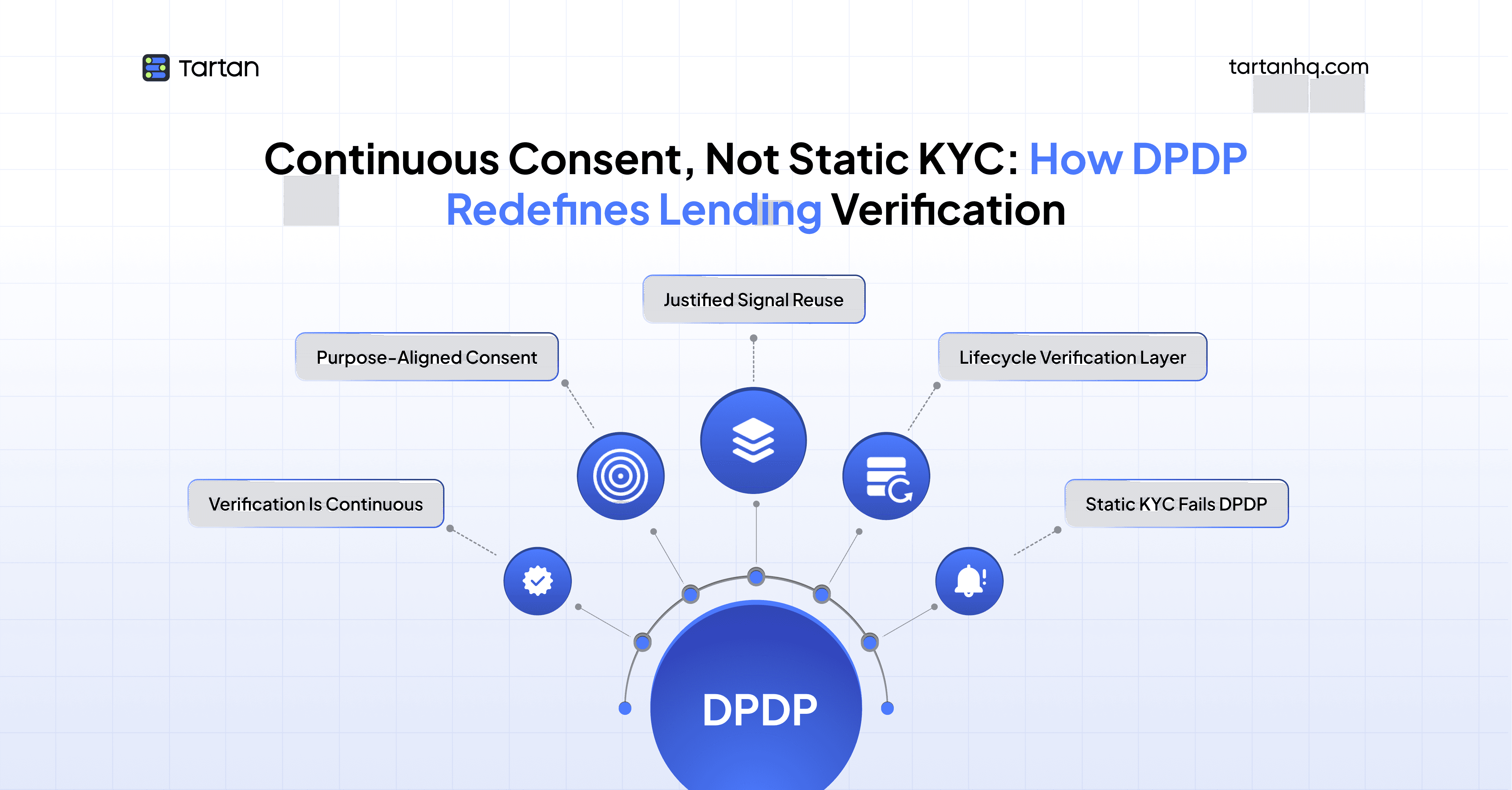
Most lending platforms today are confident about their KYC posture not because it is robust, but because it has passed audits so far.
Identity was verified at onboarding.
Consent was captured once.
Documents were stored.
Vendors returned a verification cleared status.
From that point on, the system assumes continuity.
The same identity proof is reused for underwriting decisions, limit enhancements, servicing actions, collections outreach, and regulatory explanations often months or years later, without revisiting whether the original consent, purpose, or data relevance still holds.
This is not a policy gap.It is a verification architecture gap. And DPDP exposes it.
The Digital Personal Data Protection Act is framed internally as a legal or compliance upgrade: revise consent language, update privacy notices, tighten vendor contracts.
DPDP challenges a deeper assumption embedded in most fintech and NBFC systems: That verification is a one-time event, while data usage is continuous.
Under DPDP, lenders are expected to justify not just how data was collected, but why it continues to be used across the customer lifecycle. Static KYC stacks were never designed to answer that question.
Why DPDP Makes Verification a Lifecycle Decision
DPDP does not invalidate existing verification practices. It changes the conditions under which they remain acceptable.
In most lending systems, verification is still treated as an onboarding gate, a necessary step to move a customer into the book. Once cleared, that decision is assumed to hold across underwriting, servicing, collections, and audits, even as exposure, behavior, and business purpose evolve.
DPDP breaks that assumption.
The Act implicitly requires lending institutions to demonstrate that personal data usage remains aligned with its stated purpose at every material point in the customer lifecycle. This makes verification a living decision, not a historical one.
What shifts is not the need for verification, but the time horizon over which verification must remain defensible.
Verification Decisions Are Designed to Evolve Over Time
In lending, verification is not a binary outcome. It is a confidence assessment made at a specific point in the customer relationship and like all risk signals, its relevance depends on context and time.
Well-designed verification systems recognize this implicitly. Identity confidence strengthens or weakens based on behavior. Address relevance changes as customers move. Employment and income signals shift as exposure and tenure evolve. Risk is not static, and verification should not pretend otherwise.
DPDP reinforces this reality by requiring lenders to align data usage with current purpose, not historical checks.
Lifecycle-based verification makes this alignment explicit:
Verification aligns to each lifecycle action
Data stays current to its intended purpose
Rechecks are event-driven, not periodic
This approach does not increase verification volume. It increases decision quality.
By designing verification as an evolving confidence layer rather than a fixed artifact, lending enterprises gain stronger defensibility, cleaner audit narratives, and more accurate downstream decisions without introducing friction where it is not warranted.
Consent Is Managed as a Living Authorization
In regulated lending, consent is not a moment in the journey, it is an authorization that must remain aligned with how customer data is actually used.
Mature consent frameworks treat consent as scoped and contextual, not as an approval captured once and stretched across unrelated actions. As customer relationships evolve: from onboarding to underwriting, servicing, and collections the purpose, necessity, and risk profile of data usage evolves with it.
DPDP reinforces this operating model by requiring lenders to demonstrate that consent remains valid for the purpose being exercised at that point in time.
Lifecycle-oriented consent design enables this by:
Linking consent to specific verification purposes
Allowing consent to be renewed when business intent changes
Maintaining clear, explainable records of how and why data was accessed
This approach reduces ambiguity without increasing customer friction. Consent remains clear, defensible, and aligned with actual usage not treated as a static legal artifact.
Point-in-Time KYC Is Optimized for Entry, Not for the Full Lifecycle
Point-in-time KYC plays an integral role in establishing initial trust. It confirms identity, validates eligibility, and allows lending relationships to begin.
However, in high-scale lending enterprises, onboarding is only the first of many decisions that rely on customer data. Exposure changes. Behavior evolves. Risk profiles shift. Verification signals gathered at entry are not always sufficient to support downstream actions months or years later.
Onboarding KYC establishes initial trust, which can be reaffirmed or updated as exposure, behavior, or usage changes
This design allows lenders to:
Preserve onboarding speed without accumulating hidden risk
Avoid unnecessary re-KYC while keeping data relevant
Support downstream decisions with proportionate verification
The result is a verification model that scales with the customer relationship instead of constraining it.
DPDP Shifts Verification from Data Collection to Ongoing Justification
The DPDP Act does not fundamentally restrict what lending institutions can verify. It changes how verification decisions must remain justified over time.
Lending verification stacks have been optimized around data intake: collect the required attributes at onboarding, clear regulatory thresholds, store the outputs, and reuse them downstream. That model assumes that once data is collected lawfully, its continued use is implicitly acceptable.
DPDP breaks that assumption. The Act reframes personal data not as a static asset, but as a conditional input usable only when its purpose, relevance, and necessity remain intact. This has direct consequences for how verification systems must be designed.
Verification Must Remain Purpose-Aligned Without Being Re-Executed
DPDP’s purpose-limitation principle is often misunderstood in lending environments. It does not require verification to be repeated every time a customer progresses through a new workflow. Instead, it raises a more structural expectation: lenders must be able to clearly explain why an existing verification signal is being reused for a specific decision at a specific point in time.
The focus shifts from how often verification is performed to how deliberately verification evidence is applied. In a well-designed lending verification system:
The same verified identity signal can support onboarding, underwriting, and servicing
Signal reuse is conditional on relevance to the decision being made
Data usage remains within the scope of the original authorization and consent
Lifecycle-based verification enables this by explicitly separating:
Signal generation (verification once)
From signal reuse (decision-specific application)
This separation is critical. It avoids unnecessary re-verification, reduces customer friction, and limits redundant data collection, while still maintaining explicit alignment with DPDP’s purpose and accountability expectations.
HyperVerify is built on this principle: verification signals are treated as governed assets - reusable, time-aware, and decision-specific rather than disposable checks tied to individual workflows.
Data Minimization Is Achieved Through Intelligent Reuse, Not Re-Collection
Data minimization is not about stopping reuse it is about preventing casual reuse. The bigger risk for scaled lending platforms is not excessive collection at onboarding, but uncontrolled reuse of verification signals after their reliability or relevance has degraded. When systems lack visibility into signal freshness or confidence, they default to reuse by convenience rather than by intent.
HyperVerify’s approach aligns naturally with DPDP by:
Treating verification outputs as confidence-scored signals
Reusing them across journeys when they remain valid
Refreshing only when confidence decays or context materially changes
This reduces both:
Redundant vendor calls
Unnecessary customer friction
Lifecycle-based verification enables this by making reuse explicit and governed. Instead of re-running checks or blindly relying on old data, the system evaluates whether an existing signal is still fit for the decision being made.
HyperVerify operationalizes this by allowing lending teams to reuse verification signals confidently when appropriate, and to refresh them only when decision quality or regulatory defensibility would otherwise be compromised.
Verification Accountability Is Built Through Traceability
Accountability does not come from retaining more data or adding manual oversight, instead it comes from being able to clearly trace how verification evidence informed a specific decision at a specific point in the customer lifecycle.
The challenge with traditional verification stacks is not non-compliance, but fragmentation. Verification outputs are stored as static artifacts, while decision context lives elsewhere.
Over time, this separation breaks the link between verification evidence and the decisions that depend on it, despite the original verification being correct.
From a verification architecture standpoint, this means:
Every verification signal is linked to a decision context
Consent, purpose, and data usage are connected, not inferred
Evidence remains accessible and interpretable over time
Lifecycle-aware verification resolves this by embedding traceability directly into the verification layer. This is where HyperVerify fits naturally. By unifying verification signals, consent mapping, and decision lineage in a single layer, it allows lending teams to maintain audit-ready accountability as a by-product of system design not as a reactive compliance exercise.
Why DPDP Changes the Economics of Lending Operations
For lending enterprises, the impact of DPDP is operational and economic, however it is often approached as a compliance initiative.
The Act enforces enterprises to examine how verification decisions are made, reused, and defended across the full customer lifecycle. This directly affects cost structures, risk exposure, and the speed at which lending operations can scale.
Lenders that rely on static, onboarding-centric verification models tend to absorb these impacts indirectly through higher operational overhead, fragmented audit preparation, and conservative decisioning downstream.
Where the Business Impact Actually Shows Up
When verification is designed as a governed, lifecycle capability, it creates measurable advantages across core lending operations:
Lower operational load: Fewer re-verification drives and less manual evidence work.
Faster audit and regulatory responses: Clear links between data, consent, and decisions reduce back-and-forth.
Stronger downstream decisions: Teams rely on current signals, not outdated onboarding data.
Predictable verification costs: Reuse of signals avoids repeat checks as scale increases.
These outcomes are not compliance side-effects. They are the result of verification systems that are designed to support decision-making over time.
As lending platforms scale, verification becomes part of the revenue path. Friction at this layer translates into slower execution and higher operational cost.
DPDP accelerates a shift that was already underway: verification can no longer be treated as a one-time gate. It becomes shared infrastructure that supports onboarding velocity, portfolio quality, and regulatory credibility simultaneously.
Enterprises that invest in verification upgrade gain:
Fewer trade-offs between speed and control
Less friction between business, risk, and compliance teams
Greater confidence in expanding products, geographies, and use cases
In this model, compliance does not slow growth. Poorly governed verification does.
For CXOs the question is not whether DPDP introduces risk, it does. But whether verification is positioned as a cost center reacting to regulation, or as core infrastructure that strengthens business execution.
Lenders that treat verification as the latter are better positioned to scale responsibly, respond confidently to scrutiny, and maintain trust as regulatory expectations evolve.
The Competitive Advantage Will Be Verification Control, Not Compliance
DPDP does not introduce a new verification requirement. It exposes whether verification is treated as infrastructure or overhead. Lenders that continue to rely on onboarding-centric KYC stacks will find themselves compensating with manual reviews, conservative decisioning, and slower responses to scrutiny.
The cost does not appear as a compliance fine, it appears as execution friction across credit, servicing, and collections.
The solution is not heavier verification. It is controlled reuse. Verification signals that are generated once, governed centrally, and applied consistently wherever they inform a decision.
This is where verification stops being a workflow and starts being a system. HyperVerify operates as a centralized verification layer that governs signal reuse and decision traceability across journeys. It allows lending teams to reuse verified signals deliberately, maintain decision traceability, and respond to regulatory or risk scrutiny without slowing the business.
DPDP makes verification maturity a determinant of operational efficiency and regulatory defensibility.