Every bank wants a corporate salary account business. It's not hard to understand why - you get bulk deposits, a captive customer base for cross-sell, and payroll visibility that most consumer accounts can't offer.
Land a 500-person company and you've potentially acquired 500 customers in one deal.
The problem is the gap between closing the deal and actually having those accounts active. In most banks today, that gap is measured in weeks. The corporate HR team sends over a spreadsheet. The spreadsheet has inconsistencies.
Someone at the bank manually verifies employee details. KYC is done batch by batch. By the time all 500 accounts are live, several employees have already asked why their first salary didn't arrive in the new account. The company's HR head is fielding complaints.
The relationship manager is apologising.
This is how salary account onboarding has worked for a long time - and it's broken in ways that are hiding in plain sight.
The actual problem: it's a data pipeline problem, not a banking problem
Here's a reframe that's worth sitting with: slow salary account onboarding isn't a failure of banking operations. It's a failure of the data pipeline upstream of banking operations.
The bank isn't slow because it wants to be. It's slow because it's waiting for clean, verified employee data to arrive - and the only way that data currently travels is via manual export from an HRMS, sent over email, cleaned by a human, and then uploaded. Every step in that chain introduces delay and error.
The HRMS - whether it's Darwinbox, GreytHR, SAP, Keka, or any of the 50+ platforms in use across Indian enterprises - already has all the data the bank needs.
Employment status. Designation. Department. Date of joining. Monthly gross salary.
It's all there, kept current by the HR team as a matter of routine. The problem is that no one has connected it to the bank.
Once you frame it that way, the solution becomes obvious: connect the bank directly to the HRMS, with consent, and let the data flow automatically. That's exactly what unified HRMS APIs make possible - and it changes the onboarding timeline from weeks to a single working day.
What same-day account activation actually looks like
Let's walk through what the onboarding journey looks like when it's built on a live HRMS connection.
The corporate client signs the salary account agreement. Instead of someone emailing an Excel request to HR, the bank sends a secure consent link. The HR admin at the company clicks it, authenticates using their HRMS credentials, and grants the bank permission to read employee data.
This step takes about three minutes.
From that moment, the bank's system has access to the full, verified employee roster - names, designations, employment dates, salary details, department hierarchies. There's no file to clean, no column mapping to fix, no follow-up email needed. The data comes in a standardised format regardless of which HRMS the company uses.
Account creation kicks off automatically. KYC checks run against verified employment data in real time. Accounts that clear the checks - which is the majority - are activated the same day. Edge cases that need manual review are flagged with complete context, so the operations team isn't reviewing from scratch.
By the time the first payroll cycle arrives, every eligible employee has an active account. No stragglers, no complaints, no apologetic calls from the RM.
"The corporate HR team shouldn't need to touch a spreadsheet for their employees to get a bank account. The data already exists - the bank just needs a live channel to access it."
The use cases go well beyond opening accounts
Fast account opening is the headline, but it's actually the least interesting part of what a live HRMS connection enables. Once a bank has real-time access to verified employment and income data, the entire relationship with the corporate client - and its employees - changes.
Instant salary verification for credit products
A salaried employee walks into a bank branch - or opens the app - and applies for a personal loan. Normally, the bank would ask for three months of salary slips, a bank statement, and an employment letter. The employee collects the documents, submits them, and waits a few days for processing.
With a live HRMS connection, the bank already knows this person's current salary, their designation, how long they've been with the employer, and whether they're still actively employed.
The credit assessment that used to take days of document collection can be completed in seconds. The employee gets an in-principle approval before they've even left the branch.
This isn't just faster for the customer - it's more accurate for the bank. Salary slips can be faked. HRMS data, pulled directly from the employer's system with their authorisation, cannot. The bank is underwriting verified ground truth rather than documents that passed through several hands.
Pre-approved offers triggered by life events
This is where the real upsell opportunity lives - and most banks are leaving it on the table entirely.
When an employee gets promoted, their salary changes in the HRMS. That's a signal. A promotion usually means higher income, higher aspirations, and often a need for financial products that weren't relevant before - a higher credit card limit, a home loan pre-approval, a wealth management conversation.
Banks with a live HRMS feed can trigger these offers automatically, at exactly the right moment, backed by verified income data.
Similarly, when a new employee joins a company, the HRMS reflects that immediately. The bank can reach out with an account welcome offer before the employee has even had their first day. When someone's tenure crosses a threshold - say, two years of stable employment - that's another trigger for a creditworthiness upgrade.
The difference between this and generic mass marketing is enormous. These aren't spray-and-pray campaigns. They're personalised offers backed by real data, sent at the moment when they're most relevant.
Conversion rates are in a different league.
Accurate, automated payroll reconciliation
Corporate salary account relationships involve monthly payroll processing - and payroll reconciliation is one of the most labour-intensive things a bank's operations team does.
Headcount changes between cycles. Employees join and leave. Salaries are revised.
Someone goes on leave without pay.
When the bank's system is connected to the HRMS in real time, payroll reconciliation becomes significantly less painful. The bank knows the current headcount, the current salary structure, and any changes since the last cycle - without anyone having to send an update. Discrepancies between the payroll instruction and the HRMS data are flagged before processing, not discovered after a salary fails to credit.
For the corporate client, this is a material improvement in their experience. For the bank, it reduces the ops overhead on corporate accounts and frees relationship managers from being message-runners between payroll teams.
Seamless employee exits and account transitions
When an employee leaves a company, a few things need to happen on the banking side: the salary account may need to transition to a regular savings account, the employer's direct debit authority needs to be updated, and the employee may need to be offered different product terms.
All of this currently happens manually - often with a lag of weeks - because the bank finds out about exits through monthly HR data dumps.
A live HRMS connection surfaces exits the moment they're recorded by HR. The bank can handle the account transition proactively rather than reactively - and can reach out to the departing employee with a retention offer (convert to a premium savings account, maintain the credit card, keep the relationship) before they've had a chance to move their banking elsewhere.
1 day from deal close to active accounts | 80+ HRMS platforms on a single API | Real-time income and tenure verification |
The unified API layer: why it matters
At this point, a bank's technology team might reasonably ask: can't we just build direct integrations with HRMS platforms ourselves? The answer is technically yes - but practically, it's a trap.
There are over 50 HRMS platforms in active use across Indian enterprises, each with its own authentication model, data schema, and API design. Building a direct integration with the top five gets you coverage of maybe 40% of the market. Building and maintaining integrations with all of them is a years-long engineering project that will need constant upkeep as each platform releases updates.
A unified API layer solves this by abstracting all of that complexity behind a single integration point. The bank connects once, and gets standardised, real-time access to employee data across every major HRMS platform the corporate client might use. When a new client uses a platform the bank hasn't seen before, it just works - no new integration project required.
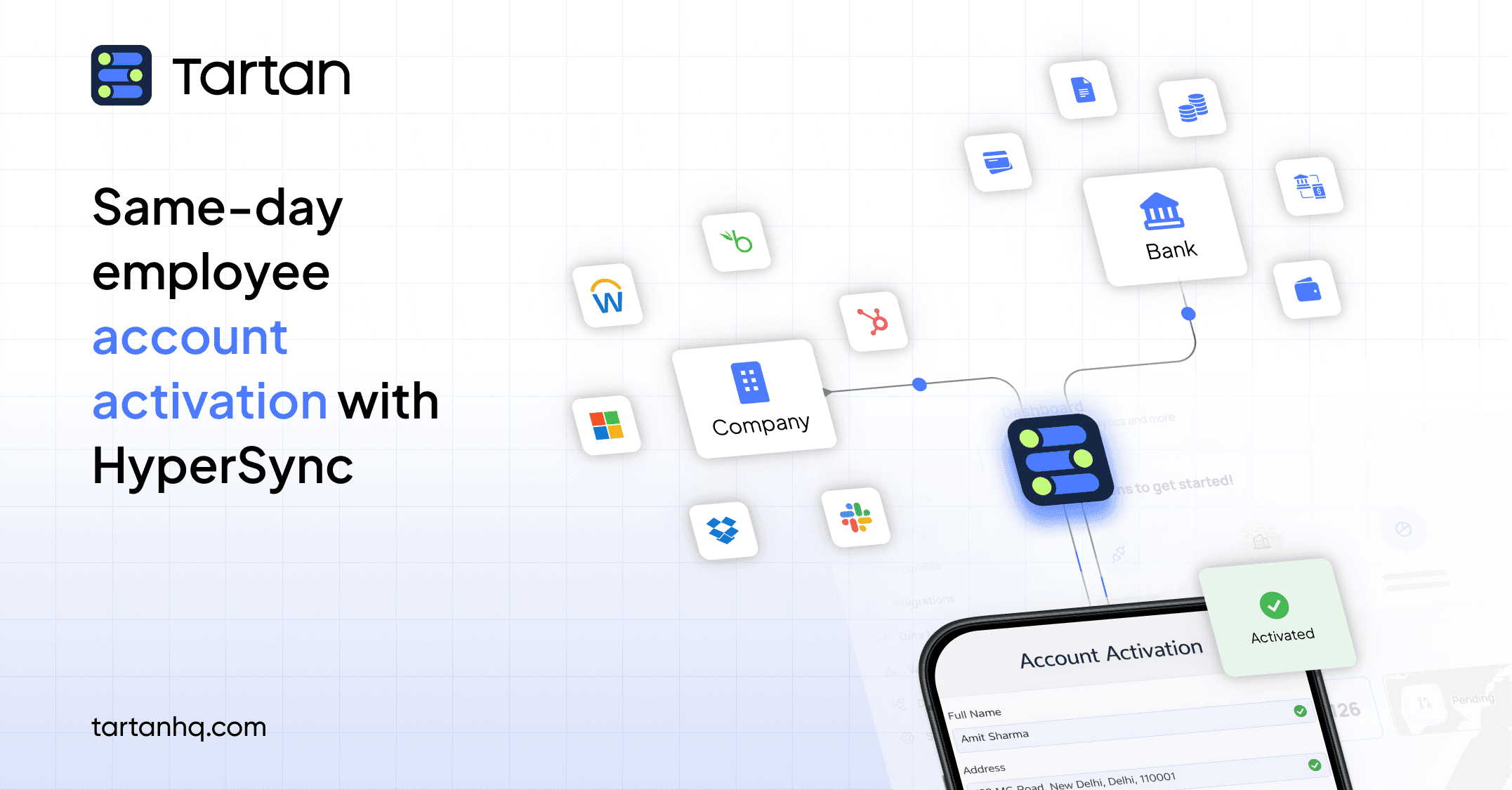
This is where Tartan's HyperSync comes in. HyperSync is built specifically to handle this - a consent-driven, real-time data sync layer that covers 80+ HRMS, CRM, and ERP platforms under one unified API. Banks using HyperSync don't need to worry about which HRMS a corporate client is on.
They connect once, and the data standardisation and platform compatibility is handled entirely on Tartan's side.
The deployment timeline reflects this simplicity. Banks have gone live with HRMS integrations in approximately two days using HyperSync - not because corners are being cut, but because there's genuinely very little for the bank's engineering team to do once the integration is in place.
What this means for the RM relationship
It's worth talking about what changes for the people on the ground - the relationship managers who own corporate salary account relationships - because this shift affects their day-to-day significantly.
Right now, a meaningful portion of an RM's time is spent on coordination work: following up on data submissions, chasing KYC documents, managing onboarding timelines, apologising for delays. None of that is value-adding work. It's friction management.
When onboarding is automated and data flows in real time, the RM's job shifts to something much more valuable. They go into every client conversation knowing the current state of the account - headcount, recent changes, credit utilisation across the employee base. They can have proactive conversations about product offerings instead of reactive conversations about operational issues.
The RM who can walk into a renewal meeting and say "we've seen 40 new joiners in your company over the past quarter, and here's what that means for your payroll account structure" is a fundamentally different partner than the one who's still chasing last month's data file. One of those RMs renews the contract easily.
The other is always at risk of being replaced by a competitor who makes it look effortless.
The competitive window is open - briefly
Corporate clients are getting better at evaluating their banking partners. Finance and HR teams at mid-market and large companies increasingly expect seamless, integrated experiences.
When one bank offers API-connected onboarding that gets accounts live in a day and another offers a spreadsheet workflow that takes two weeks, the choice becomes obvious - especially for companies that are growing fast and onboarding new employees every month.
The banks that move first on this will build a structural advantage that compounds over time. Faster onboarding means faster time to the first payroll cycle, which means earlier cross-sell conversations, which means deeper relationships before a competitor has even finished setting up the accounts.
The technology is available today. The HRMS connections are ready. The only thing left is for banks to decide whether they want to keep running a manual process that frustrates both their ops team and their corporate clients - or whether they want to run the same workflow in a day.
For most banks, the honest answer is: this should have happened already.