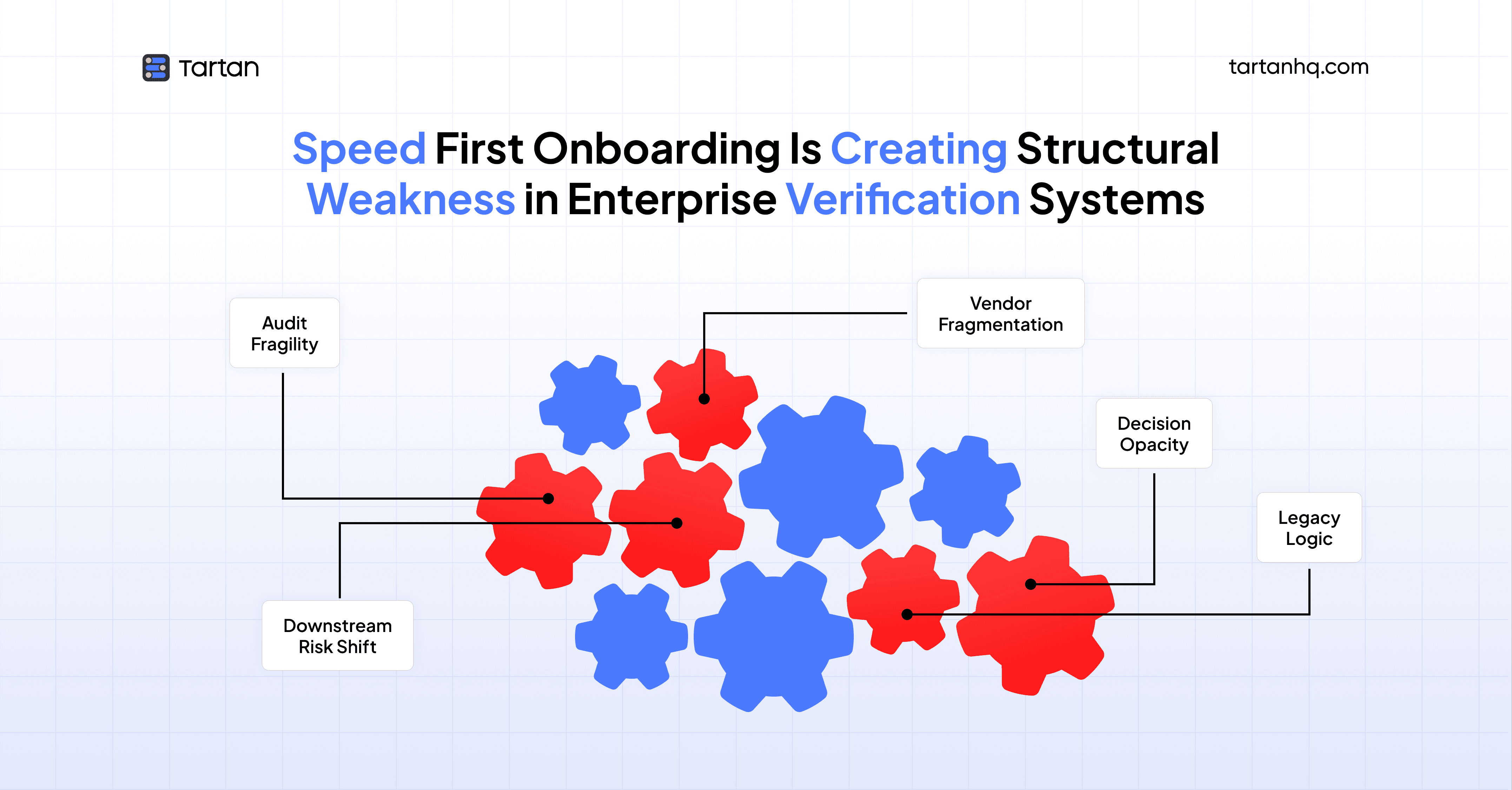
Enterprise onboarding has become drastically faster over the last few years.
Digital KYC, instant document uploads, API-driven checks, and automated decisioning have compressed what once took days into minutes. For many organizations, especially in BFSI, insurance, fintech, marketplaces, and regulated platforms, onboarding speed is now treated as a primary competitive advantage.
Enterprises that align onboarding speed with continuous verification, evidence integrity, and lifecycle governance are better positioned to absorb scale without accumulating hidden exposure.
But beneath these gains lies a quieter shift, one that many enterprises are only beginning to confront. In regulated, high-trust environments, faster onboarding has not always made systems stronger. In many cases, it has made them more fragile.
This fragility does not show up immediately. It emerges later - during audits, claims, disputes, fraud investigations, regulatory reviews, renewals, and exception handling. What appears as operational efficiency at entry often converts into structural risk downstream.
The unintended consequences emerge when speed is optimized in isolation, without re-architecting verification, control, and evidence systems to operate at the same pace.
Speed Became a Stand-In for Progress - Without Redesigning Trust
Most enterprises did not deliberately dilute onboarding controls or deprioritize trust. The shift toward faster onboarding was a response to real operational pressures.
They responded to real pressures - Digital competition, Customer drop-offs, Cost targets, Regulator-driven timelines, and Internal SLAs. Speed became a measurable, visible, and defensible KPI, one that showed immediate gains across conversion, cost efficiency, and time-to-revenue.
In most enterprises, faster onboarding was achieved by accelerating existing verification steps rather than redesigning how trust is established at scale. Checks that were originally built for sequential, manual workflows were automated and imitated with minimal change to their underlying logic.
The verification stack moved faster, but its assumptions remained unchanged.
As a result, onboarding decisions began to rely on outputs optimized for throughput rather than long-term defensibility. Verification decisions began to occur more quickly, but with less contextual grounding.
Automation removed manual friction, but it also removed the implicit documentation that required manual intervention. Over time, the system accumulated approvals that were operationally valid at the moment of entry but increasingly difficult to justify or defend later.
How Speed-First Optimization Introduced Structural Weakness
Verification logic was automated, not redefined: Rules were reused in automated flows without recalibrating confidence thresholds for real-time decisions.
Evidence was retained without decision traceability: Verification artifacts were stored, but the reasoning behind approvals was not explicitly captured.
Operational KPIs displaced governance indicators: Time-to-onboard, conversion rates, and SLA adherence metrics were tracked, while evidence quality and verification were not.
Risk materialized downstream, beyond onboarding ownership: Gaps introduced at entry appeared later during claims, disputes, renewals, or investigations
Faster Onboarding Compresses Verification Without Preserving Evidence
Traditional onboarding workflows were slow, but they produced defensible outcomes. Verification was performed sequentially, often manually.
Documents were examined, discrepancies were questioned, and exceptions were explicitly recorded. Even when judgments were subjective, they were traceable. The system retained not just what decision was made, but how and why it was reached.
Modern onboarding replaces this process with real-time verification APIs, automated rules, and binary outcomes. While this improves throughput, it changes what the system remembers. In many implementations, only the final result is stored. The underlying inputs, confidence signals, and decision logic are either discarded or distributed across multiple vendors that are not designed for later reconstruction.
This creates evidentiary gaps when decisions are reviewed after onboarding.
When onboarding decisions are revisited - during audits, regulatory reviews, claims disputes, fraud investigations, teams are often unable to reconstruct the original verification context. They can show that a check passed, but not why it was sufficient at the time
The faster the onboarding, the more likely it is that verification outputs are stored as static artifacts - PDFs, screenshots, separating it from the context. Speed reduces friction, but it also strips away defensibility unless evidence continuity is designed in.
This is not a tooling problem. It is an architectural one.
Where Evidence Breaks Down at Scale
Verification results lack underlying inputs: Outcomes are stored without the data and signals that informed them.
Decision logic is fragmented across vendors: Multiple vendors generate scores without a unified decision record.
Evidence cannot be reconstructed later: Context is scattered across logs and systems not designed for review.
Downstream teams re-verify by default: Claims and compliance functions distrust onboarding-era evidence.
Why This Weakens Enterprise Resilience
When verification evidence does not persist beyond onboarding, trust becomes time-bound rather than durable. Decisions that were acceptable at the point of entry lose their credibility over time.
Not because underlying risk has necessarily changed, but because the basis for those decisions cannot be defended. As a result, downstream functions are forced to compensate. Claims, compliance, risk, and investigations teams re-verify information, request additional documentation, or escalate cases manually.
These interventions occur at stages where timelines are tighter, customer impact is higher, and operational cost is significantly greater.
At scale, this shifts the enterprise from preventive control to reactive remediation. This erodes the value of automation itself. Faster onboarding continues to deliver volume, but not confidence.
Fragmented Verification Stacks Are a Side Effect of Speed
To move faster, enterprises often add vendors incrementally.
A new document OCR tool here. A fraud check there. A device signal layered on top. Each addition solves a narrow bottleneck in the funnel.
The result is a fragmented verification stack:
Multiple vendors validating overlapping attributes
Inconsistent confidence thresholds across journeys
Different interpretations of “verified” across teams
No shared evidence model
This fragmentation is not immediately visible during onboarding. It becomes visible when verification outputs are reused across journeys, scrutinized by regulators, or relied upon during high-stakes moments such as claims, disputes, investigations, or audits.
Why Speed-Driven Fragmentation Creates Structural Risk
Speed-driven onboarding improvements are typically implemented at the workflow level, not at the verification architecture level. Individual product or ops teams optimize their own funnels by adding vendors, parallelizing checks, or bypassing slow steps.
The result is that verification decisions become tightly bound to specific vendors, integrations, and journey-specific logic.
Verification decisions become tightly coupled to specific integrations and journey-specific logic. Identity may be considered verified one way during onboarding, another way during underwriting, and revalidated differently again during claims or audits.
When regulators, auditors, or internal risk teams later request an end-to-end explanation of how a customer or policy was verified, the enterprise cannot produce a single, coherent record. Evidence must be reconstructed from vendor dashboards, logs, archived files, and journey-specific databases, each reflecting different assumptions, timestamps, and confidence standards.
At that point, operational speed no longer matters; decisions slow down not because systems are inefficient, but because accountability was never centralized.
What This Creates at an Enterprise Level:
Verification outcomes are tied to journeys, not risk standards
Different teams rely on different vendors for the same trust decision
Confidence thresholds vary across onboarding, underwriting, and claims
Evidence is distributed across systems that were never designed to align
No single owner can explain how trust was established end-to-end
For CXOs, the issue is not vendor sprawl by itself. It is the absence of a unified verification and evidence framework capable of absorbing scale, vendor change, and regulatory scrutiny without disruption.
Faster onboarding did not create this fragmentation. But by rewarding speed without architectural discipline, it accelerated it and embedded it deeply into enterprise operations.
High-Trust Environments Cannot Rely on Speed Alone
In regulated, high-trust enterprises, onboarding speed is an operational constraint not the success metric. Banks, insurers, and other regulated platforms are required to stand behind onboarding decisions long after the transaction completes, across audits, claims, disputes, and regulatory review.
Unlike consumer workflows, where errors can often be corrected post-facto at low cost, failures here translate directly into financial exposure, compliance findings, and reputational risk. Speed therefore has to be designed alongside decision defensibility, not ahead of it.
What Trust Must Enable at Enterprise Scale:
Establishable: Decisions must be based on defined verification standards, not inferred from vendor outputs.
Refreshable: Trust must update as data changes, without repeated manual re-verification.
Explainable:Decisions must be reconstructible beyond scores and pass/fail flags.
Auditable: Evidence must support regulatory review without post-hoc reconstruction.
High-trust systems are judged not by how quickly they operate, but by how reliably their decisions withstand challenges. Those that align speed with trust properties - establishability, refreshability, explainability, and auditability build systems that scale without losing control.
The distinction is not between fast and slow onboarding, but between onboarding that clears entry and onboarding that remains defensible over time.
The Way Forward Is Not Slower Onboarding - It Is Smarter Verification
Digital onboarding has delivered measurable gains in conversion, cost efficiency, and scalability, and reversing that progress is neither realistic nor desirable. The issue lies elsewhere, speed has been increased without redefining how verification systems are expected to operate at scale.
Enterprises need verification architectures that:
Preserve evidence context, not just outcomes
Treat verification as a lifecycle, not an event
Unify signals across journeys and products
Support continuous refresh without repeated friction
Produce audit-ready narratives, not just scores
Verification in most enterprises was designed as a gatekeeping control: approve or reject access based on a single snapshot of available data. As onboarding shifted to real-time execution, this model was carried forward without modification.
As a result, systems became optimized for point-in-time clearance, not for sustaining accountability, evidence integrity, or defensibility over the lifecycle of the customer or policy.
What is required is a shift in design intent. Verification must be treated as a core enterprise capability, not a workflow constraint. Decision speed should define when outcomes are delivered, while verification architecture must independently ensure the depth, continuity, and defensibility of the underlying trust.
What Smarter Verification Requires at Enterprise Scale
Preserve decision context, not just outcomes: Verification systems must retain the inputs, confidence signals, and decision rationale behind approvals.
Design verification as a lifecycle capability: Trust must evolve with data changes, not reset at claims or renewal.
Standardize signals across journeys: Identity, address, and risk should follow shared enterprise standards.
Refresh verification based on change, not friction: Updates should trigger on data drift and risk thresholds, not manual rechecks.
Maintain audit-ready decision trails: Decisions must be explainable without post-facto reconstruction.
When verification is designed around these principles, speed stops being a trade-off. Onboarding can remain fast because decisions are supported by durable evidence and consistent governance. Downstream teams no longer need to re-verify by default.
Reframing Onboarding as the First Layer of Governance
When onboarding is framed as a hurdle to clear quickly, verification decisions are optimized for immediacy. Evidence is captured to fulfill entry requirements, not to support downstream accountability. The system appears efficient upfront but accumulates control gaps that surface only under pressure.
By contrast, when onboarding is treated as a governance layer, verification outputs are designed to travel forward with the customer or policy. Evidence is structured, signals are contextualized, and decisions are made with an assumption of future scrutiny.
This is where modern verification platforms begin to differentiate not by adding more checks, but by making verification outcomes durable, reusable, and explainable across the enterprise lifecycle. Platforms like HyperVerify are increasingly used in this context: not as onboarding accelerators alone, but as systems of record for verification evidence that downstream teams can rely on without repeated rework.
What Onboarding Governance Enables Downstream
Faster dispute resolution: Onboarding decisions can be traced and defended when disputes arise.
Stronger fraud controls: Verified onboarding signals improve downstream anomaly detection.
Audit-ready compliance: Reviews rely on system records, not manual reconstruction.
Consistent trust across teams: Risk, compliance, ops, and claims work from the same verification baseline.
When onboarding is optimized only for throughput, verification decisions are reduced to outcomes rather than explanations whereas onboarding systems designed with governance intent preserve context by default.
It allows enterprises to move quickly without losing the ability to answer basic questions later: what was verified, how it was verified, and why it was sufficient at the time.
Faster onboarding is not inherently risky. Speed becomes a liability only when it outpaces the systems responsible for verification governance and evidence integrity. Enterprises that make this shift early do not sacrifice speed. They reduce downstream friction, limit exception-driven operations, and operate with greater confidence under scrutiny.