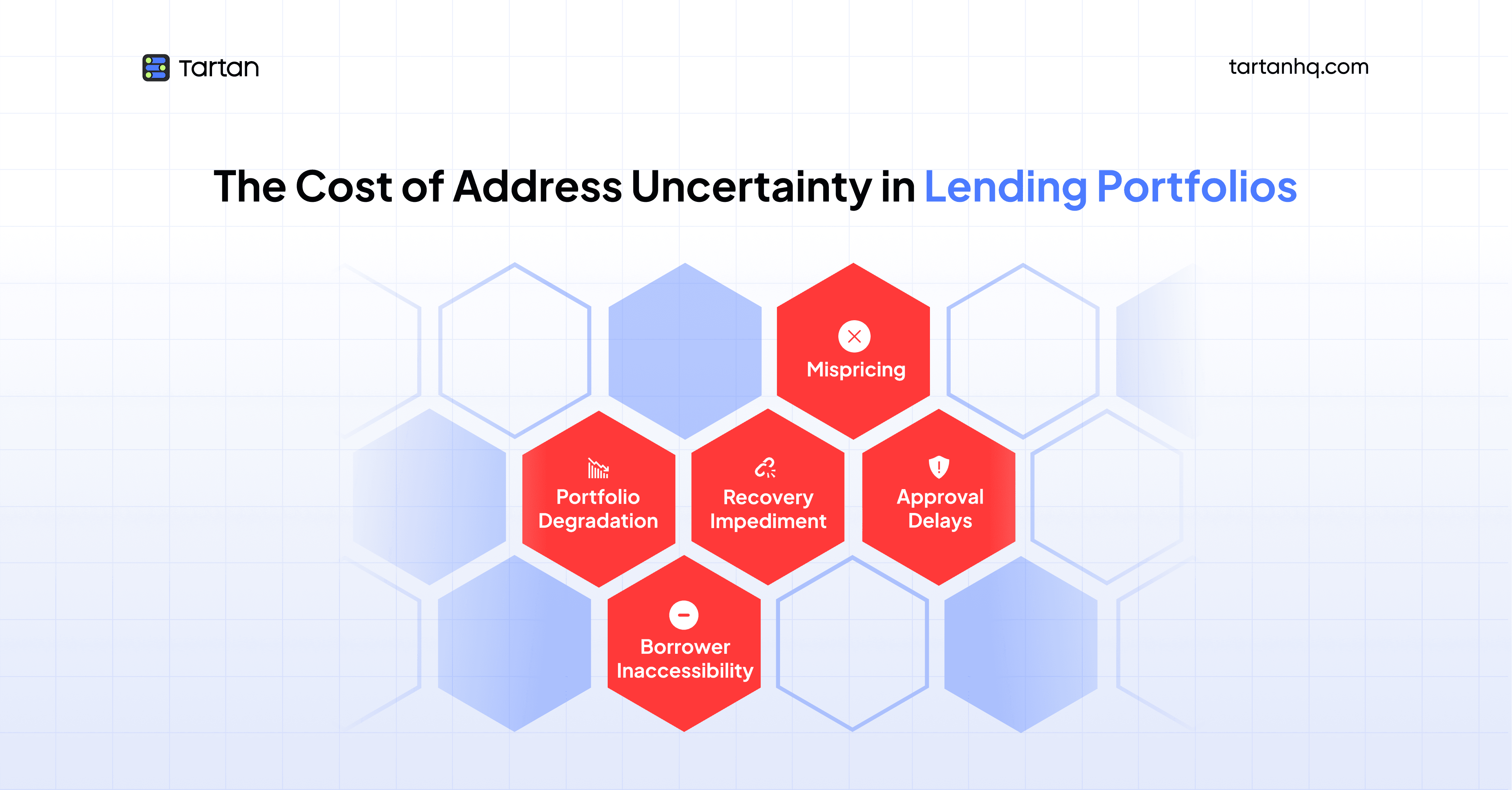
How bad address data impacts underwriting, collections, legal recovery, and regulator confidence.
Every lending institution believes it knows where its borrowers live.
Addresses are captured at onboarding. Documents are uploaded. Field checks are completed. Systems are marked verified.
And yet, as lending portfolios begin to season, familiar cracks appear.
Collection agents fail to locate borrowers.
Legal notices return undelivered.
Arbitration timelines stretch.
Regulators raise questions about borrower traceability and recovery fairness.
The root cause is rarely fraud alone. More often, it is address uncertainty.
Address uncertainty does not mean an address is fabricated. It means the lender lacks high confidence, operationally usable location data across the life of the loan. This distinction matters. Lending outcomes depend far less on whether an address exists on paper and far more on whether it can be relied upon when the portfolio is under stress.
Why address data behaves differently from other KYC attributes
Most KYC attributes behave predictably.
Identity data is binary.
Income data is periodic.
Credit data is historical.
Address data is none of these.
An address is contextual, temporal, and operational at the same time.
Contextual because formatting varies widely by region, housing type, landlord practices, and borrower literacy.
Temporal because borrowers move, sublet, and change living arrangements far more frequently than most credit models assume.
Operational because address quality directly determines whether people, courts, and systems can act.
Despite this, most lending stacks treat address verification as a one-time compliance task completed at onboarding and archived indefinitely.
This is where the cost begins.
Address uncertainty in underwriting
When location risk is mispriced at origination
Underwriting models are only as reliable as the inputs they trust. Address data plays a larger role here than most credit teams acknowledge.
At origination, address information feeds into multiple underwriting assumptions, often indirectly:
Geographic risk segmentation
Stability and tenure inference
Fraud risk signals
Field verification feasibility
Downstream recovery assumptions
When address confidence is weak, all of these assumptions become distorted.
The silent failure mode: false confidence
Most underwriting systems do not flag “uncertain” addresses. They flag only clear failures. This creates a dangerous middle zone where:
Addresses pass document checks but fail real-world traceability
PIN codes exist but do not map cleanly to habitation
Rental or informal housing is treated as permanent residence
Landmark-based addresses cannot be operationalized later
From a model’s perspective, these inputs appear acceptable. From a portfolio perspective, they embed latent risk.
Borrower stability is systematically overestimated
Address stability is frequently used as a proxy for borrower reliability, especially in thin-file or new-to-credit segments.
When verification relies on static proofs such as utility bills or rental agreements:
Short-term residences are misclassified as stable
Shared or temporary housing appears permanent
High-mobility borrowers are priced as low-risk
This leads to systematic mispricing, particularly among gig workers, migrant professionals, first-time urban borrowers, and informal sector earners.
The impact is rarely immediate default. It surfaces later as gradual slippage, which is harder to diagnose and correct.
Field verification bias creeps in
Many lenders still rely on physical verification or third-party agencies to compensate for weak address data.
At scale, this introduces bias rather than certainty. Agents optimize for speed, outcomes vary by vendor and geography, negative verifications are underreported due to incentive structures, and re-verification is rarely triggered unless something breaks.
This creates an illusion of coverage while leaving core uncertainty unresolved.
Underwriting models drift away from reality
Over time, models trained on noisy address data begin learning incorrect correlations. Certain regions appear riskier than they are. Certain borrower segments are over-penalized. Address-based exclusions emerge as blunt instruments.
The result is inefficiency at scale. High-quality borrowers are rejected. Marginal borrowers are over-approved. Portfolio performance deteriorates without a clear root cause.
Why the problem compounds as lenders scale
Address uncertainty grows faster than portfolio size.
As lending businesses expand:
New geographies dilute local knowledge
Digital sourcing reduces human intuition
Partner-led origination weakens data accountability
Speed pressures reduce verification depth
Ironically, the faster a lender grows, the more dangerous weak address data becomes. By the time issues surface, exposure is already large.
The uncomfortable truth for lending leaders
Most lenders do not have an address problem. They have an address confidence problem.
Confidence cannot be inferred from document presence alone. It must be earned, refreshed, and operationally validated across the loan lifecycle.
Address uncertainty in collections
When recovery efficiency collapses before default does
Collections is where address uncertainty stops being theoretical.
Underwriting can absorb ambiguity. Early performance metrics can look healthy. Collections cannot.
The moment an account turns delinquent, address data shifts from a compliance artifact to a physical dependency. This is where weak address confidence reveals its true cost.
Poor address data results in:
High “address not traceable” rates
Increased revisit cycles
Rising cost per successful contact
Agent fatigue and vendor churn
This is often misdiagnosed as a vendor execution issue. It is not. It is a data quality failure.
The cascading cost of address mismatch
Address uncertainty rarely exists in isolation. It compounds with other weak signals.
Borrowers move shortly after disbursal. Addresses valid at onboarding become obsolete within months. Shared accommodations rotate occupants frequently. Landmark-based descriptions break routing systems.
Each failed attempt increases friction. Visits are logged but outcomes remain inconclusive. Vendors request re-verification. Accounts roll forward without meaningful recovery.
From a portfolio view, this looks like delinquency progression. In reality, it is stalled execution.
Address uncertainty in legal recovery
When enforceability breaks down
Legal recovery is the final enforcement mechanism lenders rely on when operational recovery paths fail.
Address uncertainty breaks this mechanism.
When address data degrades, legal recovery does not merely slow. It becomes ineffective while continuing to incur cost. Notices fail. Jurisdiction is challenged. Timelines reset. Cases age without progress.
In stressed portfolios, address gaps are sometimes exploited. Borrowers relocate after disbursal. Technically valid but operationally unusable addresses are provided. Informal delivery routes avoid traceability.
Without ongoing address confidence, these patterns surface too late.
From data issue to credibility risk
Repeated enforcement failures have systemic consequences. Recovery assumptions weaken. Portfolio valuations suffer. External stakeholders lose confidence.
At this stage, address uncertainty stops being a data issue. It becomes a credibility issue.
Address uncertainty and regulator confidence
Regulators rarely ask whether address data is perfect. They ask whether it is defensible.
Address quality surfaces indirectly through questions about borrower traceability, contactability, recovery fairness, and audit readiness.
Repeated address-related failures rarely trigger immediate sanctions. Instead, they lead to:
More frequent audits
Deeper data requests
Tighter supervisory conditions
Reduced regulatory goodwill
For lenders seeking licenses, expansions, or new product approvals, this erosion matters.
Why traditional address verification breaks at scale
Address uncertainty persists not because verification is absent, but because verification is structurally misaligned with how borrowers live.
Most systems confirm that an address existed at onboarding. They do not assess whether it will remain reliable, reachable, or enforceable over time.
Traditional frameworks were built to satisfy KYC requirements, produce documentary proof, and close onboarding quickly. They were never designed to support ongoing traceability, collections efficiency, legal enforceability, or regulatory defensibility.
Static verification assumes static borrowers. That assumption no longer holds.
What digital-first address intelligence looks like
Fixing address uncertainty does not start with collecting better documents. It starts with changing how address data is incorporated and used from onboarding onward.
High-performing lenders treat addresses as living signals, not static attributes.
Instead of relying on a single proof or visit, modern systems triangulate address confidence using multiple signals such as utility and telecom data, financial and transactional footprints, and delivery or service interaction history.
Confidence becomes time-aware, graded, and refreshable. Decay is visible. Risk is measurable.
Scaling address confidence with TartanHQ HyperVerify
For lending enterprises, the challenge is not recognizing the problem. It is solving it without slowing growth.
Address confidence must scale across geographies, borrower types, and products while remaining compliant, auditable, and cost-effective. This requires infrastructure, not manual process fixes.
HyperVerify is built on this premise. Address verification is not a standalone check. It is part of a unified, API-driven verification layer that lending systems can query whenever address confidence is required.
Instead of repeated documents or physical visits, HyperVerify enables address confidence through digital, consented data sources. This includes validation using utility and telecom signals, cross-verification through alternate data footprints, normalized address formats, source-backed audit trails, and time-stamped outcomes that support lifecycle use.
With HyperVerify, lenders can reassess address confidence early in delinquency, flag accounts where enforcement risk is rising, and defend recovery actions with evidence-backed records.
In modern lending, address data is no longer a background KYC artifact. It is a core operational dependency.
The cost of address uncertainty does not surface at onboarding. It appears months later as underwriting drift, stalled collections, failed legal enforcement, and regulatory friction. Lenders that continue to treat address verification as a one-time task will keep paying this cost downstream, where fixes are slow and expensive.
The only sustainable alternative is to design address verification as ongoing infrastructure: verifiable, time-aware, and usable across the full loan lifecycle.