Most embedded finance strategies follow a familiar playbook: identify a consumer platform with high engagement and embed financial products at points of maximum intent. Buy-now-pay-later at checkout. Insurance when booking travel. Investment products when you receive cashback.
This approach has generated billions in revenue and created entire fintech categories. But it's fundamentally opportunistic - catching consumers at transaction moments and hoping the embedded product resonates.
There's a different model, hiding in plain sight, that almost every salaried person interacts with daily: the employer system.
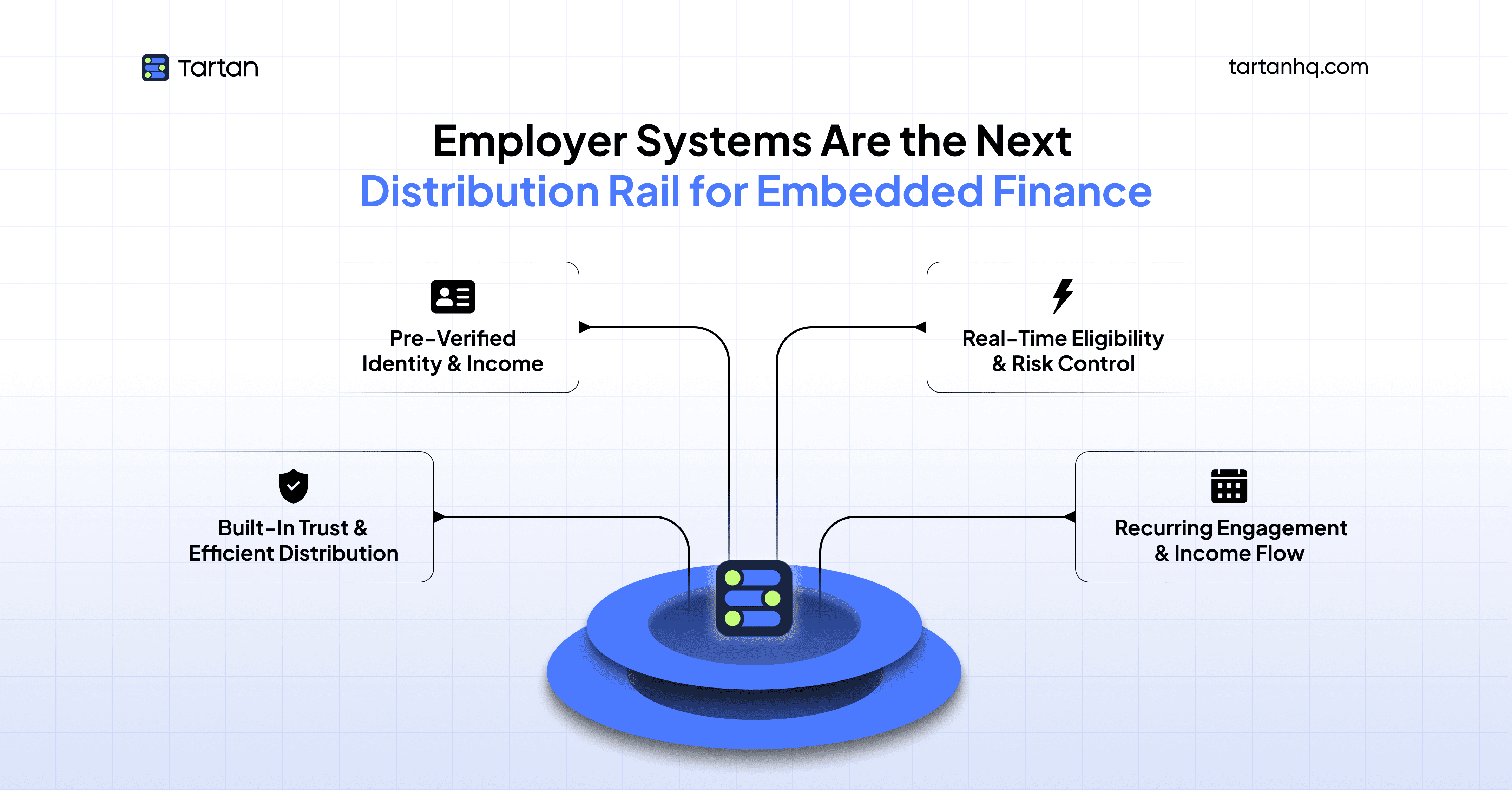
Employer systems - HRMS platforms, workforce management tools, internal portals, payroll systems - possess unique characteristics making them structurally superior as embedded finance distribution infrastructure. Yet they remain dramatically underutilized, treated as back-office systems rather than the powerful distribution rails they could become.
Why Employer Systems Are Structurally Different
High-Trust Environments
When employees log into their company's HRMS, they're in a trusted context - their employer's official system for pay slips, leave applications, and benefits. Financial products offered here carry implicit endorsement. This trust dramatically reduces acquisition friction. Conversion rates vastly exceed cold digital acquisition because the trust foundation is already established.
High-Frequency Login Surfaces
Consumer apps struggle with declining engagement. Employees, by contrast, log into employer systems with remarkable regularity - checking pay slips monthly, submitting expenses, reviewing balances. This creates recurring touchpoints for financial product discovery. Frequency compounds over employment tenure - hundreds of touchpoints across three years.
Identity-Verified by Default
KYC requirements create significant onboarding friction. Employer systems contain pre-verified identity data validated during employment onboarding. Financial products inherit this verified identity, eliminating redundant KYC. More importantly, the employer relationship itself serves as an identity anchor - an employee at a verified company represents a fundamentally different risk profile than an anonymous digital applicant.
Tied to Income Continuity
Employer systems contain real-time employment and compensation data - definitive answers to underwriting's most important questions: Is this person currently employed? What's their exact current salary? How long in this role? This creates fundamentally different economics: salary advances with payroll deduction have near-zero default risk, verified employee loans warrant better rates, insurance underwriting on actual employment data is more accurate.
The Current State: Fragmented and Underutilized
Despite structural advantages, employer systems today are dramatically underutilized as financial distribution infrastructure.
Salary advances are offered by standalone apps requiring separate account creation, bank linking, and manual income verification - despite employer payroll systems containing definitive income data and enabling automated deduction.
Insurance products are sold through separate platforms. Employees re-enter employment details, salary information, and dependent data already existing in HRIS. Enrollment stretches into days of document collection.
Savings and investment products operate without employment context. Employees manually set up contributions without understanding affordable allocation based on actual take-home after existing deductions.
Credit products require employees to prove income through documents when applying - despite being employed at a verified company that could instantly confirm these facts through API.
Eligibility checks happen manually. Employees aren't shown pre-qualified offers based on actual salary grade, tenure, and status. They apply generically and wait for approval or rejection.
The result: fragmented experiences with disconnected providers, repeated submission of identical employment information, friction at every touchpoint, and missed relevant products because they're not surfaced in context.
The API-Enabled Vision: Employer Systems as Financial Rails
When employer systems become API-accessible through unified integration layers, they transform from isolated HR databases into powerful financial distribution infrastructure.
This transformation enables several specific capabilities:
Context-Aware Financial Offers
Financial products can be personalized based on the employee's actual employment context:
Role-based offers: A software engineer at a tech company sees pre-approved home loan offers because their designation and salary band indicate affordability. A sales executive sees vehicle finance options because their role involves travel. A senior manager qualifies for wealth management products based on compensation tier.
Tenure-aware products: New employees (first 90 days) receive salary advance products designed for relocation and settling-in expenses. Employees crossing one year of tenure become eligible for longer-term credit products requiring employment stability. Long-tenured employees (3+ years) see loyalty-based insurance products with preferential terms.
Income band-specific offerings: Employees in different compensation ranges see appropriate product sets. Someone earning ₹30,000 monthly sees micro-savings products and small-ticket insurance. Someone earning ₹2,00,000 monthly sees home loans, investment products, and comprehensive insurance coverage.
This context awareness eliminates irrelevant offers and maximizes conversion by showing employees only the products that actually match their circumstances.
Dynamic Eligibility Checks
Rather than static eligibility rules applied at application time, API-integrated employer systems enable real-time eligibility verification:
Real-time employment validation: When an employee applies for a personal loan, the lender instantly verifies current employment status through the employer's HRIS - not through a submitted employment letter that may be weeks old, but through a live API call returning current status.
Automated income verification: Salary advances can calculate maximum eligible amounts based on actual monthly net pay extracted directly from payroll systems. No uploaded salary slips. No manual verification. Instant eligibility determination based on authoritative data.
Continuous eligibility monitoring: As employee circumstances change - salary revisions, promotions, status changes - financial product eligibility automatically adjusts. Credit limits increase when salaries rise. Insurance sum insured updates when employees move to higher compensation bands. Products become available the moment eligibility criteria are met.
Seamless Onboarding with Zero Document Uploads
The most transformative change is eliminating document-based onboarding entirely:
Employees enrolling in financial products through employer-integrated platforms experience:
Pre-filled applications with data from HRIS (name, PAN, date of birth, address, contact details)
Instant employment confirmation from HR systems
No uploaded documents required
Approval in minutes instead of days
The friction that causes 40-60% drop-off in traditional financial product applications simply disappears. Employees go from interest to enrolled in single-digit minutes.
Embedded Insurance, Credit, Savings, and Wealth
Multiple financial product categories can embed simultaneously into the employment context:
Insurance: Group health insurance enrollment happens as part of employee onboarding. Dependent additions trigger automatically when employees update family details in HRMS. Sum insured adjusts when salary bands change. Premiums deduct from payroll seamlessly.
Credit: Personal loans, salary advances, and credit cards are offered with instant approval based on verified employment data. EMIs deduct directly from salary before employees receive take-home pay - eliminating bounce risk and reducing default rates to near-zero.
Savings: Retirement savings (NPS), tax-saving investments (ELSS), and recurring deposits are configured with automatic monthly deductions from payroll. Employees set their savings rate once; contributions happen automatically without manual transfers.
Wealth management: High-income employees receive personalized investment advisory and wealth products. Asset allocation recommendations reflect actual disposable income after employment-linked commitments (EMIs, insurance, savings).
The Employer System as Financial Infrastructure
When these capabilities combine, the employer system fundamentally changes function. It's no longer just a payroll processor or HR database. It becomes:
An Identity Anchor
The employer relationship serves as a verified identity foundation for all financial interactions. Rather than each financial service provider running separate KYC processes, the employer's pre-verified identity data becomes the trust anchor. Financial products offered through this channel inherit this verification, reducing fraud and improving user experience.
An Eligibility Engine
Real-time access to employment, income, and status data turns the employer system into a continuous eligibility engine. Instead of employees wondering if they qualify for products, the platform proactively surfaces products they're eligible for based on current circumstances. Eligibility changes automatically as employment contexts evolve - no manual re-application required.
A Distribution Surface
The employee portal becomes a financial services distribution channel. Rather than employees seeking out financial products through search or advertising, relevant products surface in context when they interact with employment-related systems. Checking a payslip? See salary advance options. Reviewing benefits? See insurance products. Planning taxes? See investment options.
This passive discovery converts far higher than active acquisition. Employees don't feel marketed to - they feel served.
How Unified APIs Enable This Vision
The technical challenge is integration fragmentation. India's enterprise HRMS landscape spans 100+ platforms with different API structures, data models, authentication methods, and payroll mechanisms.
A fintech wanting to offer products through employer channels faces an impossible choice: build custom integrations with every HRIS (economically unviable) or limit distribution to few integrated platforms (drastically restricting market).
Unified API platforms like HyperSync solve this by providing a single integration point normalizing data access across 100+ systems.
For financial service providers: Standardised access (one API, immediate connectivity), Consent-driven data exchange (every access consent-gated and logged), Scalable integration (adding corporate clients doesn't require new technical work).
This transforms embedded finance economics. The marginal cost of adding distribution capacity through employer channels approaches zero - because technical integration is complete. Each new corporate partnership is purely commercial, not an engineering project.
From Opportunistic Placement to Employment-Aware Infrastructure
Traditional embedded finance is opportunistic: find moments of transaction intent and embed relevant financial products. This works - buy-now-pay-later at e-commerce checkout has demonstrated massive demand.
But it's limited by transaction frequency. Most people buy shoes occasionally, book travel a few times yearly, order food delivery sporadically. Transaction-based embedded finance is constrained by the underlying platform's usage patterns.
Employment-based embedded finance is fundamentally different. It's not opportunistic - it's structural. The employment relationship creates continuous context for financial needs:
Income arrives monthly, creating rhythm for savings and investment products
Career progression generates changing financial needs (first home, vehicle upgrade, children's education)
Employment stability underpins creditworthiness for multi-year products
Life events often tied to career stages (marriage after establishing career, children after financial stability)
Financial products embedded in employment context aren't catching consumers at random transaction moments. They're aligning with the underlying financial rhythm of salaried life.
This is the shift from embedded finance as opportunistic placement to embedded finance as employment-aware infrastructure.
The Strategic Implication
For financial service providers, this represents category-defining distribution:
Fintechs acquire customers at a fraction of typical CAC by distributing through employer channels. Pre-verified identity, consented employment data, and trusted context create conversion rates multiples higher than digital acquisition.
Insurers solve group insurance enrollment - seamless onboarding integrated with employee lifecycle, automatic premium reconciliation through payroll, real-time roster management eliminating ghost premiums.
Banks facing rising digital acquisition costs build proprietary B2B2E networks - acquiring salaried customers through corporate partnerships at dramatically lower cost with better risk profiles.
Wealth platforms distribute investment products through automated payroll-linked contributions - overcoming the "set it and forget it" challenge plaguing direct-to-consumer products.
For employers, this creates genuine employee value. Benefits and financial services become seamlessly accessible rather than requiring employees to seek providers, complete redundant applications, and manage disconnected accounts.
Conclusion
The opportunity in embedded finance isn't limited to opportunistically inserting financial products into consumer platforms at moments of transaction intent.
The deeper opportunity is embedding financial services into the verified employment ecosystems that 100+ million salaried Indians interact with daily - systems that are high-trust, high-frequency, identity-verified, and tied to income continuity.
When employer systems evolve from isolated HR databases into API-accessible financial infrastructure, they become the most powerful distribution rails in embedded finance. Not because of transaction volume, but because of structural advantages no consumer platform can replicate: verified identity, real-time income data, trusted context, and alignment with the fundamental financial rhythm of salaried life.
HyperSync provides the unified API layer making this transformation possible - standardised access across fragmented HRMS providers, consent-driven data exchange, and scalable integration enabling any fintech or insurer to distribute through employer channels without custom integration work.
The evolution from opportunistic embedded finance to employment-aware financial infrastructure isn't just a better distribution model.
It's the foundation for how the next 100 million salaried Indians will access financial services.