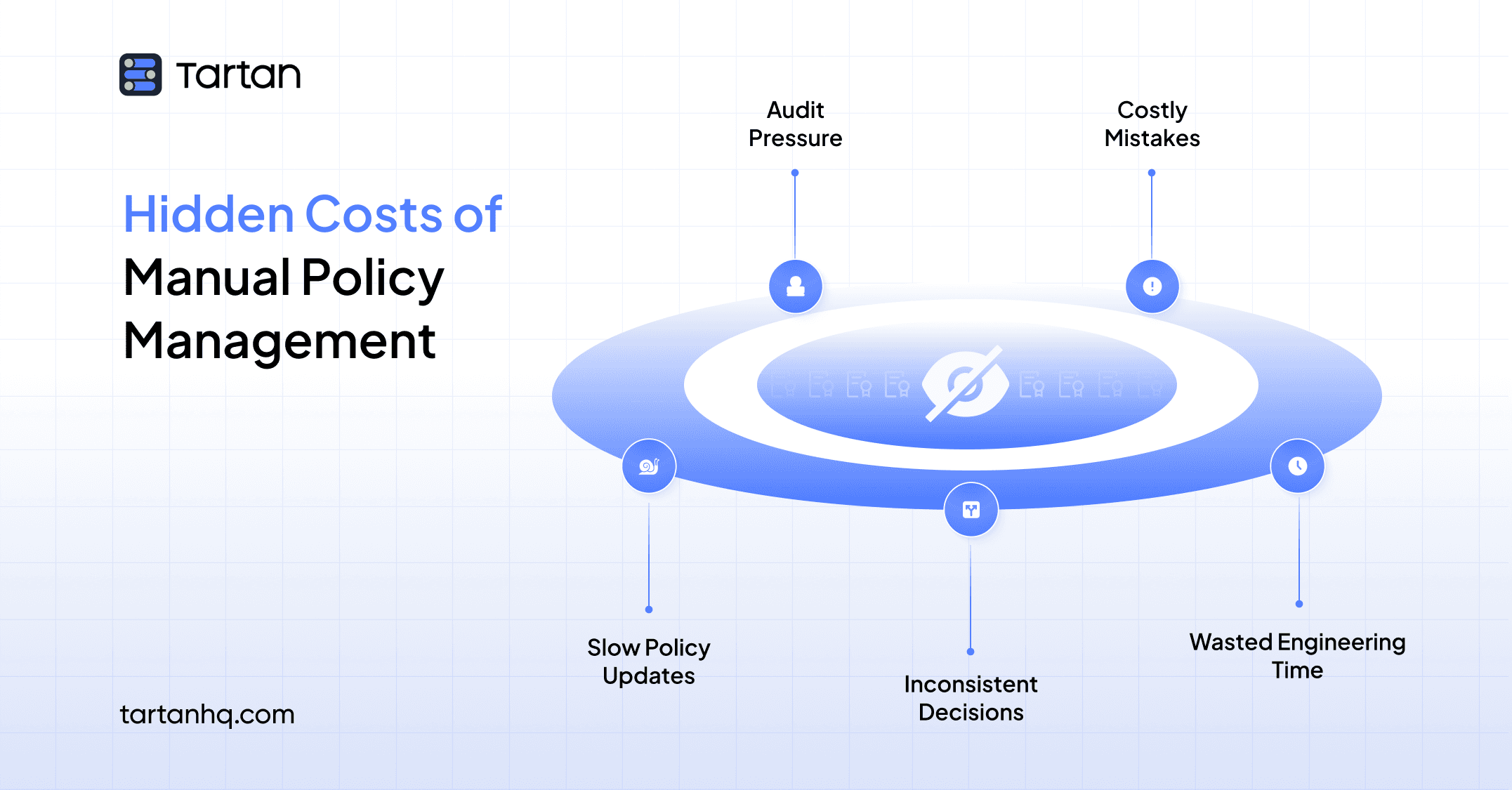
Ask a CFO at any mid-to-large BFSI institution what policy management costs them annually and you will get a blank look. Not because it doesn't cost anything - it costs a great deal - but because the costs are scattered across budgets in ways that make them nearly impossible to see as a single number.
It's in the engineering team's sprint velocity. It's in the compliance team's overtime. It's in the claims that got paid wrong, the loans that got priced incorrectly, the regulatory findings that required expensive remediation. It's in the senior person who spent three days preparing for an audit that a well-governed system could have handled in three hours.
Manual policy management is one of the most expensive invisible line items in financial services. The reason it stays invisible is that nobody ever writes a cheque for it. The cost accumulates in lost time, avoidable errors, and risk exposure - and it only becomes legible in the aftermath of something going wrong.
This article is an attempt to make it legible before that happens.
The engineering cost: sprints that shouldn't exist
Start with the cost that is most directly measurable but least often attributed correctly: engineering time spent on policy-to-rule conversion.
In most BFSI institutions, when a policy changes - a new underwriting criterion, a revised claims clause, an updated KYC requirement - the change has to travel from a Word document or PDF into a live rule engine.
That translation is done by engineers, or by business analysts working closely with engineers. It involves reading the policy document, interpreting the logic, mapping it to the rule engine's schema, writing the code, and testing it against edge cases.
For a meaningful policy change, this process reliably consumes a significant portion of a sprint. For a complex policy with multiple interdependent rules, it can consume an entire sprint - two weeks of engineering capacity - on work that is essentially transcription.
The engineer is not building anything new. They are manually converting a document into code that a system can execute.
Now multiply that by the number of policy changes your institution makes in a year. For a mid-sized insurer or NBFC, that number is rarely below 50. For a large bank operating across products, geographies, and regulatory frameworks, it can run into the hundreds.
The engineering cost alone - before you count errors, rework, and testing - is substantial. It is also entirely invisible in the product roadmap, because it shows up as reduced capacity for feature development rather than as a discrete cost.
90% of manual policy-to-rule conversion effort is eliminable | 35% reduction in manual review time with AI-assisted policy querying | 50% faster rule deployment when policy conversion is automated |
The error cost: when the translation goes wrong
Manual policy-to-rule conversion doesn't just cost time. It introduces errors - and in financial services, errors in rule engines are not minor inconveniences. They are operational and financial risks.
The most common failure mode is not dramatic.
It's a subtle misinterpretation - an engineer reading a policy clause and implementing a slightly different version of what was intended.
The clause says "borrowers with tenure of less than 12 months are ineligible."
The implementation checks for tenure of 12 months or less. Off by one condition.
The business never notices until a QA run three months later surfaces a pattern of incorrectly declined applications.
By then, the damage is done. Some number of eligible customers have been turned away. Some have gone to a competitor. The remediation involves identifying affected cases, contacting customers, reprocessing applications - an operational burden that is entirely avoidable and entirely attributable to the manual translation step.
More serious errors show up in claims processing. An insurer modifies the exclusion clause on a health product.
The policy document is updated.
The rule engine is updated - mostly correctly, but with one exception condition missed.
For several months, some claims that should have been excluded are being paid out. The financial exposure compounds quietly until a routine audit surfaces it. The cost is not just the erroneous payouts. It is the audit finding, the regulatory notification, the board-level review, and the reputational exposure of explaining to an external party that your rule engine didn't match your stated policy.
The frontline cost: decisions made without reliable guidance
Step away from the engineering floor and into the operations centre, and the cost of manual policy management looks different but is no less real.
A loan processing officer handles fifty applications a day. Each application may touch multiple policies - product eligibility, income verification requirements, bureau score thresholds, documentation norms. The officer does not have time to consult the full policy document for each case. In practice, they work from training they received at onboarding, supplemented by whatever guidance their manager has passed along informally.
When a policy changes, the updated training rarely reaches everyone simultaneously. There's a gap - sometimes days, sometimes weeks - during which different officers are applying different versions of the same policy. The applications processed during that gap are inconsistent. Some are correctly handled under the new policy. Some are incorrectly handled under the old one. The inconsistency is rarely caught in real time. It surfaces later, in quality reviews or customer complaints.
The cost here is measured in rework, in customer experience failures, and in the management bandwidth required to investigate and correct inconsistent decisions. It is also measured in something harder to quantify: the erosion of confidence among frontline staff who know that the policy environment is unclear and that they are operating on uncertain ground.
The audit cost: preparing for questions you should already be able to answer
Regulatory audits are expensive under any circumstances. They are significantly more expensive when the organisation being audited has to reconstruct its policy environment during the audit itself.
A well-run audit preparation for a mid-sized BFSI institution typically involves a dedicated team working for several weeks - pulling documents, reconciling versions, verifying that current practice matches stated policy, preparing evidence packages. Much of this work exists not because the institution is non-compliant, but because the compliance posture is not continuously maintained in a form that is audit-ready.
The difference between an organisation that maintains a structured, version-controlled policy repository and one that manages policies in shared drives and email threads is not just a matter of tidiness.
It is a direct difference in audit preparation cost - typically measured in person-weeks and in the risk of findings that stem not from substantive non-compliance but from documentation gaps.
IRDAI, RBI, and SEBI are all increasing their expectations around governance and control documentation.
The cost of being unprepared is rising. Regulatory penalties in India's financial sector have grown consistently over the past three years, and the trend is not reversing. The organisations that have their policy governance in order will face these audits with confidence. The ones that don't will spend the money on remediation that they could have spent on building the right infrastructure upfront.
The deployment lag cost: the gap between decision and execution
There is a less-discussed cost that lives in the time between a policy decision being made and that decision being live in production systems. In most BFSI organisations, that gap is measured in weeks. Sometimes months.
The business decides to tighten underwriting criteria in response to rising delinquencies in a particular segment. The credit policy is updated. The updated policy goes through legal review, compliance sign-off, and product approval.
Then it enters the engineering queue, where it competes with feature development, bug fixes, and other policy changes. It gets deployed in the next sprint - which may be two weeks away. It gets tested in staging. It goes live.
During that entire window, the old policy is live. Applications are being approved under criteria that the business has already decided are too loose. The exposure from applications processed during the deployment lag is real, quantifiable, and entirely a product of the manual process.
Faster policy deployment is not just an efficiency gain. It is a risk management capability. The ability to move from policy decision to live rule in hours rather than weeks is a meaningful operational advantage - and it is not achievable through manual processes, no matter how well-run.
Adding it up
The total cost of manual policy management in a mid-to-large BFSI institution is not a number that most organisations have ever calculated. If they did, it would likely be uncomfortable.
Engineering sprints consumed by policy translation. Errors in rule engines that generate financial exposure and rework. Frontline inconsistency that drives customer complaints and quality remediation. Audit preparation that requires weeks of dedicated resource.
Deployment lags that extend risk exposure on decisions that have already been made. Institutional knowledge concentrated in individuals who will eventually leave.
Each of these is a cost. None of them appear on a balance sheet as "policy management expense." But all of them are real, all of them are recurring, and all of them are disproportionately large relative to what it would cost to fix the underlying infrastructure problem.
The organisations that recognise this and act on it now will not just run more efficiently. They will be meaningfully better positioned as regulatory demands increase and as the pace of product and policy change accelerates.
The ones that continue treating policy management as an administrative function rather than an operational risk will keep paying - just in ways that never quite add up to a single alarming number.
Until they do.