Why Your Rule Engine Is Only as Good as the Policy Behind It
In enterprise systems, policies are not guidance documents. They are operational controls. They define how credit is approved, how risk is assessed, how eligibility is enforced, how pricing is calculated, and how compliance boundaries are maintained.
Most organizations invest heavily in rule engines and decisioning platforms to automate these controls. Yet many still experience inconsistent decisions, slow policy changes, audit friction, and unexpected risk exposure.
The reason is rarely the rule engine itself.
It is the way policies are translated, updated, and governed.
How Policy Logic Actually Reaches Production
Most enterprises still rely on a manual process to convert policy documentation into executable logic. This process introduces structural risk that compounds over time and becomes increasingly difficult to detect or unwind.
Policy documents are written for human interpretation. They are often drafted by legal, compliance, or risk teams using narrative language designed to capture intent rather than execution. Clauses reference other sections. Conditions are layered with exceptions. Ambiguity is intentionally preserved to allow for judgment.
Rule engines, by contrast, require deterministic logic. Every condition must be explicit. Every exception must be encoded. Every dependency must be resolved. The act of converting a policy into rules is not transcription. It is interpretation.
That interpretation is almost always performed manually, typically by a combination of business analysts and engineers. Each translation step introduces judgment calls that are not visible in the final system. Over time, this creates divergence between what the policy says and what the system actually enforces.
In most enterprises, the policy lifecycle looks like this:
Policies are authored by risk, compliance, legal, or business teams in narrative form
Documents live as PDFs, Word files, or internal wikis
Business analysts or engineers interpret these documents
Logic is manually encoded into rule engines or application code
Changes are tested informally and deployed
This process works at a small scale. It fails quietly at enterprise scale.
The problem is not documentation.
The problem is manual interpretation as an operational dependency.
The Downstream Impact of Policy-to-Code Translation Errors
1. Ambiguity Becomes Execution Risk
Policies are intentionally written with nuance. They include:
Conditional language
Exceptions and overrides
Cross-referenced clauses
Context-dependent interpretation
When translated manually into rules:
Ambiguity is resolved inconsistently across teams
Edge cases are simplified or ignored
Implicit assumptions are introduced without traceability
The resulting logic may be syntactically correct but semantically misaligned with policy intent.
2. Errors Do Not Fail Loudly
Policy translation errors rarely break systems. Instead, they:
Approve or reject borderline cases incorrectly
Apply thresholds inconsistently
Enforce outdated or partial rules
Because decisions still occur, these failures remain hidden until surfaced by audits, escalations, or financial leakage.
Version Control Is the Silent Failure Mode
Policy change is constant. Regulatory updates, risk recalibration, product expansion, and market conditions all drive frequent revisions.
However, most organizations lack a structured way to manage policy versions across documentation and execution.
This creates three systemic issues.
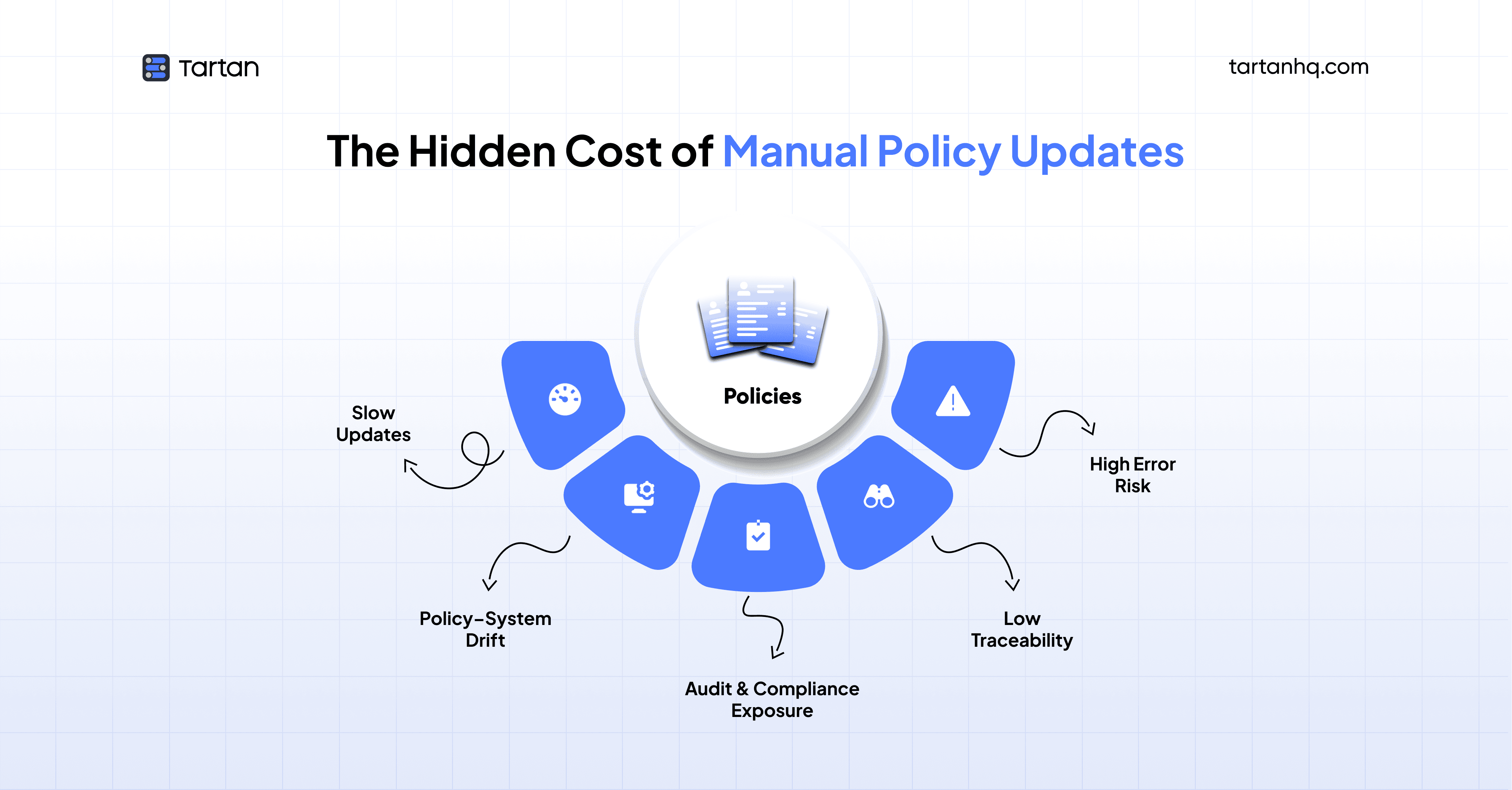
Lack of Traceability
Teams struggle to answer:
Which version of the policy is live?
What changed from the previous version?
Which systems consume this logic?
Who approved the change?
Partial or Inconsistent Updates
When updates are manual:
Some systems are updated, others are missed
Changes are applied differently across regions or products
Rollbacks are risky and slow
Audit and Compliance Exposure
During audits, organizations are forced to reconstruct history from:
Documents
Code commits
Emails and tickets
This increases audit timelines, raises regulator scrutiny, and reduces confidence even when intent was correct.
The Operational Cost Enterprises Underestimate
Manual policy updates create friction across the organization.
For Business and Risk Teams
Policy changes depend on engineering availability, slowing the ability to respond quickly to market or compliance needs.
Iteration cycles stretch from days to weeks, and repeated delays reduce confidence that rules are executed as intended.
For Engineering Teams
Engineers must interpret policy language they did not author, introducing risk from unclear or ambiguous intent.
Testing focuses on code behavior rather than policy correctness, leaving potential gaps in enforcement unnoticed.
For the Business
Time to market slows as every change requires cross-team coordination and validation.
Regulatory response becomes reactive, and risk exposure accumulates quietly until it surfaces in audits or exceptions.
This is not a tooling problem. It is an infrastructure gap.
Tools like rule engines, workflow platforms, and automation frameworks work as designed, but they cannot compensate for the absence of a structured, auditable, and machine-readable policy layer.
When policy updates rely on manual interpretation, cross-team dependencies, and disconnected documentation, the organization inherits operational risk, delays, and inconsistencies that no tool alone can fix.
Why Policy Needs to Be Treated as Infrastructure
In modern enterprises, policies are production inputs. Treating policy as infrastructure - versioned, executable, traceable, and continuously validated - enables decisioning systems to enforce rules accurately and reliably at scale.
Thus, the policy deserves the same rigor as code.
This requires:
Structured, machine-readable policy definitions
Versioning with clear change history
Approval workflows aligned with governance needs
Continuous validation against execution logic
Without this, rule engines operate on fragile foundations.
Reducing 90 Percent of Manual Effort Through Automation
Organizations are increasingly moving toward automated policy systems that:
Ingest narrative policy documents
Convert them into structured, executable logic
Maintain version control and traceability
Validate changes before deployment
This removes the manual interpretation layer that causes most errors and delays.
Platforms like Tartan’s Policy OS are designed around this shift, treating policy as a first-class system artifact rather than static documentation.
The result is not just efficiency.
It is control, speed, and confidence at scale.
What Enterprise Leaders Should Take Away
For product, platform, risk, and compliance leaders, the question is no longer whether policies should be automated.
The real question is whether manual policy translation is an acceptable operational risk.
Organizations that modernize policy management:
Ship changes faster without increasing risk
Reduce audit and compliance friction
Decouple policy updates from engineering bottlenecks
Maintain alignment between intent and execution
Those that do not continue to absorb a hidden cost that compounds with scale.
Closing Thought
If your rule engine executes logic that was manually interpreted from documents, the weakest part of your decisioning stack is not technology.
It is the process. And that process determines whether your systems enforce policy accurately or merely approximate it.