Every collections manager knows the frustration.
Your team dials a number from the CRM, and it rings through to a stranger who's never heard of your borrower. Your field agent travels 40 kilometers to an address on file, only to find the customer moved out eight months ago. Your SMS bounce rate hovers above 50%, and your recovery velocity keeps declining despite hiring more agents.
This isn't a people problem. It's a data problem.
In India's hyper-mobile economy, customer contact information decays faster than milk in summer. People change phone numbers when they switch cities for jobs. They update delivery addresses on Swiggy and Amazon but never think to inform their lender. They move from rented flats to new localities, leaving behind nothing but confused neighbors and wasted collection efforts.
The result?
Collections teams are fighting battles with outdated weapons. And it's costing banks and NBFCs far more than they realize.
The Real Cost of Contact Failure
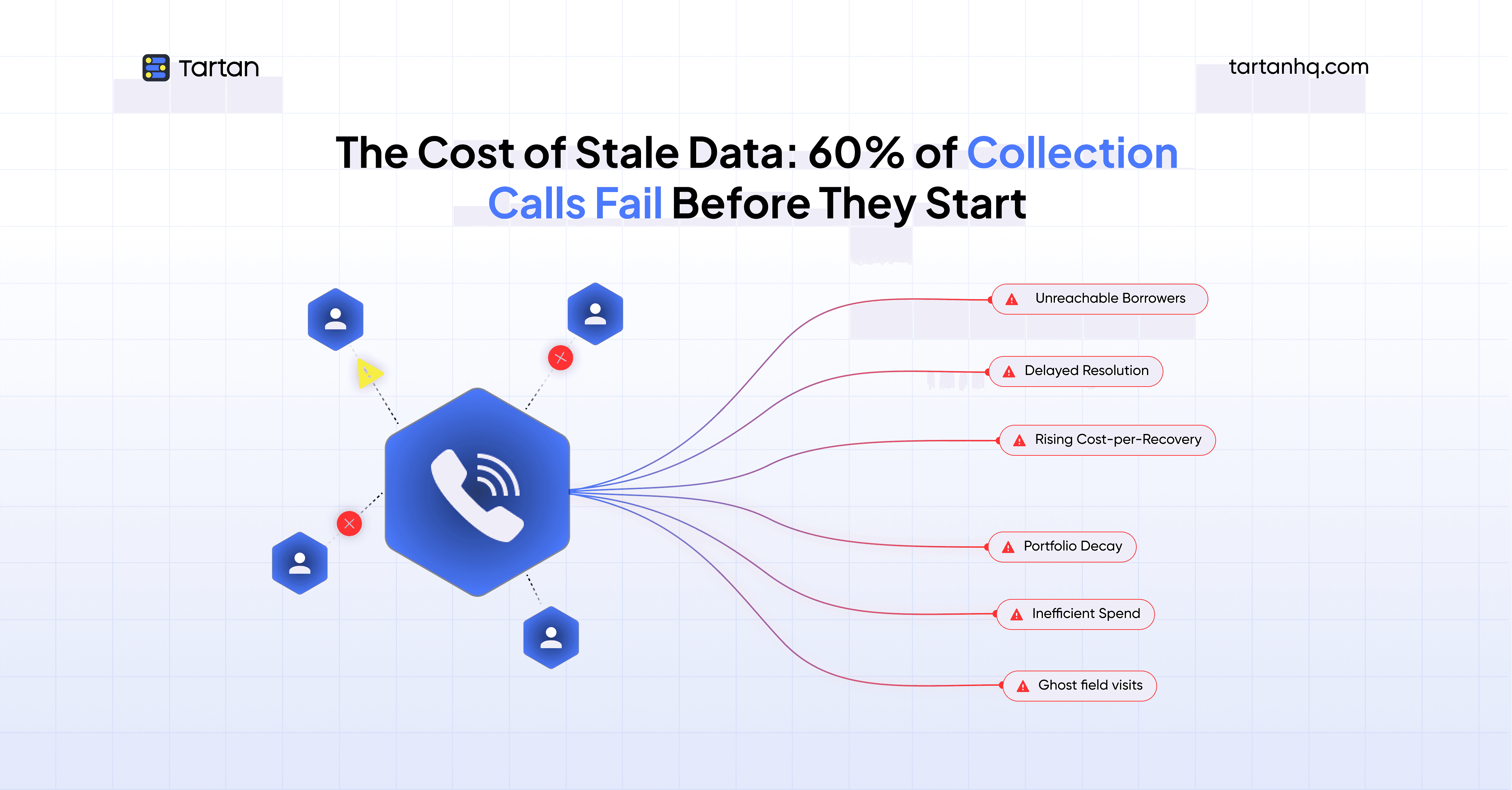
When a collections call fails because of stale data, the visible cost is obvious: wasted agent time, telecom expenses, and one more day of delinquency. But the hidden costs compound quickly.
These costs compound across multiple dimensions:
Portfolio degradation: Accounts moving from 30 DPD to 60 DPD see recovery rates drop 20-30%
Capacity loss: 60% failed contact attempts = 60% of collection capacity wasted before a single productive conversation
Field visit waste: Wrong address visits cost Rs. 500+ in direct expenses plus half-day productivity loss per agent
Compounding delinquency: Each day of delayed contact reduces probability of recovery
Consider a typical NBFC portfolio with 10,000 accounts in early delinquency. If 60% of initial contact attempts fail due to wrong numbers or addresses, that's 6,000 accounts where recovery gets delayed by days or weeks.
Each day of delay reduces the probability of recovery. Industry data shows that accounts that move from 30 days past due to 60 days past due see recovery rates drop by 20-30%. The longer you can't reach a customer, the deeper they slip into delinquency, and the harder and more expensive recovery becomes.
There's also the opportunity cost. Every minute your collections agent spends calling disconnected numbers or verifying addresses manually is a minute they're not having productive conversations with reachable customers.
If your team makes 100 calls a day and 60 fail at first contact, you've effectively lost 60% of your collection capacity before you've even started a single recovery conversation.
Then there are the field visit costs. Sending an agent to an outdated address in Mumbai or Bangalore isn't just a Rs. 500 travel expense. It's a half-day of productivity lost, fuel costs, and the morale hit when your best recovery agents spend more time commuting to ghost addresses than actually recovering accounts.
Why Customer Data Goes Stale So Fast in India
India's economic mobility creates unique challenges for maintaining current customer information. Unlike developed markets where people might stay at the same address for years, Indian customers, especially in the digitally-native segment that NBFCs serve, are remarkably fluid.
Young professionals move cities for better opportunities. Gig economy workers shift between Bangalore, Pune, and Hyderabad following projects. Students take loans for education, then relocate for jobs after graduation.
Even customers who stay in the same city often move between rented accommodations, especially in metros where rental agreements are typically 11 months.
The phone number situation is equally dynamic. Customers switch from one telecom operator to another chasing better data plans. They abandon numbers when spam calls become unbearable. They get new numbers when they move to different circles to avoid roaming charges, though this has reduced post-2021, the behavior pattern remains embedded.
Here's the critical insight: customers update their contact information constantly, just not with their lenders. They're continuously refreshing data across their digital lives:
Delivery addresses updated on Zomato, Swiggy, Amazon when they move
New phone numbers linked to UPI apps immediately
Current addresses provided on electricity bills and broadband connections
Fresh contact details given to employers for salary credits
The data exists. It's fresh. It's accurate. It's just scattered across dozens of sources that traditional collection systems never touch.
How Traditional Skip Tracing Fails Modern Collections
Most banks and NBFCs still rely on legacy approaches to skip tracing that were designed for a pre-digital era. When a customer becomes unreachable, they pull credit bureau data, hoping for an updated address.
They call alternative references provided at loan origination, which are often as stale as the primary contact. They manually search social media profiles, a time-consuming process that rarely yields verified contact information.
Some organizations have tried to solve this by purchasing bulk databases from data aggregators. This creates its own problems.
You get a massive dump of records, many contradictory, with no clear indication of which address is current. Your collections team now has five possible addresses for one customer and no reliable way to prioritize which one to try first. Decision paralysis replaces data scarcity, and you're no better off than before.
The fundamental flaw in traditional skip tracing is that it treats the problem as a one-time data lookup exercise. Find the new phone number, update the CRM, move on. But customer information is not static. It's continuously evolving.
By the time you've manually verified an address through field visits or reference calls, it might already be outdated.
The Stitched Intelligence Approach
Modern skip tracing needs to function differently. Instead of searching for a needle in a haystack of contradictory data points, collections teams need a system that automatically stitches together fragmented customer signals into one verified, current profile.
This is where the concept of stitched skip trace becomes powerful. Rather than giving collections teams raw data to manually piece together, the system does the intelligence work upfront.
It pulls contact signals from multiple high-confidence sources where customers actually update their information in real-time.
The system intelligently aggregates contact signals from sources where customers actually keep information current:
E-commerce footprints: Where customers receive deliveries right now
Utility connections: Active addresses with monthly electricity bill payments
Telecom signals: Currently active phone numbers linked to the customer's identity
Financial exhaust: UPI transactions, bank activity, digital payment patterns confirming contact validity
The key differentiation is in the stitching and deduplication. Instead of receiving ten different addresses from ten different sources, collections teams get a single consolidated view.
The system identifies that address A from the e-commerce platform, address B from the utility database, and address C from telecom records are actually the same location, just formatted differently. It eliminates the duplicates. It ranks the remaining addresses by confidence based on recency and signal strength.
What you receive is not more data, but better intelligence. If you provide a PAN and phone number, you get back only the net-new, incremental addresses that represent genuine discovery, not repetition of what you already know.
Each address comes with context about why it's considered high-confidence, allowing collections teams to prioritize their outreach intelligently.
Real-World Impact on Collections Operations
When collections teams operate with stitched, verified contact intelligence, the operational transformation is measurable:
Right-party contact rates improve dramatically. Instead of six out of ten calls reaching wrong numbers, you see seven or eight connecting to actual borrowers. Your existing team handles higher volumes because they spend time on productive conversations rather than fruitless attempts.
Resolution cycles compress. Reaching customers faster with accurate information allows earlier intervention in delinquency. A customer at 15 days past due who you can actually reach is far more likely to cure than a customer at 45 days past due you've been unsuccessfully chasing.
Field visit effectiveness multiplies. When agents are dispatched to verified, confidence-ranked addresses, their success rate in locating customers increases substantially. Fewer wasted trips, lower operational costs, better agent morale.
Cost per successful outreach drops significantly. Whether measured in cost per right-party contact, cost per promise-to-pay, or cost per resolution, accurate contact data improves every efficiency metric.
Use Cases Across the Collections Lifecycle
The application of stitched skip trace extends across different stages of the collections process, each with distinct value.
In early delinquency, speed matters most.
When an account hits 1-7 days past due, you want to reach the customer immediately before the situation escalates. If your primary contact information is already stale, you've lost critical time.
Having access to verified, current contact details means your early delinquency team can act fast, often resolving the issue before it becomes a serious problem. Sometimes customers simply forgot, changed accounts, or had a temporary cash flow issue. Quick contact, quick resolution.
For mid-stage collections at 30-60 days past due, you need multiple contact vectors. Customers at this stage might be avoiding calls from known lender numbers.
Having access to verified addresses allows you to supplement phone-based collections with field visits or formal notices sent to current locations. The multi-channel approach, powered by accurate data, increases the probability of engagement.
In advanced collections and recovery for accounts beyond 90 days past due, stitched intelligence becomes critical for legal notice delivery and asset recovery. Sending a legal notice to an outdated address creates complications in enforcement.
Locating vehicles for repossession or identifying current employment for income attachment requires up-to-date information. The difference between a successful recovery and a write-off often hinges on whether you can actually locate the customer and their assets.
Even in pre-delinquency risk management, having access to continuous contact verification helps identify early warning signals. If a customer's phone number becomes inactive shortly after loan disbursement, that's a red flag.
If their provided address shows no recent activity signals while alternative addresses emerge, it suggests potential fraud or misrepresentation. Catching these signals early allows for proactive intervention.
Building This Into Collection Workflows
The practical implementation of stitched skip trace needs to integrate seamlessly into existing collection operations without creating additional workload for already busy teams.
The ideal workflow is API-driven and automated. When an account hits delinquency triggers, the system automatically queries for updated contact intelligence using the customer's PAN and last known phone number. Fresh, verified contact details flow directly into the collections agent's interface, ready to use. There's no manual data entry, no switching between multiple systems, no interpretation required.
For organizations with dedicated skip tracing teams, the process can be batch-oriented. At regular intervals, perhaps daily or weekly, the skip tracing team submits lists of accounts where contact attempts have failed. They receive back deduplicated, confidence-ranked contact sets that they can distribute to appropriate collection teams based on geography and account characteristics.
The important principle is that stitched intelligence should reduce work, not create it. Collections teams shouldn't need to become data analysts, cross-referencing multiple sources and making judgment calls about which address to trust. The intelligence work happens upstream, and what reaches the collections agent is actionable, verified, ready-to-use information.
Moving Beyond Data Chaos
The collections industry has suffered from too much of the wrong kind of data and not enough of the right kind of intelligence. Stitched skip trace represents a fundamental shift from data accumulation to intelligence synthesis.
Banks and NBFCs that embrace this approach don't just improve their recovery rates marginally. They transform their collections operations from a reactive, labor-intensive function into a precise, data-driven capability. They stop wasting resources chasing ghosts and start focusing energy on actual customer engagement and resolution.
The economics are compelling. Improved right-party contact rates, faster resolution cycles, lower cost per recovery, and reduced write-offs add up to significant portfolio performance improvements. For a large NBFC, even a 10-15% improvement in early delinquency resolution can translate to crores in prevented losses annually.
More importantly, better contact intelligence creates better customer experiences. Customers who are actually reachable can work with lenders to resolve temporary financial difficulties before they spiral. Notices reach them at current addresses instead of haunting previous landlords. The entire collections process becomes more humane and effective simultaneously.
The question for collections leaders is no longer whether to modernize skip tracing, but how quickly they can implement solutions built for India's unique identity infrastructure and mobile-first economy. Because every day operating with stale data is another day of recovery velocity lost, costs incurred unnecessarily, and portfolios degrading that could have been saved.
The data exists. The technology exists. The only thing missing is the decision to stop accepting contact failure as inevitable and start treating it as a solvable problem with measurable solutions.