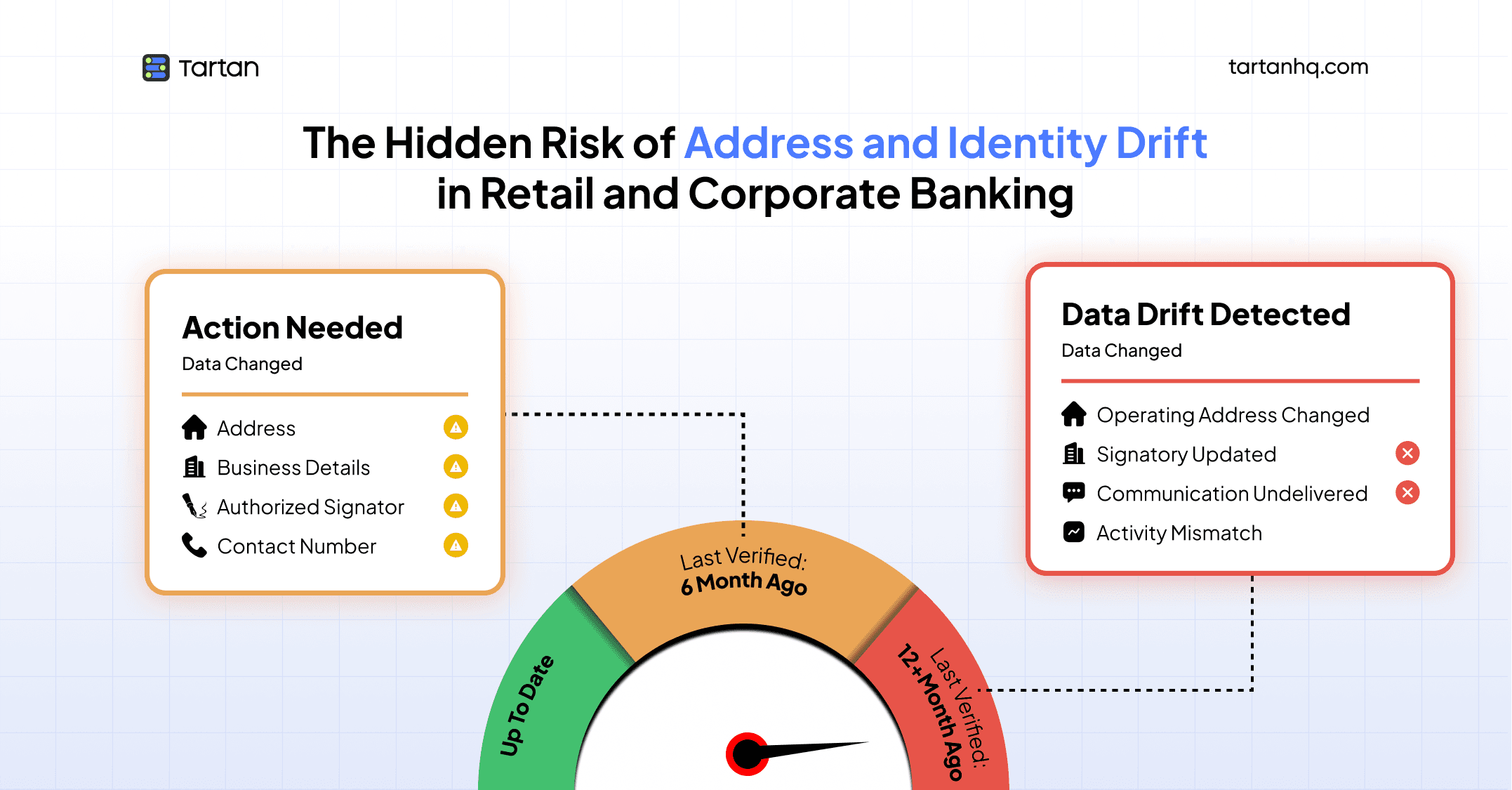
Banking systems are designed around a quiet assumption: that a customer’s identity and address remain stable enough for downstream decisions to remain valid.
That assumption no longer holds.
Across retail banking, SME lending, corporate accounts, and supply-chain finance, identity and address data decay as a natural consequence of scale. Customers relocate, businesses reorganize, authorized signatories change, and operational addresses drift away from registered records. These changes rarely propagate uniformly across core banking systems, lending platforms, CRMs, and compliance repositories.
What starts as marginal data staleness steadily compounds into material risk. Communication breaks down, enforcement actions weaken, and regulatory exposure increases often without any single system flagging a failure.
This is not an onboarding failure. It is a lifecycle control gap.
Banks that continue to treat identity and address verification as a one-time compliance event remain exposed to downstream scrutiny. The impact does not surface at account opening. It surfaces later - during audits, disputes, recoveries, investigations, and supervisory reviews when the institution must demonstrate not only what information it held, but when it was validated, how that validation was performed, and whether it remained reasonable at the moment a decision was made.
The burden shifts decisively onto banking institutions. Regulators and auditors are not evaluating intent; they are evaluating evidence continuity. If a bank cannot establish a clear, time-linked chain between verification, decisioning, and subsequent outcomes, the verification itself is treated as insufficient regardless of whether it was technically compliant at the time it was performed.
Identity and Address Drift Is Structural, Not Accidental
Drift is often misdiagnosed as an operational lapse - a missed update, a customer oversight, or an incomplete KYC refresh.
Modern banking operates across fragmented systems - core banking, LOS, LMS, CRM, trade finance platforms, collections systems, partner portals, and regulatory reporting layers. Each captures identity and address data at different moments, under different rules, and with varying levels of verification rigor. Once captured, that data is rarely re-examined unless triggered by an explicit event.
At this stage, scrutiny shifts from process execution to evidentiary defensibility.
Regulators, auditors, and internal risk committees are no longer assessing whether verification was completed, they are assessing whether the institution can demonstrate decision integrity over time.
When such continuity cannot be established, verification outcomes lose their regulatory value. A check that was compliant at onboarding but disconnected from subsequent decisions is treated as functionally incomplete.
The issue is not procedural non-compliance, but the inability to prove that risk assessments were based on information that was still accurate and relevant when exposure crystallized.
The Earliest Signal: Communication Failure as a Risk Indicator
The earliest manifestation of address and identity drift rarely appears in regulatory metrics. It surfaces first as a breakdown in enterprise communication controls.
Statutory notices are issued but not acknowledged.
Legal communications lapse into non-delivery.
Physical correspondence is returned or goes unanswered.
Field visit attempts fail repeatedly despite escalation.
Recovery and servicing teams continue to operate under the assumption that outreach has occurred, while customers operate under the assumption that no formal communication was initiated.
As these gaps scale across portfolios, they begin to systematically distort core operating and risk metrics:
Artificial delinquency inflation driven by failed notice delivery rather than borrower stress.
Reduced cure rates caused by missed engagement and remediation windows.
Extended recovery cycles as cases move deeper into collections unnecessarily.
Rising field and servicing costs due to repeated, low-yield outreach attempts.
Accelerated escalations from routine servicing into legal, dispute, or write-off tracks.
These outcomes are often misattributed to credit quality deterioration or customer intent. In reality, they stem from a breakdown in data validity.
When address and identity records no longer reflect operational reality, standard servicing controls fail silently.
Notices are issued but not received. Engagement attempts are logged but ineffective. Systems reflect compliance, while outcomes indicate failure.
Operationally, the institution is no longer managing customer or credit risk. It is absorbing the operational and regulatory cost of unresolved data drift. The issue is no longer about effort or intent; it is about control fidelity across the customer lifecycle.
When Drift Becomes a Compliance Problem
Operational inefficiencies can be absorbed and optimized over time. Regulatory exposure cannot. Once address and identity drift crosses into the compliance domain, the cost is no longer measured in effort or efficiency, but in defensibility.
Most regulatory frameworks do not expect banks to maintain perfect, real-time customer data. What they require is reasonable assurance and clear evidence that identity and address information relied upon for regulatory reporting, risk classification, enforcement, or customer communication was verified through defensible processes and refreshed in line with material risk changes.
An address verified at onboarding may have been valid at that point in time, but if it is never reassessed, the institution cannot credibly assert that it knew the customer’s location at the time of a statutory notice, regulatory filing, or enforcement action.
In corporate banking, divergence between a registered address and an operational footprint raises a more complex question: which address governed the bank’s risk assessment when exposure was assumed or renewed?
These are not theoretical edge cases. They surface routinely during supervisory reviews and thematic audits, where scrutiny shifts from process completion to control effectiveness.
Regulators and auditors focus on:
Whether the banking enterprises had mechanisms to detect when verified data no longer reflected operational reality.
Whether changes in address or identity signals were visible across systems, not siloed within one workflow.
Whether the institution could demonstrate why reliance on historical verification remained reasonable at a later point in time.
Without lifecycle-level visibility, institutions are pushed into a reactive posture. When discrepancies are flagged, teams must reconstruct the past assembling archived PDFs, vendor reports, screenshots, CRM notes, and transaction logs to explain decisions retroactively.
Each artifact reflects a different point in time, a different source, and a different confidence threshold.
Fraud Emerges Where Identity and Address Drift Goes Unchecked
Identity and address drift does not weaken controls directly. It weakens the assumptions those controls are built on.
Most banking fraud controls are calibrated against a verified baseline - an address, an identity profile, an entity structure that was accurate at a specific point in time. As long as customer behavior remains broadly aligned with that baseline, the system appears to function as intended and risk scoring remains stable.
The vulnerability emerges when reality diverges from that baseline and the system lacks visibility into the divergence.
Mule accounts, shell entities, and synthetic identity constructs rarely exploit gaps at onboarding. This drift typically surfaces through patterns such as:
A business account continuing to transact from geographies inconsistent with its verified operating address.
Retail customers exhibiting sustained spending, delivery, and device patterns misaligned with recorded residence.
Corporate entities maintain valid documentation while their operational footprint, counterparties, or transaction flows shift materially.
Individually, none of these signals are decisive. They represent a breakdown between verified identity, declared address, and observed behavior. Static verification models are structurally incapable of detecting this shift. Once onboarding checks pass, the system assumes continuity.
Risk accumulates silently because there is no mechanism to reassess whether the original verification context still holds. By the time investigations commence, drift has already translated into measurable exposure.
Fraud thrives in these drift zones not because controls are absent, but because they are temporally disconnected from customer reality. Without continuous or trigger-based signals to recalibrate identity and address confidence, banks are left defending decisions made on information that was once correct, but no longer representative.
Fraud risk is no longer driven by control coverage, but by whether controls remain valid over time.
Audit Reality: Proving Context, Not Just Compliance
Audits rarely fail due to the absence of checks. They fail because the institution cannot reconstruct decision context.
For regulators, supervisors, and internal risk committees, the question is no longer whether identity or address verification was performed in the past but whether the bank can demonstrate contextual reliance clearly.
Audit scrutiny has shifted decisively from procedural completion to control integrity.
Audit and supervisory expectations now extend across four dimensions of traceability:
Decision-state visibility: What identity and address attributes were relied upon at each material decision point - onboarding, limit assignment, renewal, servicing, enforcement.
Source lineage: Which data sources, registries, or verification mechanisms were used to establish those attributes.
Confidence posture: What risk indicators, corroboration signals, or exception flags were available at that moment.
Drift awareness: Whether the institution had any signal that previously verified data may no longer reflect operational reality.
When address or identity drift is identified either through audit sampling, customer dispute, or investigative review the evidentiary burden shifts immediately to the institution.
What is not documented is treated as not controlled.
This is where audit exposure compounds. Without a unified, time-aware verification record, banks are forced into retrospective reconstruction. Teams must assemble evidence across fragmented systems - vendor dashboards, archived documents, CRM notes, transaction histories, and manual attestations to explain the decisions.
Each artifact reflects a different timestamp, confidence threshold, and verification standard.
Banks that cannot preserve verification rationale across the customer lifecycle are left explaining outcomes instead of demonstrating governance, an increasingly difficult position to defend under modern supervisory scrutiny.
Continuous Verification as a Control Layer for Identity and Address Drift
Leading banking institutions are reframing verification away from a discrete operational task and toward a persistent risk control layer embedded across the customer lifecycle.
This shift is driven by a structural reality: identity and address risk does not materialize at onboarding. It evolves continuously as customer behavior, operating locations, ownership structures, and transaction patterns change.
Continuous verification does not imply repetitive document collection or increased customer friction. It implies ongoing assurance of the ability to maintain visibility into whether previously verified identity and address attributes remain valid, reliable, and defensible as the bank continues to rely on them for decisions.
Under a continuous verification model:
Identity and address are treated as evolving attributes, not one-time confirmations.
Signals are tracked across the customer lifecycle, not confined to individual workflows.
Mismatch between verified data and real activity is flagged early.
Verification confidence is updated when conditions change, not on fixed refresh cycles.
This approach aligns verification with how enterprise risk actually accumulates. It allows banks to preserve regulatory defensibility without resorting to blanket re-verification programs or excessive operational overhead.
HyperVerify as the Verification Control Layer
HyperVerify operates as a verification control layer for lifecycle-oriented identity and address assurance. It aggregates verification signals, normalizes evidence across sources, and preserves decision context over time. This enables banks to move beyond static checkpoints toward continuous, defensible verification governance.
For banking enterprises, this translates into:
Address verification grounded in corroborated signals, not just declared inputs
Identity assurance that remains valid beyond onboarding, even as customer reality changes
Unified verification trails spanning onboarding, servicing, credit lifecycle events, and enforcement actions
Audit-ready evidence continuity, enabling clear explanation of what was known, when it was known, and why reliance was reasonable
By treating verification as an evolving control rather than a completed task, HyperVerify helps institutions detect drift before it manifests as operational failure, fraud exposure, or regulatory scrutiny.
The strategic value is not speed alone. It is governance durability.
Banks operating with a continuous verification layer reduce the cost and uncertainty of audits and investigations. They retain control over identity and address risk as a living dimension of the customer relationship.
In an industry, where supervisory focus is increasingly centered on explainability, traceability, and ongoing assurance, verification can no longer exist as a static compliance artifact. It must function as a system of record that evolves with customer reality.
Strategic Implications for Banking Leadership
For banking leadership, the strategic question is not whether drift will occur. It is whether the institution has the visibility, controls, and response mechanisms to manage it without introducing friction, regulatory exposure, or operational instability.
Institutions that lack drift visibility are forced into reactive modes, bulk remediation exercises, aggressive re-verification drives, and post-facto justifications during audits and investigations. These responses consume capital, strain customer relationships, and divert risk teams from higher-value oversight.
Banks that invest in lifecycle-aware verification infrastructure operate from a position of control rather than correction. They can distinguish stable customers from drifted ones, intervene selectively, and demonstrate why reliance on specific identity and address data remained reasonable at each decision point.
Supervisors are placing increasing emphasis on explainability and traceability not just whether controls exist, but whether decisions can be clearly explained in terms of data validity, timing, and reliance. Address and identity drift ultimately exposes the weakest point in traditional banking controls: not intent, effort, or policy design, but temporal relevance. Controls that do not account for change decay silently.
Closing this gap is no longer an incremental improvement. It is a foundational requirement for sustainable risk management at scale.