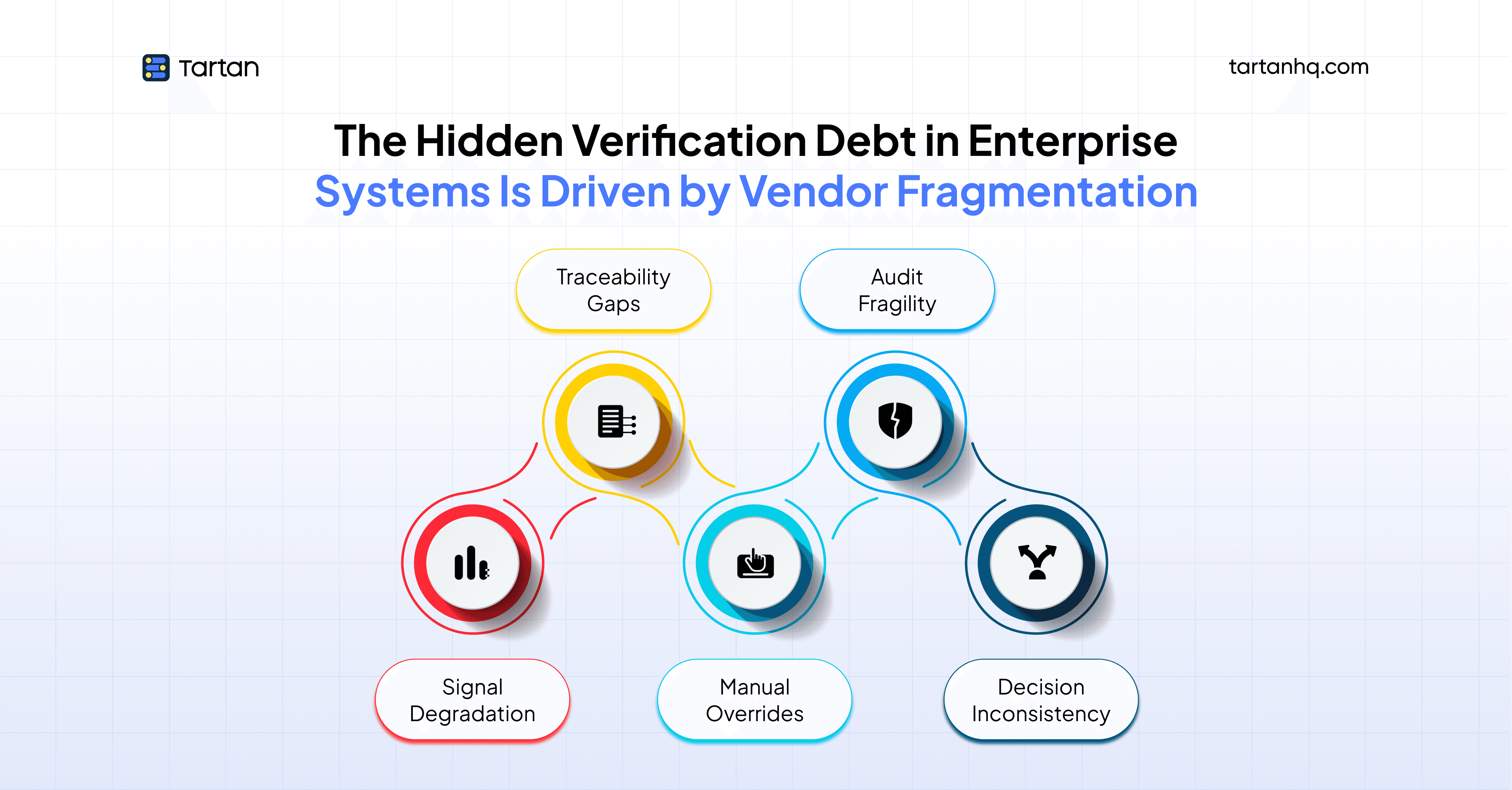
How fragmented vendor stacks amplify fraud risk, degrade customer experience, and weaken compliance
Enterprise verification stacks rarely fail loudly. They degrade silently.
In most large financial institutions, insurers, and regulated enterprises, verification is considered “under control” as long as core checkpoints function as expected.
Onboarding flows complete without friction.
Regulatory audits close without material observations.
Vendors return pass, fail, or refer flags within defined SLAs.
Identity checks are clear.
Address validation completes.
Documents are reviewed.
Scores are generated.
Decisions are logged and pushed downstream.
From the outside, the system appears stable.
What is rarely examined is the accumulated verification debt created over years of incremental vendor additions, tactical integrations, and exception handling layered on top of each other. Verification debt is the compounding liability created when verification decisions are made across disconnected systems, owned by external vendors, and reused far beyond their original context.
This debt does not appear on balance sheets or risk dashboards. It surfaces indirectly through rising fraud losses, customer friction, regulatory scrutiny, and operational drag.
Verification debt is often misdiagnosed. It is treated as a vendor performance issue, a process inefficiency, or a need for one more check. In reality, it is none of these.
Verification debt is not a tooling problem, and it is not solved by adding more vendors or tighter rules. It is an architectural problem, rooted in how verification decisions are designed, owned, reused, and governed across the enterprise.
What Verification Debt Actually Means In Enterprise Systems
Verification debt refers to the long-term risk, cost, and complexity introduced by fragmented, point-in-time verification decisions embedded across systems without a unifying control layer.
Verification decisions are embedded deep inside onboarding flows, underwriting engines, servicing workflows, partner integrations, and manual review processes. Each decision is optimized locally for speed or compliance at the time it is implemented.
Over time, these locally optimized decisions accumulate into a globally inconsistent verification posture that no single team fully owns or understands.
It builds up when enterprises:
Add new verification vendors to solve narrow problems.
Integrate checks differently across products and channels.
Store verification outcomes without retaining underlying signals.
Reuse historical verification decisions far beyond their validity window.
Lose traceability between data, rules, consent, and decisions.
Unlike technical debt, verification debt is rarely logged, prioritized, or actively reduced. It does not sit in engineering backlogs or architecture review documents. Unlike credit or operational risk, it is rarely modeled, quantified, or stress-tested. Yet its impact is systemic. It directly increases fraud exposure through stale trust, weakens compliance defensibility by eroding explainability, and degrades customer experience through inconsistency, rework, and friction.
How Patchwork Verification Stacks Form Over Time
Most enterprise verification stacks were not designed as systems. They accumulated as responses.
In large banks, insurers, and regulated enterprises, verification architecture is rarely defined upfront. Instead, it emerges incrementally shaped by regulatory deadlines, fraud incidents, product launches, and operational constraints. Each layer is added to solve a specific problem at a specific moment, often without revisiting how it interacts with what already exists.
A typical progression looks like this:
Initial onboarding checks: Identity and address verification are added to satisfy regulatory onboarding requirements. Vendors return binary outcomes. Data is stored for audit.
Product expansion: New products introduce new checks income validation, employment verification, device signals, document authenticity often from different vendors.
Channel diversification: Mobile, web, branch, agent, and partner channels implement verification differently due to UX constraints and legacy systems.
Fraud response layering: When fraud spikes, additional vendors or rules are added reactively, without re-architecting the core stack.
Operational overrides: Manual reviews, exception flows compensate for inconsistencies between vendors.
Over time, these human interventions become embedded dependencies. Decisions are made based on experience rather than policy, further distancing outcomes from documented logic.
As this progression repeats across products, regions, and years, verification ceases to function as a coherent system. It becomes distributed across vendors, workflows, teams, and time, with no single control layer capable of explaining how trust was established, why a decision was made, or whether it should still be trusted.
At that point, verification is no longer governed. It is merely functioning.
Aging Verification Decisions Are a Structural Fraud Risk
Verification in most enterprise systems is implemented as a one-time control.
At onboarding, identity, address, document, and device checks are executed to establish initial trust. Once cleared, that trust is implicitly carried forward across the customer lifecycle. Underwriting decisions, limit increases, servicing actions, renewals, and even collections activity continue to rely on the assumption that what was verified once remains valid indefinitely.
Customer attributes are not static. They evolve continuously, often in ways that materially alter risk:
Addresses change, often more than systems expect
Jobs and income change, which affects risk
Phones and devices change or get shared, breaking old trust signals
Customer behavior changes over time
Documents expire or get reused, sometimes incorrectly
Despite this, most enterprise systems continue to rely on static verification artifacts captured at onboarding. These artifacts are reused across underwriting, servicing, limit enhancements, claims processing, and collections workflows without reassessment of freshness, relevance, or original purpose.
The gap between assumed trust and actual risk widens. This creates fraud exposure in structural ways:
Stale trust
Verification decisions persist long after the data has changed. Systems continue to rely on historical validation without reassessing relevance or risk, allowing high-risk actions to be approved on outdated assumptions. Fraud exploits this gap between assumed trust and current reality.
Signal decay
Verification signals lose accuracy over time as addresses, employment, devices, and behavior change. Most systems do not model this decay, treating confidence as permanent rather than time-bound. As a result, decisions continue to rely on signals that no longer reflect current risk particularly in high-velocity, high-risk segments.
Context leakage across workflows
Verification completed for one use case is reused across others without reassessing context, risk, or consent. Onboarding checks get applied to limit increases, servicing, or collections, even when the original verification is no longer appropriate. What starts as efficiency quietly becomes a compliance and fraud exposure.
Customer Experience Breakdown Is A Structural Outcome Of Verification Debt
As verification stacks fragment, customer experience degrades in ways that are often subtle at the individual interaction level but material at scale. These issues are not the result of poor UX design or frontline execution. They are the downstream effect of verification decisions that are inconsistent, poorly orchestrated, and disconnected across systems.
These issues are not driven by poor UX design, weak frontline execution, or inadequate customer communication. They are the downstream consequence of verification decisions that are inconsistent across systems, poorly orchestrated across workflows, and detached from a unified view of customer trust.
When verification lacks structural coherence, friction becomes inevitable regardless of how well the surface experience is designed.
Common failure patterns emerge across large enterprises:
Same documents requested multiple times, because prior verification is not trusted or reusable
Different decisions across channels, driven by inconsistent rules or vendors
Manual reviews triggered by conflicting signals, slowing automated flows
Delays from system reconciliation, as teams align verification outcomes across platforms
Re-verification at sensitive moments, increasing customer frustration and drop-offs
From the customer’s perspective, these failures show up as repeated requests, unexplained delays, and inconsistent outcomes. Prior interactions are not recognized, and previous decisions appear to carry no weight. Trust erodes not due to the presence of verification, but because verification feels fragmented, unpredictable, and disconnected from the customer’s history.
These issues are typically addressed at the surface level. Friction is treated as a UX problem, a process gap, or an execution issue within operations teams. Fixes focus on interface tweaks, additional workflows, or expanded exception handling. While these interventions reduce immediate noise, they leave the underlying verification architecture intact allowing the same inconsistencies to resurface at scale.
The root cause is not customer experience design. It is verification orchestration failure the absence of a unified, decision-level control layer that ensures verification outcomes are consistent, explainable, and reusable across the customer lifecycle. Until that architectural issue is addressed, CX degradation will persist regardless of surface-level improvements.
The Compliance Impact of Non-Traceable Verification Decisions
Regulatory expectations now center on decision accountability, not control existence. Demonstrating that identity, address, or risk checks were executed is no longer sufficient. Institutions are increasingly required to prove that each decision was logically derived, policy-aligned, and appropriate for the specific moment it was enforced based on the data, context, and risk posture in effect at that time.
This shifts compliance from a checklist exercise to a decision-level standard of proof, where outcomes must be explainable, reproducible, and time-bound.
Auditors increasingly expect institutions to demonstrate:
The data used to make the decision
The sources referenced for verification
The rules or policies applied
The confidence levels enforced
The consent and purpose under which data was used
Whether the decision was still valid at the time of action
When verification logic is embedded inside vendor systems, enterprises lose direct visibility into how outcomes are generated. When multiple vendors are used across journeys, data lineage fragments across onboarding platforms, risk engines, servicing systems, and compliance repositories.
As a result, verification decisions cannot be reliably reconstructed. Institutions are forced to infer intent, reverse-engineer logic, or manually piece together narratives across systems and teams. Compliance responses become reactive rather than structured.
Compliance is no longer proactive or scalable. It becomes expensive, fragile, and dependent on institutional memory, a position that does not hold under sustained regulatory scrutiny or growth.
The Hidden Operational Load Created By Fragmented Verification
Verification debt does not only increase risk exposure. It quietly absorbs operational capacity across the organization.
As verification logic is fragmented across vendors, systems, and workflows, a significant amount of manual effort is spent compensating for what the architecture cannot resolve on its own. These efforts rarely show up as a single cost center. Instead, they are distributed across risk, operations, compliance, engineering, and customer-facing teams making the impact easy to overlook and hard to quantify.
The hidden costs include:
Risk teams resolve conflicting verification results manually.
Operations teams manage growing exceptions and review queues.
Compliance teams piece together audit explanations across systems.
Engineering teams patch and maintain fragile integrations.
Customer teams handle escalations from verification delays or failures.
These activities are embedded into day-to-day operations and gradually become accepted as normal execution overhead. Their cumulative impact, however, is significant. Effort that should be spent on decisioning, growth, or risk optimization is diverted into reconciliation, manual judgment, and workaround management.
Over time, the operating model grows more expensive and harder to scale, with no single owner accountable for the underlying verification architecture driving the cost.
How Enterprises Reduce Verification Debt In Practice
Reducing verification debt is an architectural exercise, not a vendor swap. It requires changing how verification decisions are owned, governed, and reused across the enterprise. Organizations that succeed start by establishing visibility and control over decisions, then standardize and optimize rather than attempting large-scale replacement upfront.
Verification decisions are taken across onboarding, underwriting, servicing, renewals, and collections not just at entry.
Each decision is driven by a specific set of checks, often owned by different systems or vendors.
The data and outcomes produced by these checks are stored in multiple locations, with varying levels of detail.
Many of these outcomes are reused later in the lifecycle, often without reassessing context or validity.
These patterns fragment visibility into how trust is established and sustained across the customer lifecycle. Verification decisions exist, but they are distributed, inconsistently applied, and loosely governed. As volume and complexity increase, this fragmentation limits the enterprise’s ability to standardize risk posture, explain outcomes, or evolve verification logic without introducing new failure points.
From Patchwork Verification To Governed Decisioning
Verification has moved beyond an operational or compliance concern. It is now a governance issue.
As enterprises scale digital acquisition, automate decisions, and expand across products and channels, verification sits directly on the critical path of fraud exposure, regulatory accountability, and customer trust. When verification architecture is fragmented, the resulting risk is not localized; it is systemic.
Enterprises that move ahead of this curve do not attempt to eliminate vendors or checks. They change the role verification plays in the architecture. Platforms built for enterprise verification orchestration, such as HyperVerify, are designed around this shift. The emphasis is not on adding more checks, but on restoring control at the decision level.
This means enabling enterprises to:
Integrate multiple verification sources through a unified control layer
Retain signal-level data alongside final outcomes for traceability
Apply consistent decision logic across products, channels, and lifecycle stages
The result is not just faster verification. It is defensible verification that can be governed, evolved, and explained at scale.
Enterprises that recognize verification debt early gain a structural advantage: clearer accountability, lower fraud exposure, scalable compliance, and a customer experience that does not deteriorate with growth. Those that do not continue to pay interest on a risk they are not actively tracking until it surfaces in the form of regulatory scrutiny, loss events, or trust erosion.
Verification is no longer just about proving identity. It is about proving decisions.